
- Table of Contents
- 1- Introduction:
- 2- Understanding AI in the HR Context
- 3- Why HR Transformation is Being Driven by AI
- 4- AI Across Core HR Functions
- 1- Recruitment and Talent Acquisition
- 2- Onboarding and Employee Integration
- 3- Learning and Development
- 4- Performance Management
- 5- Employee Engagement and Retention
- 5- Strategic HR Transformation Through AI
- 6- Human + AI Collaboration in HR
- 7- Risks and Ethical Challenges of AI in HR
- 8- Implementation Challenges for HR Leaders
- 9- Starter Roadmap for HR Leaders
- 10- Case Applications of AI in HR
- Corporate Environments
- Public Sector and NGO Environments
- Technology Companies
- Cross-Sector Impact
- 11- Future of AI in HR
- 12- Conclusion
1- Introduction:
Artificial intelligence is no longer an experimental layer in human resources; it is becoming part of the operational backbone of how organizations attract, manage, and develop talent. The HR function is under structural pressure from multiple directions at once: accelerated skill obsolescence, hybrid and distributed work models, and rising expectations for faster, more personalized employee experiences. These conditions are forcing HR leaders to move beyond administrative execution and toward data-driven workforce orchestration.
At the same time, HR is increasingly expected to contribute directly to business outcomes. Talent acquisition speed, employee retention, workforce productivity, and skills availability are now treated as strategic performance indicators. Traditional HR systems, which rely heavily on manual processes and periodic reviews, struggle to meet this level of responsiveness. AI introduces a different operating model: continuous analysis, predictive insight, and automated decision support embedded across the employee lifecycle.
The shift is not simply technological. It represents a structural redefinition of how HR value is created. Instead of reacting to workforce issues after they emerge, AI-enabled HR systems can identify patterns early, anticipate risks, and recommend interventions in real time. This repositioning makes AI literacy a core competency for modern HR leadership rather than a specialized technical skill.
2- Understanding AI in the HR Context
AI in HR refers to the application of computational systems that simulate aspects of human decision-making to improve or automate workforce-related processes. These systems are typically built around machine learning models, natural language processing, and predictive analytics. Their primary function is not to replace human judgment but to enhance it through pattern recognition at scale.
Machine learning systems analyze historical HR data to detect trends in hiring success, employee turnover, and performance outcomes. Natural language processing enables systems to interpret unstructured data such as CVs, employee feedback, and survey responses. Predictive analytics then uses these inputs to forecast future workforce events, such as attrition risk or hiring needs.
In practice, AI is embedded across the entire employee lifecycle. In recruitment, it supports candidate sourcing and screening. In onboarding, it structures personalized learning paths. In performance management, it identifies productivity trends and gaps. In learning and development, it recommends targeted skill-building interventions. In retention, it flags disengagement signals before they become critical.
The key distinction between AI-driven HR and traditional HR analytics is timing and adaptability. Traditional systems are largely descriptive, explaining what has already happened. AI systems are predictive and, in some cases, prescriptive, actively suggesting what should happen next.
3- Why HR Transformation is Being Driven by AI
The adoption of AI in HR is primarily driven by structural inefficiencies embedded in traditional workforce management systems. One of the most pressing constraints is operational scale. As organizations expand globally and shift toward hybrid and distributed work models, HR functions are required to process increasingly large and complex datasets without a corresponding increase in workforce capacity, creating a clear scalability bottleneck.
Talent market volatility further intensifies this pressure. Skill requirements are evolving at a pace that traditional job architectures cannot effectively accommodate. This is reinforced by evidence from the World Economic Forum’s Future of Jobs Report, which indicates that 44% of workers’ skills will be disrupted within the next five years, with large-scale reskilling becoming a systemic necessity rather than an exception. Such levels of workforce transformation cannot be managed through static, periodic HR planning cycles alone, making adaptive and predictive systems essential.
Employee expectations are also undergoing a structural shift. Modern employees increasingly expect real-time feedback mechanisms, personalized development pathways, and seamless digital experiences comparable to consumer technology platforms. This expectation places additional pressure on HR systems to operate with continuous responsiveness rather than delayed, cyclical interventions.
At the same time, HR data complexity has expanded significantly. Organizations now operate across multiple integrated systems, including HRIS platforms, engagement tools, learning management systems, collaboration environments, and performance analytics platforms. Without AI-driven synthesis and pattern recognition, transforming this fragmented data landscape into coherent, actionable insight becomes operationally unsustainable at scale.
4- AI Across Core HR Functions
1- Recruitment and Talent Acquisition
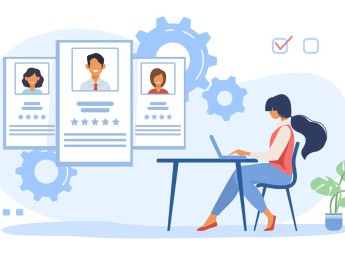
AI has fundamentally changed the mechanics of recruitment by introducing automation into sourcing, screening, and candidate engagement. Resume parsing systems can process thousands of applications in seconds, identifying candidates that match predefined skill and experience profiles. Matching algorithms then rank candidates based on historical hiring success patterns.
Chatbots are increasingly used in early-stage candidate interaction, handling screening questions and scheduling interviews. This reduces time-to-hire and improves candidate experience consistency. However, these systems must be carefully monitored to avoid reinforcing historical bias embedded in training data.
2- Onboarding and Employee Integration
AI-driven onboarding systems structure personalized learning journeys based on role, experience level, and prior skills. Instead of static onboarding checklists, employees receive adaptive content sequences that adjust based on progress and feedback. This reduces cognitive overload and accelerates time-to-productivity.
AI systems also track onboarding engagement signals, identifying employees who may be struggling to integrate into organizational processes or culture.
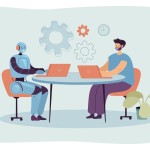
As artificial intelligence (AI) continues to transform industries, the most successful organizations are those that integrate AI tools with human expertise to drive strategic decisions. Rather than replacing humans, AI offers powerful capabilities that, when used collaboratively, can enhance analysis, reduce uncertainty, and support innovation in complex environments.
3- Learning and Development
AI is particularly transformative in learning and development. Adaptive learning platforms assess employee skills in real time and recommend targeted learning modules. This creates a continuous learning loop aligned with actual performance needs rather than generic training schedules.
Learning systems increasingly integrate with workflow tools, embedding learning into daily tasks rather than separating it from work execution. This aligns learning with immediate application, improving retention and relevance.
4- Performance Management
Traditional annual performance reviews are being replaced or supplemented by continuous AI-supported performance tracking systems. These systems analyze productivity data, collaboration patterns, and goal completion rates to generate ongoing performance insights.
Rather than replacing managerial judgment, AI provides structured evidence that supports more informed conversations between employees and managers. This reduces recency bias and improves consistency in evaluation.
5- Employee Engagement and Retention
AI-driven sentiment analysis tools process employee feedback from surveys, communication platforms, and engagement tools to detect early signs of disengagement. Predictive attrition models identify employees at risk of leaving based on behavioral and performance patterns.
Organizations use these insights to design targeted retention interventions, such as career development opportunities or workload adjustments.
5- Strategic HR Transformation Through AI
AI is shifting HR from an operational support function to a strategic intelligence layer within organizations. Instead of focusing primarily on process execution, HR teams are increasingly responsible for interpreting workforce data and translating it into business strategy.
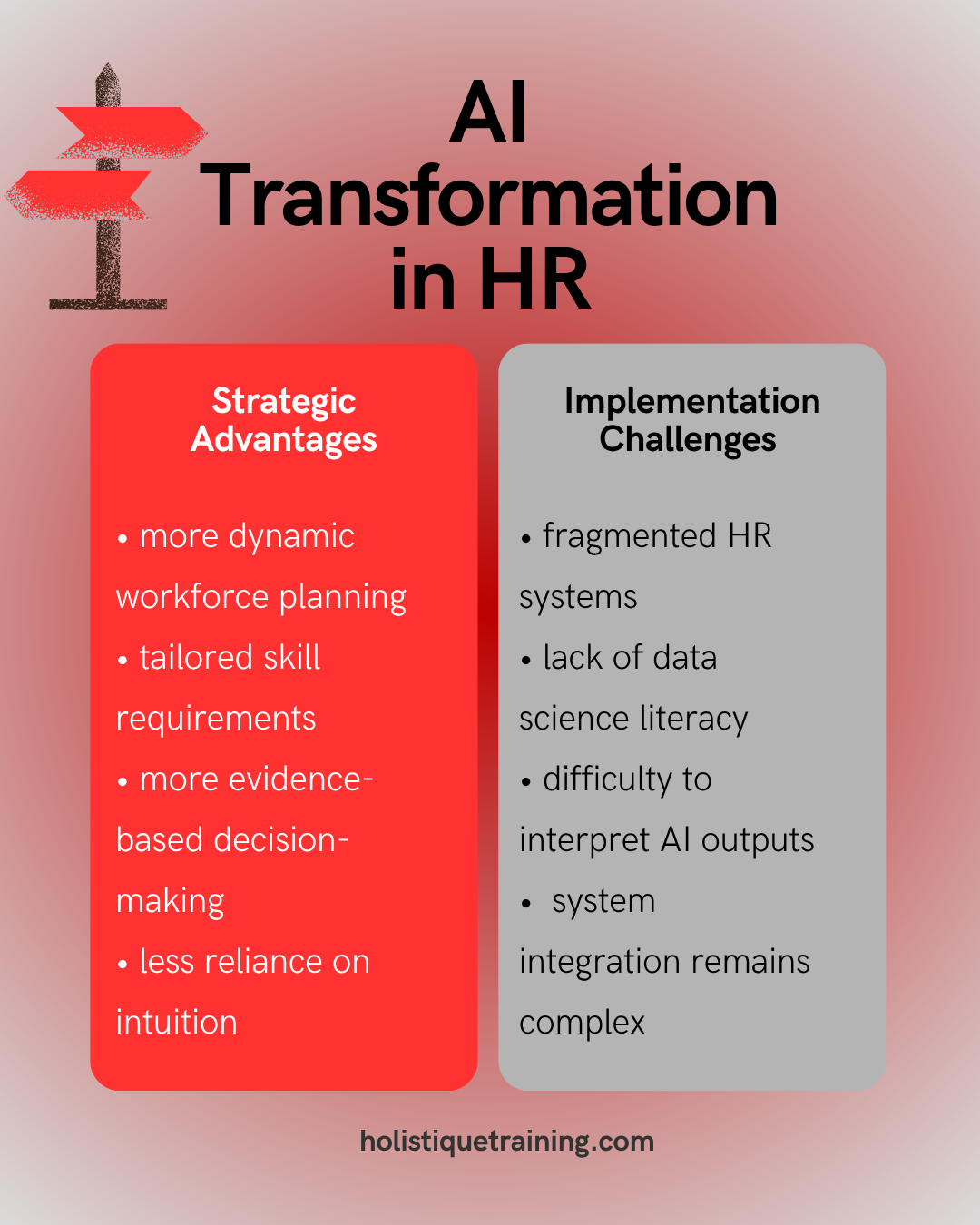
Workforce planning is becoming more dynamic. AI systems can model future skill requirements based on business strategy, market conditions, and internal capability gaps. This allows organizations to proactively build talent pipelines rather than react to shortages.
Decision-making is also becoming more evidence-based. AI dashboards provide leaders with real-time workforce insights, enabling scenario planning and risk assessment. This reduces reliance on intuition and improves strategic alignment between HR and business objectives.
6- Human + AI Collaboration in HR
AI does not remove the need for human judgment in HR; it restructures it. Routine, repetitive, and data-intensive tasks are increasingly automated, while human responsibility shifts toward interpretation, ethical oversight, and complex decision-making. This transition is not theoretical; it is already visible in how HR work is being redesigned around AI-enabled systems that handle screening, analysis, and prediction at scale.
HR professionals are therefore evolving from administrative operators into analysts and workforce strategists. This shift requires significantly higher levels of data literacy, critical thinking, and the ability to interrogate AI-generated outputs rather than passively accept them. According to a McKinsey Global Institute report on the future of work, as much as 30% of current work activities could be automated by 2030, particularly those involving structured data processing and predictable decision rules. This reinforces the expectation that human roles will increasingly concentrate on higher-order cognitive and interpersonal tasks rather than routine execution.
Despite advances in automation, the human dimension of HR remains irreplaceable. Functions such as conflict resolution, organizational culture development, leadership coaching, and employee relations depend on empathy, contextual interpretation, and ethical sensitivity. These are areas where AI can support analysis but cannot replicate lived understanding or moral accountability.
The most effective HR operating models are therefore hybrid in nature. AI systems handle scale, speed, and pattern recognition across large datasets, while humans provide judgment, contextual interpretation, and meaning-making. This division of roles is not about replacement but about functional complementarity, where each side strengthens the other within a shared decision-making ecosystem.
This specialised training programme equips HR professionals with the knowledge and practical skills to integrate Artificial Intelligence into modern people management. The course explains how AI enhances recruitment, talent analytics, performance management, learning & development, and employee experience. Participants learn to evaluate AI tools, interpret HR data responsibly,
7- Risks and Ethical Challenges of AI in HR
Risk / Challenge | Description | HR Impact | Why It Matters |
Algorithmic Bias | AI systems trained on historical HR data may inherit and amplify existing biases in hiring, promotion, or evaluation decisions | Unfair hiring outcomes, discrimination risks, reduced workforce diversity | Bias becomes scalable and systemic when embedded in automated decision systems |
Lack of Transparency | Many AI models operate as “black boxes,” making it difficult to explain how decisions or recommendations are generated | Reduced trust in HR decisions, accountability gaps in critical workforce decisions | HR decisions require explainability, especially in hiring and promotions |
Data Privacy Concerns | AI-driven HR systems often collect and analyze large-scale employee behavioral and performance data | Increased risk of surveillance concerns, employee distrust, and regulatory non-compliance | Improper handling of sensitive employee data can lead to legal and ethical violations |
Over-Reliance on Automation | Excessive dependence on AI may reduce human involvement in nuanced decision-making | Loss of contextual judgment in complex HR cases (conflict resolution, promotions, disciplinary actions) | HR decisions often require empathy, ethics, and contextual understanding that AI cannot replicate |
The most significant risk in AI-driven HR systems is algorithmic bias. If historical HR data reflects biased decision-making, AI models can replicate and amplify those biases at scale. This can lead to unfair hiring or promotion outcomes.
Transparency is another major challenge. Many AI systems operate as “black boxes,” making it difficult to explain why a specific decision or recommendation was made. This creates accountability issues in high-stakes HR decisions.
Data privacy is also a critical concern. AI-enabled HR systems often rely on large-scale employee monitoring, raising questions about surveillance, consent, and regulatory compliance.
Finally, over-reliance on automation can reduce human judgment in areas where nuance is essential. HR decisions that involve people’s careers require interpretability and ethical reasoning that cannot be fully delegated to algorithms.
8- Implementation Challenges for HR Leaders
Organizations face several barriers when implementing AI in HR. The first is digital maturity. Many HR systems are fragmented, with legacy platforms that do not integrate easily with modern AI tools.
A second challenge is capability. HR teams often lack data science literacy, making it difficult to interpret or validate AI outputs effectively.
Change management is another critical barrier. Employees and managers may resist AI-driven decision systems due to trust concerns or fear of surveillance.
Finally, system integration remains complex. AI tools must be embedded into existing HRIS ecosystems without disrupting operational continuity.
9- Starter Roadmap for HR Leaders
A structured approach to AI adoption in HR reduces risk and improves scalability. The following roadmap outlines a practical progression model.
Phase | Focus | Objective |
1 | Assessment | Evaluate HR data maturity and system readiness |
2 | Use Case Selection | Identify high-impact HR processes for AI integration |
3 | Pilot Deployment | Implement small-scale AI pilots in controlled environments |
4 | Governance | Establish ethical, legal, and data governance frameworks |
5 | Capability Building | Upskill HR teams in data literacy and AI usage |
6 | Scaling | Expand successful use cases across HR functions |
This staged approach ensures that AI adoption is incremental, measurable, and aligned with organizational readiness rather than driven by technology hype.
10- Case Applications of AI in HR
Artificial Intelligence is no longer limited to experimental HR tools or isolated automation tasks. Across industries, organisations are integrating AI into core human resource functions to improve efficiency, strengthen decision-making, and create more adaptive workforce systems. The application of AI varies depending on organisational structure, sector priorities, workforce size, and operational complexity, but its influence is now visible across recruitment, workforce planning, employee development, performance management, and organisational strategy.
Corporate Environments
In large corporate environments, AI is primarily used to manage high-volume and data-intensive HR operations. Multinational companies often receive thousands of applications for a single role, making traditional recruitment processes slow and resource-heavy. AI-powered recruitment platforms help streamline this process by screening CVs, analysing candidate qualifications, ranking applicants based on predefined competencies, and identifying profiles that closely match organisational needs. These systems significantly reduce administrative burden and accelerate hiring timelines.
AI is also widely applied in workforce analytics. HR departments use predictive models to analyse employee behaviour, identify turnover patterns, forecast future hiring needs, and measure workforce productivity. By examining variables such as engagement levels, promotion histories, absenteeism, and performance trends, AI systems can help organisations predict attrition risks before employees decide to leave. This allows HR teams to intervene proactively through retention strategies, learning opportunities, or internal mobility programmes.
Another important application is internal talent mobility. AI-driven platforms map employee skills, experiences, and career aspirations to recommend internal job opportunities, project assignments, or leadership pathways. This improves talent retention while helping organisations maximise existing human capital instead of relying solely on external recruitment. In highly competitive industries, these systems support long-term succession planning and organisational resilience.
Public Sector and NGO Environments
In public institutions and non-governmental organisations, AI applications are increasingly focused on workforce planning, operational coordination, and resource allocation. These sectors often operate in complex environments with financial limitations, humanitarian pressures, and rapidly changing priorities. AI helps organisations make more strategic staffing decisions under resource constraints.
For example, humanitarian organisations and NGOs working in crisis response can use AI systems to analyse field data, population movements, security conditions, and service demands in order to allocate personnel more effectively. Workforce planning tools can identify where additional staff or specialised expertise is needed, helping organisations deploy teams faster and more efficiently during emergencies or large-scale operations.
AI also supports administrative optimisation in public sector HR systems. Government institutions often manage large workforces with extensive bureaucratic processes. AI-powered automation can assist with scheduling, employee documentation, payroll analysis, attendance tracking, and policy compliance monitoring. This reduces operational inefficiencies and allows HR professionals to focus more on strategic and employee-centred responsibilities.
In international development and humanitarian contexts, AI can additionally support multilingual communication, volunteer coordination, and skills matching for short-term projects. These capabilities are particularly valuable in environments where organisations must respond quickly to changing social or humanitarian conditions while operating with limited administrative capacity.
Technology Companies
Technology companies represent some of the most advanced adopters of AI in HR. In these organisations, AI is deeply integrated into performance management systems, employee learning platforms, and organisational development strategies. Rather than relying solely on annual performance reviews, AI enables continuous feedback systems that collect real-time data on employee contributions, collaboration patterns, project outcomes, and learning progress.
AI-driven performance management tools provide managers with ongoing insights into team dynamics and employee development needs. These systems can detect productivity trends, identify skill gaps, and recommend personalised development opportunities. As a result, performance evaluation becomes more dynamic, evidence-based, and responsive to changing business requirements.
Learning and development systems in technology companies also rely heavily on AI-powered personalisation. Employees receive customised learning recommendations based on their current roles, future career goals, project requirements, and emerging industry trends. Adaptive learning platforms continuously update recommendations as employees acquire new competencies or as organisational priorities evolve.
Additionally, AI supports rapid skill adaptation in fast-changing technological environments. Since digital industries evolve quickly, organisations must constantly reskill employees to remain competitive. AI systems help companies identify future skill demands, monitor workforce readiness, and design targeted upskilling programmes that align with strategic objectives.
Cross-Sector Impact
Although the application of AI differs across sectors, several common patterns are emerging. Organisations increasingly use AI to improve operational efficiency, enhance strategic workforce planning, support data-driven decision-making, and create more personalised employee experiences. At the same time, the growing reliance on AI in HR raises important concerns related to ethics, transparency, algorithmic bias, employee privacy, and accountability.
As AI adoption continues to expand, successful organisations will not only focus on technological implementation but also on responsible governance. Human oversight, ethical standards, and inclusive design will remain essential to ensuring that AI strengthens human-centred HR practices rather than replacing the human judgment and empathy that effective people management requires.
Discover how Generative AI is revolutionizing HR! Learn about its impact, tools, ethical concerns, essential skills, and how HR leaders can empower their teams in the age of AI-driven transformation.
11- Future of AI in HR
The future HR function will be increasingly personalized, predictive, and automated. Employee experiences will become highly individualized, with AI systems tailoring career development, learning pathways, and benefits structures.
Skills-based organizational models will replace rigid job architectures. Instead of fixed roles, organizations will increasingly operate around dynamic skill pools that can be reconfigured based on business needs.
AI will also become more autonomous in workforce planning, continuously adjusting hiring and development strategies based on real-time organizational data. This will shift HR from periodic planning cycles to continuous optimization systems.

As artificial intelligence continues to influence decision-making in healthcare, finance, justice, and beyond, questions around fairness, accountability, and transparency have moved to the forefront of AI development. This course introduces the ethical challenges posed by AI systems and focuses on explainable AI (XAI) as a critical component for
12- Conclusion
AI is fundamentally reshaping HR from a process-driven administrative function into a data-informed strategic system. The transformation is not optional; it is structurally embedded in how modern organizations operate. However, the value of AI in HR depends on how it is implemented. Without governance, transparency, and human oversight, AI systems introduce significant ethical and operational risks.
The most effective HR organizations will not be those that fully automate human decision-making, but those that successfully integrate AI into human-centered workforce strategy. In this model, AI enhances speed, scale, and insight, while humans retain responsibility for judgment, ethics, and organizational culture.