

- Table of Contents
- Introduction
- 1. What Are Career Acceleration Programmes?
- 2. The Main Types of Career Acceleration Programmes
- Executive MBAs and Part-Time Business Degrees
- Short Executive Education Programmes
- Internal High-Potential Programmes
- Coaching and Mentoring Programmes
- Online and Blended Leadership Programmes
- 3. Why Mid-Level Managers Need Structured Acceleration
- 4. The Return on Investment of Career Acceleration Programmes
- 5. What Career Acceleration Programmes Teach That Experience Alone Cannot
- 6. Networking as a Career Accelerator
- 7. How to Choose the Right Programme
- Clarity on Career Goals
- Programme Reputation and Accreditation
- Format and Fit with Professional Commitments
- Employer Alignment
- 8. The Role of Employers in Career Acceleration
- 9. Measuring Progress and Managing the Career Acceleration Journey
- 10. Common Challenges and How to Navigate Them
- Time Pressure
- Imposter Syndrome and Peer Comparison
- Translating Learning into Organisational Impact
- Choosing Between Breadth and Depth
- 11. The Future of Career Acceleration
- Conclusion
Introduction
For mid-level managers, the gap between where they are and where they want to be is rarely a question of ambition. It is more often a question of access: access to the right knowledge, the right networks, and the right signals of readiness for senior leadership. Career acceleration programmes exist precisely to close that gap. These structured interventions, which include executive education courses, leadership development programmes, mentoring frameworks, and accelerated MBA pathways, are designed to help professionals move upward at a pace that ordinary career progression simply cannot match.
The demand for these programmes has grown steadily in recent years, driven by several forces at once. Organisations are managing flatter hierarchies, faster strategy cycles, and greater complexity across functions and geographies. Senior roles now require broader competencies than they did a generation ago. At the same time, mid-level managers are increasingly aware that their technical expertise, however strong, may not be enough to secure a move into the executive tier. Something more is needed, and career acceleration programmes are increasingly seen as the mechanism to provide it.
This article explores what career acceleration programmes are, why they have become important for working executives, the different forms they take, how to choose the right one, and what managers can realistically expect in return for the time and financial investment they require. Whether you are weighing up an Executive MBA, a short leadership programme, or an internal high-potential scheme, this guide will help you understand the landscape and make an informed decision.
1. What Are Career Acceleration Programmes?
Career acceleration programmes are structured learning and development interventions designed to help professionals reach senior roles more quickly than they might through standard career progression alone. Unlike conventional training, which typically focuses on job-specific technical skills, these programmes target the broader capabilities associated with executive leadership: strategic thinking, organisational influence, commercial acumen, and the kind of cross-functional perspective that senior roles demand.
The term covers a wide range of formats. Some programmes are offered by universities and business schools as executive education products. Others are run internally by organisations as part of their talent pipeline strategy. Some are individually funded and pursued, while others are employer-sponsored. What they share is an orientation towards movement: the explicit intent of accelerating a transition, whether that means a promotion, an expanded remit, a functional shift, or a move toward the C-suite.
It is useful to distinguish career acceleration programmes from general professional development. General development might include technical courses, compliance training, or skills updates that help a professional perform their current role better. A career acceleration programme, by contrast, is primarily aimed at preparing someone for a role they do not yet hold. The logic is forward-looking rather than maintenance-oriented.
2. The Main Types of Career Acceleration Programmes
There is no single format that defines a career acceleration programme. The most effective choice depends on the individual's goals, current level, industry, and available time. Understanding the main categories helps in making a considered selection.
Executive MBAs and Part-Time Business Degrees
The Executive MBA is probably the most well-known form of career acceleration for working professionals. Designed specifically for people who cannot pause their careers to study full time, EMBA programmes are typically delivered over eighteen months to two years, with classes on weekends or in intensive blocks. They cover strategy, finance, leadership, operations, and organisational behaviour, and they are explicitly designed around the experiences and challenges that managers already bring with them.
Short Executive Education Programmes
Business schools such as Harvard, INSEAD, London Business School, and others offer short open-enrolment programmes lasting between a few days and several weeks. These cover specific topics such as strategic leadership, financial acumen for non-finance executives, negotiation, or managing organisational change. They are faster and less expensive than an EMBA, and they can be targeted precisely at a skill gap or a specific career ambition. Their main limitation is depth: a one-week programme cannot replace years of structured learning, but it can open thinking, provide frameworks, and signal ambition to an employer.
Internal High-Potential Programmes
Many larger organisations run structured high-potential or accelerated leadership programmes for employees identified as having senior leadership potential. These may involve rotational assignments, stretch projects, executive mentoring, and access to board-level visibility. They are powerful because they operate within the specific context of the organisation, but they are not universally available, and inclusion in them is itself a competitive process.
Coaching and Mentoring Programmes
Executive coaching is increasingly recognised as one of the most effective levers for career acceleration at the individual level. A skilled coach helps a manager surface and address the personal and professional patterns that may be limiting their upward progression. Senior mentors can provide strategic guidance, sponsorship, and access to networks that would otherwise take years to build independently.
Online and Blended Leadership Programmes
The growth of high-quality online learning has expanded access to executive-level content for professionals who cannot attend residential programmes. Platforms and providers now offer blended formats that combine self-paced digital learning with live virtual sessions, peer cohort work, and project-based assignments. These are increasingly credible options, particularly in contexts where geography or cost make campus-based programmes impractical.
Programme Type | Duration | Typical Cost | Best For | Delivery |
Executive MBA | 18–24 months | £30,000–£90,000+ | Broad transformation | Blended / weekend |
Short exec. education | Days to weeks | £2,000–£15,000 | Targeted skill gaps | Campus / online |
Internal hi-po scheme | 6–24 months | Employer-funded | Pipeline succession | In-house |
Executive coaching | Ongoing | £200–£600/session | Behavioural change | One-to-one |
Online leadership prog. | Weeks to months | £500–£5,000 | Flexibility-first | Digital / blended |
3. Why Mid-Level Managers Need Structured Acceleration
The path from mid-level management to senior leadership is not linear. Many managers find that strong performance in their current role does not automatically translate into readiness for the next. The skills and mindset required at the executive level differ in important ways from those that succeed at the managerial tier. Career acceleration programmes address this gap directly.
At the mid-level, a manager is typically valued for operational excellence: managing teams, hitting targets, running effective processes. At the senior level, the emphasis shifts towards strategic contribution: shaping direction, making decisions under uncertainty, building external relationships, and influencing across organisational boundaries. Without deliberate investment in these capabilities, technically strong managers may find themselves passed over in favour of candidates who demonstrate a clearer executive presence and strategic orientation.
There is also the matter of visibility. In large organisations, capable managers who remain within a single function or business unit may simply not be visible to the decision-makers who allocate senior roles. Career acceleration programmes, particularly those with cohort-based learning and alumni networks, create a form of structured visibility that is difficult to replicate through performance alone.
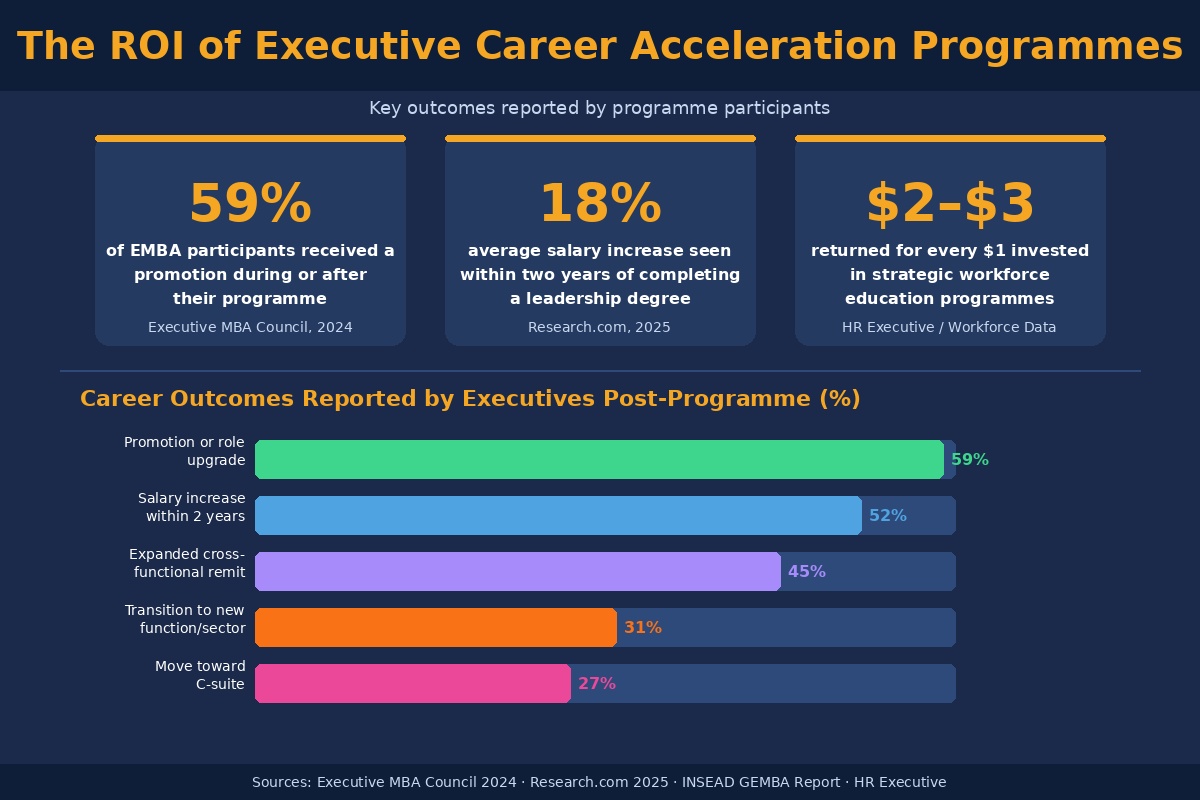
According to the 2024 Executive MBA Council Report , 59 percent of participants received a promotion during or after their executive education programme. This figure reflects not only the knowledge gained but also the signalling effect of a completed programme: a demonstrated commitment to professional development that organisations tend to reward.
4. The Return on Investment of Career Acceleration Programmes
For any working professional, the decision to invest in a career acceleration programme involves a genuine trade-off. These programmes demand time, money, and energy, often while the participant is simultaneously managing a full-time role and, in many cases, family and personal responsibilities. Understanding the likely return on that investment is therefore not an abstract exercise; it is a practical necessity.
The financial returns are measurable. According to data published by Research.com , leadership programme graduates see an average salary increase of 18 percent within two years of completing their qualification. For a manager earning £70,000, that represents a salary uplift of over £12,000 per year, which, compounded over several years, can return the cost of most short programmes many times over. At the broader organisational level, strategic workforce education programmes have been shown to generate between £2 and £3 for every £1 invested, according to analysis cited by HR Executive.
Beyond compensation, the returns are also structural. Graduates of EMBA and short executive programmes consistently report gains in strategic thinking, financial literacy, negotiation effectiveness, and the ability to manage complexity. These are not incremental improvements; they represent the kind of capability shift that can genuinely alter a career trajectory.
The infographic below summarises the key outcome data from major executive education studies, illustrating the career and financial returns that participants most commonly report.
5. What Career Acceleration Programmes Teach That Experience Alone Cannot
Experience is irreplaceable, but it has a fundamental limitation: it is local. A manager who has spent ten years in marketing at a single company has accumulated deep knowledge of that function and that context. What they may lack is the broader framework for thinking about strategy, capital allocation, international operations, or the governance structures through which senior decisions are made. Career acceleration programmes provide that framework.
Several capabilities are consistently identified as the differentiating outputs of well-designed executive programmes. Strategic thinking is perhaps the most frequently cited. This refers not simply to the ability to plan ahead, but to the capacity to analyse competitive dynamics, understand how value is created and destroyed, and make decisions that balance short-term operational demands against long-term positioning. It is a skill that improves significantly with structured learning and peer challenge.
Financial acumen is another. Many mid-level managers have limited exposure to the financial logic that drives board-level decisions. Understanding how to read a balance sheet, evaluate a business case, or think about capital structure is not merely a technical skill; it is a form of language that communicates readiness for senior leadership.
Executive presence, communication, and the ability to influence without authority are also developed through well-constructed programmes. Cohort-based learning, particularly with peers from different industries and functions, creates a laboratory for practising these skills in conditions that replicate the complexity of senior roles.
6. Networking as a Career Accelerator
One of the most consistently underestimated returns from career acceleration programmes is the quality of the network they build. This is not simply a question of collecting contacts. The networks formed in rigorous, cohort-based programmes tend to be deeply meaningful, because they are forged through shared intellectual challenge, honest peer feedback, and extended periods of collaborative work. These are the conditions under which trust is built, and trust is the foundation of the networks that actually generate opportunities.
Senior roles are rarely filled purely through formal recruitment processes. Research consistently suggests that a significant proportion of leadership appointments come through professional relationships, referrals, and informal channels. A manager who participates in a well-regarded executive programme gains access to the networks of faculty, alumni, and fellow participants, all of whom may be in positions to open doors that would otherwise remain closed.
The alumni networks of established business school programmes in particular can be genuinely valuable. INSEAD's Global Executive MBA data, for example, shows that participants experience an increase in seniority towards C-suite roles, moving from 17 percent to 27 percent representation in senior leadership positions post-programme. This reflects not only learning outcomes but the sustained networking effect that follows programme completion.

Discover how leadership networking expands influence, builds credibility, and drives innovation. Learn strategies, case studies, and future trends.
7. How to Choose the Right Programme
The range of available options means that choosing the right career acceleration programme is itself a strategic decision. A poor match between programme and professional context can mean spending considerable time and money without achieving the intended outcome. Several factors should guide the selection process.
Clarity on Career Goals
Before selecting a programme, a manager should be clear about what they are trying to achieve. A promotion within the current organisation is a different goal from a functional transition or an industry move. The right programme varies accordingly. An internal high-potential scheme may serve the first goal best, while a well-regarded open-enrolment executive programme may be more effective for the second or third.
Programme Reputation and Accreditation
Not all programmes carry equal weight in the labour market. Accreditation bodies such as the Association to Advance Collegiate Schools of Business (AACSB), EQUIS, and AMBA provide quality assurance signals that matter to employers. The reputation of the provider and the strength of its alumni network are also relevant considerations, particularly if networking outcomes are a primary motivation.
Format and Fit with Professional Commitments
A programme that requires attendance on campus several days per week may be incompatible with the responsibilities of a senior management role. Flexibility matters, and the growth of blended and online formats has significantly expanded the options available to working professionals who need to maintain full professional commitments alongside their studies.
Employer Alignment
Where possible, it is worth exploring whether a prospective programme is valued by the employer, whether sponsorship or partial funding is available, and whether the organisation has existing relationships with specific providers. Employer-sponsored participants tend to report stronger career outcomes, in part because the organisational investment signals institutional endorsement of the individual's potential.
Career Goal | Recommended Programme Type | Key Considerations |
Promotion within current organisation | Internal hi-po scheme or exec coaching | Visibility to senior stakeholders |
Transition to new function | Short exec. education or EMBA | Breadth of curriculum and credentialing |
Move to a new industry | EMBA with strong alumni network | Network access and brand recognition |
Accelerate to C-suite | EMBA or senior leadership programme | Strategic depth and peer quality |
Bridge a specific skill gap | Targeted short programme or coaching | Relevance and immediate application |
8. The Role of Employers in Career Acceleration
Organisations have a direct interest in accelerating the development of high-potential managers, and the best employers understand that structured career acceleration programmes are a retention and succession planning tool as much as a development one. When an organisation sponsors a manager through an executive programme, it is making a visible investment in that person's future, and that investment typically generates loyalty and performance in return.
Employer involvement can take several forms. Direct financial sponsorship is the most straightforward, but it is not the only form of support. Allowing study time, providing access to senior mentors, creating visibility opportunities for high-potential managers, and integrating programme learning into real organisational challenges are all forms of investment that strengthen the impact of formal programmes significantly.
From the manager's perspective, securing employer support is both a practical and a strategic goal. It reduces the personal financial risk of programme participation, and the process of making the case for sponsorship is itself a useful exercise in executive communication and business case construction.

Leadership is a position desired by many yet only achievable by a select few. A wide range of skills are required to be an effective leader, and while some may come naturally to some, for most people, they need to be taught and developed over
9. Measuring Progress and Managing the Career Acceleration Journey
Enrolling in a programme is not, by itself, a career strategy. The managers who benefit most from career acceleration programmes are those who approach them with deliberate intent, connecting what they learn to specific professional goals, building relationships with purpose, and translating programme insights back into their daily leadership practice.
Setting clear goals before starting a programme is essential. What specific outcomes are you seeking? A promotion within twelve months, an expanded remit, a move into a new function, or the credibility to make a case for a board-level role? Having these defined in advance allows the programme experience to be shaped around them rather than experienced passively.
During the programme, the habit of reflection and application is critical. Executive programmes work best not when participants absorb content but when they actively test frameworks against their own organisational challenges, seek feedback from peers and faculty, and return each week to their professional environment with a specific idea or tool to try. This integration of learning and practice is what distinguishes genuine career acceleration from credential acquisition.
After the programme, maintaining the network and continuing to develop the habits of strategic thinking and executive communication are what sustain the momentum that the programme creates. Many participants find that the real returns begin to compound six to eighteen months after programme completion, as opportunities connected to the network or enabled by new capabilities begin to materialise.

In today’s connected world, leadership is no longer limited to one culture, country, or mindset. Leaders must understand how to navigate and lead across cultures, time zones, and ways of thinking. This training course helps you develop the mindset and skills to lead effectively in diverse,
10. Common Challenges and How to Navigate Them
Career acceleration programmes are demanding, and the challenges they present are as real as the opportunities. Understanding these challenges in advance helps participants prepare more effectively and reduces the risk of a poor experience.
Time Pressure
The most consistently cited challenge is managing programme demands alongside a full-time professional role. This is genuinely difficult, and there is no formula that eliminates the pressure. However, programmes specifically designed for working professionals tend to be structured with this reality in mind. Honest communication with your manager about the time commitment, combined with realistic planning of when intensive study periods will fall, makes the challenge manageable for most participants.
Imposter Syndrome and Peer Comparison
Executive programme cohorts typically contain highly accomplished professionals from a wide range of organisations and industries. This is one of the programme's greatest strengths, but it can also generate comparison and self-doubt, particularly early in the experience. It is worth knowing that this response is almost universal and that it tends to resolve relatively quickly as participants recognise that the diversity of experience in the room is itself the source of the learning.
Translating Learning into Organisational Impact
The gap between classroom insight and organisational change is real. A manager may return from an executive programme with a sharply developed sense of strategic priorities, only to find that the organisation is not immediately receptive. Navigating this gap requires patience, incremental demonstration of value, and the willingness to apply new thinking in small, concrete ways before attempting larger structural interventions.
Choosing Between Breadth and Depth
Some professionals find themselves torn between a broad EMBA and a series of targeted short programmes. There is no universal answer. Breadth is valuable when a career ambition is to move into a general management or C-suite role. Depth is more valuable when a specific capability gap is the limiting factor in upward progression. Many managers benefit from combining both approaches over time, using short programmes for targeted development and an EMBA for the broader transformation.
Common Challenge | Why It Occurs | How to Manage It |
Time pressure | Dual demands of work and study | Plan study blocks in advance; involve line manager |
Imposter syndrome | High-calibre peer cohort | Recognise it as near-universal; engage early |
Applying learning at work | Pace of organisational change | Start small; build evidence of impact |
Breadth vs depth dilemma | Multiple programme options available | Align to specific career goal first |
Cost justification | High programme fees | Build ROI case; explore employer sponsorship |
11. The Future of Career Acceleration
The landscape of executive development is shifting. Advances in artificial intelligence, the growth of personalised learning platforms, and the global expansion of blended delivery formats are all changing what career acceleration programmes look like and who can access them. The next generation of executive education is likely to be more modular, more data-driven, and more directly integrated with the specific challenges that organisations face.
At the same time, the core logic of career acceleration programmes is not changing. The gap between mid-level management capability and senior leadership readiness remains real, and the most effective way to close it remains a combination of structured learning, peer challenge, and deliberate network development. What is changing is the range of formats through which these outcomes can be pursued and the speed with which high-quality programmes can be designed and delivered.
For working executives, this means more choice but also more responsibility for discernment. The quality differential between the best and worst programmes is significant, and the risk of investing time and money in a credential that carries little weight in the labour market is real. The principles for choosing well, however, remain consistent: clarity of goal, quality of provider, rigour of curriculum, and strength of the network that the programme connects you to.

The Chief Executive Officer (CEO) Leadership Program is an intensive and comprehensive course designed for aspiring and current CEOs who aim to enhance their leadership skills and drive organisational success. This program provides participants with the tools, frameworks, and strategies needed to lead complex organisations
Conclusion
Career acceleration programmes for working executives are not a shortcut. They are, at their best, a deliberate and well-structured investment in the capabilities, networks, and professional identity that senior leadership requires. For mid-level managers who have built a strong track record but find that ordinary progression is not moving them toward their goals fast enough, these programmes represent one of the most effective tools available.
The returns are well evidenced. Higher salaries, faster promotions, expanded networks, and the strategic mindset shift that comes from genuinely rigorous learning are all consistently reported by programme graduates. But the returns are not automatic. They flow from clarity of purpose, deliberate engagement with the programme, and the sustained work of translating learning into practice. Managers who approach these programmes with that intent are likely to find that the investment was among the most consequential of their professional lives.
To explore relevant leadership and executive development courses tailored for working professionals, visit holistiquetraining.com and browse the management and leadership portfolio.