
- Table of Contents
- 1- Introduction
- 2- Conceptual Foundations of Gamified Learning
- 1- Definition and Scope
- 2- Gamification vs Game-Based Learning
- 3- Theoretical Underpinnings
- 3- Core Game Mechanics in Education
- 1- Points, Scores, and Rewards Systems
- 2- Levels and Progression Systems
- 3- Immediate Feedback Mechanisms
- 4- Challenges, Quests, and Missions
- 5- Leaderboards and Social Competition
- 4- Gamified Learning in the Flow of Work
- 1- Integration with Microtraining
- 2- Contextual and Just-in-Time Learning
- 3- Personalization Through Algorithms
- 4- Mobile and Platform-Based Delivery
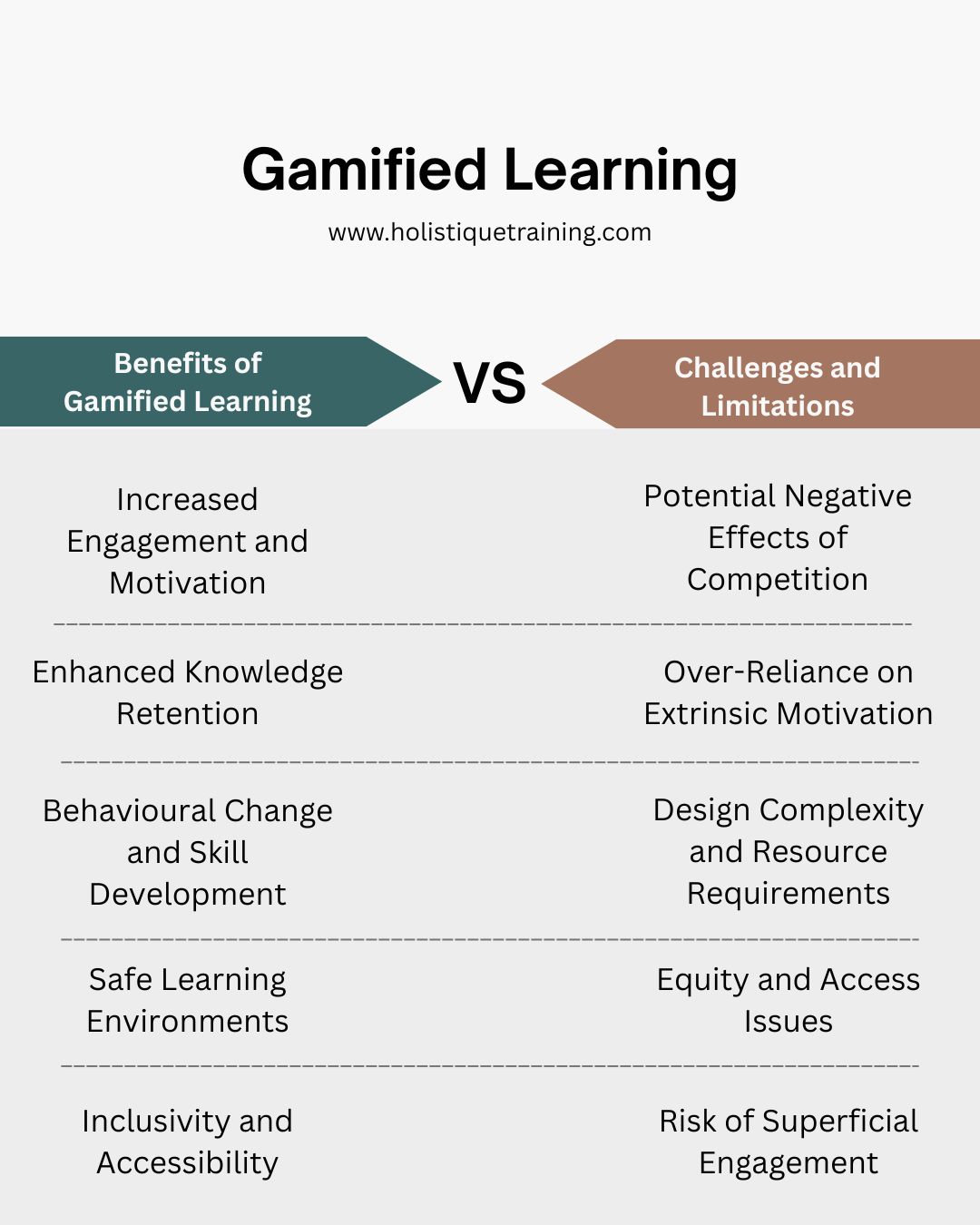
- 5- Benefits of Gamified Learning
- 1- Increased Engagement and Motivation
- 2- Enhanced Knowledge Retention
- 3- Behavioural Change and Skill Development
- 4- Safe Learning Environments
- 5- Inclusivity and Accessibility
- 6- Challenges and Limitations
- 1- Risk of Superficial Engagement
- 2- Over-Reliance on Extrinsic Motivation
- 3- Design Complexity and Resource Requirements
- 4- Equity and Access Issues
- 5- Potential Negative Effects of Competition
- 7- Case Applications and Practical Examples
- 1- Education Sector (Schools and Universities)
- 2- Corporate Training and NGOs
- 3- Language Learning and Skill-Based Platforms
- 4- Community-Based Learning Initiatives
- 8- Design Principles for Effective Gamified Learning
- 1- Aligning Mechanics with Learning Objectives
- 2- Balancing Challenge and Skill Level
- 3- Meaningful Feedback and Progress Tracking
- 4- Encouraging Intrinsic Motivation
- 9- Future Trends in Gamified Learning
- 1- Artificial Intelligence and Adaptive Learning
- 2- Virtual and Augmented Reality
- 3- Data-Driven Learning Analytics
- 4- Expansion in Humanitarian and Development Contexts
- 10- Conclusion
1- Introduction
Gamified learning refers to the integration of game design elements into educational contexts to enhance learner engagement, motivation, and performance. It is essential to distinguish this concept from game-based learning, where full-fledged games are used as instructional tools. In contrast, gamification does not necessarily require a complete game environment; instead, it embeds elements such as points, levels, feedback systems, and challenges into existing learning structures. This distinction is critical because gamification operates as a layer that enhances traditional or digital learning systems rather than replacing them entirely.
The rise of digital learning environments has accelerated the adoption of gamified approaches. As education shifts from teacher-cantered to learner-centred models, there is an increasing emphasis on personalization, engagement, and active participation. Learners today are accustomed to interactive and responsive digital experiences, which traditional educational methods often fail to provide. Gamified learning addresses this gap by incorporating mechanics that mirror the engagement loops found in video games, thereby aligning educational experiences with contemporary user expectations.
At the core of gamified learning lies the hypothesis that structured game mechanics can significantly improve educational outcomes. These mechanics create continuous feedback loops, reinforce progress, and sustain motivation over time. When applied effectively, they enhance not only engagement but also knowledge retention and behavioural change. This approach aligns closely with the concept of learning in the flow of work, where learning is embedded seamlessly into daily activities rather than treated as a separate, disruptive process. By emphasizing immediacy, relevance, and motivation, gamified learning transforms education into a dynamic and continuous experience.
2- Conceptual Foundations of Gamified Learning
1- Definition and Scope
Gamification is defined as the application of game design elements in non-game contexts to influence user behaviour and enhance engagement. In education and training, this involves integrating mechanics such as rewards, progression systems, and interactive challenges into learning environments. The scope of gamification extends across formal education, corporate training, and informal learning platforms, making it a versatile approach adaptable to various contexts. It is not limited to digital environments, although technology significantly amplifies its effectiveness by enabling real-time feedback and personalization.
2- Gamification vs Game-Based Learning
While gamification and game-based learning are often used interchangeably, they represent distinct pedagogical approaches. Game-based learning involves the use of complete games designed specifically for educational purposes. These games simulate environments where learners interact with content through gameplay. Gamification, on the other hand, applies selected game elements to existing learning systems without transforming them into full games.
Aspect | Gamification | Game-Based Learning |
Core Concept | Use of game elements in non-game contexts | Use of full games for learning |
Structure | Adds layers to existing content | Built entirely as a game |
Flexibility | Highly adaptable | Less flexible |
Development Cost | Lower | Higher |
Focus | Motivation and engagement | Experiential learning |
This distinction highlights the practical advantage of gamification, particularly in contexts where resources are limited or rapid implementation is required.
3- Theoretical Underpinnings
Behaviourism
Behaviourism provides a foundational framework for understanding gamification through its emphasis on reinforcement and rewards. According to this theory, behaviours are shaped by external stimuli, with positive reinforcement increasing the likelihood of repetition. Gamified systems leverage this principle by offering rewards such as points, badges, and achievements to reinforce desired behaviours. This creates a feedback loop where learners are continuously encouraged to engage with the material.
Constructivism
Constructivism shifts the focus from passive reception to active learning. It posits that learners construct knowledge through interaction and exploration. Gamified learning environments align with this theory by encouraging experimentation, problem-solving, and discovery. Challenges and missions, for example, require learners to apply knowledge in context, thereby deepening understanding and promoting meaningful learning experiences.
Self-Determination Theory
Self-Determination Theory emphasizes intrinsic motivation and identifies three key psychological needs: autonomy, competence, and relatedness. Gamification addresses these needs by allowing learners to make choices, track their progress, and interact with others. Autonomy is supported through personalized pathways, competence through progression systems, and relatedness through social features such as leaderboards and collaboration. These elements collectively enhance motivation and engagement.
Aspect | Behaviourism | Constructivism | Self-Determination Theory |
Core Principle | Learning is driven by external stimuli and reinforcement | Learning is an active process of knowledge construction | Motivation is driven by fulfilment of psychological needs |
Key Focus | Observable behaviour change | Meaning-making and understanding | Intrinsic motivation and engagement |
Role of Learner | Passive recipient responding to stimuli | Active participant exploring and discovering | Self-directed agent seeking autonomy and mastery |
Motivation Type | Primarily extrinsic (rewards and punishments) | Mix of intrinsic and contextual motivation | Primarily intrinsic (autonomy, competence, relatedness) |
Application in Gamification | Points, badges, rewards reinforce desired actions | Challenges and missions promote exploration and problem-solving | Personalized pathways, social interaction, and progression systems enhance engagement |
Feedback Mechanism | Immediate reinforcement strengthens behaviour | Feedback supports reflection and deeper understanding | Feedback enhances sense of competence and progress |
Strength in Learning | Effective for habit formation and repetition | Promotes critical thinking and deep learning | Sustains long-term motivation and engagement |
Potential Limitation | May lead to superficial learning if overused | Can lack structure if not well guided | Requires careful design to balance all psychological needs |
3- Core Game Mechanics in Education
1- Points, Scores, and Rewards Systems
Points and rewards systems are among the most recognizable elements of gamification. They function as immediate indicators of progress and achievement, reinforcing participation and completion. Reward loops, where actions lead to rewards and motivate further actions, are central to maintaining engagement. However, it is important to balance extrinsic rewards with intrinsic motivation to ensure that learners remain genuinely interested in the content.
2- Levels and Progression Systems
Levels and progression systems provide structure to the learning experience. By breaking content into stages, they create a sense of advancement and accomplishment. This structured progression helps learners visualize their journey and maintain motivation as they move toward higher levels of mastery.
3- Immediate Feedback Mechanisms
Immediate feedback is a critical component of effective learning. Gamified systems provide real-time responses to learner actions, allowing for quick correction and reinforcement. This aligns with microlearning principles, where short, focused interactions are designed to deliver immediate value and support continuous improvement.
4- Challenges, Quests, and Missions
Framing learning activities as challenges, quests, or missions fundamentally reshapes how learners perceive tasks. Instead of viewing them as routine or obligatory, learners interpret them as goal-driven activities with a clear purpose and endpoint. This shift introduces a sense of direction and intentionality, which is critical for sustained engagement. Challenges typically involve defined objectives, constraints, and measurable outcomes, all of which contribute to stronger goal orientation and task commitment. By structuring content in this way, educators transform passive learning into an active pursuit, where progress is continuously linked to achievement.
From a cognitive perspective, challenges activate problem-solving processes and encourage learners to apply knowledge rather than simply recall it. This aligns with higher-order thinking skills, as learners must analyse situations, make decisions, and adapt strategies to complete missions. The presence of incremental goals within quests also creates a progression pathway, allowing learners to experience frequent moments of success. These small achievements reinforce motivation and maintain momentum over time.
Empirical evidence supports the effectiveness of challenge-based gamification in enhancing engagement and learning outcomes. For instance, experimental research in education has shown that integrating challenges, alongside other gamification elements such as points and levels, leads to significantly improved learning performance compared to traditional instructional methods. At a broader level, engagement data indicates that challenge-based mechanics can increase user activity substantially; some studies report that introducing challenges can raise daily user engagement by approximately 30 percent. This demonstrates that when learners are given structured, meaningful tasks framed as missions, they are more likely to participate consistently and invest effort in completing them.
Importantly, the effectiveness of challenges depends on their design. Tasks must be appropriately calibrated in terms of difficulty to avoid frustration or boredom. When well-balanced, challenges create a sense of progression and mastery, reinforcing both competence and motivation. In this way, quests and missions function not merely as engagement tools, but as structured learning pathways that guide learners toward deeper understanding and sustained participation.
5- Leaderboards and Social Competition
Leaderboards introduce a social dimension to learning by enabling comparison and competition among peers. While this can enhance motivation and foster a sense of community, it also carries risks. Poorly designed competitive systems may discourage learners who consistently rank lower, highlighting the need for careful implementation.
4- Gamified Learning in the Flow of Work
1- Integration with Microtraining
Gamification integrates effectively with microtraining by enhancing short, focused learning units. These units are designed for quick consumption and immediate application, making them ideal for busy learners. Gamified elements such as points and badges reinforce completion and encourage continuous engagement.
Discover why traditional training often fails, causing cognitive overload and poor retention through the Ebbinghaus Forgetting Curve and memory limits.
2- Contextual and Just-in-Time Learning
Gamified learning supports contextual and just-in-time learning by embedding educational content directly into workflows. This reduces disruption and ensures that learning is relevant to immediate tasks. By aligning learning with real-world applications, gamification enhances both efficiency and effectiveness.
3- Personalization Through Algorithms
Adaptive systems use algorithms to tailor learning experiences based on individual performance and preferences. Gamification enhances this personalization by adjusting difficulty levels, recommending content, and providing targeted feedback. This ensures that learners remain challenged without becoming overwhelmed.
4- Mobile and Platform-Based Delivery
Mobile technologies and Learning Experience Platforms have expanded the reach of gamified learning. These platforms enable on-demand access to content and facilitate the integration of gamified elements at scale. Mobile delivery, in particular, supports continuous learning by allowing users to engage with content anytime and anywhere.
5- Benefits of Gamified Learning
1- Increased Engagement and Motivation
Gamification addresses the challenge of maintaining attention in modern learning environments. By incorporating interactive and rewarding elements, it transforms passive learning into an engaging experience. This increased engagement leads to higher participation rates and improved learning outcomes.
2- Enhanced Knowledge Retention
Repetition, feedback, and rewards contribute to improved memory retention. Gamified systems reinforce learning through continuous interaction and immediate feedback, which strengthens neural connections and supports long-term retention.
3- Behavioural Change and Skill Development
Gamification is particularly effective in driving behavioural change and skill development. A study by TalentLMS found that 83 percent of employees who receive gamified training feel motivated, compared to 61 percent who receive non-gamified training. This demonstrates the impact of gamification on motivation and performance. By encouraging consistent engagement, gamified systems help learners develop habits and acquire practical skills over time.
4- Safe Learning Environments
Gamified environments provide a safe space for experimentation and failure. Learners can test their knowledge, make mistakes, and learn from them without real-world consequences. This reduces anxiety and encourages exploration, which is essential for effective learning.
5- Inclusivity and Accessibility
Gamified systems can be designed to accommodate diverse learning needs. By offering multiple pathways, adjustable difficulty levels, and personalized feedback, they ensure that learners with different abilities and preferences can engage effectively with the content.
6- Challenges and Limitations
1- Risk of Superficial Engagement
One of the primary challenges of gamification is the risk of superficial engagement. If poorly designed, gamified systems may focus on rewards rather than learning outcomes. This can lead to a situation where learners are motivated to earn points rather than understand the material.
2- Over-Reliance on Extrinsic Motivation
Excessive reliance on extrinsic rewards can undermine intrinsic motivation. When learners become dependent on rewards, their interest in the content itself may diminish. This highlights the importance of balancing extrinsic and intrinsic motivational factors.
3- Design Complexity and Resource Requirements
Effective gamification requires careful design and significant resources. Developing systems that align with learning objectives while maintaining engagement is a complex process that involves expertise in both education and game design.
4- Equity and Access Issues
The digital nature of many gamified systems raises concerns about equity and access. Learners in low-resource environments may lack the necessary technology to participate fully, creating disparities in educational opportunities.
5- Potential Negative Effects of Competition
While competition can enhance motivation, it can also lead to stress and disengagement. Learners who consistently perform poorly may feel discouraged, highlighting the need for inclusive and supportive design strategies.
7- Case Applications and Practical Examples
1- Education Sector (Schools and Universities)
In formal education, gamified quizzes, interactive platforms, and classroom tools are widely used to enhance engagement. These systems often incorporate points, badges, and leaderboards to motivate students and track progress.
2- Corporate Training and NGOs
Gamification is increasingly used in corporate training and capacity-building programs. In NGO contexts, it supports skill development and knowledge transfer, particularly in areas such as community engagement and project management.
3- Language Learning and Skill-Based Platforms
Language learning platforms utilize gamification extensively, employing streaks, levels, and rewards to sustain daily engagement. These systems encourage consistent practice, which is critical for language acquisition.
4- Community-Based Learning Initiatives
Gamification can be adapted for community-based learning initiatives, even in low-resource settings. By using simple mechanics such as challenges and rewards, educators can create engaging learning experiences without relying on advanced technology.
8- Design Principles for Effective Gamified Learning
1- Aligning Mechanics with Learning Objectives
Game elements must be aligned with educational goals to ensure that they support rather than distract from learning. This requires a clear understanding of both the content and the desired outcomes.
2- Balancing Challenge and Skill Level
Maintaining an optimal balance between challenge and skill is essential for sustaining engagement. This concept, often referred to as flow, ensures that learners remain motivated without becoming overwhelmed or bored.
3- Meaningful Feedback and Progress Tracking
Transparent feedback and clear progress tracking are critical for effective learning. Gamified systems should provide learners with accurate and timely information about their performance.
4- Encouraging Intrinsic Motivation
Designing for intrinsic motivation involves creating systems that foster autonomy, mastery, and purpose. This ensures that learners remain engaged even in the absence of external rewards.
9- Future Trends in Gamified Learning
1- Artificial Intelligence and Adaptive Learning
Artificial intelligence is transforming gamified learning by enabling highly personalized experiences. Adaptive systems can predict learner needs and adjust content accordingly, enhancing both efficiency and effectiveness.

Artificial Intelligence is reshaping the future of education by enabling highly personalized, responsive, and scalable learning experiences. AI-powered learning systems analyze learner behavior, adapt to individual needs, and deliver customized content that evolves in real time. This course explores how educators, instructional designers, and EdTech innovators can harness
2- Virtual and Augmented Reality
Virtual and augmented reality technologies are creating immersive learning environments that simulate real-world scenarios. These technologies enhance experiential learning and provide opportunities for hands-on practice.
3- Data-Driven Learning Analytics
Learning analytics play a crucial role in optimizing gamified systems. By analysing performance data, educators can identify patterns, measure effectiveness, and make informed improvements.

Educational leaders and teachers face critical decisions every day that shape the experiences and outcomes of learners. In an era of increasing data availability, the ability to collect, analyse, and act on data is a key competency for improving teaching, learning, and institutional performance.This course equips
4- Expansion in Humanitarian and Development Contexts
Gamified learning is increasingly being used in humanitarian and development contexts to provide scalable and cost-effective education solutions. These systems are particularly valuable in underserved communities where traditional educational resources are limited.
10- Conclusion
Gamified learning represents a significant evolution in educational practice, offering a strategic approach to enhancing engagement, retention, and behavioural outcomes. By integrating video game mechanics into learning environments, it aligns education with the expectations and habits of modern learners. However, its effectiveness depends on thoughtful design, alignment with learning objectives, and careful consideration of potential challenges. When implemented correctly, gamified learning has the potential to transform education and workforce development, making learning more accessible, engaging, and impactful in an increasingly digital world.

In an age of digital natives and short attention spans, educators and trainers face the challenge of making learning both meaningful and engaging. Gamification — the application of game elements to non-game contexts — has emerged as a powerful strategy to motivate learners, increase participation, and improve outcomes.