

- Table of Contents
- Introduction
- 1- The Skills Gap Driving Demand for Tech Training
- 2- What Tech Training Programmes for Career Transition Look Like
- Bootcamps
- Online certifications and micro-credentials
- Structured self-study and open learning
- Employer-sponsored programmes
- Comparison of main training formats
- 3- Key Tech Fields for Career Transition
- Artificial intelligence and machine learning
- Cybersecurity
- Data analytics and data science
- UX and product design
- Cloud computing
- Digital marketing and marketing technology
- 4- How Employers Are Responding to the Career Transition Trend
- 5- The Role of Certification and Credentialling
- 6- Barriers to Tech Career Transition and How to Overcome Them
- The experience paradox
- Financial pressure during transition
- Psychological and social barriers
- Choosing the wrong programme
- 7- The Organisational Perspective: Building Reskilling Strategies
- 8- Equity and Access in Tech Training
- 9- How to Choose the Right Tech Training Programme
- 10- The Future of Tech Training as a Career Pathway
- Conclusion
Introduction
Changing careers is no longer the rare, once-in-a-lifetime event it was once thought to be. For millions of professionals around the world, switching fields mid-career is now a practical and often necessary response to shifting labour markets, automation, and the growing dominance of digital industries. What has changed most dramatically in recent years is not the appetite for career change, but the availability of structured, accessible, and employer-aligned training that makes those transitions realistic. Tech training programmes have emerged as one of the most powerful tools for bridging that gap, helping professionals move into roles in artificial intelligence, data analytics, cybersecurity, UX design, cloud computing, and digital marketing without requiring a full return to formal education.
This article explores the full landscape of tech training programmes for career transition: what they are, why they have grown so rapidly, which fields they serve best, how they benefit both individual learners and the organisations that invest in them, and what it takes to make a training-led career shift succeed. Whether you are a professional considering a transition, an HR leader building a reskilling strategy, or an organisation trying to close skills gaps, this guide covers the practical and strategic dimensions you need to understand.
In this article, we will discuss the tech skills gap driving demand, the main types of tech training programmes available, key fields for career transition, how employers are responding, the role of certification and credentialling, barriers and how to overcome them, the organisational perspective, equity and access considerations, how to choose the right programme, and the future of tech training as a career pathway.
1- The Skills Gap Driving Demand for Tech Training
The global economy is undergoing a structural shift that is putting technology skills at the centre of nearly every industry. The demand for tech-literate workers is outpacing what traditional education systems can supply, creating a gap that training programmes are increasingly being asked to fill.
According to the World Economic Forum's Future of Jobs Report 2025 , nearly 40% of skills required on the job are set to change, and 63% of employers already cite the skills gap as the key barrier to business transformation. The same report identifies AI and big data, networks and cybersecurity, and technological literacy as the three fastest-growing skills categories globally.
This is not a problem confined to any single sector. Financial services firms are hiring data scientists. Healthcare organisations are seeking professionals who understand health informatics and digital infrastructure. Retail businesses need UX specialists and digital marketing analysts. Logistics companies require cloud and automation expertise. The result is a labour market in which a professional from almost any background can find a credible pathway into tech, provided they have access to the right training.
Tech training programmes have responded to this demand by offering structured, outcome-focused courses that are faster and more affordable than traditional degrees. They meet learners where they are, whether in employment, between roles, or at the early stages of a deliberate career pivot.
2- What Tech Training Programmes for Career Transition Look Like
Tech training programmes for career changers come in several formats, and understanding the differences between them is essential for anyone trying to choose the right path. The landscape ranges from immersive in-person bootcamps to self-paced online certifications, and from short micro-credentials to longer structured apprenticeships.
Bootcamps
Bootcamps are intensive, time-limited programmes typically lasting between eight and twenty-four weeks. They are designed to take a learner from foundational knowledge to job-ready skill in a compressed timeframe. They are common in software development, UX design, data analytics, and cybersecurity, and many offer career services, portfolio projects, and employer connections as part of the package.
Online certifications and micro-credentials
Online platforms have made it possible to earn industry-recognised credentials in fields like cloud computing, machine learning, and digital marketing without disrupting employment. Certifications from providers such as AWS, Google, Microsoft, and CompTIA are valued by employers and can signal technical competency even in the absence of a formal degree. They are often stackable, meaning learners can build progressively from foundational to advanced levels.
Structured self-study and open learning
A growing number of platforms offer free or low-cost structured courses that allow learners to develop tech skills independently. These suit highly self-directed learners who can manage their own pacing and accountability. The trade-off is that they offer less structure, fewer employer connections, and more variable credibility in the job market.
Employer-sponsored programmes
Some organisations have moved training in-house, building reskilling academies, apprenticeship tracks, and internal bootcamps to redeploy existing employees into tech roles. Amazon's Upskilling 2025 initiative, for instance, committed to training 300,000 employees in technology skills, signalling the scale at which large organisations are treating training as a strategic response to labour shortages.
Comparison of main training formats
Format | Duration | Cost | Flexibility | Employer recognition | Best for |
Bootcamp | 8–24 weeks | Moderate to high | Low | Strong in tech fields | Fast full transition |
Online certification | Weeks to months | Low to moderate | High | Strong (vendor-backed) | Working professionals |
Structured self-study | Variable | Low to free | Very high | Variable | Self-directed learners |
Employer programme | Weeks to months | Funded by employer | Moderate | High (internal) | Employees being reskilled |
Degree/diploma | 1–3 years | High | Low to moderate | High across all sectors | Deep career change |
3- Key Tech Fields for Career Transition
Not all tech fields are equally accessible to career changers, and not all offer the same pace of skills acquisition. The following areas are among the most viable for professionals making their first move into tech, based on the strength of employer demand, the availability of structured training, and the breadth of transferable skills that apply.
Artificial intelligence and machine learning
AI-related roles are among the fastest-growing in the global labour market. Entry-level positions in machine learning operations, prompt engineering, AI product management, and data labelling do not always require deep programming expertise, making them accessible to professionals with analytical or project management backgrounds. More technical AI roles typically require Python fluency, statistical knowledge, and experience with frameworks such as TensorFlow or PyTorch, which can be built up through structured training over six to twelve months.

Technology is constantly advancing, and in recent years, the interest in artificial intelligence has peaked. Artificial intelligence has attracted the attention of world leaders and successful business and organisation leaders due to its advantages. Artificial intelligence has the opportunity to completely revolutionise many industries and
Cybersecurity
Cybersecurity is one of the most urgent hiring priorities for organisations across all sectors. According to the US Bureau of Labour Statistics, employment of information security analysts is projected to grow by 33% between 2023 and 2033, far outpacing most other occupations. Entry into the field is often achieved through certifications such as CompTIA Security+, Certified Ethical Hacker (CEH), and the ISC2 CISSP, which are recognised globally and do not require a prior degree in computing. Professionals with backgrounds in law, compliance, finance, or operations often find strong transferable value in cybersecurity roles.

As cyber threats become more complex and frequent, traditional security tools alone are no longer sufficient. Artificial Intelligence (AI) is now playing a critical role in transforming cybersecurity from reactive protection to proactive defense. By using machine learning and automation, AI systems can detect anomalies, predict attacks, and
Data analytics and data science
Data roles are among the most accessible for professionals making a transition from adjacent fields. A background in finance, marketing, research, or operations translates well into data analytics, where the core skills involve SQL, Excel, Python or R, and visualisation tools such as Power BI or Tableau. Training programmes in data analytics are widely available, relatively affordable, and increasingly aligned with specific employer requirements. Data science roles require more statistical and programming depth, but structured bootcamps and online programmes have made the transition achievable within twelve to eighteen months for motivated learners.
UX and product design
UX design is one of the most accessible tech fields for people coming from non-technical backgrounds. Core skills include user research, wireframing, prototyping, and usability testing, which draw on empathy, communication, and analytical thinking rather than programming. Professionals from teaching, psychology, social work, journalism, and customer service have all made credible transitions into UX design through structured bootcamps and portfolio-building programmes. The ability to show a portfolio of real projects matters more in this field than formal credentials, making it particularly well suited to career changers who are willing to invest time in practical work.
Cloud computing
Cloud platforms have become the infrastructure backbone of modern businesses, and demand for certified cloud professionals continues to grow across industries. AWS, Google Cloud, and Microsoft Azure all offer structured certification pathways that can be completed in a matter of months. Cloud roles range from infrastructure management and cloud architecture to cloud security and DevOps, meaning that professionals with backgrounds in IT support, systems administration, or even project management can find viable entry points with targeted training.
Digital marketing and marketing technology
For professionals already working in communications, sales, PR, or content creation, digital marketing is a natural transition point. Training in SEO, paid media, email marketing automation, CRM platforms, and analytics tools can be acquired quickly and is widely available through short-form certifications. The growing complexity of marketing technology stacks means that hybrid professionals who understand both the business and the technical side of digital marketing are in particularly high demand.
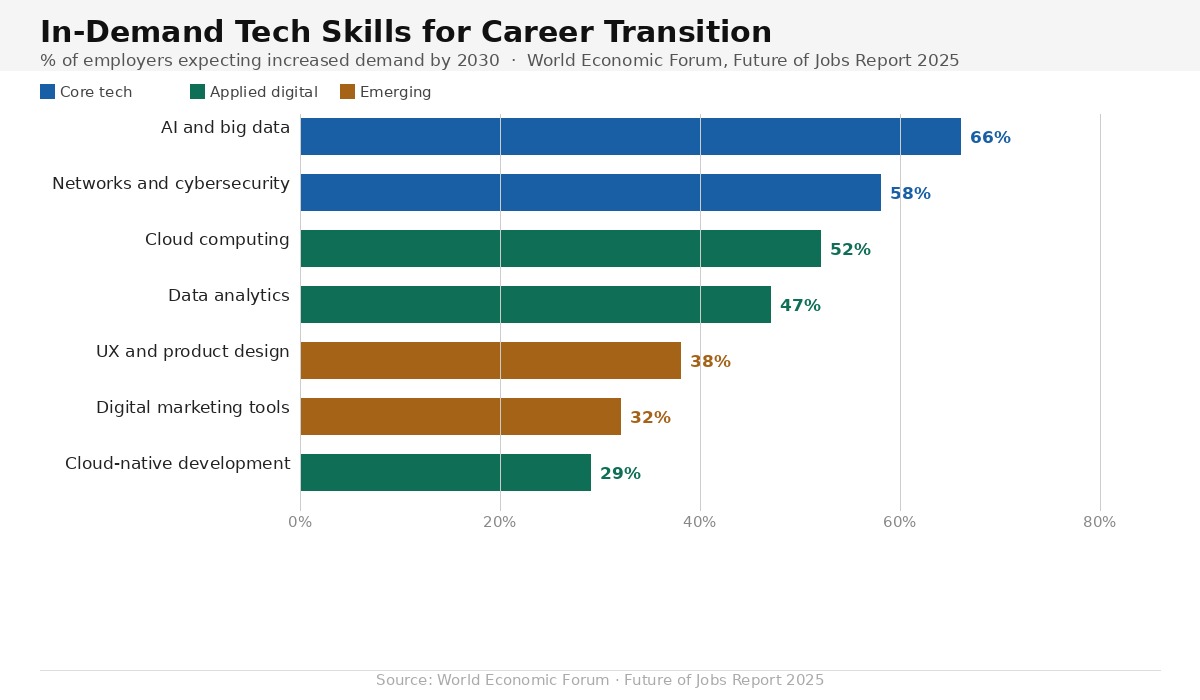
The infographic below summarises projected employer demand for key tech skills by 2030, drawn from the WEF Future of Jobs Report 2025.
4- How Employers Are Responding to the Career Transition Trend
Employers are increasingly aware that sourcing all their tech talent from traditional degree pipelines is neither sufficient nor always desirable. Career changers bring domain expertise, professional maturity, diverse perspectives, and problem-solving experience that complements purely technical profiles. This has led to meaningful shifts in how organisations recruit and develop tech talent.
Skills-based hiring is the most visible change. Rather than requiring specific degrees or academic backgrounds as a prerequisite for consideration, many employers now focus on demonstrable capability. Candidates are expected to show what they can do, through portfolio projects, technical assessments, case studies, or certifications, rather than simply presenting academic credentials.
Many large organisations have also invested directly in training pipelines by partnering with bootcamps, online learning platforms, and professional training providers to design curricula that map directly to their internal needs. This co-design approach reduces the lag between what training produces and what employers actually require, and it has strengthened employer confidence in non-traditional credentials.
LinkedIn Learning's research found that 94% of workers would choose to stay longer with companies that actively invest in their career development. This is a significant signal for organisations that reskilling is not just a talent acquisition strategy but a retention tool as well.
For HR and L&D leaders, the practical implication is that supporting employees who wish to transition into tech roles internally is both a retention strategy and a workforce planning investment. Building internal pathways into data, AI, or digital roles allows organisations to leverage existing institutional knowledge while filling roles that would otherwise require costly external recruitment.

The 21st century demands more than just subject knowledge — learners need a set of future skills to thrive in an ever-changing, technology-driven, and interconnected world. These skills — often called “soft” or “essential” — include creativity, critical thinking, digital literacy, collaboration, and resilience.This course equips
5- The Role of Certification and Credentialling
One of the defining features of tech training programmes is their strong relationship with formal credentialling. Unlike many other areas of professional development, tech fields have developed robust, industry-recognised certification frameworks that give employers a reliable way to evaluate competency outside of traditional degree pathways.
Vendor-backed certifications from AWS, Microsoft, Google, Cisco, and CompTIA carry strong market credibility because they are tied to widely used platforms and tools. Passing an AWS Solutions Architect exam or a Google Data Analytics certificate demonstrates a verified level of practical competency that transcends the reputation of any individual training provider.
Beyond vendor certifications, professional bodies in cybersecurity (ISC2, CREST, ISACA), project management (PMI, APMG), and data science (The Data Science Council of America) also offer credentials that are valued by employers. For career changers, these credentials serve multiple purposes: they signal commitment and capability, they provide a structured learning pathway, and they offer a credential that can stand in place of a degree on a job application.
The stackable nature of many certification frameworks is particularly valuable for career changers. Rather than committing to a single long-term programme at the outset, learners can start with a foundational credential, validate it in the job market, and then build towards more advanced qualifications as their experience grows. This incremental approach reduces the financial and time risk of a full career transition.
Field | Entry-level credential | Issuing body | Typical study time |
Cybersecurity | CompTIA Security+ | CompTIA | 3–6 months |
Cloud computing | AWS Cloud Practitioner | Amazon Web Services | 1–3 months |
Data analytics | Google Data Analytics | Google / Coursera | 3–6 months |
AI and ML | TensorFlow Developer Certificate | 3–6 months | |
UX design | Google UX Design Certificate | Google / Coursera | 6 months |
Digital marketing | Google Digital Marketing | 2–3 months |
6- Barriers to Tech Career Transition and How to Overcome Them
Despite the growing availability of training and the genuine demand from employers, career transitions into tech are not without their challenges. Understanding the most common barriers and how to address them is essential for anyone planning a move.
The experience paradox
Many entry-level tech roles now require one to two years of experience despite being labelled as entry-level. This creates a genuine catch-22 for career changers who have completed training but lack a formal employment record in the field. The most effective solution is to build a portfolio of real projects during training, contribute to open-source work, freelance on small projects, or take part in hackathons and competitions that generate visible, credible output.
Financial pressure during transition
Career transitions often involve a period of reduced income, particularly when moving into an entry-level tech role after years in a more senior position elsewhere. Employer-sponsored training, income share agreements offered by some bootcamps, government-funded reskilling programmes (particularly in the UK, EU, and parts of the Asia-Pacific region), and part-time study formats all help reduce this financial burden.
Psychological and social barriers
Research consistently shows that career transitions often fail for psychological reasons rather than technical ones. Imposter syndrome, fear of starting over, and the discomfort of being a beginner again are all real obstacles. Peer communities, mentorship from people who have made similar transitions, and clear short-term milestones all make the psychological dimension of transition more manageable.
Choosing the wrong programme
The tech training market is large and variable in quality. Not all bootcamps, certifications, or online programmes deliver on their promises, and choosing a poorly rated or weakly recognised credential can waste time and money without improving job prospects. Due diligence before committing to a programme matters enormously.
7- The Organisational Perspective: Building Reskilling Strategies
For organisations, tech training programmes are not just a resource for individual employees but a strategic lever for workforce planning. The shortage of tech talent in the open labour market means that internal reskilling is increasingly the most cost-effective and reliable way to build digital capability.
Effective organisational reskilling strategies typically share several characteristics. They start with a clear skills gap analysis that maps current capability against future needs, identifying which roles can be filled through internal transitions and which genuinely require external hiring. They invest in partnerships with credible training providers that can deliver both the technical content and the practical application that learners need to become productive. And they create visible career pathways so that employees who invest in reskilling can see where those skills will take them within the organisation.
According to CompTIA's 2025 State of the Tech Workforce report , the US tech workforce reached 5.9 million in 2024 and is projected to reach 6.1 million in 2025, yet demand continues to far outpace supply, with more than 125,000 active AI-related job postings recorded in May 2025 alone. For organisations, this signals that waiting for the external labour market to solve their tech talent problem is not a viable strategy.
Mentorship and on-the-job support are also critical. Training gives learners knowledge and skills, but they typically need guided experience to become genuinely proficient. Pairing newly reskilled employees with experienced practitioners, creating stretch assignments, and providing psychological safety to make mistakes during the learning phase all increase the probability that a training investment converts into real capability.
Organisations in sectors such as financial services, healthcare, retail, and the public sector have a particular opportunity here. These industries often have large workforces with deep domain knowledge that is highly valuable in technology roles. A compliance professional who becomes a cybersecurity analyst, a nurse who transitions into health informatics, or a retail buyer who moves into data analytics all bring something that a fresh graduate without that experience cannot easily replicate.
8- Equity and Access in Tech Training
Tech training programmes have a genuine potential to democratise access to high-paying careers, but that potential is not equally distributed. Structural barriers can limit who benefits from training-led career transition, and organisations and policymakers have a responsibility to account for these inequities.
Digital access remains a foundational issue. Online training assumes a device, reliable broadband, a suitable environment for study, and often English language proficiency. In regions or households where these are not given, the benefits of online tech training remain out of reach. Hybrid and blended delivery models, community-based learning infrastructure, and multilingual provision are all steps that can reduce this gap.
Cost is another significant barrier, particularly for people in low-income or precarious employment who cannot afford to step back from paid work or fund their own training. Government-funded schemes, employer co-investment, income share agreements, and sliding-scale pricing all make training more equitable in practice, though availability varies significantly by geography and sector.
Representation in tech training itself matters too. Programmes that lack diversity in their intake, faculty, and case studies risk reinforcing the existing demographic profile of the tech industry rather than broadening it. Training providers that actively recruit from underrepresented groups, offer mentorship from practitioners with similar backgrounds, and design curricula that reflect diverse professional experiences are better placed to contribute to a genuinely more inclusive tech workforce.
9- How to Choose the Right Tech Training Programme
With hundreds of programmes available in any given field, choosing the right one is one of the most consequential decisions in a tech career transition. The following framework offers a practical way to evaluate options.
Evaluation criterion | What to look for |
Employer recognition | Do hiring managers in your target field know and value this credential or provider? |
Curriculum relevance | Does the programme teach the tools and workflows actually used in current job roles? |
Graduate outcomes | What is the employment rate among completers, and in what types of roles? |
Learning format | Does the format fit your current work and life commitments? |
Support and community | Is there career support, mentorship, or peer community included? |
Cost and financial options | Is the cost justified by the outcomes, and are flexible payment options available? |
Accreditation | Is the programme accredited by a recognised body (BAC, CPD, etc.)? |
Beyond these criteria, talking to graduates of any programme before enrolling is one of the most reliable ways to get an honest picture. Alumni networks, LinkedIn, and community forums can all provide honest, ground-level perspectives that marketing materials cannot.
It is also worth being honest about your own readiness. The most effective training investment happens when learners have a clear sense of the role they are targeting, an understanding of the gap between their current skills and what that role requires, and a realistic plan for how they will build applied experience during and after training.
10- The Future of Tech Training as a Career Pathway
Tech training programmes for career transition are not a temporary phenomenon. They are becoming a durable and increasingly central part of how people move through working life in a technology-driven economy. Several trends suggest that their importance will only grow in the years ahead.
AI is transforming the training experience itself. Adaptive learning platforms that personalise content based on individual progress, AI-generated practice exercises, and real-time feedback systems are making training both more effective and more efficient. Learners can increasingly work through material at a pace and in a sequence that matches their own background and goals, rather than following a uniform curriculum.
The boundaries between training and work are also blurring. Micro-credentials embedded into professional platforms, learning content integrated directly into workplace tools, and employer-designed reskilling pathways are all examples of a broader shift towards learning that happens continuously rather than in discrete episodes. The concept of learning in the flow of work is increasingly being applied not just to skill refreshment but to substantive capability development, including training for entirely new roles.
Governments and intergovernmental bodies are also paying closer attention to tech training as a labour market policy tool. The European Commission's Pact for Skills, the UK's Skills England initiative, and comparable frameworks in Singapore, Australia, and Canada all reflect a growing recognition that structured reskilling infrastructure is a public good, not just a private matter for individuals and employers.
Finally, the social legitimacy of non-traditional credentials is strengthening. As skills-based hiring spreads, as tech certifications become more standardised and recognisable, and as more career changers build visible and successful track records in tech roles, the notion that a bootcamp or certification is a second-best credential compared to a university degree is steadily losing its force. What matters in most tech roles is demonstrable competency, and that can be built through many different routes.
Conclusion
Tech training programmes have become one of the most practical and viable pathways into the digital economy for professionals at every stage of their careers. Whether through cybersecurity certifications, data analytics bootcamps, AI upskilling courses, or UX design programmes, structured training is giving career changers a credible route into some of the most in-demand and well-compensated roles in the modern labour market.
The conditions driving this growth are structural rather than cyclical: the skills gap is real and growing, technological change is accelerating, and traditional education cannot supply enough digitally skilled workers quickly enough to meet demand. Training programmes fill that gap in a way that is fast, targeted, increasingly affordable, and increasingly recognised by employers.
For individuals, the key is choosing the right programme for the right field, building real applied experience alongside credentials, and approaching the transition with both realism about the effort required and confidence in the transferable value of their existing professional background. For organisations, the opportunity is to treat tech training not as an expense but as a strategic investment in workforce capability, retention, and resilience. The professionals who will define the next decade of the digital economy are already in the workforce. They just need the right training to get there.
To explore courses that can support your own transition into a tech-led career, subscribe to our newsletter and discover our range of specialist programmes designed for modern professionals.