


- Table of Contents
- Introduction
- 1- What Are Accounting for Managers Courses?
- 2- Why Financial Literacy Has Become a Core Management Skill
- 3- Core Topics Covered in Accounting for Managers Courses
- 4- Who Should Take an Accounting for Managers Course?
- 5- Accounting for Managers vs Professional Accounting Qualifications
- 6- The Business Case: Why Organisations Invest in Manager Financial Training
- 7- Key Financial Statements Every Manager Should Understand
- 8- Budgeting and Forecasting for Managers
- 9- Cost Awareness, Break-Even Analysis, and Profitability
- 10- Using Financial Data in Day-to-Day Decisions
- 11- Common Challenges Managers Face Without Financial Training
- 12- How Accounting for Managers Courses Are Delivered
- 13- Choosing the Right Accounting for Managers Course
- 14- The Future of Financial Literacy Training for Managers
- 15- Conclusion
Introduction
Every manager, regardless of department, eventually runs into a budget spreadsheet, a variance report, or a request to justify spending against return. Whether the request comes from finance, a supplier, or the board, the underlying expectation is the same: managers are increasingly expected to read, question, and act on financial information, not simply defer it to the accounts team. Accounting for managers courses have grown in popularity precisely because this expectation has outpaced the training most people receive on the way into a management role. These programmes are not designed to turn a marketing manager or an operations lead into a qualified accountant. Instead, they focus on giving non-specialists a working, practical command of the accounting concepts that shape everyday business decisions: budgets, cost behaviour, financial statements, and investment appraisal. In this article, we examine what these courses typically cover, why demand for them has grown, who benefits most, how they differ from formal accountancy qualifications, and what to look for when choosing one.
1- What Are Accounting for Managers Courses?
Accounting for managers courses are structured training programmes designed to teach non-financial professionals how to read, interpret, and apply financial information in their day-to-day roles. Unlike a degree in accountancy or a professional qualification such as ACCA or CIMA, these courses are shorter, more practical, and focused squarely on the accounting knowledge a manager actually needs rather than the full technical depth required to prepare statutory accounts. Typical programmes run from a single day to several weeks, delivered in a classroom, online, or blended format, and are built around real business scenarios rather than theoretical bookkeeping exercises. Content usually spans financial statement literacy, budgeting, cost analysis, and the basics of investment appraisal, with an emphasis on communication: helping managers speak confidently and accurately with finance colleagues, auditors, and senior leadership. Because the target audience already holds operational or people-management responsibilities, course design tends to prioritise application over memorisation, using case studies drawn from the learner's own sector wherever possible.
2- Why Financial Literacy Has Become a Core Management Skill
The rise of accounting for managers courses reflects a broader shift in what organisations expect from people in leadership roles. Decisions that once sat exclusively with finance departments, such as approving a marketing spend, evaluating a new supplier contract, or deciding whether to replace ageing equipment, are now routinely delegated to operational managers, who are expected to weigh the financial consequences themselves. This shift has coincided with employers placing growing weight on analytical capability generally. According to the World Economic Forum , close to seven out of ten employers now regard analytical thinking as an essential core skill for their workforce, ranking it above most other competencies surveyed.
Financial literacy is a direct, practical expression of that analytical capability: it gives managers the vocabulary and the tools to interpret numbers rather than simply reacting to them. A manager who understands how a decision will move a budget line, a margin, or a cash position is better placed to defend that decision, anticipate objections from finance, and align day-to-day choices with wider organisational goals.

A finance for non-finance managers course builds budgeting, ratio, and reporting skills managers need to lead with financial confidence.
3- Core Topics Covered in Accounting for Managers Courses
Although providers vary in emphasis, most accounting for managers courses converge on a similar core curriculum. The starting point is usually financial statement literacy: reading and interpreting the income statement, balance sheet, and cash flow statement well enough to answer basic questions about performance and position. From there, courses typically move into budgeting and variance analysis, cost behaviour and break-even analysis, and a foundational introduction to investment appraisal techniques such as payback period and net present value. Many programmes also cover the language and structure of management reporting, since managers are frequently asked to present or defend numbers to senior stakeholders. The table below summarises the topics most commonly found across accounting for managers courses and the practical skill each one is designed to build.
Topic Area | Typical Content | Skill Developed |
Financial statement literacy | Income statement, balance sheet, cash flow statement | Reading and interpreting company performance |
Budgeting and variance analysis | Operating budgets, forecasting, variance reporting | Planning and controlling departmental spend |
Cost behaviour and break-even analysis | Fixed vs variable costs, contribution margin | Pricing and cost control decisions |
Investment appraisal basics | Payback period, net present value, ROI | Justifying capital and project spending |
Management reporting | KPIs, dashboards, financial communication | Presenting numbers to senior stakeholders |
4- Who Should Take an Accounting for Managers Course?
These courses are built for people who carry financial responsibility without a financial background. This typically includes department heads, project managers, team leaders, and functional specialists in areas such as marketing, operations, HR, and IT who are responsible for a budget or who regularly present business cases involving cost or return. Recent graduates moving into their first management role, as well as experienced professionals stepping up to a position with wider budgetary oversight, are also common participants. The common thread is not seniority but exposure: anyone whose decisions have a financial footprint, and who is expected to explain that footprint to others, stands to benefit. Courses such as Financial Acumen for Non-Finance Experts are specifically designed for this audience, focusing on distinguishing accounting from finance, understanding operating budgets, and applying cost-volume-profit analysis to real decisions.
For managers without any prior exposure to financial concepts, an introductory course is generally a more productive starting point than attempting to self-teach from technical accounting textbooks, which are written for a different audience and a different level of depth.

Maintaining financial understanding is crucial for any business's success. Executives and other senior positions need to be able to effectively communicate the current state of finances with other employees with financial control. A non-finance manager developing the skillset required to manage
5- Accounting for Managers vs Professional Accounting Qualifications
It is worth being clear about what these courses are not. They are not a substitute for a professional accounting qualification such as ACCA, CIMA, or a chartered accountancy designation, nor are they designed to prepare someone for a technical accounting or audit role. The distinction lies in depth, duration, and purpose: professional qualifications take years to complete, involve rigorous examinations, and produce practitioners qualified to prepare, audit, or certify financial accounts. Accounting for managers courses, by contrast, take days or weeks, involve no formal examinations in most cases, and are designed to produce confident consumers of financial information rather than producers of it. The comparison below sets out the key differences.
Dimension | Accounting for Managers Course | Professional Accounting Qualification |
Duration | Days to a few weeks | Two to five years |
Depth | Practical, applied | Technical, comprehensive |
Assessment | Case studies, workshops | Formal examinations |
Outcome | Financial literacy for decision-making | Licence to practise as an accountant |
Typical audience | Non-financial managers | Aspiring or practising accountants |
Neither model is superior in absolute terms; they serve different purposes. A manager who completes a short accounting course gains enough fluency to interpret reports, ask informed questions, and avoid basic errors in judgement, but should still rely on qualified finance colleagues for technical matters such as statutory reporting, tax treatment, or complex valuation work.
6- The Business Case: Why Organisations Invest in Manager Financial Training
For employers, the case for training managers in accounting fundamentals rests on a simple observation: poor financial understanding among people who control budgets tends to produce poor financial outcomes, even when technical accounting elsewhere in the business is sound. Much of the underlying problem stems from how managers are appointed in the first place. Research from the Chartered Management Institute, conducted with YouGov across more than 4,500 UK workers and managers, found that 82 percent of people entering management roles had received no formal management or leadership training beforehand, becoming what the report terms ‘accidental managers.’
Financial responsibility is frequently handed to these same individuals without any accompanying preparation. The same body of research found that organisations investing in structured management and leadership development see, on average, a 23 percent increase in organisational performance and a 32 percent increase in employee engagement and productivity, a pattern that extends naturally to financial training given how closely budget ownership sits within the management role. Courses such as Accounting Basics for Department Managers are frequently commissioned by employers precisely to close this gap at department level, giving managers the grounding needed to stay within budget and make sound financial decisions without escalating every query to finance.

In any department, it’s important to have an overview and understanding of accounting procedures to remain within budget and make important financial decisions. Understanding how your finances can affect wider business performance and change is crucial to staying ahead of the market and remaining competitive.
7- Key Financial Statements Every Manager Should Understand
Whatever the course provider, the income statement, balance sheet, and cash flow statement form the backbone of any accounting for managers curriculum. The income statement shows whether the organisation, or a manager's specific cost centre, generated a profit or loss over a given period, breaking revenue down against the costs incurred to produce it. The balance sheet offers a snapshot at a single point in time of what the organisation owns and owes, and by extension its net worth. The cash flow statement, often the most revealing of the three for operational purposes, tracks the actual movement of cash rather than accounting profit, which explains why a profitable business can still run into difficulty if cash is tied up in stock, receivables, or capital projects. Managers who can read these three documents, even at a basic level, are far better equipped to interpret monthly management packs, understand why finance is asking a particular question, and spot early warning signs in their own area of responsibility before they escalate into larger problems.
8- Budgeting and Forecasting for Managers
Budgeting is usually the most immediately relevant topic for managers, since most will be responsible for planning and controlling a departmental budget regardless of their functional background. Courses typically cover how an annual operating budget is built, how it should align with wider strategic objectives, and how forecasts are adjusted as actual performance data becomes available throughout the year. Variance analysis, comparing budgeted figures against actual results and investigating the causes of any gap, is usually taught alongside budgeting itself, since the two skills are used together in practice. Understanding incremental versus zero-based budgeting approaches also helps managers appreciate why finance teams sometimes ask departments to justify spending from a blank sheet rather than simply carrying forward the previous year's figures. For managers, budgeting competence tends to translate directly into greater autonomy: those who can build a credible, well-reasoned budget case are typically given more latitude by finance and senior leadership than those who submit requests without supporting logic.
9- Cost Awareness, Break-Even Analysis, and Profitability
Understanding cost behaviour, specifically the distinction between fixed and variable costs, underpins much of the financial reasoning managers are asked to apply. A manager who can calculate a contribution margin or a break-even point is able to answer practical questions that arise constantly in operational settings: how many units must be sold before a new product line covers its costs, whether a proposed discount still leaves a healthy margin, or whether a cost-cutting measure will meaningfully affect the bottom line. More advanced accounting for managers courses also introduce activity-based costing, a method that assigns overhead costs to specific activities rather than spreading them evenly across all products or services, giving a more accurate picture of which offerings are genuinely profitable. What Is Activity-Based Costing (ABC)? Explanation & Example sets out how this approach works and where it adds the most value.

Learn about Activity-Based Costing (ABC) – a transformative method for precise cost allocation. Discover its benefits, like accurate expense distribution and strategic insights, despite its complex implementation. Find out how ABC reshapes decision-making, streamlines resource usage, and refines pricing strategies.
Even where a manager will never personally implement activity-based costing, understanding the logic behind it helps explain why finance sometimes challenges cost allocations that look reasonable on the surface.
10- Using Financial Data in Day-to-Day Decisions
The practical value of an accounting for managers course is best measured not by how much theory a participant retains, but by how differently they approach ordinary decisions afterwards. A manager weighing up whether to hire a new team member, invest in new equipment, or approve a supplier contract extension is, in each case, making a financial decision dressed as an operational one. Training in payback period, return on investment, and net present value gives managers a consistent framework for comparing options rather than relying on instinct or precedent alone. This is particularly valuable when a manager needs to build a business case for senior leadership or finance, since a proposal supported by a clear, well-reasoned financial argument is generally more persuasive, and more likely to be approved quickly, than one supported only by qualitative reasoning.
11- Common Challenges Managers Face Without Financial Training
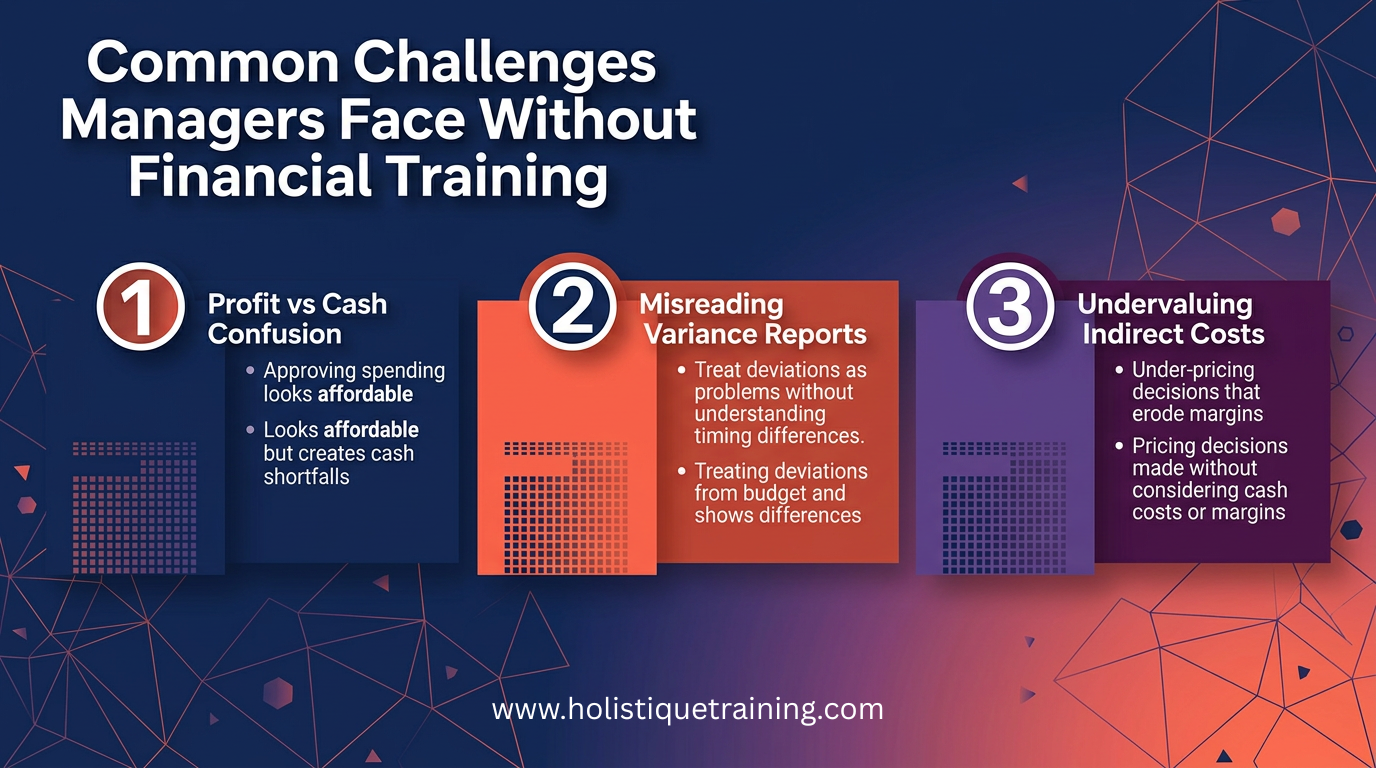
Managers who have never received formal financial training tend to encounter the same recurring difficulties. Many struggle to distinguish between profit and cash, approving spending that looks affordable on paper but creates a cash shortfall in practice. Others misread variance reports, treating any deviation from budget as a problem rather than understanding that some variances are simply timing differences. A further common issue is undervaluing indirect or overhead costs when pricing a product or justifying a project, leading to decisions that look profitable in isolation but erode margin once full costs are properly allocated. These are not failures of intelligence or effort; they are simply the predictable result of asking someone to operate in a technical language they were never taught. Structured training closes this gap quickly, since most of the concepts involved, once explained clearly and applied to a manager's own context, are straightforward to grasp and retain.
12- How Accounting for Managers Courses Are Delivered
Delivery format has become one of the more significant differentiators between providers. Classroom-based courses remain popular for organisations that want a cohort of managers trained together, often because shared vocabulary and shared case studies help embed consistent financial practice across a department or business unit. Online and self-paced formats have grown quickly in popularity for individual learners who need flexibility around existing workloads, while blended formats combine live instructor sessions with self-paced modules to balance interaction with convenience. The table below compares the three most common delivery formats.
Format | Best Suited For | Trade-off |
Classroom | Cohort training, shared vocabulary across a team | Less flexible scheduling |
Online self-paced | Individual learners with variable schedules | Less real-time interaction |
Blended | Balancing structure with flexibility | Requires more self-discipline |
There is no universally superior format; the right choice depends on how many managers need training at once, how much scheduling flexibility they require, and whether the organisation values the consistency that comes from training a group together.
13- Choosing the Right Accounting for Managers Course
Selecting a course depends largely on a manager's starting point and objectives. Someone with no prior financial exposure will generally benefit most from an introductory programme that covers financial statement literacy, budgeting, and cost behaviour before moving into anything more advanced. Managers who already have a working grasp of the basics, and who are moving into a more senior role with broader financial oversight, may be better served by a more advanced programme such as MBA Accounting and Finance, which covers accounting and finance processes in greater depth alongside governance and strategic decision-making relevant to senior roles.

Having accurate and efficient accounting and finance processes, employees, and systems are essential to any business. Without good record upkeep, policies designed to keep track of spending and overheads, and competent employees who are prepared to identify issues and risk areas, your business could fall
When comparing providers, it is worth checking whether the course uses real financial documents and sector-relevant case studies rather than generic examples, since applied learning tends to transfer far more effectively into daily decision-making than abstract theory. Accreditation, delivery format, and the balance between individual and group learning are also worth weighing before committing, since the right course for a first-time budget holder looks quite different from the right course for someone stepping into a senior operational role with broader financial oversight.
14- The Future of Financial Literacy Training for Managers
Demand for accounting for managers courses is likely to keep growing rather than fade, for two connected reasons. First, decision-making authority continues to be pushed down and out from centralised finance functions towards operational managers, a trend accelerated by flatter organisational structures and more devolved budget ownership. Second, as reporting tools and dashboards become more accessible, managers are expected to interact directly with financial data rather than waiting for a periodic summary from finance, which raises the baseline level of financial fluency required simply to do the job competently. Artificial intelligence and automated reporting tools are likely to change how financial data is presented to managers, surfacing insights and flagging anomalies automatically, but this is more likely to increase the value of financial literacy than reduce it, since managers will still need to interpret, question, and act on what these tools surface rather than accept outputs uncritically. Organisations that treat financial literacy as a core management competency, rather than an optional add-on, are likely to see this reflected in faster, better-supported decision-making at every level of the business.
15- Conclusion
Accounting for managers courses fill a specific and increasingly necessary gap: they give people with real budgetary and operational responsibility a working command of financial concepts, without requiring the years of study needed for a professional accounting qualification. For managers, this typically means greater confidence in decision-making, stronger working relationships with finance colleagues, and business cases that are taken seriously because they are backed by sound financial reasoning. For organisations, it means fewer decisions made in a financial vacuum, and a workforce better equipped to translate operational judgement into measurable business outcomes. As financial responsibility continues to spread beyond dedicated finance teams, courses of this kind are likely to become a standard part of management development rather than a specialist add-on, and choosing the right level and format of course remains the most important decision a prospective participant can make.