

- Table of Contents
- Introduction
- 1- What Is a Finance for Non-Finance Managers Course?
- 2- Why Financial Literacy Has Become a Core Management Skill
- 3- Who Should Take a Finance for Non-Finance Managers Course?
- 4- Core Financial Statements Every Manager Should Understand
- 5- Budgeting and Forecasting for Non-Finance Managers
- 6- Cost Behaviour, Break-Even Analysis, and Decision-Making
- 7- Key Financial Ratios Every Manager Should Know
- 8- The Risks of Financial Illiteracy in Management Roles
- 9- Benefits for Corporate Managers
- 10- Benefits for Humanitarian and Non-Profit Sector Managers
- 11- Financial Literacy and Cross-Departmental Communication
- 12- Financial Literacy and Career Progression
- 13- Choosing the Right Finance for Non-Finance Managers Course
- 14- Common Challenges When Learning Finance as a Non-Finance Manager
- 15- Conclusion
Introduction
Every manager, regardless of department or sector, is ultimately a custodian of resources. Marketing managers control campaign budgets, operations managers oversee cost centres, project managers report on spend against forecast, and programme managers in humanitarian organisations account for donor funds down to the last line item. Yet many of these managers have never been formally taught how to read a balance sheet, interpret a variance report, or explain why a project that looks successful on paper is quietly losing money. This gap between operational responsibility and financial fluency is precisely what a finance for non-finance managers course is designed to close.
The idea is simple but powerful: managers do not need to become accountants, but they do need enough financial confidence to make sound decisions, challenge numbers that do not add up, and communicate credibly with finance teams, boards, and donors. As organisations flatten their hierarchies and push budget ownership further down the chain of command, this kind of financial fluency has moved from a nice-to-have to a core management competency.
This article explores what a finance for non-finance managers course typically covers, why financial literacy has become so important across corporate and non-profit sectors alike, the core financial concepts every manager should master, the risks of financial illiteracy in leadership roles, and how to choose a course that actually builds lasting confidence rather than short-term familiarity with jargon.
1- What Is a Finance for Non-Finance Managers Course?
A finance for non-finance managers course is a structured training programme designed for professionals who make decisions with financial consequences but who do not work in finance or accounting roles. Typical participants include marketing managers, operations leaders, project and programme managers, HR directors, engineers moving into management, and non-profit or humanitarian programme staff who manage grants and budgets.
Unlike an accounting qualification, this type of course does not aim to produce bookkeepers or auditors. Instead, it focuses on practical financial comprehension: how to read the three core financial statements, how budgets are built and controlled, how costs behave, and how to use ratios and simple financial models to support everyday decisions. The emphasis is on interpretation and application rather than the mechanics of double-entry bookkeeping.
Most courses are structured around real financial documents. Participants review sample income statements, balance sheets, and cash flow statements, and are asked to identify inconsistencies, calculate key ratios, and translate the numbers into a plain-language business narrative that a non-specialist audience, such as a management team or a donor board, can understand.
2- Why Financial Literacy Has Become a Core Management Skill
For much of the twentieth century, financial reporting was treated as the exclusive domain of the finance department. Managers in other functions were expected to hit their targets and leave the numbers to accountants. That division of labour has become increasingly impractical. Modern organisations operate with devolved budgets, cross-functional projects, and performance frameworks that tie departmental decisions directly to financial outcomes. A manager who cannot interpret a monthly variance report is at a structural disadvantage compared with one who can.
The financial literacy gap is not a marginal issue. According to the World Economic Forum, financial literacy in the United States has hovered at around fifty per cent for several years, with comprehension of financial risk falling even further behind, and the European Union performing similarly poorly on comparable benchmarks.
While that figure reflects personal finance knowledge among the general public rather than workplace financial skills specifically, it illustrates a wider truth: financial concepts that professionals assume are common knowledge, such as compounding, risk, and the time value of money, are frequently misunderstood even by well-educated adults. Inside organisations, this translates into managers who nod along in budget meetings without fully grasping what the figures mean for their own decisions.
The table below summarises how the expectations placed on operational managers have shifted over time, and why financial fluency has become a baseline requirement rather than an optional extra.
Management Era | Financial Expectation of Managers | Typical Outcome |
|---|---|---|
Traditional hierarchical model | Managers execute; finance department reports | Slow feedback loops, limited accountability |
Matrix and project-based organisations | Managers own project budgets and forecasts | Greater need for real-time financial interpretation |
Devolved and agile structures | Managers control departmental P&L and KPIs | Financial literacy becomes a core competency |
Donor-funded and NGO structures | Programme managers account for restricted funds | Compliance and financial transparency are essential |
3- Who Should Take a Finance for Non-Finance Managers Course?
These courses are designed for a wide range of professionals rather than a single job title. Operations and supply chain managers benefit because their decisions on inventory, staffing, and logistics directly affect cost structures. Marketing and sales managers benefit because campaign budgets, customer acquisition costs, and return on investment calculations all depend on financial reasoning. Engineering and technical managers benefit because capital investment decisions, equipment purchases, and project appraisals require an understanding of concepts such as payback period and net present value.
Humanitarian and development sector professionals form a particularly important audience. Programme managers, country directors, and grant coordinators in NGOs are frequently responsible for multi-year, multi-donor budgets, yet many come from technical or social science backgrounds with no formal finance training. In these organisations, the consequences of financial misunderstanding are not limited to profitability; they extend to donor compliance, audit findings, and organisational reputation.
4- Core Financial Statements Every Manager Should Understand
The starting point of any finance for non-finance managers course is the set of core financial statements that every organisation, whether commercial or non-profit, produces on a regular cycle. The income statement, sometimes called the profit and loss statement, shows revenue, costs, and the resulting profit or deficit over a defined period. The balance sheet presents a snapshot of what the organisation owns and owes at a single point in time, distinguishing between assets, liabilities, and equity or net assets. The cash flow statement tracks the actual movement of cash in and out of the organisation, which is a different and equally important measure from profit, since a profitable project can still run out of cash if payments and receipts are poorly timed.
Understanding the relationship between these three statements is often the moment when financial concepts click for non-finance managers. A manager who previously saw budgets as a static spreadsheet begins to understand why a delayed invoice affects cash flow even though it has no impact on reported profit, or why a large capital purchase reduces cash immediately but is expensed gradually over several years through depreciation.
5- Budgeting and Forecasting for Non-Finance Managers
Budgeting is usually the most immediately relevant skill for a non-finance manager, since most managers are directly responsible for a departmental or project budget at some point in their career. A well-designed finance for non-finance managers course teaches participants how an operating budget is constructed, how it should align with strategic objectives, and how sales or activity forecasts feed into cost projections.
Equally important is budgetary control: the ongoing process of comparing actual spend against the budget, identifying variances, and understanding what is driving them. A manager who understands the difference between a favourable variance caused by delayed spending and one caused by genuine efficiency is far better placed to make accurate forecasts and avoid unpleasant surprises later in the financial year.
Incremental and zero-based budgeting approaches are typically introduced at this stage as well, since the choice of budgeting method significantly affects how departments justify their spending and how easily new priorities can be funded without simply carrying forward last year's assumptions.

Controlling your financial processes and tools is one of the most effective and efficient ways to manage your business performance, decisions and changes. Ultimately, the applied management of your financial processes is the main thing that will determine your abilities and options as a company
6- Cost Behaviour, Break-Even Analysis, and Decision-Making
Understanding how costs behave is central to sound managerial decision-making. Fixed costs remain constant regardless of activity levels, while variable costs rise and fall with output or sales volume. Many decisions that managers face, such as whether to accept a lower-margin order, whether to outsource a function, or whether a new product line is viable, depend on correctly separating these two cost types and understanding the contribution margin they generate.
Break-even analysis is one of the most practical tools introduced in this part of a course, since it allows a manager to calculate the minimum level of sales or activity required to cover costs before any profit is generated. This single calculation underpins pricing decisions, staffing decisions, and investment appraisals across almost every sector, from manufacturing to professional services to programme delivery in the non-profit world.
7- Key Financial Ratios Every Manager Should Know
Ratio analysis converts raw financial statement figures into comparable, interpretable metrics. For non-finance managers, a small set of ratios covers the majority of practical needs. Liquidity ratios indicate whether an organisation can meet its short-term obligations. Solvency ratios assess the ability to meet long-term debt commitments. Activity ratios measure how efficiently assets, including inventory and receivables, are being used. Profitability ratios show how effectively revenue is converted into profit at various stages of the income statement.
Ratio Category | Example Ratio | What It Tells a Manager |
|---|---|---|
Liquidity | Current ratio | Ability to cover short-term liabilities with short-term assets |
Solvency | Debt-to-equity ratio | Reliance on borrowed funds relative to owner or donor equity |
Activity | Inventory turnover | Efficiency of stock management and working capital use |
Profitability | Gross margin | Proportion of revenue retained after direct costs |
Profitability | Operating margin | Efficiency of core operations before finance costs and tax |
None of these ratios should be read in isolation. Their value comes from comparison, whether against the organisation's own historical performance, against budget, or against sector benchmarks. A finance for non-finance managers course typically spends con siderable time on this comparative discipline, since a ratio without context can be as misleading as no ratio at all.
8- The Risks of Financial Illiteracy in Management Roles
The cost of financial illiteracy among managers is rarely visible in a single dramatic failure. More often, it accumulates through small, repeated errors: a department head who does not query an unusual cost allocation, a project manager who signs off on a budget variance without understanding its cause, or a programme manager who submits a donor report that does not reconcile with the underlying ledger.
Evidence from the small business sector illustrates how significant these gaps can be. A survey conducted by Xero found that exactly half of small business owners had encountered fiscal challenges directly linked to a lack of financial literacy, with interpreting financial metrics, sticking to budgets, and managing cash flow cited among the most common areas of difficulty.
While that research focuses on business owners rather than managers within larger organisations, the underlying pattern is consistent: financial confidence directly affects the quality of operational decisions, and the areas where confidence is weakest, budgeting, cash flow, and metric interpretation, are precisely the skills a finance for non-finance managers course is built to strengthen. In larger organisations, the consequence of similar gaps is less likely to be business failure and more likely to be poor resource allocation, missed cost-saving opportunities, strained relationships with the finance function, or, in donor-funded contexts, compliance findings that damage institutional credibility.
9- Benefits for Corporate Managers
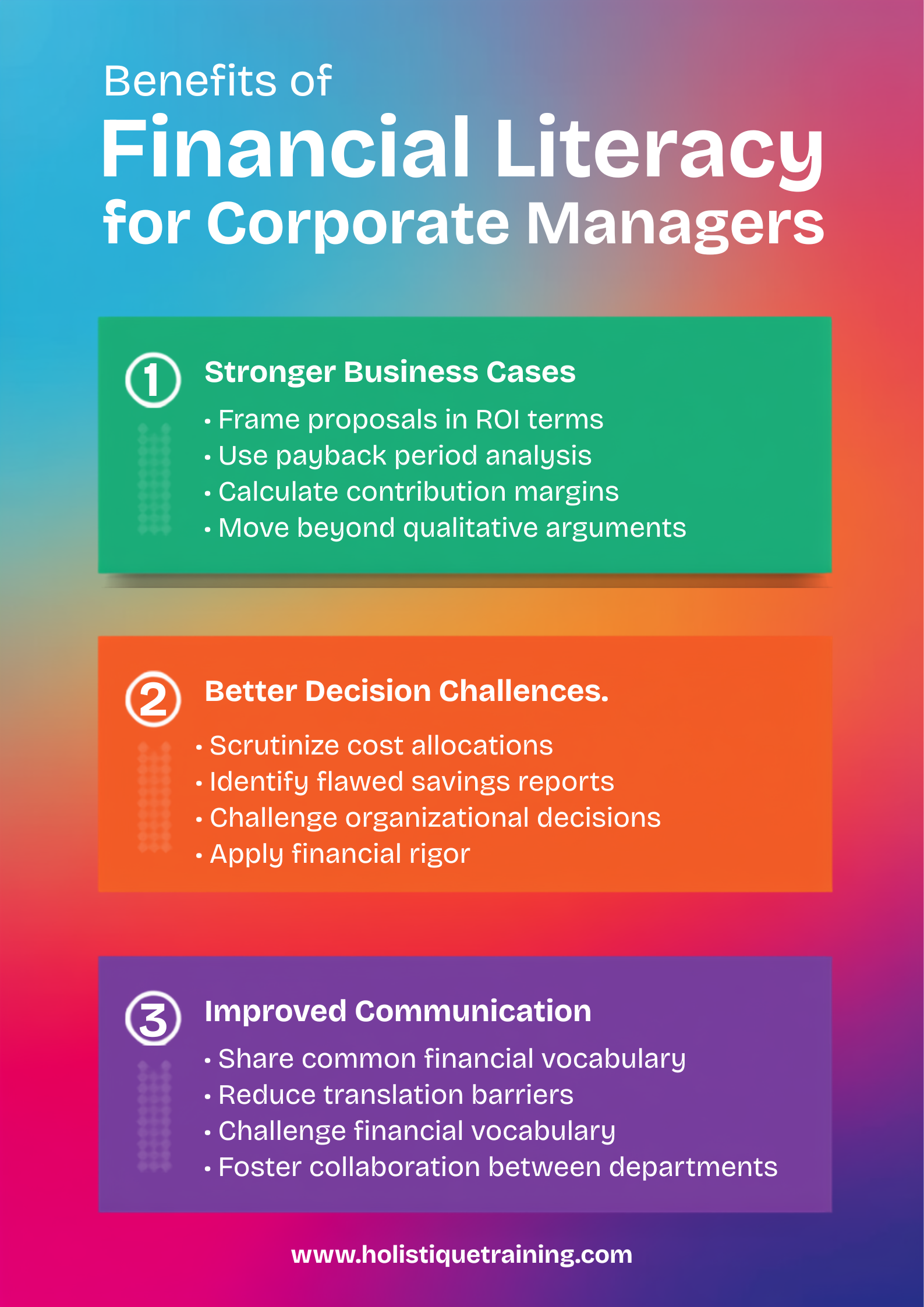
For managers in commercial organisations, financial literacy delivers benefits that extend well beyond the immediate task of budget management. Financially literate managers can build stronger business cases for new initiatives because they understand how to frame a proposal in terms of return on investment, payback period, or contribution margin rather than qualitative argument alone. They are also better equipped to challenge decisions made elsewhere in the organisation, since they can identify when a cost allocation or a reported saving does not stand up to scrutiny.
Communication between operational departments and the finance function improves substantially once managers share a common financial vocabulary. Finance teams frequently report that a significant portion of their time is spent translating financial information into terms that operational colleagues can use, a task that becomes far more efficient when both sides understand core financial concepts.
10- Benefits for Humanitarian and Non-Profit Sector Managers
In the humanitarian and development sector, financial literacy carries additional weight because of the compliance obligations attached to donor funding. Programme managers are routinely required to track restricted and unrestricted funds separately, allocate shared costs across multiple grants, and produce financial reports that satisfy both internal governance requirements and external donor audits. A programme manager who understands budget variance analysis, cost allocation methodology, and the distinction between direct and indirect costs is far better positioned to manage these obligations without constant reliance on the finance team for basic interpretation.
Financial literacy also strengthens the working relationship between programme and finance departments within NGOs, a relationship that is often described as strained precisely because programme staff are rarely given formal training in the financial concepts that finance colleagues take for granted. Closing that gap through structured training reduces friction, speeds up reporting cycles, and improves the accuracy of the financial narratives presented to donors and boards.

Maintaining financial understanding is crucial for any business's success. Executives and other senior positions need to be able to effectively communicate the current state of finances with other employees with financial control. A non-finance manager developing the skillset required to manage
11- Financial Literacy and Cross-Departmental Communication
One of the most underappreciated benefits of financial training for non-finance managers is improved communication, both upward to senior leadership and boards, and laterally with finance, procurement, and audit functions. Managers who can present a business case using recognisable financial terminology are taken more seriously in resource allocation discussions. Equally, managers who understand why a finance team insists on a particular cost allocation method or reporting deadline are less likely to view finance as an obstacle rather than a partner.
This shared vocabulary becomes particularly valuable during budget season, when departments across an organisation compete for limited resources. A manager who can articulate the financial logic behind a request, rather than relying purely on operational urgency, is considerably more persuasive in that process.
12- Financial Literacy and Career Progression
Financial acumen is increasingly treated as a differentiator for career advancement into senior management and executive roles. Most leadership positions, whether a chief operating officer, a country director, or a departmental vice president, carry ultimate accountability for a budget, and organisations are understandably reluctant to promote candidates who have never demonstrated financial competence at an operational level.
For managers who anticipate moving into more senior positions with direct P&L or budget ownership, a foundational finance for non-finance managers course is often the first step, with more advanced financial management and portfolio analysis training following as responsibilities grow.

In today's corporate landscape, sound financial decision-making is paramount to business success and sustainability. This course equips executives with essential tools to navigate complex financial scenarios, mitigating risks and maximising returns. Participants will delve into the language of finance and accounting, gaining insights into financial markets, investment
13- Choosing the Right Finance for Non-Finance Managers Course
Not all courses labelled as finance training for non-specialists are built to the same standard. The most effective programmes are structured around practical application rather than theory alone, using real or realistic financial documents so that participants practise the skills they will actually use at work. Course length and depth should also be matched to the audience: a short introductory session may suit a team that needs basic budget literacy, while a more intensive multi-day course is appropriate for managers who will take on direct P&L responsibility.
Course Feature | Best Suited For | What to Look For |
|---|---|---|
Short introductory workshop | Team leads with limited budget exposure | Clear explanation of core terms and statements |
Multi-day comprehensive course | Managers with existing budget responsibility | Practical exercises using real financial documents |
Sector-specific training | NGO or donor-funded programme managers | Coverage of restricted funds and compliance reporting |
Advanced financial management course | Managers moving into senior or P&L roles | Capital budgeting, ratio analysis, and investment appraisal |
Delivery format matters as well. Online, self-paced formats suit managers who need flexibility around operational schedules, while classroom-based courses often provide more opportunity for the kind of case discussion and peer learning that helps concepts stick. Whichever format is chosen, the most reliable indicator of course quality is whether participants leave able to interpret an unfamiliar set of financial statements confidently, rather than simply able to recite definitions.
14- Common Challenges When Learning Finance as a Non-Finance Manager
Even well-designed courses face predictable obstacles. Many adult learners approach financial training with residual anxiety from earlier, unsuccessful encounters with mathematics or accounting, which can make them reluctant to ask clarifying questions in a group setting. Effective courses address this directly by normalising financial uncertainty and building confidence gradually through low-stakes practice before introducing more complex ratio work or investment appraisal techniques.
A second common challenge is the temptation to focus purely on terminology rather than application. Managers can often recite the definition of a balance sheet without being able to use one to challenge a budget proposal or evaluate a business case. The strongest courses continually anchor new concepts to realistic workplace scenarios, ensuring that the learning transfers directly into better decisions rather than remaining abstract knowledge.
A third challenge is retention over time. Financial concepts that are not applied regularly fade quickly, which is why many organisations pair initial training with ongoing access to simplified financial dashboards, mentoring from finance business partners, or refresher sessions tied to the annual budgeting cycle.
15- Conclusion
Financial literacy has moved from being a specialist skill confined to accountants and finance professionals to a core competency expected of managers across corporate, operational, and non-profit environments alike. A well-designed finance for non-finance managers course does not attempt to turn participants into accountants; instead, it gives them the confidence to read financial statements, understand budgets and variances, apply ratio analysis, and communicate credibly with finance colleagues, senior leadership, and, in the case of humanitarian organisations, donors and oversight bodies.
The organisations that invest in this kind of training tend to see the benefits reflected in faster, more accurate reporting, stronger business cases, improved cross-departmental trust, and managers who are genuinely prepared for the financial responsibilities that come with more senior roles. As budget ownership continues to spread beyond the finance department, financial literacy is no longer optional for ambitious managers; it is one of the clearest ways to demonstrate readiness for greater responsibility.