
- Table of Contents
- Introduction
- 1. What AI Reskilling and Upskilling Really Mean
- Understanding Upskilling
- Understanding Reskilling
- Why the Distinction Matters
- 2. Why the Future of Work Demands a New Skills Strategy
- The Speed of Change
- The Scarcity of AI Talent
- Redesigned Roles, Not Only Removed Roles
- The Cost of Inaction
- 3. The Skills Employers Need in an AI-Enabled Workplace
- 1- AI Literacy:
- 2- Workflow Automation:
- 3- Data Analysis and Interpretation:
- 4- AI Governance and Responsible Use:
- 5- Critical Thinking and Verification:
- 6- Communication and Collaboration:
- Defining Proficiency Levels
- 4. Starting with a Skills Audit and Workforce Map
- Mapping Tasks, Not Just Jobs
- Identifying Skill Gaps and Adjacent Skills
- Prioritising by Business Impact
- Gathering Reliable Evidence
- 5. Designing Learning Pathways That Work
- Role-Based Pathways
- Learning in the Flow of Work
- Personalised and Adaptive Learning
- Blending Formats and Practice
- 6. Building the Human Capabilities AI Cannot Replace
- Adaptive Thinking
- Judgement and Ethics
- Collaboration with Intelligent Systems
- 7. Leadership, Governance, and Culture
- Setting a Clear Mandate
- Governance and Responsible Innovation
- Creating Psychological Safety
- Aligning Incentives and Recognition
- 8. Inclusion and Equity in Reskilling
- 1- Older Workers:
- 2- Early-Career Employees:
- 3- Frontline and Shift Workers:
- 4- Workers with Limited Connectivity or Resources:
- 9. Choosing the Right Delivery Models
- 10. Measuring the Impact of Reskilling and Upskilling
- 11. Common Pitfalls to Avoid
- 12. A Practical Twelve-Month Roadmap
- Conclusion
Introduction
Few shifts in modern business have moved as quickly as the arrival of artificial intelligence in everyday work. Tools that once belonged in research laboratories now sit inside email platforms, spreadsheets, customer service systems, and design software. Job descriptions are changing, tasks are being redistributed between people and machines, and the skills that made a professional valuable five years ago are no longer a reliable guide to what will be valued five years from now.
Reskilling and upskilling are the practical response. They allow employers to keep pace with technology and allow individuals to protect and grow their careers. Yet many programmes fall short because they focus on tools rather than capabilities, on one-off training rather than continuous learning, or on technical specialists rather than the whole workforce. The organisations that succeed treat AI capability as something built steadily and deliberately, not bought in a single purchase.
In this article, we will discuss what AI reskilling and upskilling mean, why the future of work demands a new approach, the skills employers need, how to audit existing capability, how to design learning pathways, the human capabilities AI cannot replace, leadership and governance, inclusion, delivery models, measurement, common pitfalls, and a practical twelve-month roadmap.
1. What AI Reskilling and Upskilling Really Mean
Understanding Upskilling
Upskilling means deepening or extending the skills a person already uses so they can perform their current role more effectively in an AI-enabled environment. An accountant who learns to use AI to reconcile accounts faster, a marketer who tests campaign variants with generative tools, or a project manager who interprets AI-generated risk forecasts are all upskilling. The role remains recognisable, but the way it is performed changes.
Understanding Reskilling
Reskilling is more substantial. It prepares someone to move into a different role, often because their current tasks are shrinking or being absorbed by automation. A data entry clerk moving towards data quality analysis, or a customer service agent transitioning into conversation design or AI operations support, illustrates the idea. Reskilling usually takes longer, costs more, and requires stronger organisational support.
Why the Distinction Matters
Mixing the two leads to poorly targeted programmes. A short tool tutorial does not help someone whose role is being redesigned, while a lengthy reskilling pathway wastes time and budget when a few practical workshops would be enough. The table below summarises the main differences.
Dimension | Upskilling | Reskilling |
|---|---|---|
Purpose | Strengthen skills for the current role | Prepare for a different role |
Typical duration | Weeks to a few months | Six to eighteen months |
Typical example | Using AI to analyse reports | Moving from administration to data operations |
Investment level | Low to moderate | Moderate to high |
Main business outcome | Productivity and quality gains | Internal mobility and talent retention |
2. Why the Future of Work Demands a New Skills Strategy
The case for action rests on three pressures: the speed of change, the scarcity of talent, and the restructuring of roles themselves.
The Speed of Change
Traditional training cycles were built for a world in which skills stayed relevant for a decade. AI has compressed that lifespan dramatically. New capabilities appear within months, and workflows that employees mastered last year may be partly automated this year. Annual training calendars cannot keep up with that rhythm, which is why continuous learning has moved from a desirable extra to a core operating requirement.
The Scarcity of AI Talent
Hiring alone cannot close the gap. According to the 2026 Talent Shortage Survey by ManpowerGroup, which covered 39,000 employers across 41 countries, 72 per cent of employers report difficulty filling roles. The survey found that AI model and application development (20 per cent) and AI literacy (19 per cent) now lead the ranking of the hardest skills to find. It also found that upskilling and reskilling is the most common response, cited by 27 per cent of employers.
Redesigned Roles, Not Only Removed Roles
Public debate often focuses on jobs disappearing, yet the more common effect is task redistribution. Within a single role, routine drafting, data gathering, and scheduling may shift to AI tools, while judgement, relationship management, and quality assurance grow in importance. Reskilling and upskilling strategies must therefore be built around tasks and capabilities, not job titles alone.
The Cost of Inaction
Delaying action carries real costs. Employees who are not supported tend to use AI tools inconsistently, or avoid them altogether, which leaves productivity gains unrealised and creates uneven standards within teams. Others use unapproved tools without guidance, exposing the organisation to data and compliance risks. Meanwhile, high performers who see no investment in their development often look elsewhere. Structured learning is therefore both a growth strategy and a risk management measure.
3. The Skills Employers Need in an AI-Enabled Workplace
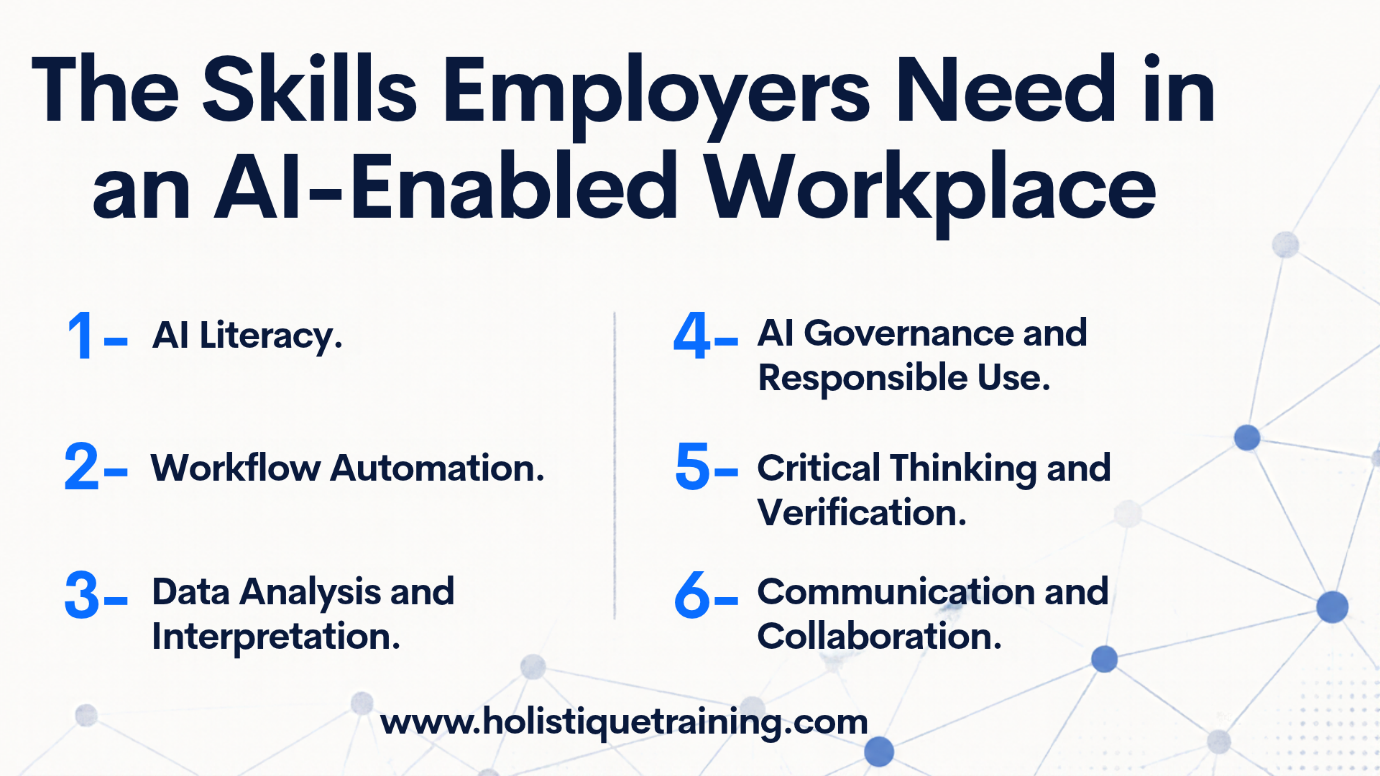
AI skills are often reduced to prompt writing, but the real picture is broader. The capabilities that matter span technical, analytical, and human categories, and most employees need a blend rather than deep expertise in a single area. Six are especially important.
1- AI Literacy:
Employees need a working understanding of how AI systems generate outputs, where they are reliable, and where they fail. This includes recognising errors, bias, and fabricated information, and knowing when a task should not be handed to a tool at all.
2- Workflow Automation:
Identifying repetitive tasks and connecting tools so that routine steps run without manual effort is now a valued skill across finance, operations, marketing, and administration, not only in IT teams.
3- Data Analysis and Interpretation:
AI produces large volumes of output, and someone must judge whether it is meaningful. Employees who can read charts, question assumptions, and link findings to decisions add the most value.
4- AI Governance and Responsible Use:
Understanding data protection, confidentiality, intellectual property, and fairness helps employees use AI safely and protects the organisation from avoidable risk.
5- Critical Thinking and Verification:
Checking sources, testing outputs against known facts, and challenging plausible but wrong answers is essential when machines can produce confident text instantly.
6- Communication and Collaboration:
As AI handles first drafts and summaries, the ability to explain decisions, negotiate priorities, and work across teams becomes a stronger differentiator.
Employer expectations confirm this shift. According to the 2026 AI Employer Report from ZipRecruiter, 74 per cent of employers regard AI skills as a strong advantage or an outright requirement for at least some roles, and 64 per cent say AI is changing the specific skills they look for in candidates. The report also found that majorities of employers rate workflow automation (60 per cent), data analysis (60 per cent), and AI governance (56 per cent) as more important than they were a year ago.
Defining Proficiency Levels
Because needs differ, it helps to define proficiency levels rather than a single standard. A foundation level covers safe, confident everyday use for all staff. A practitioner level covers workflow design and advanced analysis for teams that depend on AI daily. A specialist level covers building, evaluating, and governing AI systems for a small group of experts. Clear levels let employees see where they stand, and let managers assign the right learning to the right people.
4. Starting with a Skills Audit and Workforce Map
Effective strategies begin with evidence, not assumptions. Before any course is purchased, leaders need to know what skills exist, which are at risk, and which will be needed.
Mapping Tasks, Not Just Jobs
Break each role into its main tasks and assess which are likely to be automated, augmented, or left largely unchanged. This task-level view shows where upskilling will be enough and where genuine reskilling is required. It also reveals hidden opportunities, such as roles where AI could remove administrative load and free time for higher-value work.
Identifying Skill Gaps and Adjacent Skills
Compare current capabilities with those needed over the next two to three years. Adjacent skills deserve special attention, because people can move into nearby roles far faster than they can start from zero. A reporting analyst, for example, is often closer to a data governance role than a newly recruited graduate would be.
Prioritising by Business Impact
Not every gap deserves immediate investment. Rank gaps by their effect on revenue, risk, customer experience, and delivery, then match the scale of the learning response to the scale of the impact. This keeps budgets focused and makes it easier to secure leadership support.
Gathering Reliable Evidence
Combine several sources rather than relying on one. Manager assessments, employee self-ratings, practical skills tests, performance data, and workforce planning forecasts each reveal something different. Treat self-ratings with care, as confidence and competence do not always match, and repeat the exercise regularly so that the picture stays current as tools and roles evolve.
AI is reshaping HR through automation, analytics, and ethics, transforming hiring, performance, and workforce strategy for modern organizations.
5. Designing Learning Pathways That Work
Role-Based Pathways
Generic AI courses rarely change behaviour. Pathways built around specific roles, using real documents, data, and decisions from the workplace, are far more effective. A finance team should practise on reconciliations and forecasts, while a customer service team should practise on live-style queries and escalation decisions.
Learning in the Flow of Work
Employees rarely have time for long classroom programmes. Short, task-specific learning units delivered inside the tools people already use allow them to learn and apply at the same moment. Prompts, checklists, short demonstrations, and on-demand assistants all support this approach, and they reduce the gap between training and practice that causes knowledge to fade.
Personalised and Adaptive Learning
AI can also improve the learning itself. Adaptive platforms identify weak areas, adjust difficulty, recommend the next module, and give instant feedback. This allows employees with different starting points to progress at their own pace, and it gives learning teams data on where support is most needed. Human coaching remains important, however, because motivation and confidence are rarely built by software alone.
Blending Formats and Practice
The strongest programmes combine short digital modules, live workshops, coaching conversations, and real projects. Digital modules build knowledge efficiently, workshops allow discussion and shared problem solving, and projects turn understanding into habit. Employees should leave each stage having produced something useful for their own work, such as an automated report, a revised process, or a tested set of prompts, so that learning delivers value immediately.

Artificial Intelligence is reshaping the future of education by enabling highly personalized, responsive, and scalable learning experiences. AI-powered learning systems analyze learner behavior, adapt to individual needs, and deliver customized content that evolves in real time. This course explores how educators, instructional designers, and EdTech innovators can harness
6. Building the Human Capabilities AI Cannot Replace
Technical fluency is necessary, but it is not sufficient. As AI takes on more routine cognitive work, the capabilities that distinguish strong professionals are increasingly human.
Adaptive Thinking
Adaptive thinking is the ability to learn quickly, unlearn outdated habits, and apply knowledge in unfamiliar situations. Because specific tools will keep changing, this capacity matters more than mastery of any single platform. Organisations can develop it through varied assignments, reflective practice, and learning goals that focus on problems rather than software features.
Judgement and Ethics
Deciding when to trust an output, when to override it, and who is accountable for the result are human responsibilities. Employees need practice with realistic scenarios in which AI recommendations are incomplete, biased, or simply wrong, so that sound judgement becomes a habit rather than an afterthought.
Collaboration with Intelligent Systems
The most productive teams treat AI as a collaborator with strengths and limits. They divide work deliberately, with machines handling speed and scale and people handling context, empathy, and accountability. Teaching this partnership explicitly helps employees move from anxiety about replacement to confidence in augmentation.
https://holistiquetraining.com/en/course/adaptive-thinking-in-a-hybrid-intelligence-world
7. Leadership, Governance, and Culture
Learning strategies succeed or fail on leadership. Employees watch what managers do, and if senior leaders ignore AI or use it carelessly, formal training has little effect.
Setting a Clear Mandate
Someone must own AI capability building, with authority, budget, and a clear link to business strategy. According to The State of Enterprise Learning 2026, a report released by 2U and based on a NewtonX survey of 507 learning and workforce leaders, 83 per cent say AI capabilities are an active workforce priority, but only 29 per cent say their companies have built mature AI capabilities. The same research found that 78 per cent of employers lack a strong mandate to lead AI upskilling.
Governance and Responsible Innovation
Training should sit alongside clear policies on approved tools, data handling, and human review of important outputs. Employees who understand the rules are more willing to experiment, because they know where the boundaries lie. Leaders who connect AI use to innovation, while setting sensible limits, create an environment where learning translates into better products, services, and processes.

Modern technologies are constantly making vast advancements in all areas, which greatly influences all industries that utilise them. One technology that has made extreme advancements in recent years is artificial intelligence. Artificial intelligence is merging machine systems with data to create a
Creating Psychological Safety
Fear is a major barrier to adoption. Employees who worry that using AI exposes them to criticism, or that admitting gaps will harm their prospects, will avoid learning. Managers can reduce this by sharing their own learning journeys, rewarding experimentation, and making clear that reskilling is an investment in people rather than a prelude to redundancy.
Aligning Incentives and Recognition
People invest effort in what is recognised. Include AI capability in role profiles, promotion criteria, and performance conversations, and celebrate teams that share practical improvements. When employees see that new skills lead to interesting projects, wider responsibility, or progression, participation rises without the need for pressure.
8. Inclusion and Equity in Reskilling
A strategy that reaches only digitally confident graduates will widen existing inequalities. Inclusive design means thinking about who is most likely to be left behind and building support around them. Four groups deserve particular attention.
1- Older Workers:
Experienced employees bring judgement, institutional knowledge, and communication skills that AI cannot replicate, yet they are often wrongly assumed to be reluctant learners. Offering them relevant, respectful programmes with peer support usually brings strong participation.
2- Early-Career Employees:
Routine entry-level tasks are those most exposed to automation, which can remove traditional learning opportunities. Structured rotations, mentoring, and project work help junior staff build skills they would once have gained by doing routine tasks.
3- Frontline and Shift Workers:
Employees without desks or regular screen time need short, mobile-friendly learning delivered during paid hours. Expecting them to learn in their own time excludes many of the people most affected by automation.
4- Workers with Limited Connectivity or Resources:
Devices, bandwidth, and language can all limit access. Offline materials, shared learning spaces, and multilingual content widen participation at modest cost.
Explore upskilling, reskilling and career transitions for older workers. Practical strategies for individuals and organisations.
9. Choosing the Right Delivery Models
No single model suits every need. Most organisations combine several, matching the format to the audience, the urgency, and the depth of change required. The table below compares the main options.
Delivery Model | Best For | Key Strength | Main Limitation |
|---|---|---|---|
Internal academy | Company-specific processes and tools | High relevance to real work | Requires design capacity and funding |
External course platforms | Broad AI literacy at scale | Fast, flexible, and affordable | Content can be generic |
University or provider partnerships | Deep reskilling and recognised credentials | Quality assurance and credibility | Longer and more costly |
Peer learning and mentoring | Applied practice and culture change | Builds trust and shared habits | Depends on committed facilitators |
Whichever mix is chosen, protect learning time. Programmes fail most often not because content is poor but because employees are never given space to complete them. Building learning hours into workloads, and recognising completion in performance conversations, signals that the organisation means what it says.
Smaller organisations can achieve a great deal with limited resources by choosing one or two platforms, nominating internal champions, and encouraging employees to teach one another. Larger organisations benefit from a central learning team that sets standards while allowing departments to tailor content. In both cases, simplicity and consistency matter more than the number of programmes on offer.
10. Measuring the Impact of Reskilling and Upskilling
Measurement is what separates a strategic investment from a well-meaning expense. Track results at several levels, from participation through to business outcomes, and review them regularly so that weak programmes can be improved or stopped.
Measurement Level | Example Indicators | What It Shows |
|---|---|---|
Participation | Enrolment, completion, and time spent learning | Whether people are engaging |
Capability | Assessment scores and practical project results | Whether skills are improving |
Behaviour | AI tool adoption and quality of use in daily tasks | Whether learning is applied |
Business outcomes | Time saved, error reduction, and customer satisfaction | Whether performance is improving |
Workforce outcomes | Internal mobility, retention, and employee confidence | Whether careers are being strengthened |
Qualitative evidence matters too. Short surveys, manager feedback, and examples of improved workflows help explain the numbers and show where support is still needed. Be cautious about attributing every gain to training, since other factors, such as new tools or process changes, also influence results.
Set baselines before programmes begin, so that improvement can be demonstrated credibly, and share results openly with employees. Transparency builds trust, encourages further participation, and gives leaders the evidence they need to justify continued investment when budgets are under pressure.
11. Common Pitfalls to Avoid
Many organisations invest heavily and still see limited results. The causes are usually predictable, and most can be avoided with early attention.
1- Tool-Centred Training: Courses built around a single product become outdated quickly. Focus on transferable capabilities, such as verification and workflow design, and treat tools as examples.
2- One-Off Events: A single workshop rarely changes habits. Reinforce learning through follow-up tasks, short refreshers, and regular practice in real work.
3- Ignoring Managers: Managers shape whether employees apply what they learn. Equip them first, so they can coach, set expectations, and model good practice.
4- Overlooking Job Security Concerns: If employees suspect training is a precursor to redundancy, participation will be cautious. Communicate openly about intentions, and link learning to visible career pathways.
5- No Link to Strategy: Programmes disconnected from business priorities struggle for funding and attention. Tie every initiative to a defined outcome that leaders care about.
12. A Practical Twelve-Month Roadmap
Organisations often ask where to begin. A phased approach keeps momentum while allowing time to learn from early results.
1- Months One to Two, Diagnose: Appoint an owner, map tasks and skills, run a baseline survey of AI confidence, and agree two or three priority outcomes.
2- Months Three to Four, Pilot: Launch role-based pathways with two or three teams, provide approved tools, and collect early feedback on content, timing, and support.
3- Months Five to Eight, Scale: Refine the pilots, extend to additional functions, train managers as coaches, and begin structured reskilling for roles facing the greatest change.
4- Months Nine to Twelve, Embed: Link learning to performance reviews and career frameworks, publish results, update governance policies, and set goals for the following year.
Conclusion
AI is not a passing trend that training can address once and then forget. It is a continuing change in how work is performed, and it calls for a continuing change in how skills are built. The organisations best placed for the future of work will be those that understand the difference between upskilling and reskilling, audit capability honestly, design role-based pathways, and develop the human strengths that machines cannot supply.
Success depends as much on leadership, culture, and inclusion as on content. Employees need time, trust, and clear routes forward, and managers need the confidence to coach rather than simply instruct. When these foundations are in place, reskilling and upskilling stop being a defensive response to disruption and become a lasting source of resilience, productivity, and competitive advantage.