
- Table of Contents
- Introduction
- 1- What Is Leadership Training for Individual Contributors?
- Who Counts as an Individual Contributor
- Leadership as Behaviour Rather Than Position
- How It Differs from Traditional Management Training
- 2- Why Demand for This Training Is Rising
- Flatter Organisational Structures
- Project-Based and Cross-Functional Work
- A Changing Skills Landscape
- Rising Employee Expectations
- 3- The Business Case for HR and L&D Teams
- Strengthening the Leadership Pipeline
- Improving Engagement and Team Performance
- Reducing the Cost of Poor Decisions
- Supporting Change and Innovation
- 4- Core Competencies to Develop
- 5- Building Influence Without Authority
- Credibility and Reputation
- Stakeholder Mapping and Persuasion
- Communicating With Impact
- Navigating Organisational Dynamics
- 6- Delivery Formats and Learning Methods
- Blended Learning
- Learning Through Real Work
- Choosing the Right Format
- 7- Designing an Effective Programme
- 8- Measuring the Impact of Leadership Training
- Linking Behaviour to Outcomes
- The Value of Qualitative Evidence
- 9- Common Challenges and How to Overcome Them
- Confusion With Promotion
- Lack of Manager Support
- Retention Risk and Career Pathways
- Ensuring Fair Access
- 10- Future Trends in Leadership Development
- 11- Conclusion
Introduction
Organisations have long assumed that leadership belongs to those who manage people. Job titles, reporting lines, and spans of control have traditionally defined who is invited to leadership programmes and who is not. That assumption is increasingly difficult to defend. Modern work is organised around projects, cross-functional teams, and specialist expertise, and much of the most important work is carried out by individual contributors who have no direct reports but who shape decisions, guide colleagues, and set standards every day. Developing their leadership capability is no longer a luxury reserved for a few high performers. It is a practical response to how work actually gets done.
For HR and learning and development professionals, this shift raises pressing questions. How should leadership be defined for people without formal authority? Which skills matter most, and how should they be taught? How can programmes avoid becoming a thinly disguised promotion track, and how can their value be demonstrated to senior stakeholders? Answering these questions requires a more nuanced view of leadership than traditional management training has offered.
In this article, we will discuss what leadership training for individual contributors involves, why demand for it is rising, the business case behind it, the core competencies it should develop, how to build influence without authority, the delivery formats available, how to design and measure a programme, the challenges organisations commonly face, and where the field is heading.
1- What Is Leadership Training for Individual Contributors?
Leadership training for individual contributors is a structured development approach that builds leadership behaviours in employees who do not manage people. It focuses on the capabilities that allow a specialist, analyst, engineer, designer, or adviser to influence outcomes beyond the boundaries of their own task list. Rather than teaching delegation, performance appraisal, or budget control, it concentrates on communication, collaboration, initiative, judgement, and the ability to bring others along without relying on a reporting line.
Who Counts as an Individual Contributor
An individual contributor is an employee whose primary value comes from their own expertise and output rather than from managing the work of others. The category is broad. It includes junior staff at the start of their careers, highly experienced specialists at the top of their professional ladders, and everyone in between. Many organisations now also employ senior individual contributors, such as principal engineers or lead consultants, whose influence rivals that of managers even though their job descriptions contain no supervisory duties.
Leadership as Behaviour Rather Than Position
The central idea behind this type of training is that leadership is a set of behaviours rather than a position. Taking ownership of a problem, raising concerns constructively, mentoring a new colleague, and building consensus around a proposal are all acts of leadership. Training therefore treats leadership as something that can be practised at any level, which also makes it easier to justify investment in a wider population of employees.
How It Differs from Traditional Management Training
Management training prepares people to direct teams and administer organisational processes. Leadership training for individual contributors prepares people to contribute to direction without possessing the authority to impose it. The table below summarises the main differences between the two approaches.
Dimension | Individual Contributor Leadership Training | Traditional Management Training |
Primary focus | Influence, initiative, and collaboration | Directing people and processes |
Authority | Informal, earned through credibility | Formal, granted by position |
Typical content | Communication, stakeholder alignment, and mentoring | Delegation, appraisals, and performance management |
Target audience | Specialists and professionals without direct reports | Supervisors and managers with direct reports |
Intended outcome | Greater impact and readiness for broader roles | Effective supervision of a team |
2- Why Demand for This Training Is Rising
Flatter Organisational Structures
Many organisations have removed layers of management in pursuit of speed and efficiency. Fewer managers are responsible for larger teams, which leaves less time for close supervision and places greater responsibility on individual employees to make decisions, coordinate with colleagues, and solve problems independently. In such environments, leadership capability among non-managers acts as a form of organisational resilience, because work does not stall while waiting for direction from above.
Project-Based and Cross-Functional Work
Work is increasingly organised around temporary teams that bring together people from different functions. In these settings, the person best placed to lead a particular piece of work is often the one with the relevant expertise, regardless of seniority. Employees who can coordinate across boundaries, clarify goals, and resolve disagreements without formal power are therefore among the most valuable members of any team.
A Changing Skills Landscape
The skills that employers prize are also shifting. According to the World Economic Forum's Future of Jobs Report 2025, leadership and social influence recorded one of the largest increases in importance of any skill, with the share of survey respondents identifying it as a core skill rising by 22 percentage points compared with the 2023 edition. The finding suggests that employers no longer regard these capabilities as the preserve of senior staff.
Technology is accelerating this trend. As routine tasks are automated and analytical tools become widely available, the distinctly human elements of work, such as persuasion, empathy, and judgement, take on greater weight. Organisations that expect their people to adapt to digital change need to equip them with the confidence and capability to lead that change from wherever they sit, and to do so without waiting for a formal mandate.

Discover why leadership training is crucial in today’s digital era. Learn how modern leaders overcome challenges, develop essential skills, and thrive with effective, technology-driven training programmes.
Rising Employee Expectations
Employees themselves are asking for more. Many talented professionals want to grow without being forced into people management, and they increasingly judge employers by the quality of development on offer. Organisations that provide leadership training for non-managers signal that expertise, initiative, and influence are valued in their own right, which strengthens the employer brand and helps attract specialists who might otherwise look elsewhere.
3- The Business Case for HR and L&D Teams
Securing budget for any development programme requires a clear business case, and leadership training for individual contributors offers several compelling arguments. The first is leverage. Individual contributors usually make up the majority of an organisation's workforce, so even modest improvements in their communication, ownership, and collaboration can produce substantial cumulative gains in productivity and quality.
Strengthening the Leadership Pipeline
The second argument concerns succession. Organisations that promote strong specialists into management without preparing them often find that technical excellence does not translate into people leadership. Training individual contributors in leadership skills before promotion allows them to test their aptitude and interest, and it gives the organisation better evidence on who is genuinely ready. The result is fewer failed promotions and a more reliable internal pipeline.
Improving Engagement and Team Performance
The third argument relates to engagement. According to Gallup, managers account for 70% of the variance in team engagement, which shows how strongly daily leadership behaviours shape the working experience. Individual contributors who model clarity, respect, and accountability extend that influence beyond the manager, creating a team climate that does not depend on a single person. Peers who communicate openly and support one another sustain engagement even when management attention is stretched.
Reducing the Cost of Poor Decisions
A final argument is risk reduction. Employees who understand how to raise concerns, challenge assumptions respectfully, and escalate issues appropriately help organisations identify problems sooner. This speaks directly to quality, safety, and compliance outcomes, which is why leadership development for non-managers belongs within broader governance conversations as well as talent strategy.
Supporting Change and Innovation
Change initiatives succeed or fail on the willingness of ordinary employees to adopt new ways of working. Individual contributors with leadership skills act as early adopters, explain the rationale to colleagues, and give honest feedback to project teams. Their credibility with peers often exceeds that of a distant sponsor, which makes them powerful allies during transformation programmes and technology rollouts.
4- Core Competencies to Develop
An effective curriculum is built on a small number of competencies that transfer across roles and sectors. The following six areas form the foundation of most well-regarded programmes.
1- Self-Awareness and Emotional Intelligence:
Leadership begins with understanding one's own strengths, triggers, and impact on others. Participants learn to recognise their emotional responses, seek feedback, and adjust their approach to different colleagues. This competence underpins trust, which is the currency of influence for anyone without formal authority.
2- Communication and Active Listening:
Individual contributors must explain complex ideas clearly, tailor messages to different audiences, and listen carefully to understand perspectives that differ from their own. Training typically covers structured presentations, concise written proposals, and techniques for holding difficult conversations calmly.
3- Ownership and Initiative:
Leaders at any level take responsibility for outcomes rather than waiting to be told what to do. Programmes teach participants how to spot opportunities, frame problems, propose workable solutions, and follow through reliably until the result is delivered.
4- Collaboration and Conflict Resolution:
Cross-functional work inevitably produces disagreement. Participants practise negotiating priorities, resolving tension between competing interests, and building agreement around shared goals so that disputes strengthen rather than damage working relationships.
5- Coaching and Mentoring:
Sharing knowledge is one of the most visible forms of informal leadership. Participants learn to ask effective questions, give constructive feedback, and support the development of newer colleagues without taking over their work.
6- Critical Thinking and Decision Making:
Sound judgement earns credibility. Training introduces structured approaches to analysing evidence, weighing risks, and making decisions under uncertainty, then explaining the reasoning clearly so that others can follow and challenge it.
Among these, emotional intelligence deserves particular emphasis, because it shapes how every other competence is received. Frameworks that connect emotional intelligence to leadership versatility help participants understand when to guide, when to collaborate, and when to step back, which is especially valuable for people who must adapt their approach to many different colleagues.

This specialised training course explores Daniel Goleman’s six leadership styles, rooted in emotional intelligence, and their practical application in diverse organisational contexts. Participants will learn how to assess situations, adapt their leadership approach, and build emotionally intelligent teams that deliver sustained performance.By combining theoretical insights with real-world
5- Building Influence Without Authority
Influence is the practical test of leadership for individual contributors. Without the power to assign tasks or approve budgets, they must secure cooperation through credibility, relationships, and the quality of their ideas. Training in this area is often the most transformative part of a programme, because many specialists have never been taught how persuasion works in organisational settings.
Credibility and Reputation
Credibility rests on reliable delivery, domain knowledge, and consistent behaviour. Participants learn to build a reputation deliberately, by following through on commitments, being transparent about uncertainty, and acknowledging the contributions of others. Quiet, steady influence can be as powerful as visible assertiveness, particularly for professionals who prefer to lead by example.

Discover if silent leadership suits you. Explore traits like reflection, EQ, and communication to align your style with effective leadership.
Stakeholder Mapping and Persuasion
Participants also learn to identify who is affected by a decision, what each party cares about, and how best to present a case to them. A proposal framed around the priorities of its audience is far more likely to succeed than one that simply lists technical merits. Practical exercises such as stakeholder mapping, preparing a one-page argument, and rehearsing likely objections turn these ideas into habits.
Communicating With Impact
Strong communication ties these elements together. Programmes that combine advanced speaking, active listening, and the thoughtful use of non-verbal cues give participants the tools to present ideas with confidence and to build a positive, inclusive culture around them.

Leadership, innovation, and communication are integral components of any organisation's success. Effective leadership provides direction, inspires confidence, and fosters a cohesive work environment. The guiding force sets the tone for innovation, encouraging teams to think creatively and embrace change.
Navigating Organisational Dynamics
Influence also requires an understanding of how decisions are really made. Participants learn to read the informal networks that sit alongside the organisation chart, identify sponsors and potential blockers, and time their proposals sensibly. This is not about manipulation. It is about recognising that good ideas still need support, and that building that support openly and ethically is a core professional skill.
6- Delivery Formats and Learning Methods
No single format suits every organisation or every learner. The most effective programmes blend several approaches so that classroom insight is reinforced by real-world practice. The table below compares the main options that HR and L&D teams typically consider.
Format | Main Strength | Main Limitation |
Facilitated workshops | Interaction, peer learning, and rehearsal of skills | Knowledge fades without follow-up |
Coaching | Personalised and focused on real challenges | Costly to scale across large groups |
Mentoring | Builds relationships and transfers experience | Quality depends on the mentor |
Stretch assignments | Immediate application on live work | Requires careful selection and support |
Online modules | Flexible, scalable, and consistent | Limited depth for interpersonal skills |
Blended Learning
A blended design usually delivers the strongest results. Short online modules can introduce concepts at scale, workshops allow participants to rehearse skills in a safe setting, and coaching or mentoring connects the learning to each person's actual circumstances. Spacing these elements over several months gives participants time to apply ideas between sessions, which strengthens retention and reduces the risk of a single event being quickly forgotten.
Learning Through Real Work
Practical application is essential. Stretch assignments, such as leading a cross-team initiative, running a community of practice, or facilitating a project retrospective, allow participants to exercise leadership in a real setting with appropriate support. Peer learning groups add accountability and a space to reflect, which helps turn isolated experiences into lasting habits.
Choosing the Right Format
The right mix depends on audience size, budget, and the maturity of existing leadership practice. Smaller organisations may rely on mentoring and stretch assignments, while larger employers can combine cohort-based workshops with digital platforms. Whatever the choice, the format should reflect how adults learn best, through relevance, practice, and timely feedback, rather than simply what is easiest to administer.
7- Designing an Effective Programme
Good design begins with clarity of purpose. Programmes that try to do everything tend to achieve very little, so HR and L&D teams should decide at the outset what the programme is for and whom it serves. The following steps provide a practical sequence.
1- Diagnose the need:
Start with evidence. Review engagement results, performance data, exit interviews, and conversations with business leaders to understand where leadership gaps in non-managerial roles are limiting performance.
2- Define the target audience:
Decide whether the programme is open to all individual contributors or aimed at particular groups, such as high-potential specialists, new starters, or senior experts. Clear eligibility criteria protect the programme's credibility and prevent it being seen as a hidden promotion list.
3- Set measurable objectives:
Translate broad ambitions into specific outcomes, such as improved cross-team collaboration, stronger peer feedback scores, or greater participation in improvement initiatives.
4- Secure manager sponsorship:
Line managers shape whether new behaviours are encouraged or ignored. Brief them on the programme, explain how to support participants, and ask them to provide regular opportunities to practise.
5- Build in application and reflection:
Include real projects, feedback loops, and follow-up sessions so that learning is applied soon after it is acquired rather than weeks later.
6- Review and refine:
Collect feedback and data after each cohort, then adjust content and delivery. A programme should evolve as business priorities and participant needs change.
8- Measuring the Impact of Leadership Training
Leadership development is often criticised for weak evidence of impact, so measurement deserves careful attention from the start. Because the behaviours involved are subtle, a single metric rarely tells the whole story. A layered approach that examines reactions, learning, behaviour, and business results offers a more credible picture.
Level | What It Measures | Example Methods |
Reaction | Participant satisfaction and perceived relevance | Post-session surveys |
Learning | Knowledge and skills gained | Assessments and case exercises |
Behaviour | Change in workplace conduct | 360-degree feedback and manager observation |
Results | Effect on business outcomes | Engagement scores, project delivery, and retention |
Linking Behaviour to Outcomes
The most persuasive evidence connects observed behaviour change to outcomes that senior stakeholders already track. For example, if a programme aims to improve cross-functional collaboration, HR teams can examine project delivery times, rework rates, and peer feedback before and after participation. Comparing participants with a similar group of non-participants adds rigour, although such comparisons are rarely perfect.
The Value of Qualitative Evidence
Numbers alone rarely capture the full effect. Short case studies, participant stories, and manager testimonials add context and show how new behaviours are being applied. Combined with quantitative data, they give decision-makers a balanced view and help sustain support for the programme.
9- Common Challenges and How to Overcome Them
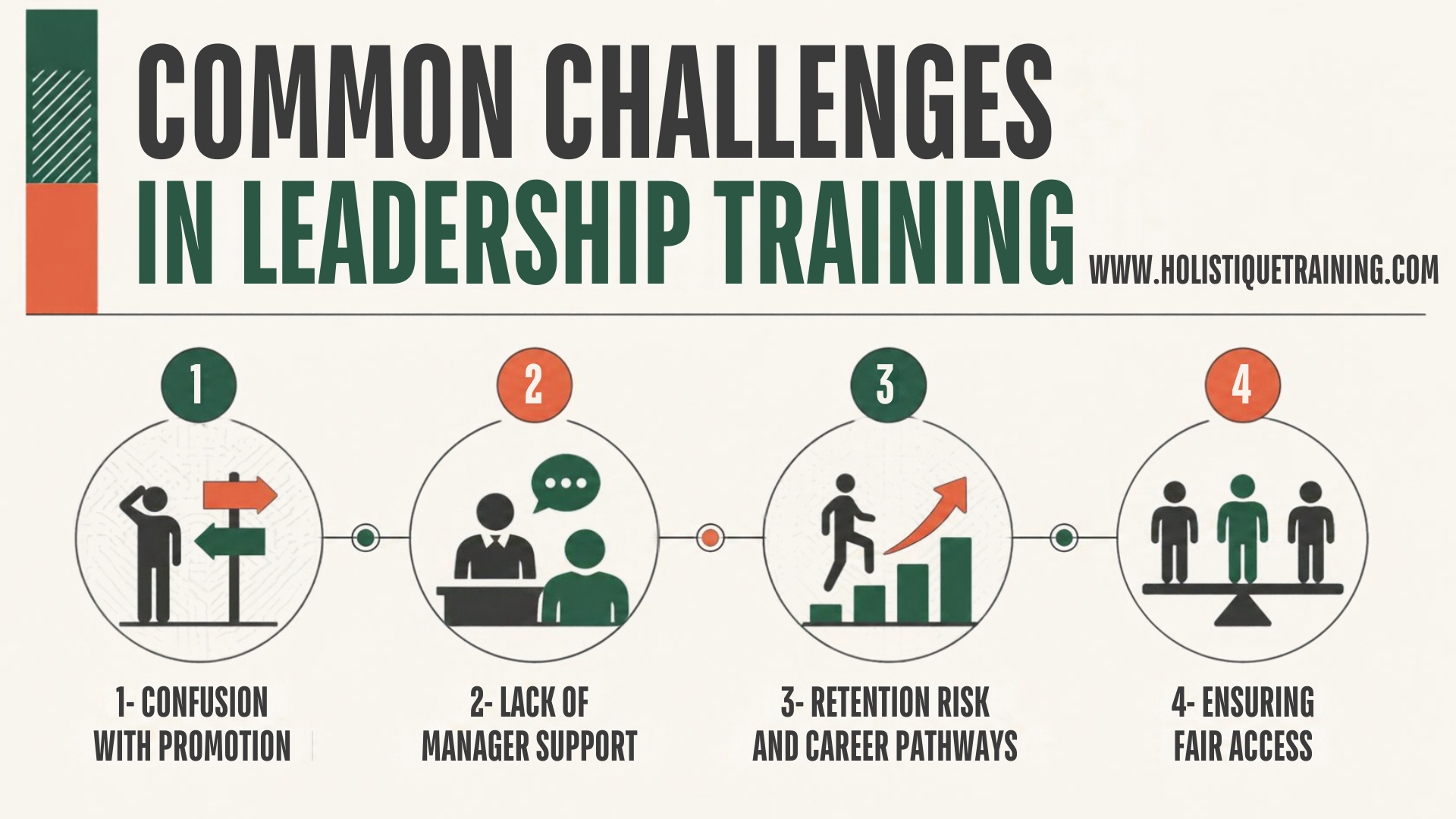
Even well-designed programmes encounter obstacles. Anticipating them allows HR and L&D teams to plan responses before problems arise.
Confusion With Promotion
Participants and colleagues may assume that attending leadership training signals imminent promotion. Without careful communication, this can create disappointment among those who are not promoted and resentment among those who were not selected. Programmes should state plainly that the aim is to build capability, not to guarantee advancement, and should be open to a broad audience wherever possible.
Lack of Manager Support
New behaviours fade quickly if managers discourage them. A participant who is encouraged to challenge assumptions in a workshop but is ignored or rebuked in team meetings will soon stop. Equipping managers to recognise and reward leadership behaviours is therefore essential to the success of any programme.
Retention Risk and Career Pathways
There is also a retention dimension. Employees who gain confidence and skills will look for ways to use them, and if no path exists, they may leave. According to DDI's Global Leadership Forecast 2025, the intention to depart among high-potential individual contributors rose from 13% in 2020 to 21% in 2024, and high-potential talent is 3.7 times more likely to leave within a year if their manager does not regularly provide opportunities for growth and development. Organisations should therefore pair training with credible career pathways, including senior specialist tracks that reward expertise and influence without requiring a move into management.
Ensuring Fair Access
Access is another concern. If places are allocated informally, programmes can favour employees who are already visible or well connected, reinforcing existing inequalities. Transparent selection criteria, open applications, and monitoring of participation by role, location, and background help ensure that leadership development reaches a diverse range of people and that the organisation benefits from the full breadth of its talent.
10- Future Trends in Leadership Development
Several trends are shaping the next generation of programmes. Artificial intelligence is enabling more personalised learning, recommending content and practice scenarios based on each participant's strengths and gaps. Data analytics is giving HR teams richer insight into how behaviour change relates to performance. Hybrid and remote working is increasing the importance of written communication, virtual collaboration, and trust-building across distance.
At the same time, uncertainty is becoming a permanent feature of working life. Individual contributors are expected to respond to shifting priorities, new technologies, and unclear situations without waiting for instruction. Training that develops adaptability, resilience, and empathy will therefore grow in importance, supporting people to lead through volatility and ambiguity rather than merely endure it.

In today's fast-paced corporate landscape, leaders often grapple with overwhelming responsibilities amidst the ever-evolving VUCA challenges - Volatility, Uncertainty, Complexity, and Ambiguity. This course offers a candid exploration of leadership strategies essential for navigating through turbulent times. Participants will learn to cultivate empathetic behaviours, prioritise
Finally, the boundary between leadership and expertise is likely to blur further. Senior specialist roles are becoming more common, and organisations are beginning to recognise that technical mastery combined with strong influence can be as valuable as a management title. Leadership training will need to prepare people for both paths, and to help them move between them as their interests and circumstances change.
11- Conclusion
Leadership training for individual contributors reflects a simple truth about modern organisations: influence does not depend on a job title. Specialists who communicate clearly, take ownership, collaborate across boundaries, and support their colleagues raise the performance of everyone around them. By investing in these capabilities, HR and L&D teams strengthen engagement, improve decision quality, and build a pipeline of people who are prepared for broader responsibility when the time comes.
The most successful programmes share common features. They are built on clear objectives, blend workshops with real work, secure the support of line managers, and measure behaviour change rather than attendance. They also sit alongside credible career pathways so that newly confident leaders can see a future within the organisation. Those that combine these elements will find that leadership development becomes a shared capability across the workforce rather than a privilege held by a few.