
- Table of Contents
- Introduction
- 1- What Are Renewable Energy Masters Courses?
- Taught and Research Formats
- 2- Why Renewable Energy Masters Courses Matter
- 3- Types of Renewable Energy Masters Programmes
- Technical and Engineering Programmes
- Policy, Economics and Management Programmes
- Joint International Programmes
- 4- Core Subjects and Specialisations
- 5- Renowned University Programmes Around the World
- 6- Entry Requirements and the Application Process
- Academic Requirements
- English Language Requirements
- Application Documents
- 7- Costs, Funding and Scholarships
- 8- Career Opportunities After a Renewable Energy Masters
- 9- Workforce Demand and Skills Gaps
- 10- How to Choose the Right Renewable Energy Masters Course
- 11- Short Courses and Professional Development Alongside a Masters
- 12- Challenges Students Should Consider
- 13- The Future of Renewable Energy Education
- Conclusion
Introduction
The global energy system is being rebuilt at remarkable speed, and the people who will design, finance, regulate and operate the new system need advanced training. Renewable energy masters courses have become one of the most direct routes into this field, offering graduates the technical depth, policy awareness and professional credibility that employers increasingly expect. For prospective postgraduate students, however, the choice is far from simple. Programmes differ widely in length, focus, cost, entry requirements and international recognition, and a poor match can mean wasted time and money.
Universities in the United Kingdom, continental Europe, North America and Asia now offer dozens of specialist programmes covering solar power, wind energy, bioenergy, energy storage, smart grids, energy economics and sustainable energy policy. Some are intensive one-year taught degrees, while others are two-year international programmes that award qualifications from two institutions. Understanding how these options differ is the first step towards making a confident decision about your academic and professional future.
In this article, we will discuss what renewable energy masters courses are, why they matter, the main types of programme, core subjects and specialisations, renowned university courses around the world, entry requirements, costs and funding, career opportunities, workforce skills gaps, how to choose the right programme, shorter alternatives, common challenges, and the future of renewable energy education.
1- What Are Renewable Energy Masters Courses?
Renewable energy masters courses are postgraduate programmes that prepare students to work with energy sources that are naturally replenished, such as solar, wind, hydropower, bioenergy, geothermal and marine energy. They combine engineering principles, scientific theory, economics and policy analysis so that graduates understand not only how clean energy technologies work, but also how they are financed, regulated and integrated into national power systems. Most programmes lead to a Master of Science (MSc) qualification, although some institutions also offer Master of Engineering, Master of Research or professional master's awards.
Unlike a bachelor's degree, which usually provides a broad grounding in a single discipline, a masters course concentrates on a specific area and expects students to engage with research, industry data and real-world problems. A typical programme includes taught modules, practical or laboratory work, a group project and an individual dissertation, often completed with an industry partner. Many courses also teach modelling and data analysis, which have become essential as energy systems grow more complex and digital.
Taught and Research Formats
Taught masters programmes are the most common option. They follow a structured timetable of lectures, seminars and assessed coursework, followed by a major project. Research masters programmes, by contrast, place greater emphasis on independent investigation under academic supervision, which makes them attractive to students who plan to continue to doctoral study or work in a research laboratory.
2- Why Renewable Energy Masters Courses Matter
The scale of change in the energy sector explains the growing demand for specialist education. According to the International Renewable Energy Agency's Renewable Energy Statistics 2026, published in July 2026, renewables supplied 31.7% of the world's electricity in 2024, and renewable generation grew by 9.8% in that year, a faster pace than in 2023. The same release reports that annual renewable capacity additions reached a record of around 693 GW in 2025, lifting renewables to 49.5% of global installed power capacity. Delivering growth on this scale requires engineers, analysts and policy specialists who understand both the technology and the wider system around it.
Several forces sit behind this trend, and each one creates demand for advanced skills:
Climate commitments.
Governments have pledged to reduce emissions and expand clean electricity, which requires specialists who can translate national targets into workable projects, regulations and investment plans.
Energy security.
Countries that generate more power from domestic renewable sources are less exposed to volatile fuel markets, so planners and engineers who can design resilient systems are increasingly valuable.
Falling technology costs.
Solar and wind have become cost-competitive in many markets, which has opened new opportunities in project development, financing and asset management.
Corporate decarbonisation.
Large employers now set emissions targets and purchase renewable electricity directly, creating roles in energy strategy, procurement and sustainability reporting.
Grid modernisation.
Integrating variable renewable power into networks requires expertise in storage, forecasting, digital control and market design, all of which feature prominently in masters curricula.
3- Types of Renewable Energy Masters Programmes
Not every programme serves the same student. Some courses are deeply technical, others focus on policy and markets, and a growing number combine both through international partnerships. Choosing the right category matters because it determines the modules you study, the people you meet and the careers that open up afterwards.
Technical and Engineering Programmes
These courses suit graduates in engineering, physics or related sciences. They cover the design, operation and optimisation of technologies such as photovoltaic systems, wind turbines, energy storage and power electronics. Students usually complete significant modelling or laboratory work and are expected to be comfortable with advanced mathematics.
Policy, Economics and Management Programmes
These courses attract graduates from economics, law, politics, business and environmental studies. They examine energy markets, regulation, investment appraisal, climate policy and project management, and they often include a technical overview so that students can communicate with engineers.
Joint International Programmes
Joint programmes, such as those coordinated by EIT InnoEnergy, require students to study at two universities in different countries and graduate with a degree from each. They usually add entrepreneurship and innovation training, which appeals to students who want international experience and a strong industry network.
Programme Type | Typical Duration | Main Focus | Best Suited To |
|---|---|---|---|
Taught MSc (technical) | 1 to 2 years | Engineering of solar, wind, storage and grid systems | Engineering and physics graduates |
Taught MSc (policy and economics) | 1 year | Energy markets, regulation and climate policy | Graduates in economics, law, politics or business |
Joint international master's | 2 years | Technology and entrepreneurship across two countries | Students seeking mobility and two degrees |
Research master's | 1 to 2 years | Original research and laboratory or field work | Future doctoral candidates |
Online or part-time master's | 2 to 4 years | Flexible study alongside employment | Working professionals |
4- Core Subjects and Specialisations
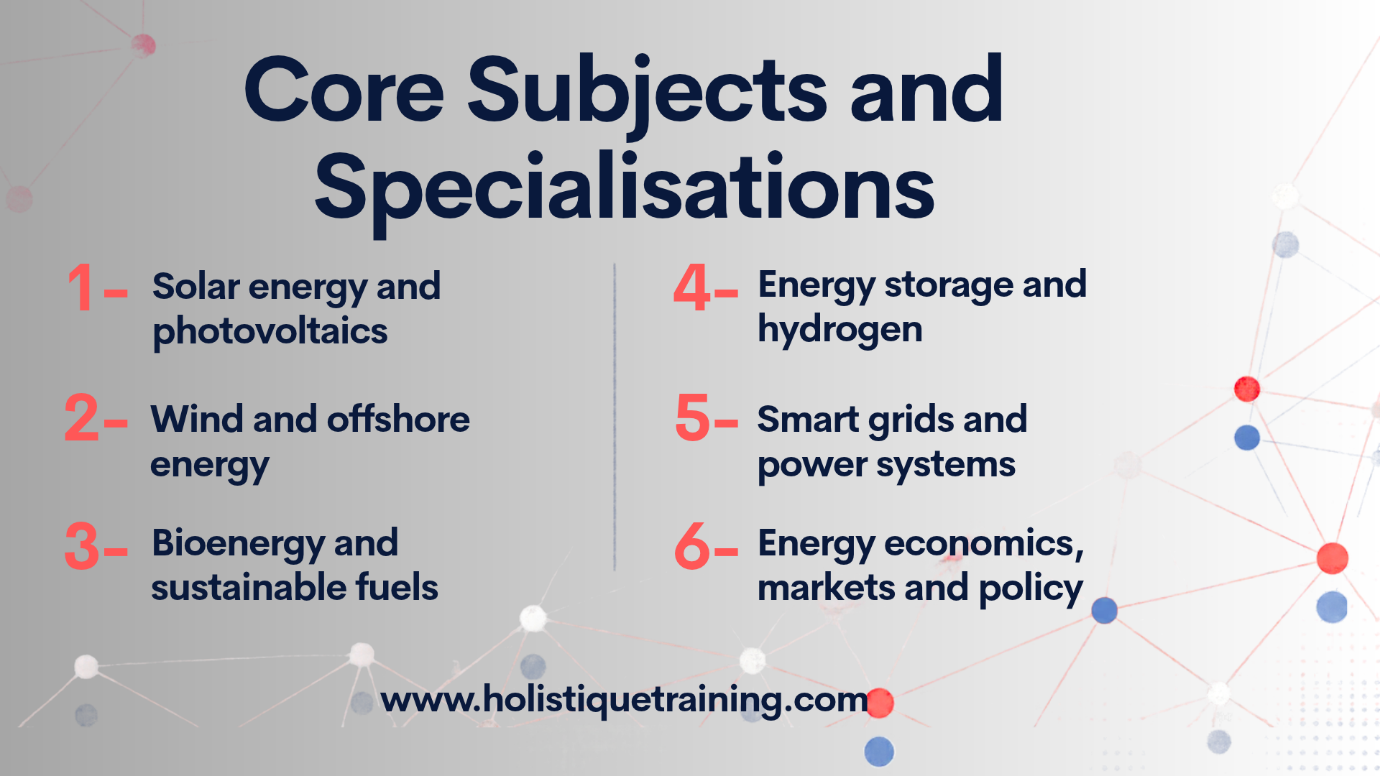
Most renewable energy masters courses begin with foundation modules covering energy systems, thermodynamics, electricity networks, resource assessment and environmental impact. Students then select a specialism that shapes their dissertation and their early career. Common specialisations include the following:
Solar energy and photovoltaics.
Modules explore solar resource assessment, cell and module technology, system design, grid connection and the economics of utility-scale and rooftop installations.
Wind and offshore energy.
Students study turbine aerodynamics, structural loads, wind farm layout, offshore foundations, maintenance strategies and the regulatory frameworks that govern project development.
Bioenergy and sustainable fuels.
This pathway covers biomass supply chains, anaerobic digestion, biofuels and the sustainability criteria used to judge whether bioenergy genuinely reduces emissions.
Energy storage and hydrogen.
Topics include battery chemistry, thermal storage, pumped hydro, green hydrogen production and the role of storage in balancing variable generation.
Smart grids and power systems.
Students learn how to integrate distributed generation, manage demand, apply digital control and keep networks stable as the share of renewables grows.
Energy economics, markets and policy.
This route develops skills in cost-benefit analysis, project finance, carbon pricing, market design and the evaluation of public policy.
Across all of these pathways, graduates are expected to develop transferable skills in data analysis, modelling, report writing and project management. Students who come from a non-technical background, or who simply want a practical introduction before committing to a degree, can benefit from a short course on how organisations assess and adopt clean power.

The rapidly changing climate and environment have recently given rise to many more renewable energy sources. These are cleaner energy sources that have fewer negative environmental effects than traditional forms of energy. Traditional energy sources such as coal, nuclear energy, or energy gained from non-renewable
5- Renowned University Programmes Around the World
Several universities have built strong reputations in renewable and sustainable energy education through long-standing research centres, industry partnerships and accredited curricula. The following programmes are widely recognised examples, although prospective students should always confirm current details on the official university pages before applying:
- Imperial College London, MSc Sustainable Energy Futures. This one-year full-time programme is accredited by the Energy Institute and is overseen by the university's Energy Futures Lab. It brings together engineering, natural sciences and business expertise, and students complete a research project that may be linked to industry. Entry normally requires a strong first-class degree in engineering or the physical sciences.
- University of Strathclyde, MSc Wind Energy Systems. Delivered within one of Europe's largest university power and energy technology groups, this one-year course covers wind turbine technology, power systems and wind integration, and includes a research project or internship. Strathclyde also offers an MSc in Renewable Energy and Decarbonisation Technologies for students seeking a broader focus.
- Loughborough University, MSc Renewable Energy Systems Technology. Described by the university as the longest-established master's degree in the United Kingdom specialising in renewable and sustainable energy engineering, it is taught by experts from the Centre for Renewable Energy Systems Technology and runs over twelve months.
- University of Edinburgh, MSc Sustainable Energy Systems. Based in the School of Engineering, this programme normally expects a 2:1 honours degree or international equivalent in engineering or physics, and it appeals to students who want a systems-level view of energy supply and demand.
- Technical University of Denmark, MSc Sustainable Energy Technologies. This two-year programme of 120 ECTS credits gives students broad expertise across energy technologies with a sustainability focus, and it offers an Industry Master of Science option for those who wish to combine study with practical experience.
- KTH Royal Institute of Technology and EIT InnoEnergy partners, MSc Renewable Energy. Students study at two universities in different European countries and receive a master's degree from each. Topics include wind, hydropower, ocean and offshore energy, biomass and the integration of renewable systems into the wider energy system.
- Delft University of Technology and partners, MSc Sustainable Energy Technology. A Dutch collaboration involving Delft, Eindhoven and Twente, this two-year, 120-credit programme is designed to give engineers broad knowledge of energy technology, with an internship that can help students gain industry experience.
University | Programme | Location | Typical Duration |
|---|---|---|---|
Imperial College London | MSc Sustainable Energy Futures | United Kingdom | 1 year full time |
University of Strathclyde | MSc Wind Energy Systems | United Kingdom | 1 year full time |
Loughborough University | MSc Renewable Energy Systems Technology | United Kingdom | 12 months |
University of Edinburgh | MSc Sustainable Energy Systems | United Kingdom | 1 year full time |
Technical University of Denmark | MSc Sustainable Energy Technologies | Denmark | 2 years (120 ECTS) |
KTH and InnoEnergy partners | MSc Renewable Energy | Sweden and partner countries | 2 years (120 ECTS) |
Delft, Eindhoven and Twente | MSc Sustainable Energy Technology | Netherlands | 2 years (120 EC) |
When comparing these options, remember that a famous name is only one factor. Accreditation, curriculum content, project opportunities and graduate outcomes are often more important than rankings alone.
6- Entry Requirements and the Application Process
Academic Requirements
Most renewable energy masters courses require a good undergraduate degree in engineering, physics, mathematics, chemistry, environmental science or a closely related subject. Policy and management programmes are usually more flexible and may accept graduates in economics, business, law and the social sciences. Requirements vary considerably between institutions: some leading programmes ask for a first-class degree or equivalent, while others accept a 2:1 or comparable grade. Applicants with relevant professional experience may sometimes be considered even if their academic background is less direct.
English Language Requirements
Students whose first language is not English normally need to provide evidence of proficiency through a recognised test such as IELTS or TOEFL. Postgraduate scores are often higher than undergraduate scores, and some engineering departments set minimum results for each component of the test, so it is wise to check the requirement early and allow time to retake the test if needed.
Application Documents
Most universities ask for a similar set of materials, and preparing them well in advance improves the quality of your application:
- Academic transcripts and certificates. These show your grades, subjects and degree classification, and international applicants may need certified translations.
- A personal statement. This should explain why you want to study renewable energy, which modules interest you and how the programme fits your career plans.
- Academic or professional references. Choose referees who can comment on your technical ability, analytical skills and motivation.
- A current CV. Highlight projects, internships, research experience and any practical exposure to energy systems.
- Proof of English proficiency. Include the test report or evidence that you meet an exemption.
7- Costs, Funding and Scholarships
Tuition fees differ greatly by country, institution and student status. International fees for one-year programmes at leading universities in the United Kingdom can exceed £30,000, while many public universities in continental Europe charge lower fees, although non-European students may still pay more than local students. Living costs, visas, health insurance and travel should be added to the budget, so it is sensible to calculate the total cost of the whole programme rather than the tuition fee alone.
Fortunately, a range of funding sources exists for students who plan carefully and apply early:
- Chevening Scholarships. Funded by the United Kingdom government, these awards support outstanding future leaders from eligible countries to study a one-year master's degree at a UK university, and renewable energy programmes have been popular choices.
- Commonwealth Scholarships. Available to students from eligible Commonwealth countries, these awards are designed to support development-focused postgraduate study.
- Erasmus Mundus and European scholarships. Some joint master's programmes in Europe offer scholarships or tuition waivers that reduce the cost of studying across multiple countries.
- University scholarships. Many institutions provide merit-based or subject-specific awards. For example, Imperial College London lists a dedicated scholarship for its Sustainable Energy Futures programme, and Strathclyde has offered international scholarships for engineering masters students.
- Employer sponsorship. Energy companies, utilities and public agencies sometimes fund staff to study, especially when the programme addresses a skills shortage.
8- Career Opportunities After a Renewable Energy Masters
Graduates of renewable energy masters courses enter a wide range of sectors, including utilities, engineering consultancies, project developers, equipment manufacturers, financial institutions, government agencies, research organisations and non-governmental organisations. The employment market is large and global. According to the Renewable Energy and Jobs Annual Review 2025, produced by the International Renewable Energy Agency and the International Labour Organization and released in January 2026, global renewable energy employment reached 16.6 million jobs in 2024. The report also found that growth slowed to 2.3% compared with 2023, and it highlighted that women and people with disabilities remain under-represented in the workforce.
The skills gained on a masters programme can lead to many different roles, depending on the specialism chosen:
Career Area | Typical Roles | Core Skills Used |
|---|---|---|
Engineering and technology | Renewable energy engineer, wind or solar design engineer, power systems analyst | Modelling, system design, power electronics, simulation |
Project development | Project developer, site assessor, project manager | Resource assessment, permitting, stakeholder management |
Energy analysis and markets | Energy analyst, market analyst, trader | Data analysis, forecasting, energy economics |
Policy and regulation | Policy adviser, regulatory analyst, climate officer | Policy evaluation, legal frameworks, communication |
Consultancy and sustainability | Sustainability consultant, energy auditor, ESG specialist | Life-cycle assessment, reporting, organisational change |
Consultancy and sustainability roles deserve particular attention because they exist in almost every industry. Organisations in manufacturing, retail, property and finance need advisers who can help them reduce energy use, buy clean power and report progress credibly. Graduates who also understand how to embed sustainable habits across an organisation are especially attractive to employers.
9- Workforce Demand and Skills Gaps
Strong demand does not automatically mean that employers can find the right people. A 2026 International Energy Agency report, Ensuring a Skilled Renewable Energy and Energy Efficiency Workforce, combines analysis of online job postings with employment modelling and stakeholder evidence across solar, wind and energy efficiency. The agency concluded that the low attractiveness of energy careers, limited availability and accessibility of training, and a mismatch between energy policy and workforce planning are among the main barriers to building a sufficiently large and skilled workforce.
For prospective students, this finding is encouraging. It suggests that people who combine technical knowledge with an understanding of policy, markets and project delivery can offer something that is genuinely scarce. It also shows why programmes with strong industry links, practical projects and clear career pathways deserve extra weight when you compare options.
10- How to Choose the Right Renewable Energy Masters Course
With so many programmes available, a structured approach helps you avoid being swayed by marketing alone. The following criteria offer a practical framework:
- Curriculum and specialisation. Review the module list in detail and make sure it matches the technologies and skills you want to develop, rather than relying on the programme title.
- Accreditation and recognition. Check whether professional bodies, such as engineering institutions or energy institutes, accredit the programme, since this can support future chartered status.
- Industry links. Look for industry-sponsored projects, internships, guest lecturers and placement opportunities that help you build a professional network before you graduate.
- Research strength. Departments with active research centres often provide access to modern laboratories, software and datasets, and may offer routes to doctoral study.
- Location and cost. Consider tuition fees, living costs, visa conditions and the local energy industry, because a location with active employers can improve your chances of finding work.
- Duration and flexibility. Decide whether a one-year intensive course or a two-year international programme better suits your finances, learning style and career timeline.
- Graduate outcomes. Ask admissions teams where recent graduates work and how the careers service supports job applications.
It is also worth reading independent guidance on how to compare renewable energy courses, particularly the practical steps for researching programmes, comparing curriculums and understanding the career paths that each option can open.

Explore renewable energy education—key to climate action, energy security, and green careers. Learn trends, tech, and SDG-driven opportunities.
11- Short Courses and Professional Development Alongside a Masters
A full masters degree is not the only way to build expertise. Short professional courses can complement a degree, prepare you for postgraduate study or help you change career without committing to a full programme. They are especially useful for managers, policymakers and technical staff who need to understand how renewable technologies, incentives and international energy frameworks affect their organisation.
Short programmes often cover renewable technologies and applications, the benefits and challenges of adoption, grid integration strategies and the policies and financial incentives that shape project economics. Students who complete a short course before applying for a masters often find that they can write a more convincing personal statement and choose a specialism with greater confidence.
The global energy landscape is undergoing a major transformation as countries, industries, and communities seek cleaner, more resilient, and sustainable energy systems. This course introduces participants to the core principles, technologies, and policy mechanisms that are driving the global shift toward renewable energy. It explores how replacing fossil
12- Challenges Students Should Consider
Although the career outlook is promising, prospective students should be realistic about the challenges they may face:
- High workload. One-year programmes compress a large amount of content into a short period, and the dissertation phase can be particularly demanding.
- Cost and currency risk. International students may face fee increases, exchange-rate movements and rising living costs during their studies.
- Uneven regional opportunities. Renewable energy employment is concentrated in certain countries and regions, so students should research where their target employers are based.
13- The Future of Renewable Energy Education
Renewable energy education is changing as quickly as the industry it serves. Universities are introducing modules on artificial intelligence, digital twins, hydrogen, offshore wind, battery recycling and the circular economy. Online and hybrid delivery is widening access, and partnerships with employers are making projects more relevant to current industry problems.
Climate adaptation is another growing theme. Energy systems must now be designed to withstand extreme weather, supply disruptions and shifting demand patterns, so programmes increasingly teach resilience alongside efficiency and decarbonisation. Students who understand both the energy transition and the resilience of infrastructure will be well placed for the next generation of leadership roles.

The global shift toward low-carbon, sustainable energy systems is one of the most critical responses to the climate crisis. This comprehensive training course explores the dynamic relationship between energy transition and climate change, providing participants with the tools and insights needed to lead and support climate-aligned energy transformation
Conclusion
Renewable energy masters courses offer a powerful way to turn interest in sustainability into a credible professional career. The best programmes combine rigorous technical or policy training with practical projects, industry connections and international perspectives. As renewable capacity and electricity generation continue to grow, and as employers report persistent skills gaps, well-qualified graduates are likely to remain in demand across engineering, finance, consultancy and government.
The right choice depends on your academic background, career goals, budget and preferred study style. Start by clarifying whether you want a technical, policy-focused or joint international programme, then compare curricula, accreditation, funding options and graduate outcomes. By researching carefully and applying early, you can find a masters course that supports both your ambitions and the global transition to clean energy.