

- Table of Contents
- Introduction
- What Makes a Note-Taking Technique Efficient?
- Efficient Techniques for Note-Taking to Use in 2026
- 1) Cornell Method
- 2) Charting Note-Taking Method
- 3) Outline Method
- 4) Flow-Based Note-Taking Method
- Best Practices for Making Notes Efficiently
- Write with Revision in Mind
- Keep Formatting Consistent
- Use an Summarizer Tool to Reduce Manual Effort
- Review and Refine
- Final Words
Introduction
Note-taking methods have evolved significantly over the past few years. Earlier, people used to note down important points in no particular order. Then, some useful note-taking methods were proposed by researchers, and people adopted them.
Also, people used to rely on paper and printed materials. Later, digital documents and typing became common. And now students and professionals use a mix of handwritten notes, apps, screenshots, and online resources to capture and organize notes more efficiently.
Because of this shift, managing notes has become more complex as the information comes from multiple sources. Writing everything down is not always practical.
That is why note-taking methods matter more now than before. In this article, we will look at the most efficient note-taking techniques that are relevant for 2026 and explain how they work in real use.
What Makes a Note-Taking Technique Efficient?
An efficient note-taking approach helps you save time while capturing the most important information. It focuses on:
- Capturing key ideas instead of full content
- Organizing information for a quick review
- Reducing revision time later
- Supporting long-term understanding
Hence, when we take notes using a good technique , it becomes very easy to follow them later. This makes it quicker to recall information and saves time during meetings or for future reference.
Efficient Techniques for Note-Taking to Use in 2026
There are multiple techniques that one can use. But not every technique fits with every situation. So here, we will discuss 4 techniques that can be used by professionals according to their convenience and situation.
1) Cornell Method
The Cornell Method is a note-taking technique that follows a fixed page layout. It was developed by Walter Pauk at Cornell University. Before writing anything, the page is divided into three parts. One large section on the right side is kept for writing the actual notes. A smaller section on the left side is called the cue column. And a small box at the bottom is made for summary writing.
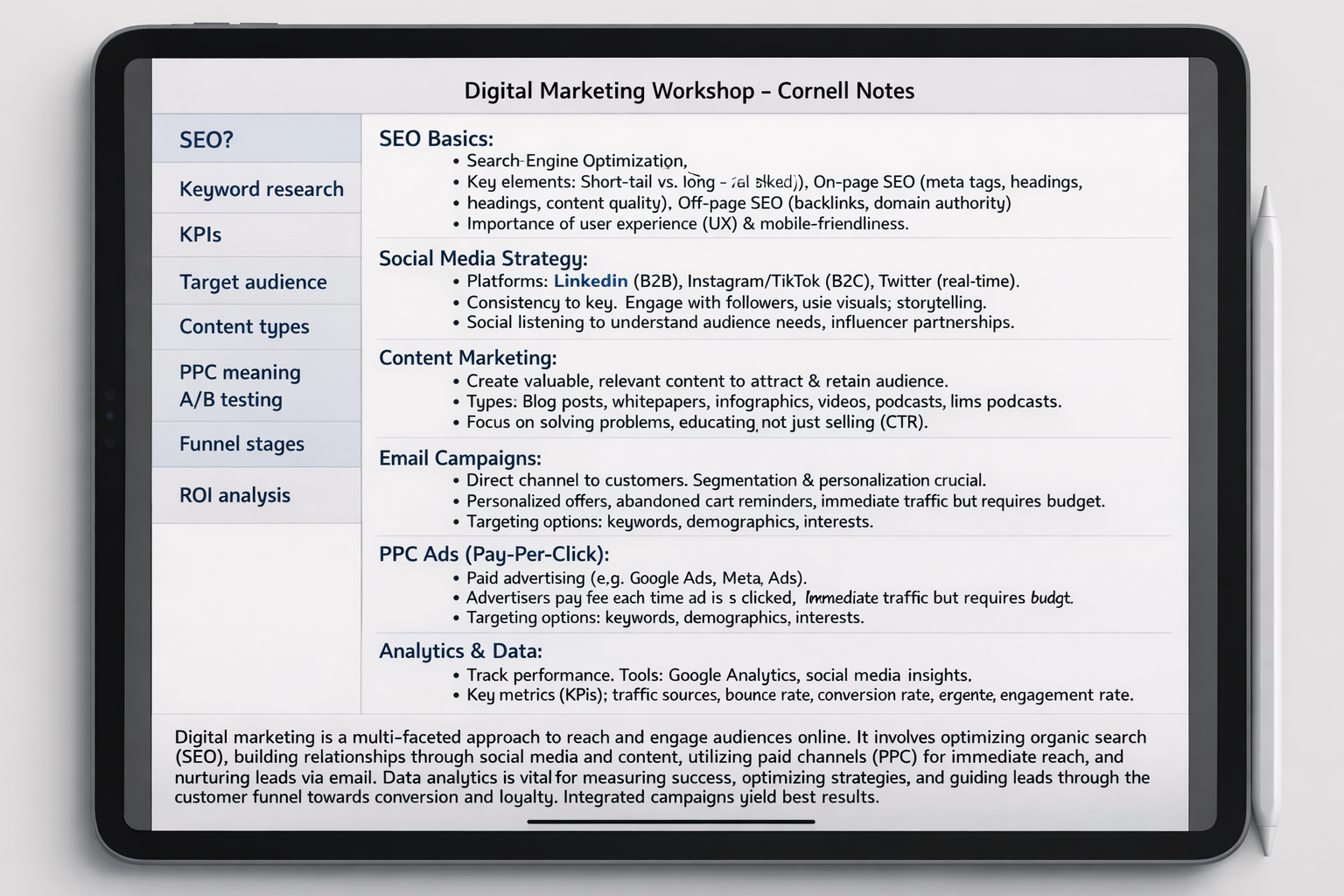
During a lecture, meeting, or training session, notes are normally written in the main section. There is no pressure to organize everything at that moment. Later, when there is time for review, the side section is used to include short questions or key concepts derived from the notes. In the summary box, a brief overview of the highlights of the entire page is then written.
This method is typically advantageous in cases when the data comes rapidly, like in classrooms and quick office meetings.
2) Charting Note-Taking Method
This method is very straightforward. It works best when information is based on facts. Numbers. Definitions. Comparisons. Before writing anything, the page is divided into columns. Each column is given a small heading. That heading represents one topic or one idea. As information comes in, it is placed under the matching column.
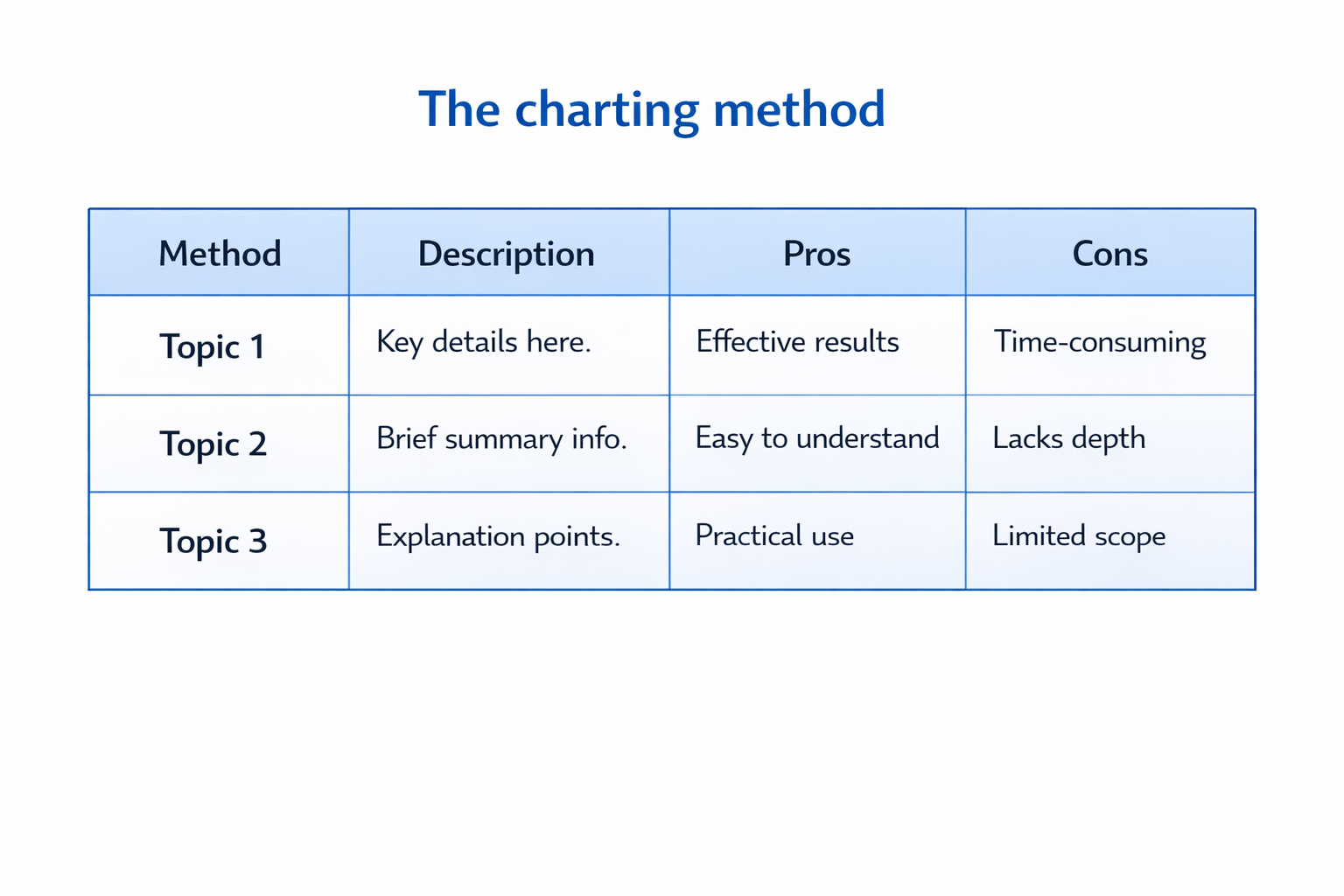
Because notes are written in short points and keywords, this method stays clean. It is easy to look back later. It also helps with memory because the brain starts linking facts with their column position. This method is not flexible, though. It works well only when you have all the information in hand, and you make notes in a structured manner.
Charting is often used in research work and exam preparation. Analysts, researchers, and students dealing with statistics or comparisons find it useful.
3) Outline Method
This one is a very common way to take notes used by people. In this method, the information is arranged in a clear way. The main topic is written on the left side of the page. Then related points are written under it, slightly indented. If there are more details, they are added under those points with more indentation. This creates a visible structure where topics and subtopics are easy to separate.
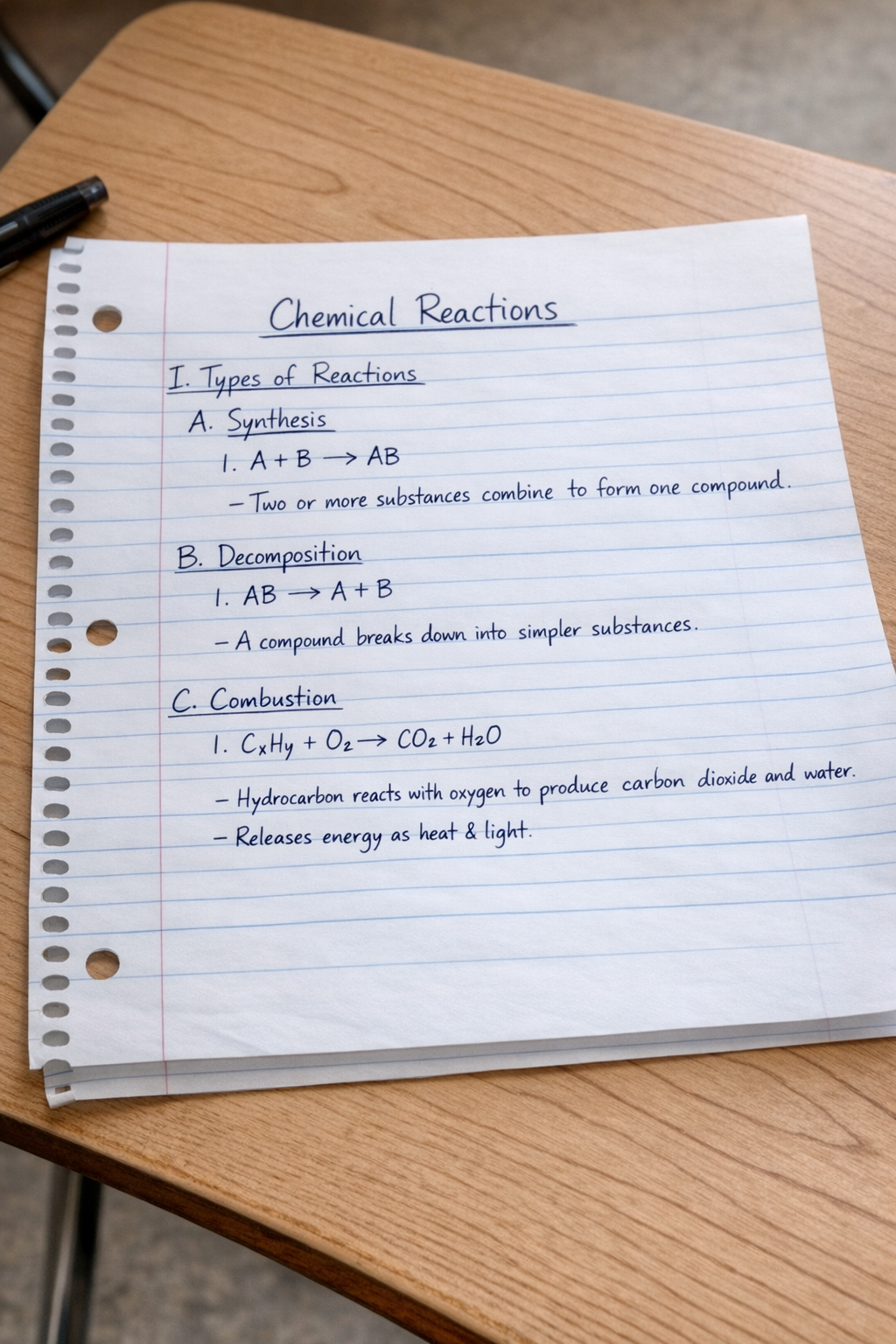
This method can be used on paper or digitally. On paper, some space needs to be left under each heading to add details later. In digital notes, this is easier because sections can be expanded anytime. The outline method works best when information is already organized, such as lectures. Students, project managers, and team leaders frequently use it when subjects naturally split into little components.
4) Flow-Based Note-Taking Method
This method basically follows an unstructured way of taking notes. There is no fixed layout or sections of the page. As the name suggests, notes are written as ideas appear, one after another. Sometimes they go sideways. Sometimes they go back to an earlier point.
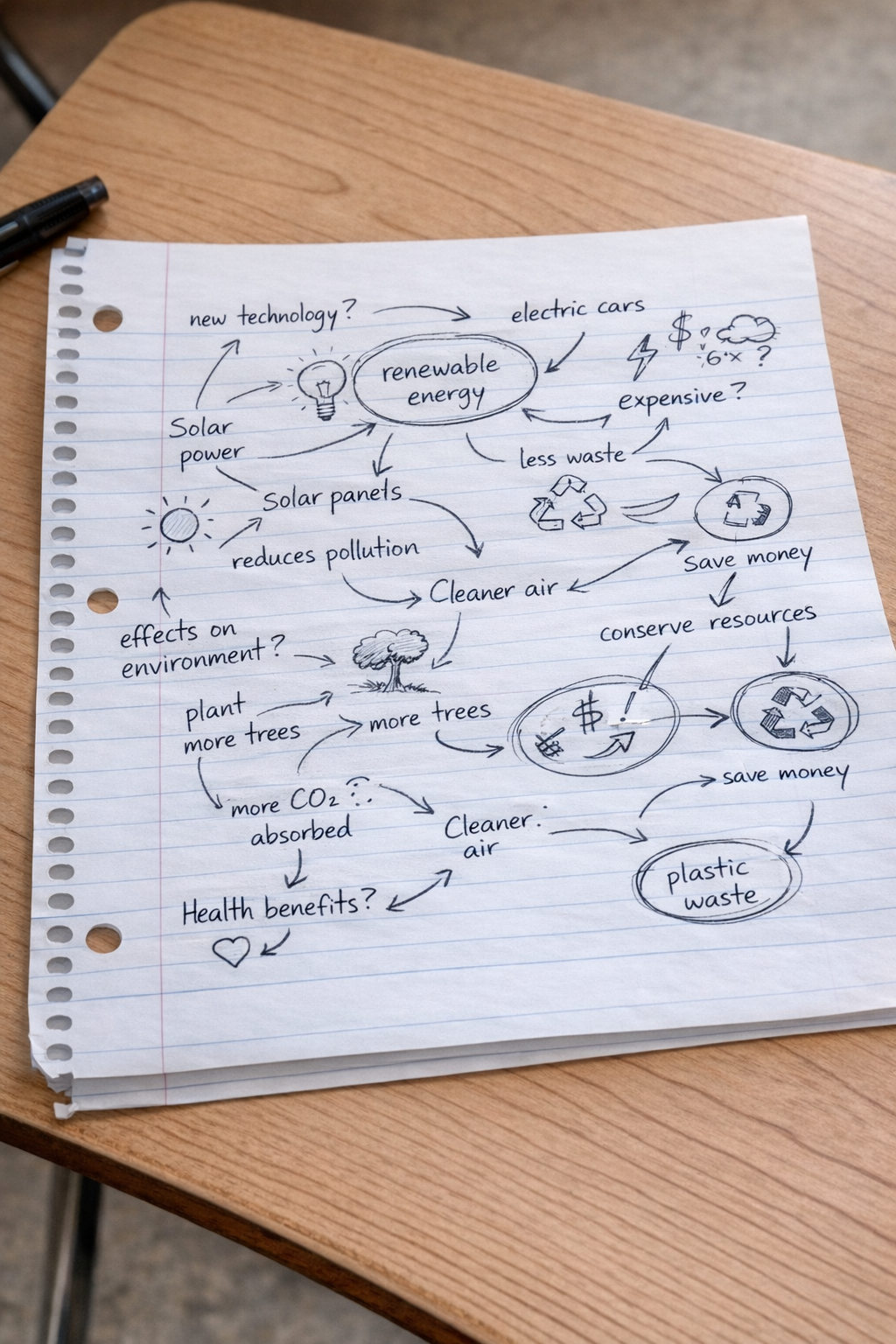
There is no fixed style, such as outlines or bullet points. The flow-based notes capture information in a way that replicates our brains’ processing and connecting concepts.
While writing, arrows, circles, lines, or small drawings are often added to connect ideas. One thought leads to another, and the notes grow in that direction.
Because of this, the page may not look clean at first glance. But it shows how ideas are linked. This method is usually used during brainstorming, discussions, or creative work. Designers, developers, and people working on complex systems often use it when ideas are still forming and not fully structured yet.
Best Practices for Making Notes Efficiently
Note-taking techniques work best when paired with smart habits. Small things matter here, like how you write or how you clean your notes. These practices make a noticeable difference:
Write with Revision in Mind
Notes are not only for the moment you write them. They are for later. Usually, you open them again when you need quick answers. So write in a way that helps you in the future. If you are using a loose method, like flow-based notes, make sure to connect ideas clearly. Use arrows or short linking words. Show how one idea moves into the next. This makes the page readable at first glance.
Keep Formatting Consistent
Pick one format and stay with it. Do not change styles on every page. Use the same technique and the same way to write headings. This reduces mental effort. Your brain stops figuring out structure and starts focusing on meaning. Over time, note-taking feels easier and faster.
Use an Summarizer Tool to Reduce Manual Effort
Technology can make note-taking faster and more efficient, especially when dealing with large amounts of information. For example, if you need to review a long research article, business report, or meeting transcript, manually reading and condensing it can take a lot of time. AI Summarizer can quickly highlight the key points, helping you focus on understanding and connecting ideas rather than copying every detail. This way, your notes remain concise and organized, making your overall note-taking process more efficient.
Review and Refine
Do not leave notes untouched for weeks. A short review after taking notes helps a lot. Fix unclear lines and remove extra words. If you find anything missing, like an idea or an important detail about a specific point, add it. Because at that time, you have the information in your mind, which you can forget later. This small step improves understanding more than rewriting everything later.
Final Words
There is no single best way to take notes. What works well for one person may not work the same for another. The important thing is to understand why you are taking notes in the first place. Notes are meant to help you remember, review, and think clearly later.
Try different methods and see which one works the best. Adopt that method, and after some time, it will be convenient for you to follow that while making notes and reviewing.