

- Table of Contents
- 1. Introduction:
- 2. Understanding Explainable AI (XAI): Concepts and Definitions
- Transparency
- Interpretability
- Explainability
- Black-Box Models vs. Explainable Models
- 3. Why Trust Matters in Business AI Systems
- 4. The Business Risks of Non-Explainable AI
- Compliance Risks Across Regulations
- 5. How Explainable AI Builds Trust: Core Mechanisms
- 6. XAI and Ethical Decision-Making in Business
- 7. Regulatory and Compliance Drivers for Explainable AI
- 8. Industry Use Cases: How Businesses Apply XAI in Practice
- Finance & Banking
- Healthcare & Insurance
- Human Resources
- Marketing & Pricing
- Supply Chain & Operations
- 9. Challenges and Limitations of Explainable AI
- The Trade-Off Between Accuracy and Explainability
- Technical and Organisational Barriers
- The Risk of Misinterpretation and Overconfidence
- 10. Best Practices for Implementing Explainable AI in Business
- Match Explainability to the Audience
- Involve Stakeholders from the Start
- Build AI Literacy Beyond Technical Teams
- Embed XAI into Governance and Oversight
- 11. The Future of Explainable AI and Trust-Centric Business Models
- Human-Centred AI as the New Norm
- Explainability as a Brand and Leadership Asset
- Trust by Design, Not by Reaction
- 12. Conclusion:
1. Introduction:
Artificial intelligence has moved from experimental innovation to a central force shaping business decisions. Today, AI systems influence who gets hired, who receives credit, how prices are set, which transactions are flagged as fraudulent, and how patients are prioritised for care. As organisations increasingly rely on algorithmic intelligence to drive efficiency and scale, a new strategic challenge has emerged: trust.
While AI promises speed, consistency, and data-driven accuracy, it also introduces opacity. Many advanced AI systems operate as “black boxes,” producing outcomes without clearly explaining how those outcomes were reached. For customers, employees, regulators, and even executives, this lack of visibility can be deeply unsettling. When a loan application is rejected, a job candidate is filtered out, or a medical claim is denied by an algorithm, people want to understand why. Without that understanding, confidence erodes.
Public and employee scepticism toward automated decision-making is growing. Surveys consistently show that people are wary of AI systems making high-stakes decisions without human oversight or clear justification. This scepticism is not rooted in technophobia alone; it reflects legitimate concerns about fairness, accountability, bias, and responsibility. In regulated industries such as finance, healthcare, and insurance, opaque AI decisions can also expose organisations to legal and reputational risk.
In this context, trust is no longer a soft ethical ideal. It has become a competitive advantage. Businesses that can demonstrate responsible, transparent, and accountable use of AI are more likely to gain customer loyalty, employee acceptance, and regulatory confidence. Trust enables adoption, and adoption determines whether AI investments deliver real value.
This is where Explainable Artificial Intelligence (XAI) enters the conversation. XAI does not reject advanced AI models; instead, it seeks to make their outputs understandable to human stakeholders. It acts as a bridge between innovation and accountability, enabling organisations to harness AI’s power while maintaining transparency and control.
Ultimately, businesses do not just need AI systems that work. They need AI systems that can be understood, questioned, and trusted.
2. Understanding Explainable AI (XAI): Concepts and Definitions
Explainable Artificial Intelligence (XAI) refers to a set of methods and design principles that allow AI systems to provide clear, human-understandable explanations for their decisions and outputs. Rather than presenting results as unquestionable conclusions, XAI enables stakeholders to see the reasoning, factors, and logic behind an AI-driven outcome.
XAI is often confused with related concepts such as transparency and interpretability. While these ideas are closely connected, they serve different purposes in business contexts.
Transparency
Transparency refers to openness about how an AI system is developed, trained, and deployed. A transparent AI system allows stakeholders to understand what data is used, what objectives the model optimises, and how decisions are governed. Transparency is particularly important for regulators and internal auditors, as it supports accountability and compliance.
Interpretability
Interpretability focuses on how easily a human can understand the internal mechanics of an AI model. Simpler models, such as rule-based systems or linear models, are inherently more interpretable. However, many modern AI systems sacrifice interpretability in pursuit of higher predictive performance.
Explainability
Explainability bridges the gap between complex AI models and human understanding. Even when a system is not fully interpretable, explainability techniques can clarify why a specific decision was made. For business users, explainability matters more than understanding every mathematical detail.
Black-Box Models vs. Explainable Models
Aspect | Black-Box AI Models | Explainable AI Models |
Decision logic | Hidden and opaque | Partially or fully visible |
Stakeholder trust | Low to moderate | High |
Regulatory readiness | Risky | Strong |
Bias detection | Difficult | More feasible |
Business accountability | Limited | Enhanced |
Traditional AI explanations often failed because they were designed for data scientists rather than decision-makers. Technical metrics and abstract probabilities rarely help managers justify decisions to employees, customers, or regulators. As AI adoptionmatured, businesses began shifting from an accuracy-first mindset to an accountability-first approach—recognising that performance alone is not enough.
3. Why Trust Matters in Business AI Systems
Trust is the foundation upon which successful AI adoption is built. Without trust, even the most accurate AI systems face resistance, underuse, or outright rejection.
In business environments, trust operates across multiple relationships. Customers must trust that AI-driven decisions are fair and reasonable. Employees need confidence that algorithms will not arbitrarily judge performance or career progression. Regulators require assurance that AI systems comply with legal and ethical standards. Executives must trust AI outputs enough to base strategic decisions on them.
When trust is missing, the consequences are tangible. Organisations experience resistance to AI adoption, where employees override or ignore algorithmic recommendations. Customers may challenge decisions, leading to complaints or legal disputes. Reputational damage can arise when opaque AI systems are perceived as unfair or discriminatory. Even internally, managers may hesitate to rely on AI insights they cannot explain.
The psychological dimension of trust in automation is well documented. A widely cited study by MIT Sloan Management Review shows that people are more likely to accept automated decisions when they understand the rationale behind them, even if the outcome is unfavourable.
This insight highlights a critical shift: accuracy without explainability is no longer sufficient. In high-stakes business decisions, stakeholders expect transparency, justification, and the ability to question outcomes. Explainable AI responds directly to this expectation, transforming AI from an authority that dictates outcomes into a tool that supports informed decision-making.
4. The Business Risks of Non-Explainable AI
Non-explainable AI systems introduce a range of risks that extend far beyond technical failure. One of the most serious concerns is algorithmic bias. When decision logic is hidden, biased outcomes can go undetected, reinforcing discrimination in hiring, lending, pricing, or access to services.
Another major risk is the inability to audit or challenge decisions. Without explainability, organisations struggle to investigate errors, respond to customer complaints, or demonstrate compliance during regulatory reviews. This creates vulnerability in sectors where accountability is legally required.
Compliance Risks Across Regulations
Regulation | Key Requirement | Risk of Non-Explainable AI |
GDPR | Right to meaningful explanation | Legal penalties |
EU AI Act | Transparency for high-risk AI | Market restrictions |
UK AI Governance | Responsible AI use | Regulatory scrutiny |
Global standards | Ethical accountability | Reputational harm |
When AI systems fail, accountability becomes blurred. Was the error caused by the model, the data, or the organisation deploying it? Without explainability, assigning responsibility is difficult, undermining governance structures.
Internally, managers face significant challenges. Leaders may be unable to justify AI-driven decisions to teams, weakening authority and confidence. Stakeholders lose trust when outcomes cannot be clearly defended. Several industries have already experienced public backlash against opaque AI systems, demonstrating that social acceptance cannot be assumed.
Explainable AI mitigates these risks by making decision processes visible, reviewable, and defensible.
5. How Explainable AI Builds Trust: Core Mechanisms
Explainable AI builds trust through a set of interrelated mechanisms that transform how AI systems interact with human decision-makers.
Transparency → Business Benefit → Trust Outcome
By revealing how decisions are generated, XAI reduces uncertainty. Stakeholders gain clarity, leading to greater acceptance and reduced resistance.
Interpretability → Business Benefit → Trust Outcome
When outputs are presented in plain language or visual explanations, non-technical users can engage with AI insights. This empowers managers and employees to use AI confidently rather than blindly.
Accountability → Business Benefit → Trust Outcome
XAI supports human oversight. Decision-makers remain responsible, using AI as an advisory system rather than an unquestionable authority.
Fairness Checks → Business Benefit → Trust Outcome
Explainability enables organisations to detect and correct bias. This strengthens ethical credibility and protects brand reputation.
Traceability → Business Benefit → Trust Outcome
AI decisions can be traced back to inputs and logic, supporting audits, compliance, and continuous improvement.
For executives, these mechanisms translate into confidence. Leaders are more willing to integrate AI into strategy when they can explain outcomes to boards, regulators, and the public. Trust becomes embedded not only in technology, but in governance and leadership practices.
6. XAI and Ethical Decision-Making in Business
Ethical AI is no longer an abstract ideal; it is a practical requirement for responsible business conduct. Explainable AI plays a central role in translating ethical principles into operational reality.
Ethical frameworks emphasise fairness, non-discrimination, and responsibility. Without explainability, these values remain difficult to enforce. XAI allows organisations to assess whether AI decisions align with corporate values and societal expectations.
Explainability supports fair treatment by revealing whether similar cases are treated consistently. It enables non-discrimination by exposing biased patterns before they cause harm. Responsible automation is achieved when humans remain accountable for outcomes, supported—not replaced—by AI systems.
XAI is increasingly integrated into Environmental, Social, and Governance (ESG) strategies, signalling commitment to ethical innovation. A study by OECD highlights that explainability is essential for trustworthy AI governance and long-term sustainability.
Human-in-the-loop models further reinforce ethical decision-making, ensuring that critical judgments involve human oversight informed by explainable insights.

As artificial intelligence continues to influence decision-making in healthcare, finance, justice, and beyond, questions around fairness, accountability, and transparency have moved to the forefront of AI development. This course introduces the ethical challenges posed by AI systems and focuses on explainable AI (XAI) as a critical component for
7. Regulatory and Compliance Drivers for Explainable AI
Regulation is accelerating the adoption of explainable AI. Governments and international bodies increasingly recognise that opaque AI systems pose systemic risks.
In Europe, GDPR introduced the principle of a “right to explanation,” requiring organisations to provide meaningful information about automated decisions. The EU AI Act expands this approach, classifying high-risk AI systems and mandating transparency, documentation, and oversight.
The UK and other jurisdictions are adopting governance-based approaches that emphasise accountability over prohibition. Globally, regulatory trends converge on one message: AI must be understandable to be acceptable.
Explainability reduces compliance burdens by enabling proactive risk management. Rather than reacting to investigations or penalties, organisations can demonstrate responsible practices from the outset. XAI thus becomes a strategic compliance tool, not a regulatory afterthought.
8. Industry Use Cases: How Businesses Apply XAI in Practice
Finance & Banking
In credit scoring, AI evaluates risk based on multiple variables. XAI explains which factors influenced approval or rejection, enabling transparency for customers and regulators. In fraud detection, explainable alerts help analysts understand why transactions are flagged, improving response accuracy and trust.
Healthcare & Insurance
Risk assessment models guide treatment prioritisation and insurance pricing. XAI enables clinicians and policyholders to understand decisions, supporting informed consent and fair claims processing.
Human Resources
Hiring algorithms screen candidates efficiently but raise fairness concerns. XAI clarifies evaluation criteria, allowing HR teams to justify decisions and ensure compliance with employment laws. Performance analytics become tools for development rather than surveillance.
Marketing & Pricing
Dynamic pricing systems adjust offers in real time. Explainability reassures customers that pricing reflects logical factors rather than arbitrary discrimination. Recommendation systems become more persuasive when users understand why products are suggested.
Supply Chain & Operations
Forecasting models guide inventory and risk planning. XAI helps managers understand demand drivers and disruption risks, enabling confident strategic decisions.
Across industries, the pattern is consistent: AI decision → XAI explanation → Trust benefit.

Within the world of business, there is a constant drive to improve the inner functions, processes, and services it provides. Traditionally, this responsibility would solely rely on management and employees and would come with a moderate amount of uncertainty. However, with new technological advancements such
9. Challenges and Limitations of Explainable AI
Explainable AI offers a powerful response to the trust challenges surrounding AI adoption, but it is not a silver bullet. Like any emerging capability, XAI comes with practical, technical, and organisational limitations that businesses must understand before relying on it as a solution.
The Trade-Off Between Accuracy and Explainability
One of the most persistent challenges in XAI is the balance between model performance and explainability. Highly complex AI models often achieve superior accuracy, particularly in large-scale or data-intensive environments. However, these same models are usually the hardest to explain in simple, intuitive terms.
To make explanations understandable, organisations may simplify outputs or focus on selected decision factors. While this improves accessibility, it can also strip away nuance. The result may be an explanation that feels reassuring but does not fully reflect the complexity of the underlying decision. This creates a risk of illusory transparency—where stakeholders believe they understand a decision when, in reality, important subtleties remain hidden.
Technical and Organisational Barriers
Implementing XAI is not just a technical upgrade; it requires organisational readiness. Many companies lack the internal expertise, tools, or infrastructure needed to deploy explainable systems effectively. Developing explanations, validating them, and maintaining them as models evolve can significantly increase costs and development time.
For organisations at an early stage of AI maturity, these requirements can feel overwhelming. Without a clear strategy, XAI initiatives may stall or be treated as experimental add-ons rather than core business capabilities.
The Risk of Misinterpretation and Overconfidence
Explainability does not automatically guarantee correct understanding. Explanations still require human judgment. Without proper training, decision-makers may misinterpret insights, draw incorrect conclusions, or rely too heavily on explanations that appear logical but are incomplete.
This overconfidence can be just as dangerous as opacity. Responsible use of XAI therefore demands not only technical solutions, but also education, context, and ongoing review. Recognising these limitations is essential for using explainable AI wisely rather than uncritically.
10. Best Practices for Implementing Explainable AI in Business
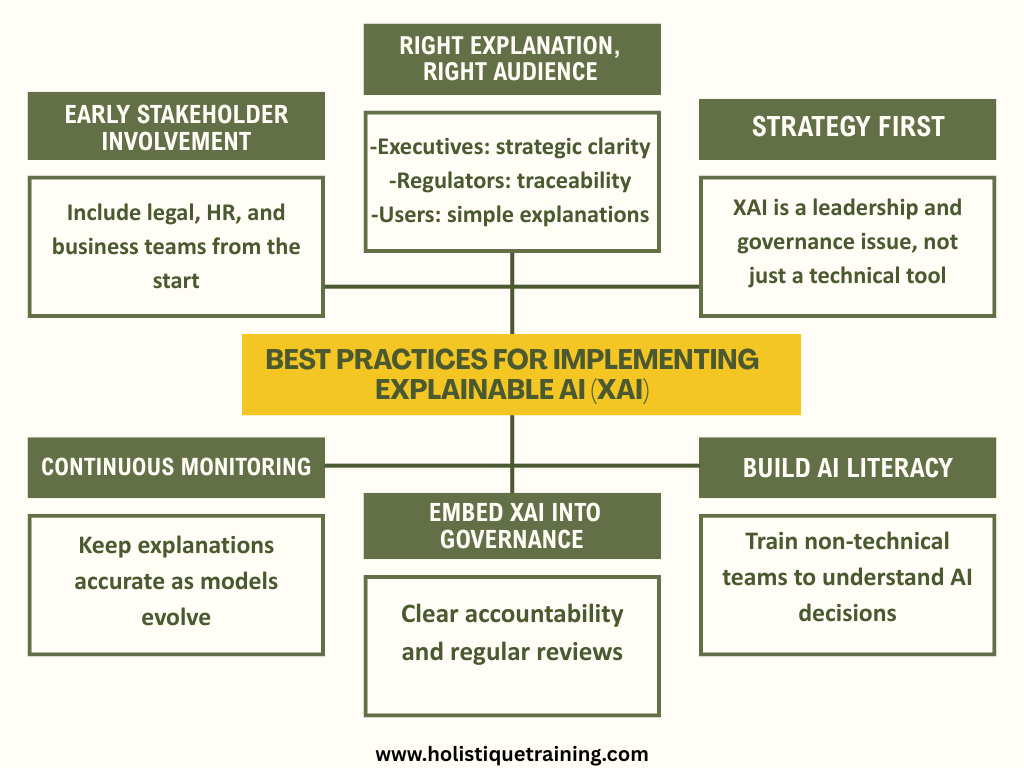
Successful adoption of Explainable AI depends less on tools and more on strategy. Organisations that treat XAI as a governance and leadership issue—rather than a purely technical feature—are far more likely to achieve meaningful outcomes.
Match Explainability to the Audience
Different stakeholders require different forms of explanation. Executives need high-level clarity to support strategic decisions. Regulators require structured documentation and traceability. Customers and employees expect simple, accessible reasoning.
Effective XAI implementation begins by identifying who needs explanations and why. Overloading users with technical detail can be as damaging as providing no explanation at all.
Involve Stakeholders from the Start
Explainability should not be added after deployment. Involving legal teams, compliance officers, HR leaders, and frontline users early in the design process ensures that explanations align with real-world expectations and risks. This early involvement also builds internal trust and reduces resistance to AI adoption.
Build AI Literacy Beyond Technical Teams
XAI only delivers value when people know how to interpret and use it. Training non-technical teams—managers, HR professionals, customer-facing staff—is essential. When employees understand how AI reaches conclusions, they are more confident using it and more capable of challenging it when necessary.
Embed XAI into Governance and Oversight
Explainable AI should be integrated into existing governance frameworks, not treated as a standalone initiative. Clear accountability, regular reviews, and documented decision processes ensure that explainability remains consistent as systems evolve.
Continuous monitoring is particularly important. As data changes and models are updated, explanations must remain accurate and relevant. Aligning XAI initiatives with business objectives prevents explainability from becoming a box-ticking compliance exercise.
A study by PwC shows that organisations embedding explainability into responsible AI governance achieve higher levels of adoption, trust, and long-term value.
11. The Future of Explainable AI and Trust-Centric Business Models
The future of AI in business will not be defined by raw computational power alone. It will be shaped by how well organisations integrate intelligence with human values. In this future, explainability will move from a “nice-to-have” feature to a defining standard of trustworthy AI.
Human-Centred AI as the New Norm
As AI systems become more deeply embedded in everyday business operations, expectations will shift. Stakeholders will no longer ask whether AI is being used, but whether it is being used responsibly. Human-centred AI—designed to support, not replace, human judgment—will become the dominant model.
Explainability as a Brand and Leadership Asset
Transparency will increasingly differentiate trusted brands from risky ones. Organisations that can clearly explain how their AI systems make decisions will earn credibility with customers, employees, and regulators alike.
At the same time, AI literacy will emerge as a core leadership skill. Executives will be expected to question AI outputs, understand limitations, and guide responsible use. Explainability will empower leaders to do so with confidence.
Trust by Design, Not by Reaction
Rather than responding to public concern or regulatory pressure after problems arise, forward-looking organisations will embed trust directly into AI design. Explainable AI will become a foundation for sustainable innovation—supporting growth that is socially accepted, legally compliant, and ethically grounded.
Importantly, XAI does not slow innovation. It enables innovation that lasts.
12. Conclusion:
Explainable AI represents a decisive shift in how businesses relate to technology. It transforms AI from an opaque authority that delivers unexplained outcomes into a collaborative system that supports informed human decision-making.
Trust is the cornerstone of sustainable AI adoption. Without trust, even the most advanced systems face resistance, scrutiny, and eventual rejection. With trust, AI becomes a source of resilience, competitive advantage, and long-term value.
XAI is more than a technical capability. It is a strategic commitment to transparency, accountability, and responsible leadership. It reflects an understanding that in modern business, performance alone is not enough—decisions must also be understood, justified, and owned.
In the era of intelligent automation, trust is not built through blind reliance on algorithms. It is built through clarity, explanation, and respect for human judgment.

In the modern world, technology is constantly improving all areas of society. Newer technologies that have risen in popularity are artificial intelligence and machine learning. Many businesses and organisations increasingly rely on artificial intelligence systems to improve productivity. Artificial intelligence (AI) is computer