
- Table of Contents
- Introduction
- 1- What Is Advocacy in Leadership?
- Defining Leadership Advocacy
- The Three Dimensions of Advocacy
- Common Misconceptions
- Why Leaders Hesitate to Advocate
- 2- Why Advocacy Matters in Modern Organisations
- Retention and Trust
- Better Decisions
- Stronger Culture
- 3- Advocacy Compared with Sponsorship, Mentoring and Allyship
- How They Overlap
- Choosing the Right Approach
- 4- The Main Types of Leadership Advocacy
- 5- Core Skills of an Advocate Leader
- Persuasive Communication
- Evidence-Based Reasoning
- Empathy and Active Listening
- Courage and Integrity
- Political Awareness
- 6- Advocacy and Employee Voice
- Closing the Feedback Loop
- 7- Advocating for Inclusion and Career Progression
- 8- Advocating Upwards, Downwards and Sideways
- Advocating Upwards
- Advocating Downwards
- Advocating Sideways
- 9- Advocacy During Change and Uncertainty
- Communicating with Consistency
- 10- Stakeholder Advocacy and External Influence
- 11- Common Pitfalls and Risks in Leadership Advocacy
- 12- Measuring the Impact of Advocacy
- 13- How HR and L&D Teams Can Build Advocacy Capability
- Conclusion
Introduction
Leaders are usually judged on what they deliver, yet some of their most important work never appears on a balance sheet. They argue for a team that is short of resources, speak up for a colleague who has been overlooked, challenge a policy that is quietly damaging morale, and persuade senior decision-makers to back an idea that is not yet proven. This behaviour has a name: advocacy.
For HR and learning and development professionals, advocacy deserves close attention because it connects engagement, inclusion, retention and organisational change. Leaders who advocate well build trust quickly and surface problems early, while those who do not may be technically capable yet leave their teams feeling unheard and unsupported.
In this article, we will discuss what advocacy in leadership means, why it matters, how it differs from sponsorship and mentoring, its main types, the skills it requires, its link to employee voice and inclusion, how leaders advocate in different directions, its role in change, stakeholder advocacy, common pitfalls, how to measure it, and how organisations can build it.
1- What Is Advocacy in Leadership?
Defining Leadership Advocacy
Advocacy in leadership is the deliberate use of influence, expertise and position to speak up for people, ideas and causes that deserve support. An advocate leader does not simply allocate tasks or enforce rules. They stand beside their people and their priorities, making the case for them in rooms where those people may not be present.
It is important to separate advocacy from self-promotion. Self-promotion serves the individual, whereas advocacy serves a person, team or principle beyond the leader's own interests. A manager who lobbies for budget purely to enlarge their department is not advocating, but one who presents evidence that an overstretched team is at risk of burnout, and proposes a workable solution, clearly is.
The Three Dimensions of Advocacy
Effective advocacy has three connected dimensions. Representation means speaking accurately for others, persuasion means making a case that decision-makers can accept, and persistence means following up until something changes. Without representation, advocacy becomes opinion. Without persuasion, it becomes complaint. Without persistence, it remains a good intention that never turns into action.
Common Misconceptions
Some leaders assume that advocacy means taking sides or avoiding difficult conversations with their own people. In reality, strong advocates are often the most candid, because they believe in the potential of those they represent. Advocacy is also not reserved for senior executives. Team leaders, supervisors and project managers advocate every day whenever they speak up for a colleague or challenge an unrealistic request.
Why Leaders Hesitate to Advocate
Despite its value, many leaders hold back. Some fear being seen as difficult, others worry that speaking up will damage their relationship with senior colleagues, and many have never been shown how to make a case effectively. Cultures that reward compliance over candour make the problem worse. Recognising these barriers is the first step towards removing them, because leaders who feel safe and skilled are far more willing to advocate.
2- Why Advocacy Matters in Modern Organisations
Advocacy matters because modern organisations rely on discretionary effort, and discretionary effort depends on trust. People rarely give their best to leaders they believe will not defend them. Advocacy is the visible proof that a leader's support is real, because it is demonstrated through action when something is at stake.
The wider picture shows why this is urgent. According to Gallup's State of the Global Workplace 2026 report, only 20 per cent of employees worldwide were engaged in 2025, costing the world economy an estimated $10 trillion in lost productivity. The same research found that manager engagement fell from 27 per cent to 22 per cent between 2024 and 2025. Managers who feel unsupported themselves have less capacity to advocate for others, which is why organisations must look after advocates as well as the people they serve.
Retention and Trust
Employees who see their leader fight for fair workloads, development opportunities or recognition are more likely to stay. Advocacy turns abstract commitments to people into concrete experiences that employees remember long after a policy has been forgotten.
Better Decisions
Advocacy also improves decision quality. When leaders carry frontline insight upwards, senior teams make choices based on operational reality rather than assumption, which reduces costly mistakes and speeds up the correction of problems.
Stronger Culture
Finally, advocacy shapes culture. Every time a leader speaks up for someone and is seen to succeed, others learn that the behaviour is valued and safe. Over time, advocacy spreads from individual leaders into shared norms, so that colleagues begin to support one another without being asked. This is how a culture of mutual accountability and respect is built in practice rather than in policy documents.
3- Advocacy Compared with Sponsorship, Mentoring and Allyship
Advocacy is often confused with related behaviours. The distinctions matter for HR and L&D teams designing development programmes, because each behaviour needs different skills and different organisational support.
Behaviour | Main Purpose | Typical Relationship | Visibility |
Leadership advocacy | Champion people, ideas or causes | Leader with team, peers and stakeholders | Public and ongoing |
Sponsorship | Open doors to promotion and opportunity | Senior leader with a chosen protégé | Often behind closed doors |
Mentoring | Share experience and guidance | Experienced colleague with a mentee | Private and developmental |
Allyship | Support groups facing disadvantage | Individuals across all levels | Both public and private |
How They Overlap
In practice these behaviours overlap. A sponsor advocates for a protégé at a promotion panel, a mentor may advocate for a mentee's development budget, and an ally advocates when they challenge exclusion in a meeting. Advocacy is the shared action that runs through all of them, which is why it is better understood as a core leadership capability than as a single programme.
Choosing the Right Approach
Organisations do not need to choose between these behaviours. Mentoring suits long-term growth, sponsorship suits career progression, and advocacy suits everyday situations in which someone needs a voice. Leaders who understand the difference can decide quickly which form of support a particular moment requires. Clear definitions also help employees understand what they can reasonably expect from the people who lead them.
4- The Main Types of Leadership Advocacy
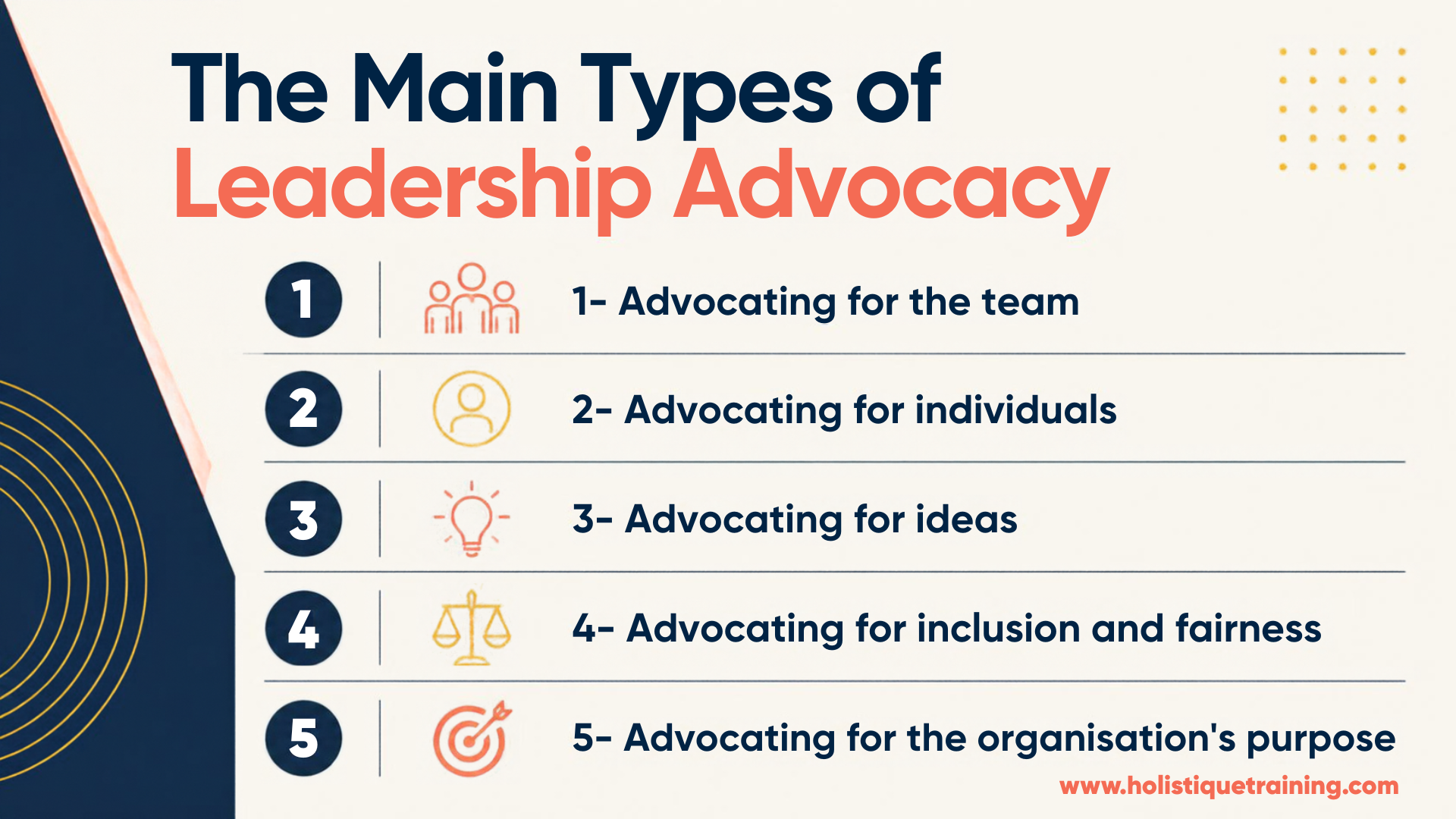
Leaders advocate in several different ways, and recognising them helps organisations decide where to focus development effort. Five types appear most often in practice.
1- Advocating for the team: Leaders argue for resources, realistic deadlines, training and protection from unreasonable demands. This might involve negotiating a workload adjustment or defending the team's results when other departments misunderstand them.
2- Advocating for individuals: This means recommending a capable colleague for a stretch assignment, correcting the record when someone's contribution has been overlooked, or supporting a person through a difficult period.
3- Advocating for ideas: Innovation rarely survives on merit alone. Leaders help promising proposals gain a hearing by framing them in terms senior decision-makers value and by securing early supporters before a formal decision is made.
4- Advocating for inclusion and fairness: Leaders challenge biased processes, speak up when someone is excluded and ensure that opportunities are distributed fairly across the whole workforce.
5- Advocating for the organisation's purpose: Leaders also represent their organisation externally, speaking with clients, regulators, partners and communities about its values and its contribution to society.
Most leaders practise more than one of these types at once, and the balance shifts with their role. A first-line supervisor is likely to focus on the team and on individuals, whereas a director may spend more time advocating for ideas and for the organisation's wider purpose. Development programmes should therefore help leaders recognise which type of advocacy their current position requires.
5- Core Skills of an Advocate Leader
Advocacy is a learnable skill set rather than a personality trait. Five capabilities underpin it, and each can be developed through practice, feedback and structured learning.
Persuasive Communication
Advocates must translate concerns into messages that decision-makers will hear. That means leading with the outcome that matters to the audience, using concrete examples, and adjusting tone to the setting. Storytelling is particularly powerful because a single well-chosen example often carries more weight than a page of figures. Leaders should also practise concise delivery, since senior decision-makers rarely have time for lengthy explanations.

Influential communication is the cornerstone of effective leadership. Discover the importance of communication skills, the persuasive leadership style, and practical tips to become an influential communicator as a leader.
Evidence-Based Reasoning
Credible advocacy rests on facts. Leaders who present data, case examples and clear options are taken more seriously than those who rely on frustration or general assertion, and they are far more likely to secure a positive decision. Preparing a short summary of the problem, the evidence, the proposed solution and the expected benefit is a simple habit that strengthens almost any case.
Empathy and Active Listening
A leader cannot represent people they do not understand. Regular, open conversations with team members ensure that advocacy reflects what people actually need rather than what the leader assumes they need. Active listening also reveals concerns that people may not raise formally, allowing leaders to act before small issues become serious ones.
Courage and Integrity
Advocacy sometimes means disagreeing with a more senior person. Doing so respectfully and honestly, without personal attack, builds long-term credibility and shows the team that speaking up is safe. Courage is not the same as confrontation, and the most effective advocates combine firmness on the issue with respect for the person they are addressing.
Political Awareness
Leaders must understand who holds influence, what pressures decision-makers face and when to raise an issue. Good timing often determines whether a well-prepared case succeeds or stalls. Building relationships before they are needed makes it far easier to ask for support at a critical moment.
6- Advocacy and Employee Voice
Employee voice is the mechanism through which people raise concerns, ideas and feedback, and advocacy is what leaders do with that input. Without advocacy, voice channels become suggestion boxes that produce no change. When leaders carry what they hear to people who can act on it, employees learn that speaking up is worthwhile.
The importance of line managers is clear in UK evidence. According to the CIPD Good Work Index 2025, the proportion of workers who feel they have a supportive manager when they have a problem rose from 74 per cent in 2023 to 79 per cent in 2025. The same survey found that 69 per cent now say their manager is open and approachable on issues such as mental health.
These gains show that manager behaviour can be improved, and advocacy is a natural next step. Listening is the foundation, but representing what is heard is what completes the cycle.
Closing the Feedback Loop
One of the most valuable advocacy habits is reporting back. When a leader raises a concern with senior colleagues, they should tell the team what was said and what happened next, even if the answer is no. This transparency shows that the concern was taken seriously and prevents the cynicism that follows when employees never hear what became of their feedback. It also helps people understand the constraints leaders face, which makes future conversations more realistic and constructive.
7- Advocating for Inclusion and Career Progression
Advocacy has particular value in addressing unequal access to opportunity. People who are less visible to senior decision-makers often depend on someone willing to speak for them, and leaders who do so help to widen the talent pipeline.
The evidence on sponsorship illustrates the point. According to McKinsey and LeanIn.Org's Women in the Workplace 2025 report, only 31 per cent of entry-level women have a sponsor compared with 45 per cent of entry-level men. The research also found that employees with sponsors were promoted at nearly twice the rate of those without. Where advocacy is unevenly distributed, careers are unevenly shaped.
HR and L&D teams can respond by making advocacy visible in talent reviews, asking leaders to name who they have championed and checking whether those names reflect the diversity of the workforce. Development programmes that build confidence and assertiveness for emerging leaders also help people advocate for themselves.

In the modern era, it’s becoming more common for women to take up leadership roles. Childcare responsibilities are shared more equally between partners, and women have greater opportunities and scope to progress within their job roles. Women possess natural skills and
Inclusion also depends on design. Transparent promotion criteria, structured interviews and diverse selection panels reduce the reliance on informal advocacy, but they do not replace it. The strongest organisations combine fair processes with leaders who are willing to challenge decisions that appear to disadvantage particular groups.
8- Advocating Upwards, Downwards and Sideways
Advocacy operates in every direction within an organisation. Each direction demands a slightly different approach.
Direction | Purpose | Example | Key Skill |
Upwards | Influence senior decisions | Presenting a business case for additional headcount | Persuasion and timing |
Downwards | Support and protect the team | Shielding staff from unrealistic demands | Empathy and fairness |
Sideways | Build cooperation across functions | Securing support from another department | Negotiation and trust |
Externally | Represent the organisation | Engaging clients, regulators and partners | Credibility and clarity |
Advocating Upwards
Upward advocacy requires leaders to frame requests in terms of organisational priorities. Senior decision-makers respond best to proposals that link a team's needs to strategy, risk or financial return.
Advocating Downwards
Downward advocacy means ensuring that people know their leader will represent them. It also involves translating senior decisions honestly, so teams understand the reasoning behind them rather than only the outcome.
Advocating Sideways
Sideways advocacy builds the cross-functional relationships on which complex work depends. Leaders who support colleagues' initiatives usually find their own requests are received more positively in return.
Leaders who advocate in all directions develop a reputation for fairness and reliability. That reputation becomes an asset, because colleagues at every level are more willing to listen when a trusted advocate makes a request.
9- Advocacy During Change and Uncertainty
Change tests advocacy more than any other situation. Employees look to leaders to explain what is happening, represent their concerns and ensure that decisions are implemented fairly. Leaders who advocate during restructures, technology shifts or strategic pivots reduce anxiety and sustain performance, while those who stay silent often see rumour and resistance fill the gap.
In volatile conditions, advocacy also involves being honest about what is not yet known. Leaders can acknowledge uncertainty, commit to sharing updates and argue for the support their teams need to adapt, such as protected training time or revised targets.

In today's fast-paced corporate landscape, leaders often grapple with overwhelming responsibilities amidst the ever-evolving VUCA challenges - Volatility, Uncertainty, Complexity, and Ambiguity. This course offers a candid exploration of leadership strategies essential for navigating through turbulent times. Participants will learn to cultivate empathetic behaviours, prioritise
Communicating with Consistency
Advocacy during change works best when messages are consistent. Leaders who give different explanations to different audiences quickly lose trust. Agreeing a clear narrative with senior colleagues, then adapting the detail for each audience, allows leaders to represent both the organisation and their people credibly.
10- Stakeholder Advocacy and External Influence
Leaders also advocate beyond organisational boundaries. Clients, regulators, funders, partners and community groups all form views of an organisation based on the quality of its leadership. Stakeholder advocacy involves understanding what each group needs, presenting the organisation's case clearly and building relationships of mutual benefit rather than one-off transactions.
Effective stakeholder advocacy begins with mapping who holds influence and interest, then tailoring messages to each group. It also means listening, since the most persuasive advocates are those who can show they have understood the concerns of the people they are addressing.
https://holistiquetraining.com/en/news/best-stakeholder-management-training-course
Reputation is built over time. Leaders who keep their promises to external partners, share information openly and respond constructively to criticism create goodwill that becomes invaluable during difficult periods, such as a service failure or a contested decision.
11- Common Pitfalls and Risks in Leadership Advocacy
Advocacy can fail when it is poorly judged. Leaders and HR teams should be alert to the following risks.
1- Favouritism: Advocating repeatedly for the same individuals, particularly those who resemble the leader, creates perceptions of unfairness and damages trust across the team.
2- Speaking for people rather than with them: Leaders who assume they know what others want may misrepresent them. Consulting people first ensures that advocacy reflects their actual priorities.
3- Over-promising: Making commitments that cannot be delivered erodes credibility. Leaders should be clear about what they can influence and what lies outside their control.
4- Advocacy without evidence: Strong feelings are not enough. Cases that lack data or a clear proposal are easy for decision-makers to dismiss.
5- Burnout among advocates: Constantly carrying other people's concerns is demanding. Organisations must support leaders who take on this role, or the behaviour will fade.
Most of these risks can be reduced through awareness and good habits. Leaders who check their assumptions, consult the people they represent and rely on evidence tend to advocate with greater credibility. HR teams can help by offering coaching and peer support, so that leaders have a place to reflect on difficult judgement calls and learn from one another's experience.
12- Measuring the Impact of Advocacy
Advocacy can seem intangible, yet its effects can be tracked. HR and L&D teams can combine survey data, talent metrics and qualitative feedback to understand whether leaders are advocating effectively.
Indicator | What It Shows | Possible Source |
Team trust scores | Confidence that the leader represents staff | Engagement surveys |
Internal promotion rates | Whether talent is being championed fairly | HR analytics |
Voice channel usage | Willingness to raise concerns | Pulse surveys and forums |
Team retention | Whether people feel supported | Exit interviews and turnover data |
No single indicator is conclusive, so trends over time matter more than snapshots. Combining quantitative measures with 360-degree feedback, which asks colleagues directly how often their leader has spoken up for them, gives a fuller and more reliable picture.
Qualitative evidence is equally useful. Stories from team members about moments when their leader spoke up for them reveal the real texture of advocacy, and they can be used in leadership programmes to illustrate what good looks like. Regular reviews also help organisations adjust their approach if the data suggests that advocacy is concentrated among a small number of leaders.
13- How HR and L&D Teams Can Build Advocacy Capability
Advocacy grows through deliberate organisational design. HR and L&D teams can support it in five practical ways.
1- Define advocacy in the leadership framework: Include it as an explicit behaviour with examples at each level, so managers know what is expected of them.
2- Train for the skills: Provide practical learning in persuasive communication, stakeholder analysis and difficult conversations, supported by role-play and real workplace cases.
3- Build advocacy into talent reviews: Ask leaders to explain who they are championing and why, and review whether opportunities are distributed fairly.
4- Create safe channels for voice: Advocacy relies on information. Regular forums, pulse surveys and open meetings give leaders the insight they need to represent people accurately.
5- Recognise and model the behaviour: Celebrate leaders who advocate well, and ensure senior executives demonstrate the behaviour themselves.
Senior leaders set the tone, so development for executives should address advocacy directly, including how it is practised, rewarded and sustained across the organisation.

The Chief Executive Officer (CEO) Leadership Program is an intensive and comprehensive course designed for aspiring and current CEOs who aim to enhance their leadership skills and drive organisational success. This program provides participants with the tools, frameworks, and strategies needed to lead complex organisations
Progress should be reviewed regularly. Short pulse surveys, leadership workshops and peer coaching circles keep advocacy on the agenda, and they give leaders a safe place to rehearse difficult conversations before they take place.
Conclusion
Advocacy in leadership is the disciplined use of influence to champion people, ideas and causes that deserve support. It differs from self-promotion, sponsorship and mentoring while drawing on elements of each, and it operates upwards, downwards, sideways and beyond organisational boundaries. Its value is visible in trust, retention, inclusion and the quality of decisions.
For HR and L&D professionals, the priority is to treat advocacy as a teachable, measurable capability. Defining it clearly, developing the underlying skills and rewarding leaders who practise it will help organisations build workplaces where people feel represented and ideas are heard. In an era of declining engagement, leaders who advocate well offer one of the most practical ways to rebuild confidence.