

- Table of Contents
- Introduction
- Empathetic Leadership
- Advantages of Empathetic Leadership
- Improved Morale, Motivation, and Job Satisfaction
- Collaboration and Inclusivity
- Challenges of Empathetic Leadership
- Striking the Right Balance
- Suitability for All Situations
- Authoritarian Leadership
- Advantages of Authoritarian Leadership
- Effective in Crisis Situations
- Quick Decision-Making
- Challenges of Authoritarian Leadership
- Stifled Creativity and Innovation
- Negative Work Culture
- Empathetic vs. Authoritarian Leadership
- The Empathetic-Authoritarian Spectrum
- The Importance of Adaptability
- Leadership in Practice
- Scenario 1: Crisis Management
- Scenario 2: Team Innovation
- Developing Empathetic Leadership Skills
- 1. Active Listening and Empathetic Responses
- 2. Walk in Their Shoes
- 3. Show Appreciation and Recognition
- 4. Be Approachable and Available
- 5. Provide Emotional Support
- 6. Empower and Develop
- 7. Foster Teamwork and Inclusivity
- Balancing Empathy and Authoritarianism
- 1. Set Clear Expectations:
- 2. Provide Constructive Feedback
- 3. Making Tough Decisions
- 4. Consistency in Leadership
- 5. Trust Your Team
- 6. Transition When Necessary
- 7. Seek Feedback and Reflect
- Conclusion
Introduction
Leadership is an essential aspect of any organisation. Effective leadership is critical to achieving success, whether it is a business, a non-profit organisation, or a government agency. However, not all leadership styles are the same. Some leaders may adopt an authoritarian style, while others may embrace empathetic leadership. This comprehensive guide will delve deep into both leadership styles, their pros and cons, and how they can impact an organisation. By the end of this article, you'll clearly understand the dynamics between empathetic and authoritarian leadership and how to navigate them effectively.
Empathetic Leadership
Empathetic leadership focuses on understanding and responding to employees' needs. It is a people-centred approach that prioritises building relationships, fostering trust, and creating a positive work environment. Empathetic leaders take the time to listen to their employees, recognise their contributions, and show appreciation for their hard work.
Advantages of Empathetic Leadership
1.Improved Morale, Motivation, and Job Satisfaction
Employees who feel valued and supported are likelier to be engaged and committed to their work. This can increase productivity, better performance, and higher job retention rates. For example, consider a scenario in which a manager regularly acknowledges the efforts of their team members and takes the time to understand their concerns. In such an environment, employees are more motivated to excel in their roles.
2. Collaboration and Inclusivity
Empathetic leaders tend to create a more collaborative and inclusive work environment. They encourage open communication, foster teamwork, and promote a culture of respect and understanding. This can lead to better decision-making, stronger relationships, and a more positive work culture. For instance, a team that feels comfortable sharing diverse perspectives is more likely to generate innovative solutions to complex problems.
Challenges of Empathetic Leadership
1.Striking the Right Balance
One of the main challenges is finding the right balance between being supportive and being too lenient. Empathetic leaders may be hesitant to provide negative feedback or make tough decisions because they do not want to upset their employees. This can lead to a lack of accountability and a failure to address performance issues. Imagine a situation where an employee consistently fails to meet deadlines. An empathetic leader might struggle to address this issue directly, which could ultimately harm the team's productivity.
2.Suitability for All Situations
Empathetic leadership may not be suitable for all types of organisations or situations. A more assertive leadership style may sometimes be necessary to address urgent or complex problems. For example, a leader who prioritises empathy over authority may struggle to make swift decisions in a crisis requiring immediate action.
Authoritarian Leadership
Authoritarian leadership is a style focused on control and authority. It is a top-down approach in which the leader makes all the decisions and expects employees to follow orders without question. Authoritarian leaders often use fear, intimidation, and punishment to maintain authority and ensure compliance.
Advantages of Authoritarian Leadership
1.Effective in Crisis Situations
One of the main advantages of authoritarian leadership is that it can be effective in situations where clear direction and immediate action are needed. For example, an authoritarian leader may be necessary in emergencies to ensure that everyone follows the proper procedures and protocols. Consider a fire drill scenario in a workplace where the immediate evacuation of employees is essential. An authoritarian leader would ensure that the evacuation process runs smoothly and efficiently.
2.Quick Decision-Making
Authoritarian leaders can also make decisions quickly and efficiently. Because they do not need to consult with others or consider different viewpoints, they can act decisively and get things done. This can be advantageous in industries where rapid decision-making is crucial. For instance, swift actions can make a significant difference in managing market volatility in the financial sector.

Explore the power of decision-making in work and life. Learn from real examples and gain practical insights to enhance your decision-making skills today.
Challenges of Authoritarian Leadership
1.Stifled Creativity and Innovation
One of the main drawbacks of authoritarian leadership is that it can lead to a lack of creativity, innovation, and critical thinking. Employees may hesitate to speak up or share their ideas because they fear retribution. This can stifle innovation and prevent the organisation from adapting to new challenges or opportunities. According to Forbes, 61% of employees report a great sense of innovation with empathetic leaders, whereas only 13% of those lacking empathetic leadership shared this sentiment. Imagine a team where employees are afraid to propose new strategies or suggest improvements because they anticipate a backlash from their authoritarian leader. In such an environment, innovative ideas are often left unexplored.
2. Negative Work Culture
Authoritarian leadership can also lead to a negative work culture. When employees feel like they are being micromanaged and have no say in the decision-making process, they may become disengaged, demotivated, and unhappy. This can lead to high turnover rates, low productivity, and poor job satisfaction. In a workplace characterised by authoritarian leadership, employees may simply go through the motions without a genuine commitment to their tasks.

Learn how a strong company culture drives success and fosters employee engagement, productivity, and innovation. Explore the 6 pillars for building a positive work environment and discover the impact of organisational health on your company's prosperity.
Empathetic vs. Authoritarian Leadership
The differences between empathetic and authoritarian leadership are significant. Empathetic leaders prioritise building relationships, fostering trust, and creating a positive work environment. They encourage open communication, show appreciation for their employees, and are willing to listen to different viewpoints. They focus on collaboration, inclusivity, and empowerment.
Authoritarian leaders, on the other hand, prioritise control and authority. They make all the decisions and expect employees to follow their orders without question. They may use fear, intimidation, or punishment to maintain their authority and ensure compliance. They focus on efficiency, productivity, and achieving specific goals.
While both leadership styles have advantages and disadvantages, empathy and authoritarianism are not mutually exclusive. Effective leadership requires a balance between these two approaches, depending on the situation and the organisation's needs.
The Empathetic-Authoritarian Spectrum
Leadership styles can be thought of as existing on a spectrum, with pure empathetic leadership at one end and pure authoritarian leadership at the other. In reality, most leaders fall somewhere in between, utilising aspects of both styles as the situation demands. Here's a breakdown of where different leadership approaches may fall on the spectrum:
Leadership Style | Characteristics |
Pure Empathetic | - Highly relationship-oriented |
| - Encourages open communication | |
- Emphasises collaboration and inclusivity | |
- Fosters a positive work culture | |
- Tends to avoid confrontation and tough decisions | |
Balanced (Hybrid) | - Adapts leadership style as needed |
- Values relationships but can make tough decisions | |
- Combines empathy with assertiveness | |
Pure Authoritarian | - Highly control-oriented |
- Makes all decisions with limited input | |
- May use fear or intimidation to enforce authority | |
- Focuses on efficiency and productivity |
Table 1: The Characteristics of Each Leadership Style
The Importance of Adaptability
It is also important to note that effective leaders can adapt their leadership style depending on the needs of their team or organisation. A good leader understands the strengths and weaknesses of their team and can adjust their leadership style to bring out the best in each individual.
For instance, if a leader recognises that a team member is struggling with a project, they may adopt a more empathetic approach by providing support, guidance, and additional resources. Conversely, when facing a critical deadline, the same leader may need to temporarily adopt a more authoritarian stance to ensure the project is completed on time.
Leadership in Practice
To put the concepts of empathetic and authoritarian leadership into practical context, let's explore two hypothetical scenarios:
Scenario 1: Crisis Management
Imagine you are the leader of a manufacturing company, and there has been a serious safety incident on the production floor. In this crisis situation, swift action is needed to ensure employees' safety and prevent further accidents. In such a scenario, an authoritarian leadership style would be essential. As the leader, you would take immediate control of the situation, ensuring that safety protocols are followed rigorously and making tough decisions, such as shutting down the production line until safety measures are verified.
While this authoritative approach may be necessary at the moment, it should be followed by empathetic actions. After the crisis is resolved, an empathetic leader would take the time to understand how the incident impacted the employees involved, address their concerns, and implement measures to prevent a recurrence. This combination of authoritarian decisiveness and empathetic follow-up creates a well-rounded leadership response to a crisis.
Scenario 2: Team Innovation
Now, consider a scenario where you lead a creative design team tasked with developing innovative solutions for your organisation's products. In this context, an empathetic leadership style would be highly beneficial. You foster a culture of innovation by encouraging open communication, showing appreciation for your team's creative contributions, and providing an environment where diverse ideas are welcomed.
However, as a leader, you must also set clear expectations and make tough decisions when necessary. For example, if a project is falling behind schedule or veering off course, you may need to step in and provide guidance, even if it means altering or redirecting the creative process. Balancing your empathetic approach with occasional assertiveness ensures that your team's creativity is channelled effectively toward achieving organisational goals.

Learn why a culture of continuous innovation is vital in the workplace. Discover the benefits it brings, how to foster it as a leader, and the state of innovation in 2024.
Developing Empathetic Leadership Skills
Empathetic leadership is a valuable asset in today's dynamic work environments, where employees seek guidance and understanding and support from their leaders. In fact, in the 2023 Empathy in Business Survey conducted by Ernst & Young LLP (EY US), following their initial analysis of empathy in 2021, it was discovered that employees believe that fostering mutual empathy between company leaders and employees results in heightened efficiency (88%), enhanced creativity (87%), increased job satisfaction (87%), improved idea sharing (86%), greater innovation (85%), and even boosted company revenue (83%). To become a more empathetic leader, consider these practical strategies that go beyond mere recognition:
1. Active Listening and Empathetic Responses
Listening actively goes beyond hearing words; it's about understanding emotions, perspectives, and unspoken concerns. Practise active listening by giving your full attention when your employees speak. Maintain eye contact, nod, and use verbal cues to show you are engaged in the conversation.
When responding, use empathetic language to acknowledge the speaker's feelings and thoughts. Phrases like "I understand how you feel" or "Tell me more about your perspective" convey empathy and encourage open dialogue. Empathetic responses create an environment where employees feel heard and valued.

Discover the transformative impact of empathetic leadership. Learn how understanding and connecting with your team on a deeper level fosters innovation, psychological safety, and trust. Explore real-world examples and practical steps to cultivate empathy as a leader.
2. Walk in Their Shoes
Empathy requires putting yourself in your employees' shoes to understand their experiences and challenges. Take time to learn about their roles and responsibilities, the obstacles they face, and the goals they strive to achieve. This knowledge allows you to relate to their daily experiences more deeply.
For instance, if you're leading a team of software developers, spend time learning about their coding processes and challenges. This fosters empathy and shows your commitment to understanding their work.
3. Show Appreciation and Recognition
Recognising your employees' contributions is a cornerstone of empathetic leadership. While words of appreciation are important, meaningful gestures can make a lasting impact. Consider small acts like handwritten thank-you notes, celebrating work anniversaries, or organising team lunches to show your appreciation.
Furthermore, publicly acknowledging and praising employees for their accomplishments can boost morale and create a positive work culture. It demonstrates that you value their efforts and encourage them to continue excelling.
4. Be Approachable and Available
Empathetic leaders create an open-door policy where employees feel comfortable approaching them with questions, concerns, or ideas. Ensure your team knows they can reach out to you without fear of judgment or retribution.
By making yourself available, you encourage honest and transparent communication. When employees know they can share their thoughts without hesitation, it can lead to innovative ideas and problem-solving.
5. Provide Emotional Support
Recognise that employees may face personal challenges that impact their work. Show empathy by providing emotional support during difficult times, whether a personal loss or a challenging project. Offer resources or flexible schedules when appropriate, and always approach such situations compassionately.
6. Empower and Develop
Empathetic leaders empower their employees by giving them the tools, resources, and authority they need to succeed. Encourage autonomy, trust your team to make decisions, and provide growth and skill development opportunities. When employees feel empowered, they are likelier to take ownership of their work and contribute effectively.
7. Foster Teamwork and Inclusivity
Empathy extends to creating a work environment where teamwork and inclusivity are valued. Encourage collaboration among team members, celebrate diversity of thought, and ensure that every voice is heard. Promoting inclusivity fosters a sense of belonging and contributes to a positive work culture.

Learn how to effectively manage multicultural teams by fostering cultural awareness, open communication, and inclusivity. Explore the benefits of diversity and discover the best practices to create a harmonious and innovative work environment.
In summary, developing empathetic leadership skills requires a genuine commitment to understanding and supporting your team members. It involves active listening, walking in their shoes, showing appreciation, being approachable, providing emotional support, empowering employees, and fostering teamwork and inclusivity. By cultivating these skills, you can create a workplace where empathy thrives, leading to increased morale, motivation, and job satisfaction among your team members.
Balancing Empathy and Authoritarianism
Balancing empathy and authoritarianism is the cornerstone of effective leadership. It's a delicate dance that requires a keen understanding of your team, the organisation's goals, and the specific context of each situation. Here, we delve deeper into the strategies and principles behind achieving this balance:
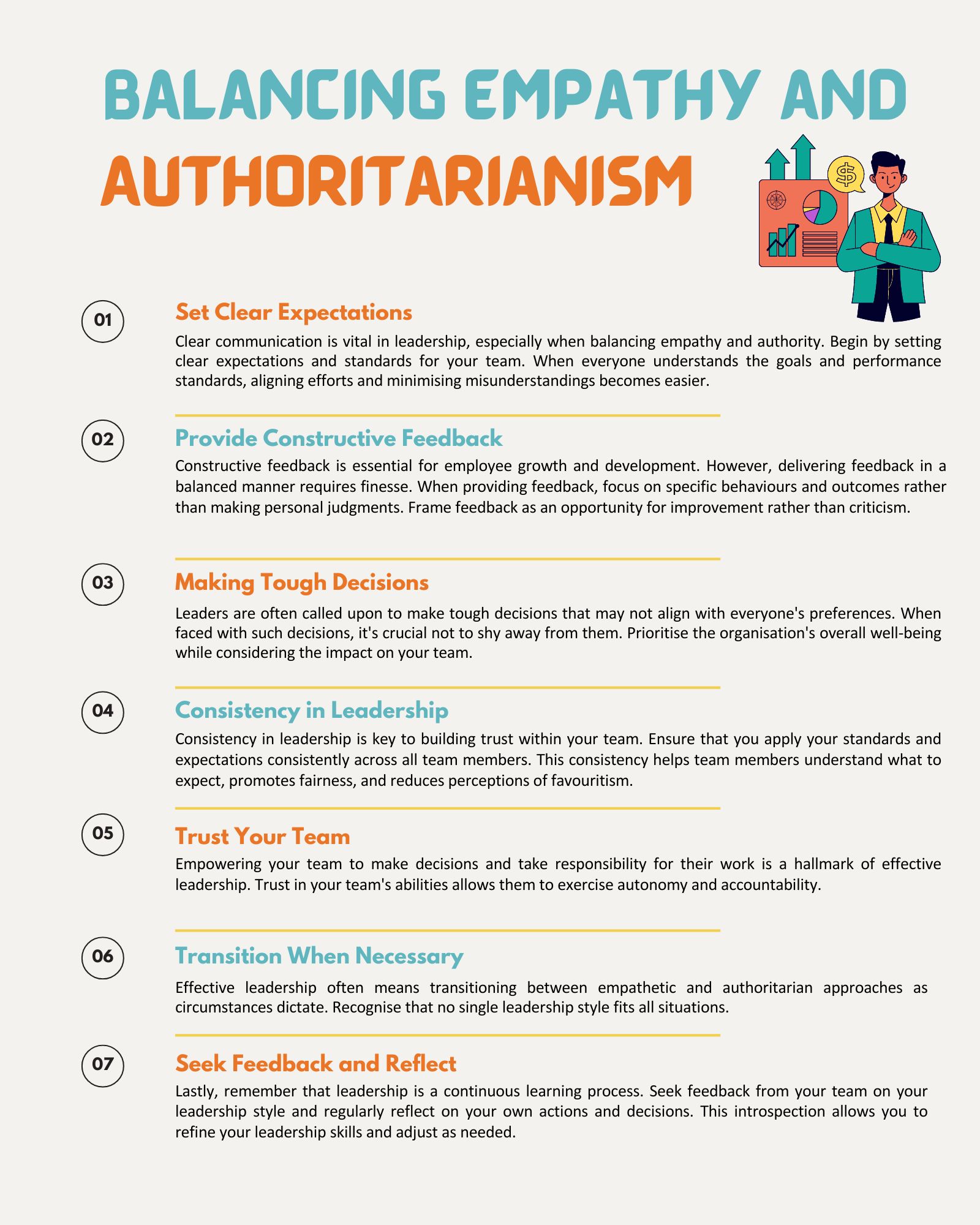
1. Set Clear Expectations:
Clear communication is vital in leadership, especially when balancing empathy and authority. Begin by setting clear expectations and standards for your team. When everyone understands the goals and performance standards, aligning efforts and minimising misunderstandings becomes easier.
For example, if you're managing a sales team, ensure they know monthly sales targets, key performance indicators, and the expected level of client interaction. This clarity empowers employees to work efficiently while reducing ambiguity.
2. Provide Constructive Feedback
Constructive feedback is essential for employee growth and development. However, delivering feedback in a balanced manner requires finesse. When providing feedback, focus on specific behaviours and outcomes rather than making personal judgments. Frame feedback as an opportunity for improvement rather than criticism.
For instance, if an employee's performance is subpar, you might say, "I've noticed that there have been delays in project submissions. Let's work together to identify any challenges and find solutions to improve our workflow." This approach maintains an empathetic tone while addressing performance issues.
3. Making Tough Decisions
Leaders are often called upon to make tough decisions that may not align with everyone's preferences. When faced with such decisions, it's crucial not to shy away from them. Prioritise the organisation's overall well-being while considering the impact on your team.
For example, if cost-cutting measures are necessary to maintain the company's financial stability, you may need to make the difficult choice of reducing team budgets. Communicate the reasons behind the decision transparently and be prepared to address concerns empathetically.
4. Consistency in Leadership
Consistency in leadership is key to building trust within your team. Ensure that you apply your standards and expectations consistently across all team members. This consistency helps team members understand what to expect, promotes fairness, and reduces perceptions of favouritism.
Consistency should also extend to how you handle situations. Whether you address performance issues, recognise achievements, or provide feedback, your team should perceive a fair and equitable approach.
5. Trust Your Team
Empowering your team to make decisions and take responsibility for their work is a hallmark of effective leadership. Trust in your team's abilities allows them to exercise autonomy and accountability.
Suppose you lead a project team. In that case, you might entrust individual team members with specific project tasks, giving them ownership of those responsibilities. When they know you trust their judgement and skills, they are more likely to excel and collaborate effectively.
6. Transition When Necessary
Effective leadership often means transitioning between empathetic and authoritarian approaches as circumstances dictate. Recognise that no single leadership style fits all situations.
For instance, during a crisis or a high-pressure situation, you may need to temporarily adopt a more authoritarian stance to ensure quick decision-making and crisis management. Once the crisis subsides, you can return to a more empathetic approach to address the emotional aftermath and ensure your team's well-being.
Balancing empathy and authoritarianism isn't about sticking rigidly to one style or the other but adapting your leadership approach to meet the specific needs of your team and organisation.
7. Seek Feedback and Reflect
Lastly, remember that leadership is a continuous learning process. Seek feedback from your team on your leadership style and regularly reflect on your own actions and decisions. This introspection allows you to refine your leadership skills and adjust as needed.
Additionally, consider seeking mentorship or leadership development programmes to further hone your abilities in striking the right balance between empathy and authority. Learning from experienced leaders and expanding your knowledge can significantly benefit your leadership journey.
Conclusion
Effective leadership requires a balance between empathy and authoritarianism. While empathetic leadership can improve morale, motivation, and job satisfaction, it can also lead to a lack of accountability and a failure to address performance issues. Authoritarian leadership can be effective in emergencies and when quick decisions need to be made, but it can also stifle creativity and innovation and lead to a negative work culture.
To be an effective leader, it is important to understand the strengths and weaknesses of both styles of leadership and adapt your leadership style to the needs of your team or organisation. You can develop your empathetic leadership skills by listening actively, showing appreciation, being approachable, practising empathy, and providing feedback. By setting clear expectations, making tough decisions, being consistent, trusting your team, and prioritising efficiency, you can balance your empathy and authoritarianism and become a more effective leader.
For those seeking to refine their leadership skills further and become exceptional supervisors, make sure to explore our comprehensive course, ‘Becoming an Effective Supervisor.’ This course offers invaluable insights and strategies to help you navigate the complexities of leadership and lead your team to success. Take the next step in your leadership journey with our course and unlock your full leadership potential. Enroll now!

Many factors contribute to business success. One important factor is efficient management. An effective supervisor is crucial to maintaining employee productivity. A supervisor must take on the responsibility of ensuring a positive working environment that encourages passion and dedication in all