
- Table of Contents
- Introduction
- 1- What Makes a Negotiation Training Course Worth the Investment?
- 2- Best Negotiation Training Courses in 2026
- 1- Negotiation and Leadership – Harvard Program on Negotiation (PON)
- 2- Changing the Game: Negotiation and Competitive Decision-Making – Harvard Business School
- 3- Introduction to Negotiation: A Strategic Playbook – Yale University (via Coursera)
- 4- Negotiation, Mediation and Conflict Resolution Specialisation – ESSEC Business School (via Coursera)
- 5- Successful Negotiation: Essential Strategies and Skills – University of Michigan (via Coursera)
- 6- Effective Negotiating® – KARRASS
- 7- Advanced Negotiation and Critical Thinking Skills to Strengthen Strategic Change
- 8- Effective Tendering, Negotiation and Contracting in Procurement
- 3- Comparing the Courses at a Glance
- 4- How to Choose the Right Course for Your Team
- 5- Making the Business Case for Negotiation Training
- Conclusion
Introduction
Negotiation is one of those skills that every professional uses and almost no one is formally trained in. Whether your teams are renewing supplier contracts, managing stakeholder conflicts, closing commercial deals, or simply pushing for budget in an internal meeting, negotiation happens every single day across every level of an organisation. Yet research by Huthwaite International consistently finds that the vast majority of companies have no formal negotiation process in place and no systematic way of measuring whether their people are negotiating effectively. The result is value left on the table, relationships unnecessarily strained, and outcomes that could have been significantly better with the right preparation and skill set.
For HR professionals and Learning and Development managers, the challenge in 2026 is not a shortage of options. The negotiation training market has matured considerably, and the choice now spans Harvard executive programmes, accredited short courses, self-paced online specialisations, and globally delivered classroom training. The real challenge is knowing which programmes are genuinely rigorous, which formats suit your team's context, and how to build a credible case for investment.
This article reviews eight of the best negotiation training courses available in 2026, drawn from internationally recognised providers across both online and in-person formats. Each review covers what the programme teaches, who it is designed for, how it is delivered, and what kind of credential participants receive. We have selected courses that represent a genuine range of depth, format, and audience, so that HR and L&D teams can identify the option that best matches their organisation's needs, whether that is a three-day executive intensive, a self-paced online specialisation, or an accredited professional programme delivered across international locations.
1- What Makes a Negotiation Training Course Worth the Investment?
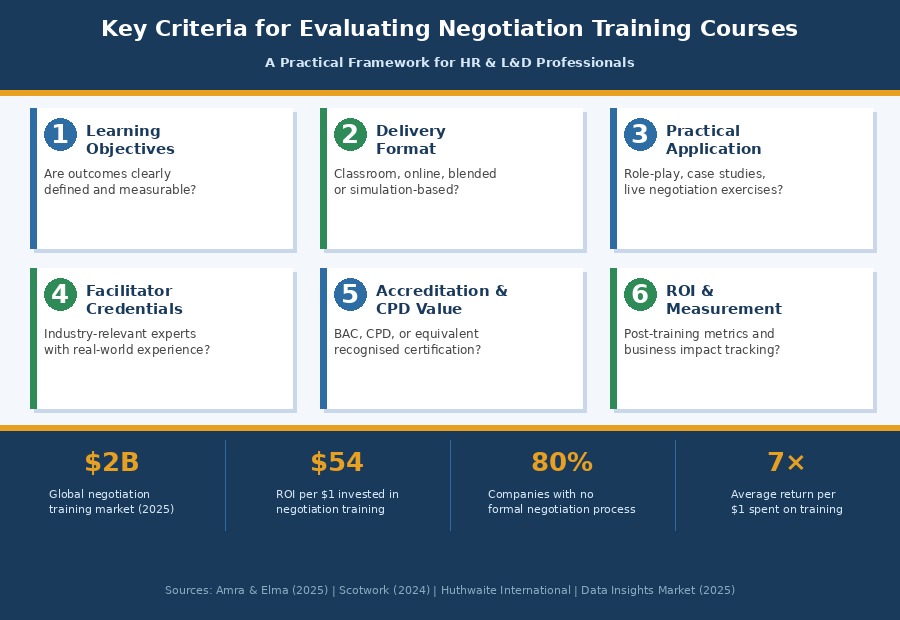
Before reviewing specific programmes, it is worth establishing the criteria that separate effective negotiation training from the large number of generic communication workshops that borrow negotiation language without delivering real competency development. A useful programme does several things consistently: it is grounded in a structured, replicable framework rather than a collection of tips; it dedicates substantial time to practice through role-plays, simulations, or live case work; it addresses the psychological and emotional dimensions of negotiation, not just the rational ones; and it produces outcomes that participants can measure and apply in their actual professional context.
According to research compiled by Scotwork , organisations with a systematic approach to negotiation experience 42.7% greater growth in bottom-line performance compared to those without one. That figure makes the business case straightforward. The remaining question is which programme delivers the depth, relevance, and practical transfer that your teams need.
The infographic below summarises the six criteria L&D professionals should use when evaluating any negotiation training programme. These criteria apply regardless of whether you are comparing an online self-paced course or a residential executive programme.
2- Best Negotiation Training Courses in 2026
1- Negotiation and Leadership – Harvard Program on Negotiation (PON)
The Harvard Program on Negotiation is widely regarded as the world's leading centre for negotiation research and teaching, and its flagship Negotiation and Leadership programme is one of the most respected short executive courses available globally. Delivered in person on the Harvard campus in Cambridge, Massachusetts, this three-day intensive draws participants from across business, government, law, and the non-profit sector from around the world.
The programme is built around the principled negotiation framework developed at the Harvard Negotiation Project and challenges participants to examine their assumptions, manage emotional and rational biases, and practise a range of competitive and cooperative negotiation strategies. Sessions move between interactive lectures, live role-plays, and case-based discussions, with substantial time dedicated to feedback and reflection. The programme is designed for intermediate to senior professionals who negotiate regularly and want to develop both the conceptual rigour and the practical flexibility of experienced negotiators. Topics include managing the tension between creating and claiming value, dealing with difficult counterparts, handling emotional dynamics, and leading complex multi-party negotiations.
Who it's for: Mid-to-senior professionals, managers, executives, lawyers, government officials, NGO leaders.
Format: In-person, Cambridge MA. Three days, instructor-led.
Certification: Certificate of completion from Harvard University.
2- Changing the Game: Negotiation and Competitive Decision-Making – Harvard Business School
This six-day residential programme from Harvard Business School takes a more strategic and psychological approach than the PON offering, making it particularly well suited to senior executives and business leaders who negotiate at the level of major deals, partnerships, and cross-organisational agreements. Delivered on the HBS campus, the programme explores how to develop psychological insights alongside practical negotiation skills, with a strong emphasis on competitive decision-making and the long-term management of complex stakeholder relationships.
Participants work through advanced case studies drawn from real business situations, engage in structured negotiation simulations, and learn how to approach each negotiation with both strategic clarity and tactical flexibility. The curriculum addresses how to steer critical deals with partners, vendors, clients, and investors, and places particular emphasis on building frameworks that hold up in high-pressure and time-constrained environments. The programme also counts towards the HBS Certificate of Management Excellence, making it a useful credential for senior professionals building a broader executive education profile.
Who it's for: Senior executives, business leaders, and professionals managing high-value commercial negotiations.
Format: In-person, HBS Campus, Boston. Six days, residential.
Certification: Certificate of completion; counts towards HBS Certificate of Management Excellence.
3- Introduction to Negotiation: A Strategic Playbook – Yale University (via Coursera)
Taught by Barry Nalebuff, Milton Steinbach Professor at the Yale School of Management, this is one of the highest-rated negotiation courses available online globally. Delivered through Coursera as a nine-module self-paced programme, it takes a distinctive approach by building a coherent analytical framework for negotiation rather than offering a list of tactics. The course is grounded in game theory and helps learners understand how to predict, interpret, and shape the behaviour of counterparts in competitive situations.
Participants work through case studies based on realistic business and personal scenarios and have the opportunity to negotiate with other enrolled students, receiving structured peer feedback on their approach. Topics include finding and strengthening your BATNA, making and interpreting offers, expanding the total value available in a negotiation, handling ultimatums, and navigating power imbalances. Advanced modules cover negotiating when you hold little leverage, managing negotiations conducted over email, and gender dynamics in negotiation contexts. The course closes with insights from three leading negotiation practitioners: Linda Babcock, Herb Cohen, and John McCall MacBain. This programme is particularly strong as a foundational course for team members who are newer to structured negotiation thinking.
Who it's for: Professionals at all levels seeking a rigorous foundational framework; strong for those new to structured negotiation.
Format: Online, self-paced. Nine modules. Approximately one to three months to complete.
Certification: Course certificate available upon completion (paid).
4- Negotiation, Mediation and Conflict Resolution Specialisation – ESSEC Business School (via Coursera)
ESSEC Business School's four-course specialisation on Coursera is one of the most comprehensive online negotiation programmes currently available, and one of the few that explicitly addresses the needs of professionals working in business, public administration, international organisations, and NGOs. The programme was developed by Professor Aurélien Colson and his team, drawing on research and assignments across more than seventy countries, which gives the content a level of real-world breadth that more narrowly focused courses often lack.
The specialisation is structured across four sequential courses: Negotiation Fundamentals, International and Cross-Cultural Negotiation, Mediation and Conflict Resolution, and a Capstone Project. This progression from foundational tools through to cross-cultural complexity and third-party mediation makes it unusually well suited to organisations with internationally dispersed teams or teams that work regularly across cultural boundaries. The Capstone Project requires participants to apply the full suite of skills developed across the programme in a structured, assessed scenario, which produces a more meaningful learning outcome than courses that rely on passive knowledge acquisition alone. According to Coursera data, the specialisation has already enrolled over 57,000 learners globally, with strong ratings across all four courses.
Who it's for: Managers, HR professionals, public sector practitioners, international organisation staff, NGO professionals.
Format: Online, self-paced. Four courses. Approximately four to six months at ten hours per week.
Certification: ESSEC Business School certificate via Coursera, shareable on LinkedIn.
5- Successful Negotiation: Essential Strategies and Skills – University of Michigan (via Coursera)
Offered by the University of Michigan through Coursera, this is one of the most widely enrolled negotiation courses on the platform, with over 16,000 learner ratings and a strong reputation for clear, structured content delivery. The course covers the four essential stages of negotiation: preparation, negotiation itself, closing, and implementation, giving participants a complete process to follow rather than isolated techniques. It is designed to be accessible to a broad professional audience and is particularly well suited to team members who negotiate as part of their role but have never received formal training in how to approach it systematically.
The curriculum addresses both psychological and practical dimensions of negotiation, covering persuasion strategies, cross-cultural considerations, and how to navigate the specific dynamics of employment and salary negotiations. The self-paced format and relatively short completion time, typically four to six weeks, make it a strong option for L&D managers looking to roll out a scalable, accessible baseline programme across a team or department before moving participants into more advanced or contextualised training. The course is also available with financial aid on Coursera, which reduces barriers for organisations in developing markets.
Who it's for: Professionals at all levels; well suited for organisation-wide baseline training or team onboarding.
Format: Online, self-paced. Four to six weeks.
Certification: Course certificate available upon completion (paid).
6- Effective Negotiating® – KARRASS
KARRASS is one of the most established names in professional negotiation training, with more than one million participants trained across 95 cities worldwide and a client list that includes a significant number of Fortune 500 companies. The Effective Negotiating® programme is available in both in-person and live online formats and is specifically designed for business professionals who need to improve outcomes in commercial, procurement, and sales negotiation contexts. Unlike academic programmes, KARRASS focuses almost entirely on applied negotiation skills with an emphasis on achieving immediate, measurable results.
The live online version runs across four half-day sessions of approximately four and a half hours each, maintaining full interactivity through paired and group negotiations, live discussion with a seminar leader, and a dedicated moderator throughout. Participants work through realistic negotiation scenarios, develop psychological awareness of buyer and seller dynamics, learn how to make strategic concessions, and build the kind of confidence under pressure that comes from repeated structured practice. The programme also includes a comprehensive resource package of workbooks, books authored by Dr Chester Karrass, and online audio materials designed to reinforce learning after the seminar. For teams in procurement, commercial roles, or sales, this programme has one of the strongest track records of producing tangible post-training improvements in deal outcomes.
Who it's for: Business professionals, procurement teams, sales teams, contract managers.
Format: Live online (4 half-days) or in-person. Also available as a private group programme.
Certification: Certificate of completion; post-seminar reinforcement materials included.
7- Advanced Negotiation and Critical Thinking Skills to Strengthen Strategic Change
This advanced programme takes a distinctive approach by combining negotiation skills development with critical thinking and strategic change management, making it particularly relevant for professionals operating in complex, multi-stakeholder environments where negotiation outcomes have direct organisational consequences. The programme is delivered across international locations and is designed for professionals who already have some negotiation experience and want to move beyond tactical competency into strategic negotiation leadership.
The curriculum covers advanced negotiation frameworks, critical analysis of negotiation dynamics, the role of emotional intelligence in high-stakes discussions, and the application of negotiation skills in contexts involving organisational change and strategic decision-making. The programme is well suited to senior HR professionals, L&D managers, and leaders who negotiate internally across departments, manage complex external partnerships, or work in environments where building consensus across competing interests is a routine professional challenge. Accreditation by the British Assessment Council adds independent quality verification and international recognition to the credential. For HR teams looking to develop negotiation capability at a senior level, this programme offers a depth of content and contextual relevance that more generic courses do not match.
Who it's for: Senior managers, HR professionals, L&D leaders, strategic change practitioners.
Format: Classroom and online delivery across international locations. Five days.
Certification: BAC-accredited certificate; CPD-recognised.

Negotiation skills are an essential aspect of any business. They help secure the most beneficial contracts, cut costs to more affordable levels to increase profitability and develop effective relationships with partners to grow and achieve future success. Negotiation skills are
8- Effective Tendering, Negotiation and Contracting in Procurement
Procurement professionals operate in one of the most negotiation-intensive professional contexts in any organisation, yet they are often trained in technical procurement processes without receiving structured development in the negotiation skills that determine whether those processes produce genuinely competitive outcomes. This programme addresses that gap directly, combining training in tendering processes and contract management with a practical and applied approach to procurement negotiation.
The programme is designed for procurement officers, supply chain managers, and contract managers who need to negotiate confidently with experienced commercial counterparts. It covers the full procurement negotiation lifecycle, from pre-tender preparation and supplier engagement through to final contract discussions and post-award relationship management. Participants develop skills in planning and structuring procurement negotiations, managing supplier tactics, protecting value during concession exchanges, and maintaining long-term supplier relationships without compromising commercial outcomes. The programme is delivered across international locations in both classroom and online formats, and the accreditation by the British Assessment Council ensures that participants receive a credential that is verifiable and internationally recognised.
Who it's for: Procurement officers, supply chain managers, contract managers, finance professionals involved in supplier negotiations.
Format: Classroom and online delivery across international locations. Five days.
Certification: BAC-accredited certificate; CPD-recognised.

Every business uses regular suppliers to provide products for its customers and employees and to support its overall operation. These may be actual saleable items, office equipment such as technology or stationery, or items, services, and platforms that will improve the company's running and growth.
3- Comparing the Courses at a Glance
The table below summarises the eight programmes reviewed in this article to help HR and L&D managers identify the best fit for their team's level, context, and delivery preferences.
Course | Provider | Format | Level | Best For |
Negotiation and Leadership | Harvard PON | In-person, 3 days | Intermediate–Senior | Executives, cross-sector leaders |
Changing the Game | Harvard Business School | In-person, 6 days | Senior–Executive | Business leaders, deal-makers |
Introduction to Negotiation | Yale / Coursera | Online, self-paced | Beginner–Intermediate | Foundational framework building |
Negotiation, Mediation & Conflict Resolution | ESSEC / Coursera | Online, self-paced | Beginner–Intermediate | NGOs, international teams, HR |
Successful Negotiation | U. of Michigan / Coursera | Online, self-paced | All levels | Team-wide baseline training |
Effective Negotiating® | KARRASS | Live online / In-person | All levels | Procurement, sales, commercial teams |
Advanced Negotiation & Critical Thinking | Accredited, intl. delivery | Classroom / Online, 5 days | Advanced | Senior HR, L&D, strategic leaders |
Effective Tendering & Negotiation | Accredited, intl. delivery | Classroom / Online, 5 days | Intermediate–Advanced | Procurement, contract managers |
4- How to Choose the Right Course for Your Team
Selecting a negotiation training programme is not simply a matter of picking the most prestigious name or the most affordable option. The most impactful choice depends on matching the programme's depth, format, and content to the specific profile and needs of your team. There are three variables worth getting clear on before you compare options.
The first is the existing skill level of your participants. A team with no formal negotiation training will benefit most from a structured foundational programme that builds a shared conceptual framework and provides substantial practice time. The Yale, University of Michigan, or ESSEC online programmes are strong starting points at this level, as they are designed for learners with no prior formal negotiation education. A team with some experience that needs to deepen and sharpen specific competencies will be better served by an intensive format such as KARRASS or an advanced accredited programme. Senior leaders negotiating at a strategic or executive level will find the Harvard programmes most directly relevant.
The second variable is the professional context in which your team negotiates. Procurement and commercial teams benefit most from programmes with heavy simulation content and a focus on supplier or client-facing dynamics. HR and people professionals need programmes that address interpersonal negotiation, emotional regulation, and dispute resolution as well as commercial frameworks, which makes the ESSEC specialisation or an advanced accredited programme particularly relevant. Cross-cultural teams or those working across international contexts should prioritise programmes that explicitly address cultural dynamics, as the ESSEC course does in its second module.
The third variable is logistical: budget, time available, and the practicality of getting your team into a classroom or online together. Online self-paced formats offer maximum flexibility for dispersed or time-constrained teams. Live virtual formats like KARRASS provide interactivity without travel costs. In-person residentials produce the deepest learning but require the largest time and financial commitment. A phased approach, combining a scalable online baseline programme with a more intensive follow-up for key negotiators, often produces the best results at organisational level.
5- Making the Business Case for Negotiation Training
For L&D managers who need to justify training investment to senior stakeholders, negotiation is one of the most straightforward areas in which to build a financial case. Unlike soft skills development, where impact is often indirect and slow to surface, negotiation training produces outcomes that can be traced directly to commercial results. According to data published by Amra and Elma , some negotiation training programmes have been shown to deliver a return of $54 for every $1 invested, with a conservative average estimated at $7 per dollar spent. These figures reflect the compounding value of better outcomes across every contract, supplier discussion, and deal that trained negotiators are involved in.
The practical starting point for building your business case is identifying where poor negotiation is currently costing the organisation. Common indicators include supplier contracts renewed at above-market rates, internal disputes that escalate unnecessarily, recruitment offers declined at final stage, or procurement outcomes that consistently fall short of competitive benchmarks. Each of these represents a quantifiable gap. Connecting even conservative improvement estimates to training investment typically produces a compelling number for finance stakeholders, particularly when backed by published research from credible sources such as Huthwaite International, Scotwork, or Coursera's own employer impact data.
Conclusion
Negotiation sits at the intersection of every commercial relationship, internal decision, and external agreement your organisation makes. It is too important to leave to intuition alone, and the range and quality of structured training available in 2026 means there is no good reason to do so. Whether your teams need a rigorous executive intensive at Harvard, a scalable online specialisation from Yale or ESSEC, a practically focused seminar from KARRASS, or an accredited professional programme delivered internationally, there is a programme reviewed in this article that fits.
The key for HR and L&D professionals is to match the programme depth, format, and content to the actual context and skill level of your participants, rather than selecting on brand name or price alone. A tiered approach, starting with a strong foundational online course and progressing key negotiators into more advanced or contextualised training, typically produces the best return on both investment and learning. The data is clear that organisations which build systematic negotiation capability outperform those that do not. The question in 2026 is simply which programme is the right starting point for your team.
To explore accredited negotiation and conflict resolution programmes designed for professionals across sectors, browse the course catalogue and subscribe to the newsletter for updates on upcoming training dates and professional development resources.