
- Table of Contents
- Introduction
- 1- What Operational Excellence Means for Service Organisations
- 2- The Major Operational Excellence Frameworks
- Lean thinking
- Six Sigma
- Total Quality Management
- Lean Six Sigma
- Agile approaches
- 3- Why Service Industries Need These Frameworks
- 4- How to Implement an Operational Excellence Framework
- Stage 1: Diagnose
- Stage 2: Design
- Stage 3: Deploy
- Stage 4: Measure
- Stage 5: Sustain
- 5- Applying Frameworks Across Service Sectors
- Healthcare
- Financial services
- Hospitality and retail
- NGOs and public sector services
- 6- The People Dimension: Culture, Leadership, and Engagement
- 7- Measurement and Performance Management
- 8- Technology as an Enabler of Operational Excellence
- 9- Common Pitfalls and How to Avoid Them
- 10- Building Internal Capability for Sustained Improvement
- 11- Conclusion
Introduction
Service industries face a distinctive challenge that manufacturing has largely solved: how do you standardise and improve something that is, by its nature, invisible, variable, and co-produced with the customer? A haircut, a loan application, a healthcare consultation, or an IT helpdesk response all involve human judgement, real-time interaction, and outcomes that are difficult to define in advance. Yet the pressure to deliver these services consistently, efficiently, and to a high standard has never been greater.
Operational excellence, long associated with factory floors and production lines, has become increasingly relevant to service contexts. Frameworks originally developed in manufacturing — Lean thinking, Six Sigma, Total Quality Management, and more recently Agile methodologies — have been adapted and applied across sectors ranging from healthcare and financial services to hospitality, logistics, and non-governmental organisations. The results, when these frameworks are applied thoughtfully, are measurable: reduced waste, faster cycle times, higher customer satisfaction, and stronger organisational resilience.
This article explains what operational excellence means in a service context, explores the major frameworks available, provides a practical implementation guide, and addresses the people, measurement, and technology dimensions that determine whether improvement efforts actually stick. It is written for operational managers, team leaders, and professionals who need to act, not just read theory.
1- What Operational Excellence Means for Service Organisations
Operational excellence is not a single methodology. It is a philosophy and an ongoing discipline centred on the idea that every process in an organisation can be improved, waste can be reduced, and value can be increased for the customer. In a service setting, this means examining how work flows through the organisation, where delays and errors occur, how staff spend their time, and whether every step in a process genuinely adds value from the customer’s perspective.
The distinction between service and manufacturing is important when applying these ideas. Unlike a product, a service cannot be inspected before delivery. Variability is built into service interactions because human behaviour, customer needs, and contextual factors all vary. This means that operational excellence in services requires a particular emphasis on standardising what can be standardised, training people to exercise sound judgement in what cannot, and building feedback mechanisms that surface problems quickly.
In practical terms, operational excellence for a service organisation means having clear, well-designed processes; staff who understand their roles and have the tools to perform them well; performance data that is collected and acted upon; and a culture in which problems are surfaced rather than hidden. It is not about perfection. It is about continuous, disciplined improvement over time.
2- The Major Operational Excellence Frameworks
Lean thinking
Lean originated in the Toyota Production System and focuses on the elimination of waste — any activity that consumes resources without adding value for the customer. In service settings, waste typically appears as unnecessary steps in a process, waiting time, duplication of effort, excessive approvals, errors that require rework, and underutilised staff capacity. Lean tools such as value stream mapping, the 5S methodology, and Kaizen (continuous incremental improvement) translate well into service contexts, helping organisations to streamline processes, reduce cycle times, and focus attention on what customers actually value.
Six Sigma
Six Sigma is a data-driven framework focused on reducing variation and defects in processes. It uses the DMAIC methodology — Define, Measure, Analyse, Improve, Control — as a structured problem-solving cycle. In service industries, Six Sigma has been applied to processes such as claims handling, loan approvals, call centre response times, and patient discharge pathways. Its strength lies in its rigour: problems are defined precisely, data is collected systematically, root causes are identified analytically, and improvements are controlled so that gains are not lost over time.
Total Quality Management
Total Quality Management (TQM) is a broader organisational philosophy that places quality at the centre of every function and every level of the organisation. It emphasises customer focus, employee involvement, process management, and continuous improvement as interconnected principles. TQM is less prescriptive than Lean or Six Sigma in terms of specific tools, which gives organisations more flexibility to adapt it to their context. It has been widely adopted in healthcare, education, and public services.
Lean Six Sigma
Lean Six Sigma combines the waste-elimination focus of Lean with the analytical rigour of Six Sigma. It is increasingly the default choice for organisations that want both speed and quality improvements. The combined approach is particularly well suited to service industries because it addresses both efficiency (doing things faster with fewer steps) and effectiveness (doing things correctly and consistently).

This program provides a comprehensive and practical foundation in Lean Six Sigma Green Belt tools, methods, and improvement techniques, equipping participants to lead process optimisation projects and reduce operational variation and waste. The course focuses on mastering the DMAIC framework, applying statistical analysis, and driving measurable
Agile approaches
Originally developed for software development, Agile methodologies emphasise iterative delivery, cross-functional collaboration, rapid feedback, and adaptation to change. In service organisations, Agile thinking has been adopted by teams managing projects, designing new services, and responding to changing customer expectations. Agile is especially relevant where requirements are uncertain or evolving, and it complements Lean and Six Sigma by providing a structure for managing change rather than just optimising existing processes.
Framework | Primary focus | Core tool | Best suited to |
Lean | Waste elimination | Value stream mapping | Streamlining high-volume processes |
Six Sigma | Defect and variation reduction | DMAIC cycle | Complex, data-rich processes |
TQM | Organisation-wide quality culture | Quality circles, customer feedback | Whole-organisation transformation |
Lean Six Sigma | Speed and quality combined | DMAIC + Lean tools | Most service improvement contexts |
Agile | Iterative delivery and adaptation | Sprints, retrospectives | Project-based and change-led work |
3- Why Service Industries Need These Frameworks
The case for operational excellence in service industries has become stronger as competitive pressure, cost scrutiny, and customer expectations have all increased. Customers who compare digital and physical service experiences now expect consistency, speed, and responsiveness regardless of channel or provider. Organisations that cannot meet these expectations lose business.
McKinsey has reported that organisations implementing next-generation operational excellence practices can achieve a 30% increase in labour productivity, a 25% increase in employee retention, and a 20% decrease in operating costs. These are not incremental gains. They reflect the compounding effect of better processes, better data, and better-equipped people working in alignment.
Service organisations also face a specific risk that operational excellence helps to mitigate: the risk of inconsistency. When processes are informal and undocumented, quality depends entirely on individual effort and memory. A structured improvement framework creates standardised baseline processes that reduce this dependency, making performance more predictable and less vulnerable to staff turnover or system change.
4- How to Implement an Operational Excellence Framework
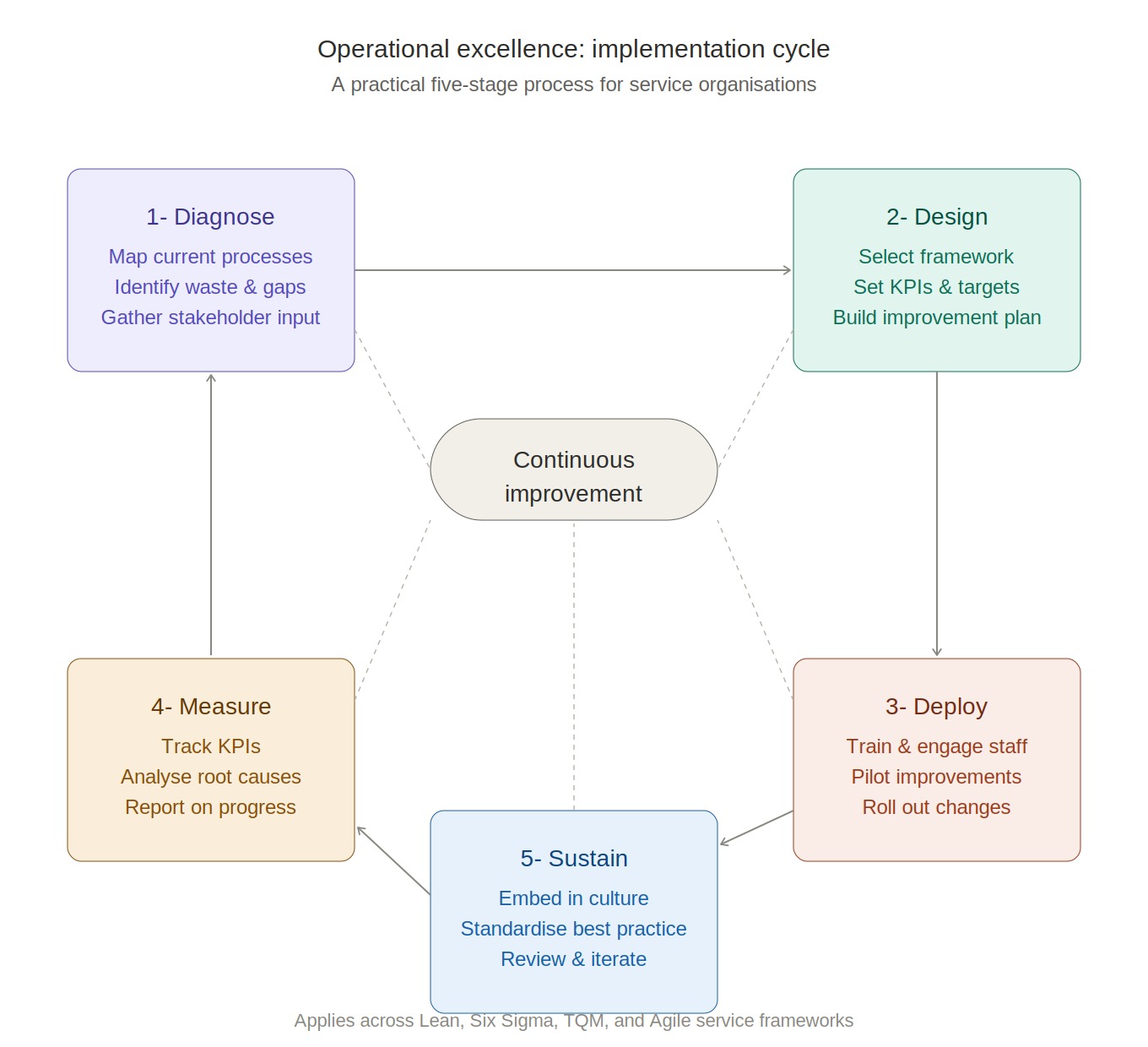
The diagram below illustrates the five core stages of an operational excellence implementation cycle. Each stage is discussed in detail in this section.
Stage 1: Diagnose
Before selecting a framework or launching an improvement project, it is essential to understand the current state of operations clearly. This means mapping key processes from end to end, identifying where delays, errors, and duplication occur, and understanding the experience from the customer’s perspective. Tools such as process maps, value stream maps, and customer journey maps are useful here. Stakeholder interviews and observation of real work are equally important: problems that are invisible in a process diagram often become obvious when you watch the work being done.
Stage 2: Design
Once the diagnosis is clear, the organisation can choose the most appropriate framework and design a structured improvement plan. The choice of framework should be driven by the nature of the problem. If the primary issue is process speed and waste, Lean is the appropriate starting point. If the problem is variation and defects in a complex process, Six Sigma or Lean Six Sigma is more appropriate. If the goal is broader cultural change around quality, a TQM-informed approach may be better suited. At this stage, clear performance indicators should be defined so that improvement can be measured objectively.
Stage 3: Deploy
Implementation requires careful management of change as well as process redesign. New processes need to be tested in a controlled environment before full rollout, and staff need to be trained and supported. Resistance to change is a predictable feature of any improvement effort and should be anticipated rather than suppressed. Visible leadership commitment, clear communication about the rationale for change, and early involvement of frontline staff in the design of new processes all help to reduce resistance and build ownership.
Simplifying work processes and procedures is critical for improving efficiency, reducing waste, and enhancing organisational productivity. This training course provides participants with the knowledge and tools to streamline their work processes, eliminate unnecessary steps, and enhance workflow efficiency. In today’s fast-paced business environment, organisations are
Stage 4: Measure
Measurement is not optional. An improvement programme without clear performance data cannot demonstrate its value, cannot identify where progress is stalling, and cannot hold teams accountable. Service organisations should track a balanced set of indicators covering efficiency (cycle time, throughput, cost per transaction), quality (error rates, rework frequency, complaint volumes), and customer experience (satisfaction scores, net promoter scores, resolution rates). Data should be reviewed regularly and used to drive decisions, not just to fill reports.
Stage 5: Sustain
The most common failure point in operational excellence programmes is sustainability. Improvements that are made during a project phase often degrade over time as staff revert to old habits, priorities shift, and attention moves elsewhere. Sustaining improvement requires embedding new processes into standard operating procedures, integrating performance data into regular management reviews, recognising and reinforcing improved behaviours, and building the organisation’s internal capability to continue improving without external support.

The best quality management strategies encompass a multifaceted approach aimed at consistently delivering superior products or services that meet or exceed customer expectations. At its core, these strategies emphasise a commitment to continuous improvement, fostering a culture of quality throughout the organisation. Adopting international standards
5- Applying Frameworks Across Service Sectors
Operational excellence frameworks are not sector-specific, but their application varies considerably depending on the nature of the service, the regulatory environment, and the organisational culture.
Healthcare
In healthcare, Lean and Lean Six Sigma have been used to reduce patient waiting times, streamline discharge processes, improve medication dispensing accuracy, and reduce administrative burden on clinical staff. A study published on ScienceDirect found that applying Lean Six Sigma in a healthcare setting reduced waiting time by 80% and cut overhead and quality costs by 20%. The patient pathway, from referral to treatment to discharge, is a classic value stream that Lean can map and improve systematically.
Financial services
Banks, insurers, and financial service providers have applied Six Sigma extensively to processes such as loan origination, claims processing, account opening, and transaction reconciliation. Research published in the International Journal of Quality and Reliability Management found that financial services companies implementing Lean Six Sigma reported reduced operational costs, improved cycle times, reduced customer complaints, and improved employee morale. In financial services, process consistency and regulatory compliance add urgency to the case for structured process management.
Hospitality and retail
In hospitality and retail, operational excellence focuses on service consistency, queue management, staff scheduling, inventory accuracy, and the quality of customer-facing interactions. Lean tools such as standardised work instructions, visual management, and daily briefings have been successfully adapted to hotel operations, restaurant management, and retail outlet management. The goal is to ensure that every customer receives the same level of service regardless of which member of staff they encounter or which branch they visit.
NGOs and public sector services
Non-governmental organisations and public sector bodies face the same process efficiency challenges as commercial service providers, often with fewer resources and greater accountability pressures. Lean thinking and TQM principles have been applied in these contexts to improve programme delivery, reduce administrative duplication, and increase the proportion of resources that reach beneficiaries rather than being absorbed by overhead. The emphasis on value from the perspective of the end user — a core principle of Lean — translates directly into the mission-driven language of NGO and public service work.
Service sector | Common problems addressed | Most applicable framework |
Healthcare | Waiting times, discharge delays, clinical errors | Lean, Lean Six Sigma |
Financial services | Processing errors, cycle times, compliance gaps | Six Sigma, Lean Six Sigma |
Hospitality and retail | Service inconsistency, queue management | Lean, TQM |
NGOs and public sector | Resource efficiency, programme delivery quality | Lean, TQM |
Technology services | Incident response, release quality, backlog management | Agile, Lean |
6- The People Dimension: Culture, Leadership, and Engagement
No operational excellence framework will produce lasting results unless the people dimension is addressed explicitly. Frameworks are tools. They do not implement themselves. The critical variables are leadership behaviour, staff engagement, and organisational culture.
Leaders who are visibly committed to operational excellence — who participate in improvement activities, ask for data-driven explanations of problems, and hold people accountable for continuous improvement — create an environment in which improvement becomes a shared expectation rather than a management initiative. Conversely, leaders who endorse improvement rhetoric without changing their own behaviour quickly undermine the credibility of the programme.
Frontline staff are the most important source of insight about where processes fail. An operational excellence culture is one in which problems are surfaced rather than hidden, where improvement suggestions from any level of the organisation are taken seriously, and where people who identify and solve problems are recognised rather than penalised for drawing attention to them. Building this culture requires consistent investment over time, not a single training programme or offsite event.
7- Measurement and Performance Management
Effective performance measurement is the backbone of any operational excellence programme. Without it, improvement efforts are based on anecdote and assumption rather than evidence. Service organisations should build a measurement framework that covers three levels: operational metrics that track day-to-day process performance, customer metrics that track the experience and outcomes of the people the service is designed for, and strategic metrics that track the contribution of operational performance to organisational goals.
Operational metrics might include average handling time, error rates, first-contact resolution rates, and throughput volumes. Customer metrics include satisfaction scores, net promoter scores, complaint rates, and resolution times. Strategic metrics might include cost-per-outcome, return on improvement investment, and employee engagement scores.
The challenge is not collecting data but using it. Too many organisations invest in performance dashboards that are reviewed in monthly meetings but do not drive daily decisions. Operational excellence requires that performance data is visible to the people doing the work, that it is reviewed frequently enough to prompt action, and that it is connected to clear accountability for improvement.
Metric type | Examples | Review frequency |
Operational | Cycle time, error rate, throughput, first-contact resolution | Daily or weekly |
Customer experience | CSAT, NPS, complaint rate, resolution time | Weekly or monthly |
Financial | Cost per transaction, waste reduction value, ROI of improvements | Monthly or quarterly |
Employee | Engagement score, suggestion rate, training completion | Quarterly |
Strategic | Operational contribution to organisational goals | Quarterly or annually |
8- Technology as an Enabler of Operational Excellence
Technology does not create operational excellence, but it amplifies it. The most common technology enablers in service industries include process automation, data analytics platforms, digital workflow tools, and customer relationship management systems. These tools are most valuable when they are deployed in support of a clear process improvement strategy rather than as an end in themselves.
Process automation reduces manual effort, eliminates certain classes of error, and creates consistent execution in high-volume, repetitive tasks. Data analytics platforms make it possible to monitor performance across large service operations in near real-time, identifying problems before they become crises. Digital workflow tools make processes visible and manageable, allowing managers to see where work is queued, where delays are occurring, and where individuals or teams are overloaded.
Artificial intelligence is beginning to play a more significant role in operational excellence, particularly in areas such as demand forecasting, intelligent routing of work, predictive maintenance of systems, and personalised customer interaction. According to research cited by McKinsey, organisations using advanced analytics report a 25% improvement in operational efficiency and 15% faster decision-making cycles. However, the benefits of AI in service operations are only realised when the underlying processes are already well designed and well managed. Deploying AI on top of a broken process produces faster, more consistent failure.
9- Common Pitfalls and How to Avoid Them
The literature and practice of operational excellence is full of programmes that started with energy and ambition but failed to deliver sustained results. The most common failure modes are worth naming explicitly so that they can be avoided.
The first is treating operational excellence as a project rather than a permanent capability. When improvement is treated as a finite initiative with a start and end date, progress made during the project phase degrades as soon as attention moves on. Operational excellence must be embedded as an ongoing management discipline, not delivered as a one-off event.
The second is selecting the wrong framework for the problem. Applying Six Sigma’ s statistical rigour to a problem that is fundamentally about culture and engagement, or applying Lean’s efficiency tools to a process that is already too thin and too fast, will not produce useful results. Framework selection should be driven by the diagnosis, not by familiarity or fashion.
The third is neglecting the change management dimension. Process improvement requires people to work differently, which is always uncomfortable and sometimes threatening. Organisations that invest heavily in technical process design but lightly in communication, training, and cultural change typically find that new processes are formally adopted but practically abandoned.
The fourth is measuring activity rather than outcomes. An organisation that counts the number of improvement projects completed, the number of staff trained in Lean, or the percentage of processes documented has measured activity. What matters is whether cycle times have decreased, error rates have fallen, costs have reduced, and customers are more satisfied. Outcome measurement is harder but infinitely more valuable.
10- Building Internal Capability for Sustained Improvement
The long-term goal of any operational excellence programme is to build the organisation’s own capability to improve continuously, without depending on external consultants or periodic project injections. This means developing internal practitioners who understand the frameworks and can apply them to new problems, building data literacy across the organisation so that performance data is understood and acted upon at every level, and creating management processes that make continuous improvement a regular expectation rather than an occasional special effort.
Internal capability building typically involves a combination of formal training in improvement methodologies, structured on-the-job application of those methods to real problems, and coaching by more experienced practitioners. In organisations that have invested seriously in this capability — building cohorts of trained Lean practitioners or Six Sigma Green and Black Belt holders — the improvement culture becomes self-reinforcing. Problems are identified and solved at the level where they occur, rather than escalated upwards or left unaddressed.
Explore the 8 best operational excellence courses for 2025—compare duration, level, and platforms like MIT Sloan, Coursera, Udemy, and more.
11- Conclusion
Operational excellence frameworks offer service organisations a rigorous, practical approach to improving performance that goes well beyond cost-cutting or reorganisation. When applied thoughtfully, Lean, Six Sigma, TQM, Lean Six Sigma, and Agile methodologies help organisations to identify and eliminate waste, reduce variation, improve customer experience, and build a culture of continuous improvement that sustains gains over time.
The frameworks are not ends in themselves. They are tools that need to be selected, applied, and adapted to the specific context of each organisation. What makes the difference between a programme that transforms an organisation and one that produces temporary gains before fading is not the choice of framework but the quality of leadership, the depth of staff engagement, the rigour of measurement, and the organisational commitment to treating improvement as a permanent capability rather than a temporary initiative.
Service organisations that make this commitment position themselves to deliver more consistent, higher-quality services at lower cost — advantages that are both commercially significant and, in sectors such as healthcare, NGO delivery, and public services, genuinely important for the people they serve.

Process industries face various challenges, including global competition, improving manufacturing efficiencies, and capacity constraints. In addition, some operations and processes can involve high risk, which can impact the entire organisation. This course provides comprehensive strategies for developing operational excellence to improve