

- Table of Contents
- Introduction
- 1- Defining Project Governance
- 2- Why Project Governance Matters
- 3- The Project Governance Framework
- 4- Key Components of Project Governance
- 5- Roles and Responsibilities in Project Governance
- 6- Project Governance vs Project Management
- 7- Stakeholder Engagement in Project Governance
- 8- Common Challenges in Project Governance
- 9- Benefits of Strong Project Governance
- 10- Project Governance in Different Organisational Contexts
- 11- How to Build Effective Project Governance
- Conclusion
Introduction
Every organisation, regardless of its size or sector, relies on projects to turn strategic ambitions into practical results. Whether the objective is launching a new product, implementing a digital system, reorganising a department, or expanding into a new market, these goals are achieved through planned, time-bound efforts with specific outcomes. Yet despite the enormous investment organisations pour into their projects, a significant proportion fail to meet their original objectives, stay within budget, or deliver on time. The reasons are varied, but one of the most consistent contributing factors is the absence of a clear governance structure that supports sound decision-making, accountability, and oversight.
Project governance is the framework that addresses this gap. It is not a rigid set of bureaucratic rules, nor is it a substitute for good project management. Instead, it is the overarching structure within which projects are directed, controlled, and delivered in alignment with organisational strategy. Project governance defines who makes decisions, how those decisions are made, how accountability is distributed, and how performance is monitored throughout the project lifecycle. For business professionals, understanding project governance is increasingly important, not only as a technical discipline but as a foundation for organisational performance and strategic execution.
This article explores what project governance is, why it matters, how it is structured, who is responsible for it, how it differs from project management, how organisations can build and sustain effective governance, and what challenges commonly arise in its application.
1- Defining Project Governance
Project governance refers to the management framework within which project decisions are made. It provides the structure through which a project is directed and controlled, ensuring that the right decisions are taken by the right people at the right time. At its core, project governance is about authority, accountability, and oversight — the three elements that distinguish a well-governed project from one that drifts without direction.
The Project Management Institute (PMI) defines project governance as the framework, functions, and processes that guide project management activities. Similarly, PRINCE2 — a globally recognised project management methodology — places governance at the heart of its approach, emphasising that every project must have a clear business justification and defined mechanisms for oversight throughout its lifecycle. The Association for Project Management (APM) describes governance as the set of policies, regulations, functions, processes, and procedures that define how a project is set up, managed, and controlled.
What all these definitions have in common is an emphasis on structure rather than execution. Project governance is not about doing the work of the project; it is about ensuring that the work is directed appropriately, overseen effectively, and connected to the wider goals of the organisation. It is the architecture within which project management operates, setting the rules, roles, and reporting lines that allow delivery teams to function with clarity and confidence.
2- Why Project Governance Matters
The practical case for project governance is straightforward: projects without clear governance structures are far more likely to fail, overspend, or miss their original purpose. In organisations where decisions are made inconsistently, accountabilities are unclear, and oversight is limited, even well-resourced projects can lose direction quickly. Governance provides the checks and balances that prevent this from happening.
According to research by the Project Management Institute, organisations collectively waste approximately $1 million every 20 seconds as a result of poor project management practices, amounting to roughly $2 trillion annually. A substantial portion of this waste is attributable to poor governance — decisions taken too late, escalation paths that are undefined, and reporting structures that obscure rather than illuminate the true state of a project.
Beyond financial waste, weak governance exposes organisations to reputational risk, failed strategic investments, and strained stakeholder relationships. When projects are conducted without a governance framework, there is no consistent mechanism for recognising that a project has gone off course. Problems are often identified too late, by which point significant resources have already been committed. Strong project governance, by contrast, creates a system of early warning and structured response. It enables organisations to make informed decisions when they still have the power to change outcomes, rather than reacting to problems after the damage has already been done.
3- The Project Governance Framework
A project governance framework is the structured system of principles, processes, roles, and reporting mechanisms through which a project is directed and controlled. It is not a single document or policy; rather, it is the combined effect of multiple governance elements working together cohesively. Understanding the framework means understanding its components, how they interact, and what each one is designed to achieve.
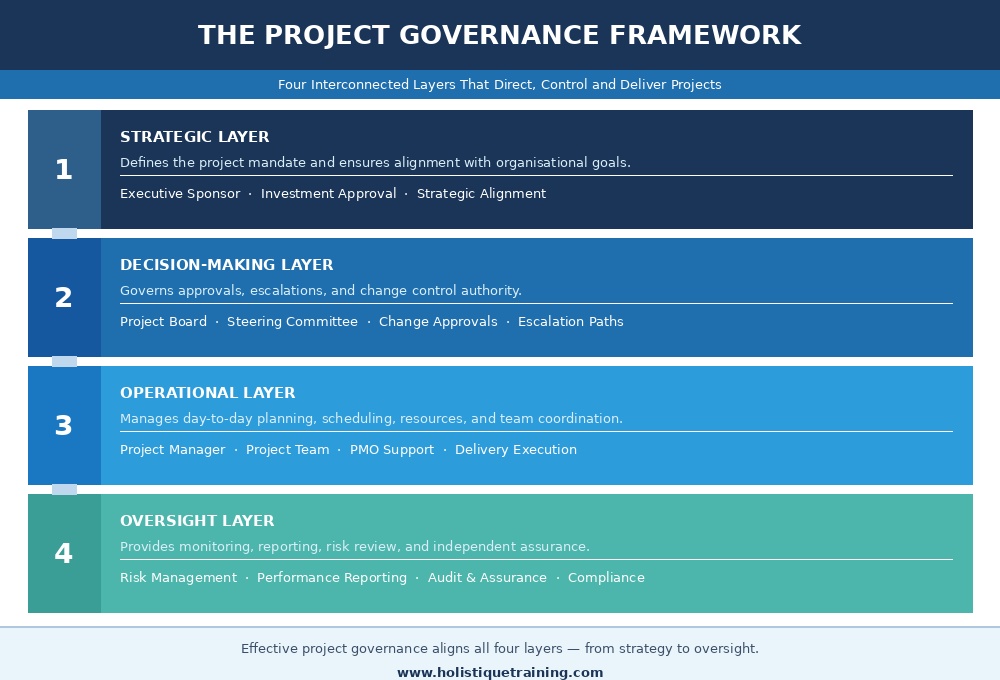
The framework typically operates across four distinct but interconnected layers. The first is the strategic layer, which connects the project to the organisation's broader objectives. At this level, senior leadership determines whether the project is worth pursuing, sanctions the necessary resources, and provides the organisational mandate that gives the project authority to proceed. The second is the decision-making layer, which defines how key decisions are taken during the project's life. This includes the project board or steering committee, the mechanisms for approving changes, and the escalation paths that allow unresolved issues to reach the right people. The third is the operational layer, which covers the day-to-day management of the project, including planning, scheduling, resource management, and team coordination. The fourth is the oversight layer, which provides the monitoring, reporting, and assurance functions that allow governance bodies to assess progress, identify risks, and verify that the project remains aligned with its original purpose.
Framework Layer | Primary Function | Key Actors |
|---|---|---|
Strategic Layer | Mandate, investment approval, strategic alignment | Senior leadership, executive sponsor |
Decision-Making Layer | Approvals, escalation, change control | Project board, steering committee |
Operational Layer | Delivery, planning, resource and team management | Project manager, project team, PMO |
Oversight Layer | Reporting, risk management, audit, assurance | PMO, audit function, governance board |

Project management is recognised as the best way to ensure that complex additions to any company are added and completed in a timely and organised manner that considers the budget and stakeholder needs. This means that there is a lot of personnel involved
4- Key Components of Project Governance
While the specific design of a project governance framework will vary depending on the size, complexity, and context of a project, most effective frameworks share a set of common components. Together, these elements create the conditions for consistent, transparent, and accountable project delivery.
The first component is decision-making authority. Every project involves a continuous stream of decisions, from initial scope definition to resource allocation to handling unexpected complications. Governance frameworks must clearly define who has the authority to make each type of decision, at what level approval is required, and how decisions should be escalated when they fall outside the delegated authority of a project manager. Without this clarity, decisions are either delayed or made by the wrong people, both of which carry serious risks for project outcomes.
The second component is accountability and responsibility. This goes beyond simply assigning names to roles. Accountability in a governance context means that individuals and bodies are genuinely answerable for specific outcomes and that there are mechanisms in place to verify performance against commitments. Clear accountability prevents the diffusion of responsibility that so often undermines project delivery.
The third component is change control. Projects rarely unfold exactly as planned. Scope changes, budget revisions, timeline extensions, and shifts in stakeholder requirements are all common occurrences. A governance framework must include a structured process for requesting, evaluating, approving, or rejecting changes so that the project does not drift from its original purpose without deliberate organisational approval.
The fourth component is risk oversight. Governance frameworks must establish how risks are identified, assessed, reported to governance bodies, and managed throughout the project lifecycle. The oversight layer of governance needs regular, accurate risk information to fulfil its function effectively. The fifth component is reporting and communication. Effective governance depends on the timely and accurate flow of information. This means defining what information is reported, how often, to whom, and in what format. Standardised reporting structures reduce ambiguity and ensure that governance bodies have the information they need to make informed decisions.
5- Roles and Responsibilities in Project Governance
Clear role definition is one of the most critical elements of any governance framework. In its absence, authority becomes uncertain, accountability becomes contested, and escalation paths break down. Most project governance structures involve several distinct roles, each with a specific function that is essential to the overall system.
The executive sponsor is the senior organisational figure who holds ultimate accountability for the project. The sponsor champions the project within the organisation, secures resources, removes high-level obstacles, and ensures that the project remains aligned with strategic priorities. Their active engagement is among the strongest predictors of project success, and their disengagement is one of the most common causes of failure.
The project board or steering committee sits above the day-to-day management of the project and holds authority over key decisions, change approvals, and risk escalations. It typically includes the sponsor, senior stakeholder representatives, and, in some models, independent members who can provide objective oversight. The project manager is responsible for planning, executing, and monitoring the project within the parameters established by the governance framework. The project manager operates within the authority delegated to them by the project board and escalates issues that exceed that authority.
The Project Management Office, or PMO, supports governance by providing standards, methodologies, templates, and assurance functions. In some organisations, the PMO takes a more active governance role, conducting project audits, enforcing process compliance, and providing portfolio-level oversight across multiple concurrent initiatives.

A Project Management Office (PMO) serves as the backbone of effective project governance, ensuring alignment with organisational goals, resource optimisation, and consistent value delivery. This comprehensive training course equips participants with the knowledge and skills necessary to establish, manage, or enhance a PMO
6- Project Governance vs Project Management
Project governance and project management are related but distinct disciplines, and conflating the two is a common source of confusion in organisations. Understanding the difference is important because it clarifies where strategic direction ends and operational execution begins, and it helps organisations design governance structures that complement rather than duplicate management functions.
Project management is primarily concerned with the delivery of a project: planning the work, managing the schedule, allocating resources, addressing day-to-day issues, and keeping the team coordinated and productive. It is an operational function that sits within the project itself. Project governance, by contrast, is concerned with oversight, direction, and accountability. It is the framework through which the project is supervised and controlled from above, ensuring that it remains justified, aligned, and on course. The two disciplines are complementary; neither can substitute for the other.
Dimension | Project Governance | Project Management |
|---|---|---|
Primary focus | Direction, oversight, accountability | Planning, execution, delivery |
Responsible parties | Project board, sponsor, PMO, senior leadership | Project manager, delivery team |
Level of involvement | Strategic and supervisory | Operational and daily |
Key activities | Approvals, escalations, risk oversight, reporting | Scheduling, resource management, issue resolution |
Timeframe | Defined intervals throughout the lifecycle | Continuous and daily |
Outcome | Strategic alignment and assurance | Deliverables and project objectives |
A project may be excellently managed in operational terms while still failing at a governance level — for example, if scope changes are approved without proper authority, if benefits are never formally defined, or if the project continues beyond the point where it still offers genuine value to the organisation. Recognising this distinction allows organisations to invest appropriately in both disciplines.
7- Stakeholder Engagement in Project Governance
Governance is not only a matter of internal structure and process. Effective project governance also depends on how well the organisation identifies, engages, and manages its stakeholders throughout the project lifecycle. Stakeholders include all individuals, teams, and organisations with an interest in the project, whether they are directly involved in delivery, affected by the project's outcomes, or in a position to influence its direction.
In a governance context, stakeholder engagement serves several important functions. It ensures that the project remains responsive to legitimate interests beyond the core delivery team. It provides a mechanism for surfacing concerns, risks, and opportunities that might not be visible at the project level. It also supports the legitimacy of governance decisions by ensuring that they are informed by a broad and representative range of perspectives. Projects that are governed in isolation from their stakeholders tend to produce outcomes that, even when technically successful, fail to deliver the anticipated benefits in practice.
Governance frameworks should therefore include defined mechanisms for stakeholder identification, engagement planning, communication, and feedback. This does not mean that all stakeholders have decision-making authority — governance structures must maintain clear lines of authority — but it does mean that those with legitimate interests are kept informed and given appropriate opportunities to contribute. Stakeholder engagement embedded within governance is one of the clearest distinguishing features between organisations that consistently deliver value from their projects and those that do not.
8- Common Challenges in Project Governance
Despite its clear benefits, effective project governance is difficult to sustain in practice, and organisations frequently encounter recurring challenges that undermine its effectiveness. Understanding these challenges is the first step towards addressing them.
One of the most common challenges is ambiguous accountability. Even when governance frameworks are formally documented, the real distribution of authority and responsibility often remains unclear. This is particularly common in matrix organisations, where project resources are drawn from multiple departments and the project manager has limited formal authority over team members. When accountability is ambiguous, decisions are delayed, issues go unescalated, and no single person feels genuinely responsible for outcomes.
A second challenge is inconsistent executive sponsorship. The project sponsor plays a critical role in maintaining governance discipline, and their disengagement — whether due to competing priorities, changing organisational structures, or simple neglect — leaves governance bodies without the authority they need to make effective decisions. According to the Project Management Institute, only 35% of projects worldwide finish successfully, meeting all goals, timelines, and budgets, and weak sponsorship is among the most frequently cited root causes of project failure globally.
A third challenge is governance fatigue. When governance processes are perceived as overly bureaucratic, they are frequently bypassed in the name of speed or efficiency. Project managers and teams that experience governance as an obstacle to delivery rather than an enabler of it will look for ways to work around it. This does not mean that governance should be minimised, but it does mean that governance frameworks must be proportionate to the complexity and risk profile of the project. A fourth challenge is the misalignment between governance structures and organisational culture. Formal governance documents can only go so far. If the broader organisational culture does not value transparency, accountability, and structured decision-making, governance frameworks will struggle to function as intended regardless of their quality on paper.
9- Benefits of Strong Project Governance
When project governance is designed well and applied consistently, the benefits are substantial and measurable. The most direct benefit is improved decision-making. When authority is clear, information flows reliably, and escalation paths are well-defined, decisions are made more quickly, by more appropriate people, and with better information. This reduces delays, minimises the cost of indecision, and allows projects to respond more effectively to changing circumstances.
Strong governance also improves risk management. When governance bodies receive regular, accurate risk information and have defined procedures for responding to escalated risks, organisations are better positioned to address problems before they become crises. Risk governance is not a separate function; it is built into the reporting and oversight mechanisms of the framework itself, making risk management a natural and continuous part of project delivery rather than a periodic exercise.
A further benefit is greater stakeholder confidence. Stakeholders — including senior leaders, funders, customers, and operational staff — are more likely to support a project when they can see that it is being governed with discipline and transparency. This confidence creates the organisational conditions that allow projects to succeed: resource support, executive backing, and cooperative engagement from affected teams. Finally, strong governance ensures strategic alignment. Projects that are governed effectively are regularly assessed against their original business case and adjusted when circumstances change, preventing the common problem of initiatives that continue to consume resources long after their strategic rationale has disappeared.
10- Project Governance in Different Organisational Contexts
The specific design of a project governance framework depends significantly on the organisational context in which it operates. A multinational corporation delivering a major digital transformation will require a very different governance structure from a small NGO managing a community development initiative. Understanding how governance must adapt to context is an important practical consideration for any organisation developing or refining its approach.
In large enterprises, governance structures tend to be formally documented, multi-layered, and integrated with broader corporate governance and risk management frameworks. Portfolio-level governance bodies oversee collections of related projects and programmes, ensuring that investment decisions are coordinated and that strategic priorities are consistently applied. In small and medium-sized enterprises (SMEs), governance is often lighter in structure but no less important in principle. Here, the governance function may be performed by a small leadership team rather than a formal project board, but the essential elements — clear authority, defined accountability, and regular oversight — remain equally necessary.
In the public sector, project governance is frequently shaped by regulatory requirements, public accountability obligations, and the involvement of multiple stakeholder groups with competing interests. Transparency and documentation requirements tend to be more demanding than in the private sector. In NGOs and non-profit organisations, project governance must often balance donor accountability requirements with operational flexibility, ensuring that limited resources are not diverted into governance administration at the expense of programme delivery.
Organisational Context | Governance Style | Key Consideration |
|---|---|---|
Large enterprise | Formal, multi-layered, portfolio-integrated | Strategic alignment and compliance |
SME | Lean, leadership-led, proportionate | Speed and practical accountability |
Public sector | Regulatory, transparent, multi-stakeholder | Public accountability and documentation |
NGO / non-profit | Donor-responsive, flexible, resource-conscious | Balancing compliance with delivery |
11- How to Build Effective Project Governance
Building effective project governance does not require an organisation to adopt a complex new methodology or invest in expensive software. It requires clarity, commitment, and consistency. The most successful governance frameworks are those that are designed before delivery begins, understood by everyone involved, and actively maintained throughout the project lifecycle.
The first step is to define the project's governance structure before delivery begins. This means identifying the project board or steering committee, confirming the sponsor, clarifying the project manager's delegated authority, and establishing the reporting calendar. Governance that is designed during the project tends to be reactive and incomplete; governance that is designed in advance provides the structure that delivery teams can rely on from the outset.
The second step is to document authority and accountability clearly. Every governance framework should specify who can approve what, up to what value or risk level, and what happens when a decision exceeds those limits. This does not need to be a lengthy document, but it must be unambiguous and shared with everyone involved. The third step is to establish a regular and meaningful reporting rhythm. Governance bodies cannot perform their oversight function without reliable information, and project teams cannot benefit from governance without clear channels for escalation. Reporting should be standardised, concise, and focused on decisions rather than information alone. The fourth step is to review and adapt the framework as the project evolves. Governance structures that made sense at the start of a project may become less appropriate as conditions change, teams grow, or risks materialise. Effective governance is a living structure that responds to the realities of delivery rather than a static set of rules established at the outset and never revisited.

Planning a new project can be challenging. Making any changes involves a lot of responsibility, so it’s important to ensure that every aspect is planned out as much as possible. One of the biggest risk areas when planning a new project is assuming that everything
Conclusion
Project governance is not a bureaucratic formality; it is a practical necessity for any organisation that is serious about delivering results. It provides the overarching structure within which projects are directed, overseen, and held accountable, ensuring that delivery remains connected to strategy, that decisions are made by the right people, and that problems are identified and addressed before they become failures. As organisations face increasing pressure to demonstrate the value of their investments and deliver on ambitious strategic programmes, the quality of project governance has never been more consequential.
The most effective governance frameworks are those that are proportionate to the project's complexity and risk, clearly understood by everyone involved, and actively maintained throughout the project lifecycle. Whether an organisation is running a single project or managing a portfolio of complex programmes, the principles of sound governance — clarity, accountability, transparency, and strategic alignment — apply universally. Project governance will not guarantee success on its own, but without it, the conditions for success are far harder to create and sustain.