

- Table of Contents
- Introduction
- 1- What Is a School Business Manager?
- A Broadening Remit
- Reporting Lines and Scope
- 2- Why Formal Training Matters for School Business Managers
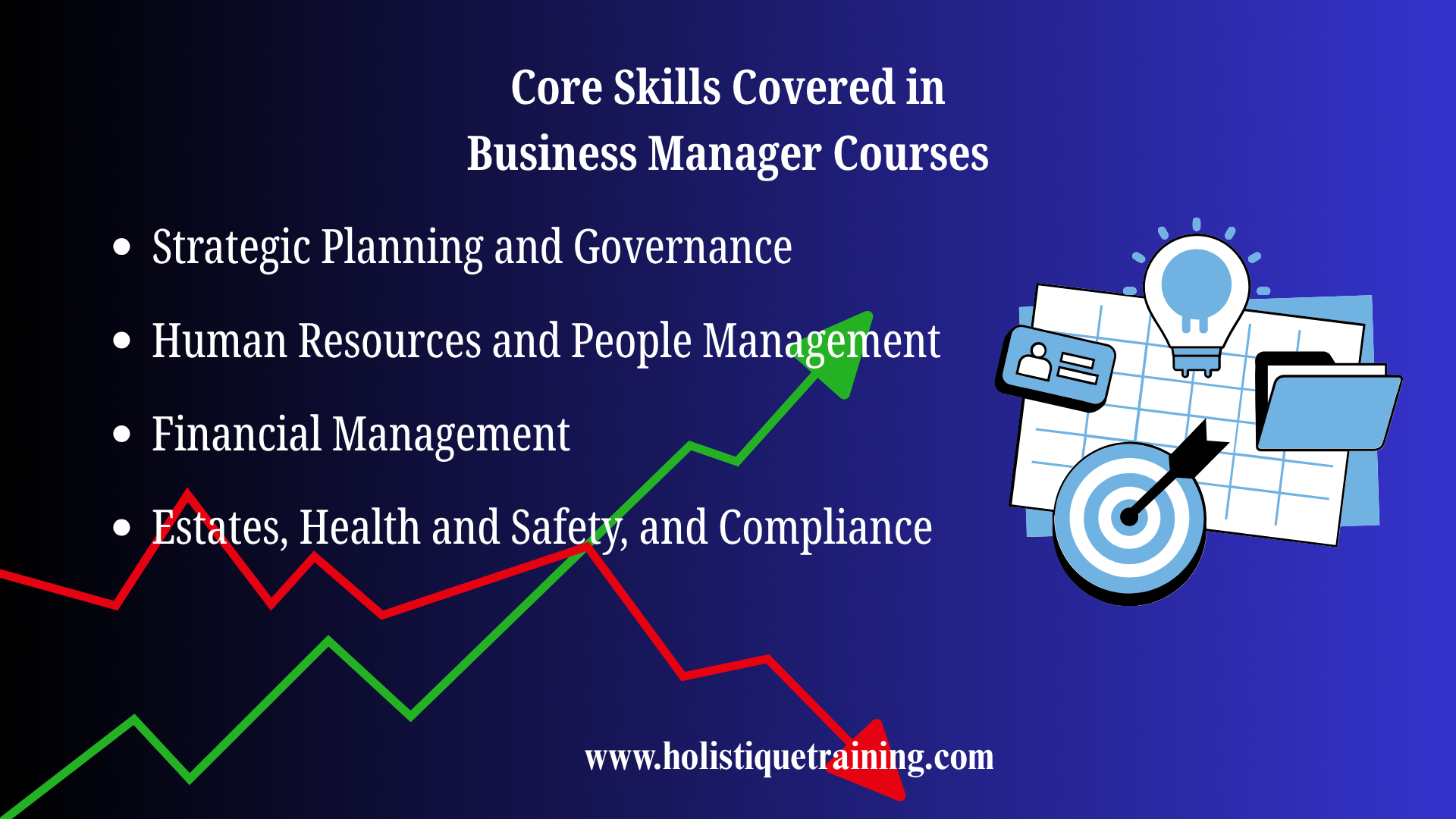
- 3- Core Skills Covered in Business Manager Courses for Schools
- 1- Financial management
- 2- Human resources
- 3- Procurement and contract management
- 4- Estates and facilities management
- 5- Strategic leadership
- 6- Income generation
- 4- Qualification Levels and Pathways
- 5- UK Courses and Providers
- Institute of School Business Leadership (ISBL)
- Institute of Leadership and Management (ILM)
- CIPFA
- National Professional Qualifications
- 6- International Courses and Global Providers
- 7- Online Versus In-Person Training
- 8- Choosing the Right Course
- 9- Costs and Funding
- 10- Career Progression After Certification
- 11- Common Challenges in the Role
- 12- The Future of School Business Management Training
- Conclusion
Introduction
Running a school today involves far more than overseeing budgets and payroll. Business managers in schools now sit at the centre of financial planning, procurement, human resources, estates management and strategic decision-making, working alongside headteachers to keep institutions financially sustainable and operationally sound. As schools and multi-academy trusts face tighter funding, growing compliance demands and increasing scrutiny over how public money is spent, the professionals leading this work need structured, recognised training rather than informal, on-the-job learning alone.
This growing complexity has fuelled demand for dedicated business manager courses for schools, ranging from entry-level diplomas for newcomers to postgraduate-level qualifications for chief financial officers running large trusts. In this article, we explore what the school business manager role involves, why formal training matters, the skills these courses build, the qualification levels available, and where to find courses from globally recognised providers, alongside practical guidance on choosing a course, understanding costs, and planning career progression.
1- What Is a School Business Manager?
A school business manager (SBM), sometimes called a school business leader or bursar, is a senior member of non-teaching staff responsible for the operational and financial running of a school. This role frees the headteacher to focus on teaching and learning while the business manager oversees budgeting, supplier contracts, premises management, health and safety compliance, and support staff supervision. In larger academy trusts, this function often scales into chief financial officer or chief operating officer positions with responsibility across multiple schools.
A Broadening Remit
The role has evolved considerably from the traditional bursar position, which focused narrowly on financial administration. Modern business managers are expected to contribute to strategic planning, workforce deployment, income generation and even elements of marketing and digital infrastructure. This shift means that qualifications built specifically around finance are no longer sufficient on their own; broader business management training has become essential.
According to a 2025 Department for Education survey of school business professionals, business managers in secondary schools are considerably more likely to sit on their school's senior leadership team than those in primary schools, with ninety-three percent of secondary respondents included compared with sixty-eight percent of primary respondents.
Reporting Lines and Scope
In smaller primary schools, the business manager role is often combined with office administration or HR duties, reporting directly to the headteacher and covering a broad generalist remit. In larger secondaries and multi-academy trusts, the role tends to split into more specialised positions, such as finance manager, HR manager or estates manager, with a trust business manager, chief financial officer or chief operating officer overseeing the function across several schools. Understanding where a given role sits on this spectrum is essential before selecting a course, since a generalist Level 4 qualification suits a small primary setting far better than a chief financial officer preparing to oversee a ten-school trust.
2- Why Formal Training Matters for School Business Managers
Unlike many corporate management roles, school business management sits at the intersection of public sector finance rules, charity and trust law, safeguarding obligations, and commercial best practice. A business manager without structured training may understand budgeting but lack awareness of procurement regulation, benchmarking tools, or curriculum-linked financial planning. Formal courses close these gaps systematically rather than leaving them to chance.
Training also strengthens the credibility of the role within a school's leadership structure. Business managers who hold recognised qualifications are more likely to be trusted with strategic responsibilities beyond day-to-day administration, and are better equipped to challenge decisions, present financial data persuasively to governors and trustees, and lead cross-functional teams.
Investment in training additionally supports staff retention. A business manager who sees a credible pathway of qualifications and career progression is more likely to remain committed to the profession rather than moving into unrelated commercial roles, reducing costly turnover in a position that carries significant institutional knowledge.

Explore why the MBA remains the most popular business management course worldwide. Learn about top institutions, career paths, key skills, and whether this path is right for you.
3- Core Skills Covered in Business Manager Courses for Schools
Courses aimed at school business managers typically combine general management theory with sector-specific application. While content varies by provider and level, most programmes converge on a consistent set of core competency areas that reflect the breadth of the role.
1- Financial management
including budget setting, forecasting, benchmarking against similar schools, and integrated curriculum and financial planning that links staffing decisions to curriculum design.
2- Human resources
covering recruitment, employment law, performance management, absence management and supporting staff wellbeing within a school setting.
3- Procurement and contract management
including public sector procurement regulation, supplier negotiation, and framework agreements for goods and services.
4- Estates and facilities management
addressing premises compliance, health and safety, capital projects and sustainability planning.
5- Strategic leadership
developing the ability to contribute to governing body discussions, trust-level strategy and long-term financial planning beyond the current academic year.
6- Income generation
exploring lettings, grant applications, sponsorship and other means of diversifying school income beyond core government funding.
Courses at higher levels increasingly add data analysis, digital transformation and risk management to this list, reflecting the growing use of financial planning software and benchmarking tools within schools and trusts.
Courses that cover these areas in an integrated way, rather than as isolated modules, tend to prepare business managers more effectively for the reality of the role, where a single decision, such as approving a facilities contract, can simultaneously touch procurement rules, budget forecasts and health and safety compliance. This is why the strongest school business courses use case studies drawn from real school and trust scenarios rather than generic corporate examples.
4- Qualification Levels and Pathways
School business management qualifications in the United Kingdom are typically mapped to national qualification levels, ranging from Level 3 for entry-level administrative staff through to Level 7 for senior finance and operations leaders. This structure allows professionals to progress steadily as their responsibilities grow, rather than jumping between unrelated qualifications.
Qualification Level | Typical Role | Focus | Typical Duration |
|---|---|---|---|
Level 4 | New or aspiring business manager | Foundational finance, HR and operations | 12-18 months |
Level 5 | Established business manager | Deeper financial and strategic skills | 12-18 months |
Level 6 | Senior business manager | Advanced leadership and governance | 18-24 months |
Level 7 | Chief financial officer / COO | Strategic financial and operational leadership | 18-24 months |
Data from the Department for Education's 2025 survey of school business professionals shows that the Level 4 Diploma in School Business Management is the most widely held school-specific qualification among practising business managers, reflecting its role as the standard entry point into the profession.
5- UK Courses and Providers
The United Kingdom has a well-established ecosystem of school business management qualifications, built around professional bodies that work closely with schools, trusts and government departments. These providers ensure that training reflects real regulatory and operational requirements rather than generic business theory.
Institute of School Business Leadership (ISBL)
ISBL is the only UK professional body dedicated specifically to school business practice. It sets professional standards across four tiers of practice, from entry-level administrative roles through to executive leadership, and its standards underpin most nationally recognised school business qualifications.
Institute of Leadership and Management (ILM)
Working in partnership with ISBL, the ILM delivers the Level 4 and Level 5 Diplomas for School Business Managers, widely regarded as the profession's baseline qualifications and often listed as a minimum requirement on job descriptions for new entrants.
CIPFA
The Chartered Institute of Public Finance and Accountancy offers the Level 7 Diploma in School Financial and Operational Leadership, aimed at chief financial officers and senior operations leaders within multi-academy trusts, combining public finance rigour with school-specific application.
For professionals wanting to strengthen general leadership and financial capability alongside these sector-specific qualifications, broader management training can be valuable. A masterclass in strategic HR management builds the people-leadership skills increasingly expected of senior business managers overseeing school workforces.

One of the current buzzwords in business is HR Transformation, but if you do not understand the concept, it is hard to deliver this within your organisation. The idea is to ensure that you are driving business and getting results while improving the
Similarly, a course focused on financial acumen for professionals without a finance background helps business managers who arrive in the role from administrative or teaching backgrounds build the financial confidence expected at senior leadership level.

Maintaining financial understanding is crucial for any business's success. Executives and other senior positions need to be able to effectively communicate the current state of finances with other employees with financial control. A non-finance manager developing the skillset required to manage
National Professional Qualifications
Alongside sector-specific finance and operations diplomas, some business managers in England pursue National Professional Qualifications originally designed for teaching staff, particularly where their role includes a significant leadership component within a trust. While not a direct substitute for ISBL-mapped qualifications, these programmes can complement school business training by building broader instructional and organisational leadership skills that help business managers work more effectively alongside headteachers and governing bodies on whole-school strategy.
6- International Courses and Global Providers
Outside the United Kingdom, school business management training tends to sit within broader school administration or educational leadership qualifications, though several globally recognised bodies now offer training specifically aligned to the finance and operations side of school leadership.
Organisation | Region | Credential | Focus Area |
|---|---|---|---|
ASBO International | United States / Global | Certified Administrator of School Finance and Operations (SFO) | School finance and operations leadership |
Alberta School Business Officials Association | Canada | Certified School Business Official (CSBO) | School business practice and governance |
ISBL / ILM / CIPFA | United Kingdom | Level 4 to Level 7 Diplomas | Finance, HR, estates and strategic leadership |
Harvard Graduate School of Education | United States / Global | Executive leadership programmes | Strategic and financial leadership for education leaders |
In the United States, the Association of School Business Officials International supports school business professionals across thousands of districts, offering its Certified Administrator of School Finance and Operations credential as a recognised marker o f professional competence in budgeting, procurement and operational leadership. In Canada, provincial associations such as the Alberta School Business Officials Association run parallel certification schemes with similar competency requirements.
Beyond dedicated school business bodies, professionals seeking globally respected, transferable business management training often supplement sector-specific qualifications with broader executive education. An in-depth professional training programme in business management gives school leaders exposure to strategic planning and operational excellence principles used across industries, which translate well into multi-academy trust environments managing several sites at once.

Building business relationships is vital no matter what industry you are in. It secures the prosperity and future growth of every company. The difference between thriving and failure is understanding and building good relationships with your partners, suppliers, and customers. Many large contracts have been won
7- Online Versus In-Person Training
Most school business management qualifications are now available in blended formats, combining online modules with occasional face-to-face workshops or assessment days. This flexibility matters considerably for practising business managers, who are rarely able to step away from their schools for extended residential training.
Online delivery suits professionals who need to fit study around a demanding operational role, offering the ability to revisit recorded content, work through case studies at their own pace, and apply learning directly to live projects at their school. In-person elements, by contrast, remain valuable for networking, peer learning and practising negotiation or presentation skills that are harder to develop through screen-based study alone.
For most business managers, the ideal balance combines self-paced online modules for core content with periodic in-person sessions for case study work, assessment and professional networking, mirroring the structure now used by most UK and international qualification providers.
Providers are also increasingly offering hybrid assessment routes, allowing candidates to submit workplace-based evidence, such as a real budget proposal or procurement plan they have developed at their own school, rather than relying solely on written examinations. This approach tends to suit experienced practitioners well, since it validates learning through direct application rather than abstract testing.
8- Choosing the Right Course
With multiple providers, qualification levels and delivery formats available, selecting the right course requires a clear view of current experience, career goals and the specific demands of the school or trust in question. Several factors deserve particular attention before enrolling.
1- Current level of experience, since enrolling on a qualification pitched too far above or below existing competence can waste both time and course fees.
2- Recognition by employers, checking whether the qualification is explicitly mapped to a recognised professional standards framework, such as those set by ISBL internationally or equivalent bodies elsewhere.
3- Relevance to school type, since the demands of a small primary school differ substantially from those of a large secondary academy or a multi-academy trust central team.
4- Delivery format, weighing whether online, blended or in-person study fits realistically around existing work commitments and personal circumstances.
5- Cost and funding availability, including whether the employing school or trust is willing to sponsor all or part of the course fees.
6- Progression pathway, checking that a chosen qualification connects logically to further study at a higher level should career ambitions grow over time.
9- Costs and Funding
Course fees vary considerably depending on level, provider and delivery format. Entry-level diplomas delivered by UK training providers typically cost less than advanced qualifications delivered in partnership with chartered professional bodies, reflecting the additional assessment rigour and professional recognition involved at higher levels.
Many schools and trusts are willing to fund all or part of a business manager's professional development, recognising the direct link between trained staff and effective resource management. Some qualifications also attract limited bursaries or subsidised places through government-backed schemes, though availability fluctuates and should always be confirmed directly with the relevant professional body before enrolling.
Professionals funding their own study should weigh course fees against the career and salary progression a recognised qualification typically supports, particularly when moving from a single-school business manager role into a multi-academy trust finance or operations position.
Trusts operating several schools can often achieve economies of scale by funding cohort-based training for several business managers at once, spreading the cost of workshops or assessment days across multiple participants. This approach also builds internal networks of similarly qualified professionals across a trust, which can be valuable for peer support and consistency of financial practice between schools.
10- Career Progression After Certification
Formal qualifications tend to open clear routes for career advancement within school business management, particularly as schools increasingly consolidate into multi-academy trusts requiring more senior, centrally based finance and operations leadership.
Career Stage | Typical Qualification Level | Typical Responsibilities |
|---|---|---|
Entry-level administrator | Level 3 | Administrative support, basic financial processing |
School business manager | Level 4-5 | Budgeting, HR, procurement, estates oversight |
Senior business manager / trust business manager | Level 6 | Multi-site coordination, governance support |
Chief financial officer / chief operating officer | Level 7 | Trust-wide strategic and financial leadership |
This progression mirrors patterns seen internationally, where certified administrators in the United States and certified officials in Canada similarly advance from single-site administrative roles into district or multi-school leadership positions as they accumulate qualifications and experience.
11- Common Challenges in the Role
Despite growing recognition of the profession, business managers continue to face structural and cultural challenges that formal training alone cannot fully resolve, though awareness of these issues helps professionals navigate them more effectively.
1- Limited involvement in strategic planning, particularly in smaller primary schools where senior leadership teams may focus predominantly on teaching and learning matters.
2- Insufficient recognition of the strategic value business managers can add beyond routine operational tasks.
3- Time pressure, with broad day-to-day responsibilities across finance, HR, estates and procurement leaving limited capacity for continued professional development.
4- Complex regulatory environments, particularly around procurement law and public sector accounting standards that require ongoing training to stay current.
5- Uneven access to funding for professional development, especially in smaller schools without the budget flexibility of larger trusts.
Addressing these challenges typically requires action beyond the individual business manager, including clearer communication from senior leadership teams about the strategic value of the role, and deliberate allocation of protected time for continued professional development within a school's annual planning cycle. Trusts that build CPD expectations directly into a business manager's job description and appraisal targets tend to see stronger, more consistent engagement with formal training than those that treat it as optional.
12- The Future of School Business Management Training
As schools continue to consolidate into larger trusts, the demand for senior, well-qualified finance and operations leaders is likely to keep growing. Training providers are responding by expanding digital delivery, incorporating data analytics and financial planning software into curricula, and developing more flexible modular qualifications that professionals can complete around demanding operational schedules.
Artificial intelligence and integrated financial planning tools are also beginning to reshape course content, with newer modules addressing how business managers can use predictive analytics and automated reporting to support more strategic, forward-looking financial planning rather than purely reactive budget management.
Sustainability and estates decarbonisation are also likely to feature more prominently in future course content, as schools face growing pressure to reduce energy costs and meet environmental targets. Business managers overseeing premises budgets will increasingly need at least a working understanding of capital funding routes for efficiency improvements, alongside the traditional finance and HR skill set that has long defined the role.
Conclusion
Business manager courses for schools have matured into a structured, multi-level professional pathway, supported by respected bodies such as ISBL, ILM and CIPFA in the United Kingdom, and ASBO International and its regional affiliates elsewhere. Choosing the right course depends on current experience, career ambitions and the specific demands of a school or trust, but the direction of travel is consistent: formal, recognised training is increasingly expected of professionals responsible for the financial and operational health of schools.
As the role continues to expand in scope and strategic importance, professionals who invest in structured qualifications, whether sector-specific diplomas or broader business management training, will be best placed to support their schools through an increasingly complex funding and regulatory environment.

Conflict is a natural part of human interaction — and when handled constructively, it can lead to growth, innovation, and stronger relationships. In schools and organisations, the ability to negotiate effectively and resolve disputes is essential for fostering a positive, collaborative environment.This course equips educators, leaders,