

- Table of Contents
- Introduction
- 1- Defining Commercial Operations Management
- 2- The Structure of Commercial Operations Teams
- 3- Key Roles and Core Responsibilities
- 4- Entry-Level Roles: Responsibilities and Remuneration
- 5- Mid-Level Roles: Expanded Scope and Rising Income
- 6- Senior and Executive Roles: Strategic Oversight and Peak Earnings
- 7- Income by Department: A Role-by-Role Breakdown
- 8- Factors That Determine Commercial Operations Salaries
- 9- The Relationship Between Responsibility and Compensation Structure
- 10- Commercial Operations Management Across Key Sectors
- 11- Building a Career Pathway in Commercial Operations
- 12- Conclusion
Introduction
Commercial operations management sits at the intersection of strategy, process execution, and financial performance. It encompasses the systems, structures, and teams that ensure a business generates, sustains, and grows its commercial output. Whilst the term is interpreted differently across industries, it broadly refers to the function responsible for translating business strategy into operational reality — managing revenue streams, commercial relationships, internal processes, and the cross-functional coordination required to keep an organisation commercially effective.
The income that professionals working in this field can expect to earn is closely connected to the scope and depth of their responsibilities. Unlike many specialist functions where expertise alone drives compensation, commercial operations roles are frequently evaluated on the range of accountability they carry — how many decisions they influence, how many people they oversee, which revenue streams fall under their remit, and how closely their work connects to organisational profitability. As a result, understanding income in commercial operations requires understanding not only seniority, but the nature of the responsibilities attached to each level of the function.
This article explores what commercial operations management involves, how teams in this field are typically structured, which roles exist at entry, mid, and senior levels, how responsibilities expand as professionals progress, and what income ranges reflect those responsibilities globally. It also examines how department, sector, geography, and compensation philosophy influence pay across the function, offering a comprehensive reference point for business professionals, hiring managers, and those considering a career pathway in commercial operations.
1- Defining Commercial Operations Management
Commercial operations management is the discipline concerned with organising, optimising, and overseeing the processes through which an organisation conducts and grows its commercial activities. It bridges the strategic intent of leadership teams with the day-to-day execution of commercial functions, including sales, business development, pricing, contract management, revenue analysis, customer success, and market strategy.
The function has grown in prominence alongside the increasing complexity of commercial environments. Organisations operating across multiple markets, product lines, or customer segments require dedicated operational infrastructure to coordinate commercial activity effectively. This infrastructure includes the processes, systems, data workflows, and team structures that enable commercial functions to scale, report accurately, comply with contractual obligations, and respond to market change.
It is important to distinguish commercial operations from general operations management. Whilst the latter typically focuses on production efficiency, logistics, and service delivery, commercial operations is more specifically concerned with the revenue-generating and commercial relationship dimensions of a business. The two functions often overlap in practice, particularly in smaller organisations, but in larger enterprises they tend to operate as distinct disciplines with different reporting lines and performance indicators.

Unlock the power of a well-designed operating model that aligns with your business strategy. This guide explains the differences between business and operating models, highlights the importance of alignment, and outlines practical steps to create an efficient framework for optimizing processes, resources, and governance.
2- The Structure of Commercial Operations Teams
Commercial operations teams vary in size and configuration depending on the organisation's scale, sector, and commercial complexity. In a large multinational business, a commercial operations function might comprise dozens of specialised roles distributed across departments including sales operations, revenue management, commercial finance, contract management, and customer operations. In a smaller organisation, the same responsibilities may be handled by a leaner team, or even by a single senior individual with broad cross-functional accountability.
Despite these variations, a recognisable structural pattern exists across most commercial operations functions. At the base of the structure sit operational coordinators and analysts whose work is primarily data-driven, administrative, and process-oriented. Above them are managers and senior analysts who translate data into commercial insight, manage processes across sub-functions, and liaise with stakeholders in sales, finance, and strategy. At the apex of the function are directors, vice presidents, and in some organisations a Chief Commercial Officer, whose responsibility spans the entire commercial ecosystem of the business.
This hierarchical structure is significant because it maps directly onto income. Each layer of the structure carries a defined and expanding range of responsibilities, and compensation at each level is calibrated to reflect the scope of accountability, the complexity of the decisions involved, and the proximity to revenue outcomes. Understanding this structure is therefore the essential starting point for any analysis of income in commercial operations.
3- Key Roles and Core Responsibilities
The commercial operations function encompasses a range of defined roles, each with specific responsibilities that reflect its position within the wider team structure. Understanding what each role involves is essential to understanding the income attached to it. The table below provides a structured overview of the principal roles within a typical commercial operations function, from entry level to the executive tier.
Role | Level | Core Responsibilities |
Commercial Operations Coordinator | Entry | Process support, data entry, reporting, scheduling, contract tracking |
Commercial Analyst | Entry–Mid | Revenue analysis, performance reporting, pricing support, data modelling |
Commercial Operations Manager | Mid | Process optimisation, cross-functional coordination, sales support, KPI tracking |
Senior Commercial Manager | Mid–Senior | Strategic programme management, pricing strategy, contract oversight, team leadership |
Commercial Operations Director | Senior | Functional strategy, budget ownership, commercial governance, executive reporting |
Vice President of Commercial Operations | Executive | Enterprise-wide commercial strategy, P&L accountability, major contract governance |
Chief Commercial Officer (CCO) | C-Suite | Overall commercial strategy, board-level reporting, growth and market leadership |
At the most junior levels, Commercial Operations Coordinators and Commercial Analysts are responsible for process support, data entry, reporting, scheduling, and foundational commercial analysis. These roles are integral to the operational effectiveness of the function, as the accuracy and consistency of their outputs directly inform the decisions made by more senior professionals above them. Commercial Operations Managers occupy the first true management tier, carrying responsibility for a defined sub-function along with the performance of any direct reports.
At the senior level, Commercial Directors and Vice Presidents take ownership of functional strategy, budget governance, and enterprise-wide commercial policy. The Chief Commercial Officer represents the function at the highest organisational level, integrating commercial operations strategy with the broader goals of the business. Each upward step in this hierarchy brings a qualitatively different set of responsibilities — from executing defined processes, to managing and improving them, to designing and governing them at a strategic level — and this qualitative shift is the primary driver of the income differentials observed across the function.

Having a great benefits and rewards system is the key to attracting quality candidates to a job role. The right employee will usually want to work with the company and participate in benefits schemes and may be more motivated by the company has extras than
4- Entry-Level Roles: Responsibilities and Remuneration
At the entry level of commercial operations, roles are structured around process support, data management, and analytical contribution. Commercial Operations Coordinators are responsible for maintaining reporting systems, processing contract documentation, tracking commercial milestones, and supporting the scheduling and logistics that underpin commercial team activities. Commercial Analysts at this level focus on translating sales and revenue data into structured reports, supporting pricing decisions with quantitative analysis, and identifying anomalies or trends in commercial performance data.
The scope of decision-making at this level is intentionally limited. Entry-level professionals are expected to execute within defined parameters rather than to set those parameters themselves. Their income reflects this constrained accountability. Globally, entry-level commercial operations professionals typically earn between $35,000 and $60,000 per year, though this range varies considerably depending on geography, sector, and the size of the employing organisation. In high-cost urban markets such as London, New York, or Singapore, salaries at this level tend to sit at the upper end of the range or above it, whilst professionals in mid-sized regional markets may expect compensation closer to the lower boundary.
Despite its more limited scope, the entry level of commercial operations is highly consequential. The accuracy, consistency, and analytical quality of work at this tier directly influences the data and intelligence on which more senior commercial decisions are made. The value of developing strong foundational competencies at this stage — in data management, commercial reporting, and process adherence — extends well beyond the entry-level role itself.
According to the United States Bureau of Labor Statistics, overall employment in management occupations is projected to grow faster than the average for all occupations from 2024 to 2034, with approximately 1.1 million openings projected each year on average — a figure that underscores the sustained and growing demand for professionals across the management pipeline, including at its early stages.
5- Mid-Level Roles: Expanded Scope and Rising Income
Mid-level commercial operations roles are characterised by significantly expanded accountability. A Commercial Operations Manager at this level is typically responsible for managing a defined sub-function — such as sales operations, contract administration, or revenue reporting — and for the performance of any direct reports within it. Managers at this level are expected to identify process inefficiencies, propose and implement improvements, and manage the interfaces between commercial operations and adjacent business functions such as finance, legal, procurement, and marketing.
Senior commercial analysts and programme managers at the mid level occupy a hybrid position, combining deep analytical expertise with growing influence over commercial strategy. These professionals frequently lead cross-functional projects, develop pricing frameworks, manage vendor or client relationships, and provide commercial intelligence to support executive decision-making. Their work is increasingly visible to senior leadership, and the quality of their output directly shapes the commercial decisions taken above them.
Income at this level rises substantially in proportion to the increased accountability. Mid-level commercial operations professionals globally can expect to earn between $70,000 and $110,000 per year. According to Glassdoor, the average total salary for a Commercial Operations Manager in the United States is approximately $133,597 per year, reflecting the premium placed on this role in a highly competitive talent market. Equivalent figures in other regions, particularly outside North America and Western Europe, tend to be lower, though the mid-level premium over entry-level pay is consistent across geographies.
The mid level is often the most critical tier in a commercial operations team. Managers at this stage are close enough to execution to maintain operational accuracy whilst also possessing sufficient seniority to shape commercial policy and influence outcomes — a combination that organisations recognise and reward accordingly.
6- Senior and Executive Roles: Strategic Oversight and Peak Earnings
At the senior and executive levels of commercial operations, responsibilities shift from managing processes and teams to shaping the commercial direction of the organisation itself. A Commercial Operations Director oversees the entire commercial operations function, owns the functional budget, sets governance standards, and reports directly to executive leadership on the commercial health of the business. Vice Presidents of Commercial Operations carry similar responsibilities at a larger scale, often managing multi-regional teams and holding direct accountability for major commercial contracts and revenue targets.
At the apex of the function, the Chief Commercial Officer integrates commercial operations strategy with the organisation's broader business objectives. This executive is responsible for aligning commercial operations with market strategy, growth targets, and customer relationships, and typically holds board-level visibility or a seat at the executive leadership table. In sectors characterised by complex commercial environments — such as energy, pharmaceuticals, or global technology — the Chief Commercial Officer role carries influence that extends across supply chains, regulatory relationships, and investor communications.
Compensation at this level is shaped by the scope of strategic authority and the scale of financial accountability. Senior commercial operations leaders globally can expect total compensation packages in the range of $130,000 to $250,000 and above, with remuneration frequently supplemented by performance-related bonuses tied to revenue outcomes, long-term incentive plans, and — in publicly listed organisations — equity-based compensation instruments designed to align executive interests with shareholder value.

Hospitals and other healthcare facilities contain many moving parts. At any given time, various healthcare professionals administer primary, secondary, and tertiary care to patients facing various healthcare challenges. Alongside caregivers, hospitals need administrators to oversee the daily operations that enable optimal care professionals who manage
7- Income by Department: A Role-by-Role Breakdown
Within commercial operations, income is not determined solely by seniority. The department or functional area in which a commercial operations professional works exerts a significant influence on compensation. This is because different departments carry different types of commercial risk, operate with different levels of revenue proximity, and require different specialist competencies that the labour market prices differentially.
Commercial operations professionals working in revenue management — including pricing strategy and yield optimisation — tend to command higher compensation than peers at equivalent seniority levels in other sub-functions, because their decisions directly and measurably affect top-line income. Similarly, professionals responsible for enterprise contract management in sectors such as energy, pharmaceuticals, or technology typically earn a premium that reflects both the complexity of the contracts they manage and the financial exposure involved.
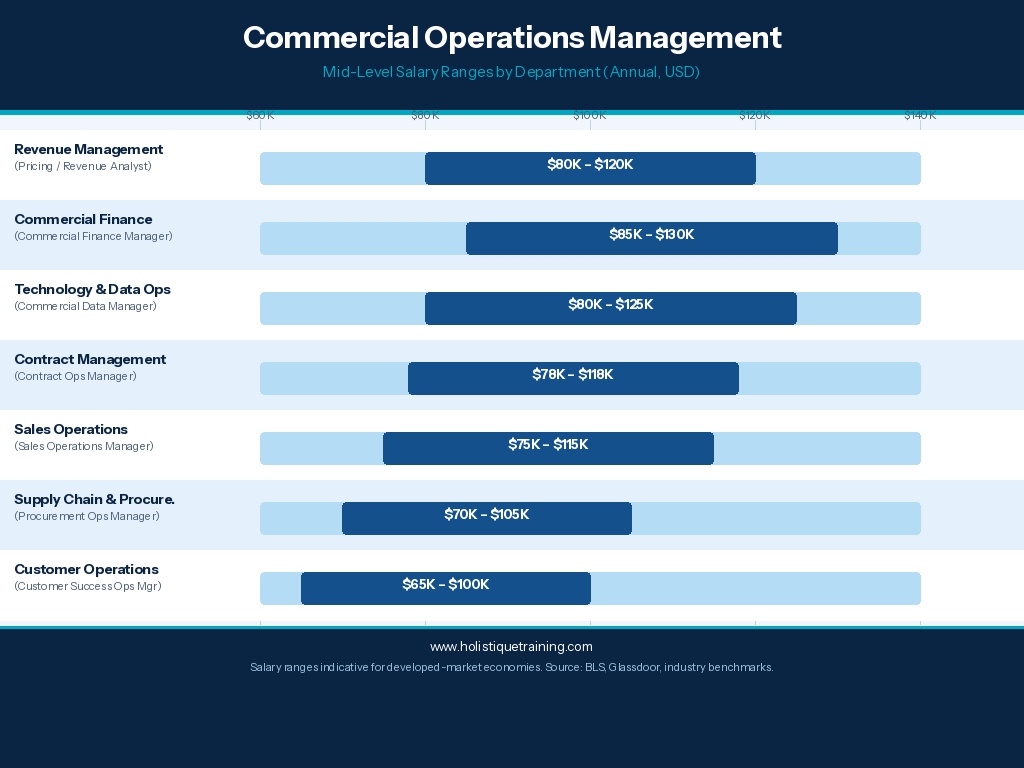
Sales operations professionals occupy a central position in the compensation landscape. Their work supports the revenue generation engine of the business, and their proximity to commercial outcomes tends to be reflected in their pay, particularly where variable components tied to sales performance are included in their total compensation package. Commercial finance professionals within the operations function earn salaries aligned with both the commercial and financial disciplines they bridge, often placing them at the higher end of the range for their seniority level. The table below presents indicative mid-level salary ranges across the key departmental areas within commercial operations in developed-market economies.
Department | Role Example | Typical Salary Range (USD) |
Revenue Management | Revenue Analyst / Pricing Manager | $80,000 – $120,000 |
Commercial Finance | Commercial Finance Manager | $85,000 – $130,000 |
Technology & Data Operations | Commercial Data Manager | $80,000 – $125,000 |
Contract Management | Contract Operations Manager | $78,000 – $118,000 |
Sales Operations | Sales Operations Manager | $75,000 – $115,000 |
Supply Chain & Procurement | Procurement Operations Manager | $70,000 – $105,000 |
Customer Operations | Customer Success Operations Manager | $65,000 – $100,000 |

Supply Chain Management (SCM) is essential in any business to ensure you have a reliable supply of products, equipment, and tools to run your operation effectively. Managing a supply chain requires consideration of many factors to keep your business sustainable into the future and to
8- Factors That Determine Commercial Operations Salaries
Several key factors shape the income that commercial operations professionals can expect to earn, independent of their formal seniority level or functional department. Understanding these factors is essential for organisations designing compensation frameworks and for individuals seeking to navigate and optimise their earning potential within the field.
Geography is one of the most powerful determinants of commercial operations income. Markets in North America, Western Europe, and the Gulf Cooperation Council states consistently offer higher nominal salaries than markets in South or Southeast Asia, Sub-Saharan Africa, or Eastern Europe, even for roles with comparable levels of responsibility. This reflects differences in cost of living, talent availability, competitive hiring dynamics, and regional economic output. According to Data USA, general and operations managers in the United States earned an average annual wage of $109,382 in 2024 — a figure that illustrates the premium that large, competitive economies place on commercial management expertise.
Industry sector is a second significant determinant. Commercial operations professionals in technology, pharmaceuticals, energy, and financial services routinely earn more than peers in retail, hospitality, or non-profit management at equivalent seniority levels. This differential reflects the complexity and financial stakes associated with commercial activity in higher-value sectors. The size and complexity of the employing organisation also exerts a significant influence — professionals at large multinational organisations manage higher volumes of commercial activity, more complex governance frameworks, and larger teams than counterparts in smaller businesses, and their compensation typically reflects that added complexity.
Educational background, professional certifications, and a demonstrated track record of revenue impact are further factors that influence where within any given salary range an individual is placed. The table below summarises the principal factors and their relative influence on commercial operations remuneration.
Factor | Impact on Salary | Example |
Geography | Very High | London vs. Nairobi for the same role level |
Industry Sector | High | Technology and energy vs. retail and hospitality |
Organisation Size | Moderate–High | Multinational corporation vs. small or medium enterprise |
Level of Responsibility | Very High | Manager-level vs. Director-level accountability |
Revenue Proximity | Moderate–High | Revenue management vs. administrative support functions |
Qualifications and Certifications | Moderate | MBA, CIPS, PMP or equivalent professional credentials |
Performance Track Record | Moderate | Demonstrable and quantified commercial revenue impact |
9- The Relationship Between Responsibility and Compensation Structure
Beyond the level of basic pay, the structure of compensation packages in commercial operations reflects the nature of the responsibilities attached to a given role. This means that the way in which income is paid — not only how much — changes as professionals progress through the function.
Entry-level roles are almost universally compensated through fixed base salaries, reflecting the fact that the work at this level is process-oriented and the impact of individual performance is difficult to isolate and measure against commercial outcomes. As professionals move into mid-level management, a variable component — typically in the form of an annual performance bonus — begins to feature in total compensation. This bonus is usually tied to team-level or functional key performance indicators rather than individual commercial metrics, ensuring that the performance assessment remains equitable and grounded in collective outcomes.
At the senior and executive levels, the compensation structure becomes considerably more complex. Long-term incentive plans, share options, deferred bonus schemes, and equity participation are common features of senior commercial operations remuneration, particularly in large corporate environments and publicly listed businesses. These instruments are designed to align the financial interests of senior commercial leaders with the long-term value creation objectives of the organisation, and to serve as retention mechanisms in a competitive talent market where experienced commercial operations leaders are consistently sought after.
10- Commercial Operations Management Across Key Sectors
The income attached to commercial operations responsibilities varies not only by function and seniority but also by the sector in which an organisation operates. Different industries present different commercial challenges, revenue models, and regulatory environments, and these differences are reflected in how commercial operations functions are structured and how they are compensated.
In the technology sector, commercial operations teams frequently focus on recurring revenue management, software licensing, and the management of complex enterprise contracts with long renewal cycles. The analytical and process demands of this environment, combined with the high value of the contracts involved, tend to generate above-average compensation for commercial operations professionals at all seniority levels. In the energy sector — particularly oil and gas, and increasingly renewables — commercial operations teams manage large-scale procurement relationships, multi-year supply and offtake agreements, and the interface between operational performance and commercial obligations.
The financial exposure associated with these responsibilities drives premium compensation, particularly at senior levels. In financial services, commercial operations professionals working in product operations, client onboarding, and commercial analytics benefit from the sector's consistently elevated compensation norms. In healthcare and pharmaceuticals, commercial operations is closely tied to market access, pricing, and contracting with payors and health systems — creating a specialised and well-remunerated niche within the broader function that demands a distinctive combination of scientific, commercial, and regulatory expertise.
11- Building a Career Pathway in Commercial Operations
A career in commercial operations management typically begins with a role in analysis, coordination, or sales support, progressing through management positions with increasing cross-functional responsibility before reaching director or executive levels. The pace of progression varies depending on the individual's skills, the sector, and the scale of the organisation in which they work, but professionals who combine strong quantitative skills with commercial acumen and leadership capability tend to advance more quickly.
Professional development in commercial operations benefits from both formal education — particularly in business, economics, finance, or management — and practical experience across multiple functional areas. Exposure to pricing, contract management, customer success, and revenue analytics builds the breadth of commercial knowledge that senior roles require. Certifications in project management, procurement, and data analytics are increasingly valued by employers as markers of professional rigour and commitment to continuous development.
The most commercially effective professionals in this field are those who understand not only the operational mechanics of the function but also the commercial logic that drives it. The ability to translate operational data into strategic insight, to identify commercial risk in process design, and to communicate financial implications clearly to non-commercial stakeholders are the competencies that differentiate those who plateau in middle management from those who reach senior and executive positions.
12- Conclusion
Commercial operations management is a function of considerable strategic importance and growing commercial complexity. The income that professionals in this field earn is not arbitrary; it is a structured reflection of the scope of responsibility they carry, the proximity of their work to commercial outcomes, the sector and geography in which they operate, and the systems of variable and long-term compensation that organisations use to align individual incentives with business performance.
Understanding the relationship between responsibility and income in commercial operations enables organisations to design compensation frameworks that attract, retain, and motivate the talent required for commercial excellence. For individuals, that understanding provides a clear map of the earning potential available at each stage of a career — and the responsibilities that must be embraced to reach the highest levels of the profession.