
- Table of Contents
- Introduction
- 1- What Is Continuous Professional Development?
- Core Principles of CPD
- CPD Compared with Traditional Training
- Who Is Responsible for CPD?
- 2- Why Continuous Professional Development Matters
- The Speed of Skills Change
- Careers Without Fixed Boundaries
- Regulation and Professional Standards
- 3- Benefits of CPD for Organisations
- 1- Stronger performance:
- 2- Higher retention:
- 3- Greater agility:
- 4- Lower recruitment costs:
- 5- Stronger succession planning:
- 4- Benefits of CPD for Individuals
- Confidence and Employability
- Career Mobility and Fulfilment
- Wellbeing and Sense of Purpose
- 5- Types of CPD Activities
- 1- Formal courses and qualifications:
- 2- Coaching and mentoring:
- 3- On-the-job learning:
- 4- Peer learning and communities of practice:
- 5- Self-directed learning:
- 6- Conferences and professional body events:
- 6- The CPD Cycle: Plan, Act, Reflect and Record
- Personal Development Plans
- 7- Building an Organisational CPD Strategy
- Start with Needs and Strategy
- Set Policy, Time and Budget
- Accreditation and Recognised Standards
- 8- The Role of Line Managers in CPD
- Managers as Gatekeepers of Learning
- Coaching and Everyday Development
- 9- The Role of HR and L&D Teams
- Designing the Framework
- Creating a Learning Culture
- 10- CPD Across Different Sectors
- Healthcare, Finance and Other Regulated Fields
- Technology and Fast-Moving Industries
- Public Sector, Non-Profit and Humanitarian Organisations
- 11- Technology and Digital Learning
- Digital Platforms and Microlearning
- Artificial Intelligence and Personalisation
- 12- Measuring the Impact of CPD
- 13- Common Challenges and How to Overcome Them
- 14- Future Trends in Continuous Professional Development
- Skills-Based Careers and Internal Mobility
- Stackable and Bite-Sized Credentials
- Learning Embedded in Daily Work
- 15- Conclusion
Introduction
Few workplace ideas have travelled as far from the margins to the centre of organisational strategy as continuous professional development. For decades, professional learning was treated as an event: a qualification earned early in a career, a two-day workshop attended once a year, or a compliance module completed to satisfy an audit. That model assumed that the knowledge gained at the start of a working life would remain sufficient for the decades that followed. In an economy shaped by artificial intelligence, automation, data and constant regulatory change, that assumption no longer holds.
Continuous professional development, usually shortened to CPD, replaces the event with a habit. It describes the ongoing process through which professionals identify what they need to learn, acquire new knowledge and skills through a mix of formal and informal activities, apply them at work and reflect on the results. For HR and learning and development professionals, it offers a way to keep capability aligned with strategy. For managers, it provides a practical route to stronger teams, better performance and lower turnover. For employees, it offers confidence, mobility and a clear sense of progress.
In this article, we will discuss what continuous professional development is, why it matters, the benefits it brings to organisations and individuals, the main types of CPD activity, the CPD cycle, how to build an organisational strategy, the role of managers and HR teams, the part played by technology, how to measure impact, and the challenges organisations commonly face, along with practical ways to overcome them.
1- What Is Continuous Professional Development?
Continuous professional development is the systematic, ongoing process of maintaining, updating and extending the knowledge, skills and competence needed to perform a role well and to progress within a career. The word continuous matters. CPD is not a single course or a certificate on the wall, but a career-long commitment that runs alongside day-to-day work. The word professional matters too, because the learning is tied directly to the standards, expectations and responsibilities of an occupation.
Core Principles of CPD
Effective CPD rests on several principles. It is planned rather than accidental, relevant to the learner's role, reflective, and measurable in terms of what changes afterwards. It also recognises that learning takes many forms, from structured courses to conversations with colleagues. Professional bodies in fields such as human resources, accounting, engineering and healthcare often require members to log CPD hours each year, which has helped establish the practice as a mark of credibility and public trust.
CPD Compared with Traditional Training
Traditional training is usually organisation-led, scheduled and event-based, whereas CPD is learner-led, ongoing and connected to career goals. The two approaches are complementary rather than competing, but the differences shape how programmes should be designed, funded and evaluated.
Dimension | Traditional Training | Continuous Professional Development |
|---|---|---|
Timing | Scheduled events | Ongoing throughout a career |
Ownership | Employer-led | Shared between individual and organisation |
Format | Mostly formal courses | Formal, informal and social learning |
Focus | Immediate task or compliance | Long-term capability and career growth |
Evidence | Attendance record | Reflection, application and outcomes |
Who Is Responsible for CPD?
A common misunderstanding is that CPD belongs either to the employer or to the employee. In practice, responsibility is shared. Individuals own their goals, their curiosity and their reflection, because no one else can learn on their behalf. Employers own the conditions that make learning possible, including time, budget, access to resources and a culture that rewards growth. When either side steps back, CPD tends to stall and becomes a paperwork exercise rather than a driver of development.
2- Why Continuous Professional Development Matters
The Speed of Skills Change
The pace of change in the world of work explains why CPD has become a strategic priority. According to the World Economic Forum's Future of Jobs Report 2025, 63 per cent of employers identify skills gaps as a major barrier to business transformation between 2025 and 2030. The same report found that 85 per cent of employers plan to prioritise upskilling their workforce, and it estimates that if the global workforce were made up of 100 people, 59 would need training by 2030. These figures show that learning can no longer be left to chance or to the enthusiasm of individual employees.
Careers Without Fixed Boundaries
Job roles are changing shape faster than qualifications can be redesigned. Tasks are being automated, new functions are emerging and professionals increasingly move between sectors, so a single qualification rarely protects long-term employability. CPD gives workers a way to adapt without starting again from the beginning, and it gives employers a pipeline of capability that does not rely entirely on external hiring.
Regulation and Professional Standards
In regulated sectors such as finance, healthcare, engineering and law, CPD is also a formal obligation. Professionals who do not maintain their knowledge risk losing their licence to practise or their professional membership. Even in unregulated fields, clients and employers increasingly look for evidence of up-to-date learning as a signal of credibility, which makes a documented CPD record a commercial asset as well as a personal one.
3- Benefits of CPD for Organisations
Organisations that invest in CPD consistently report gains in performance, culture and cost control. The main benefits can be summarised as follows.
1- Stronger performance:
Employees who regularly refresh their knowledge make fewer errors, adopt better methods sooner and solve problems with greater confidence, which raises the quality and consistency of output across teams.
2- Higher retention:
People are more likely to stay with an employer that invests in their growth. Visible development opportunities reduce the frustration that often drives talented staff to look elsewhere.
3- Greater agility:
A workforce that learns continuously can absorb new tools, regulations and market shifts without lengthy retraining programmes, which shortens the time between change and competence.
4- Lower recruitment costs:
Developing existing staff for new responsibilities is usually cheaper and faster than hiring externally, and it preserves valuable organisational knowledge that would otherwise walk out of the door.
5- Stronger succession planning:
CPD builds a bench of ready successors by preparing high-potential employees for leadership long before vacancies appear.
Taken together, these benefits explain why CPD is increasingly discussed in boardrooms as well as in HR departments.
4- Benefits of CPD for Individuals
Confidence and Employability
For individuals, the most immediate benefit of CPD is confidence. Professionals who keep their skills current feel better prepared for new tasks, more willing to take on stretching assignments and more credible in the eyes of colleagues and clients. Over time, a documented record of learning also strengthens a curriculum vitae and supports promotion cases, salary discussions and job applications.
Career Mobility and Fulfilment
CPD widens the range of roles that an individual can credibly pursue. A finance analyst who develops data skills, or an administrator who builds project management capability, gains options that would otherwise be closed. Learning also contributes to job satisfaction, because it provides a sense of progress and purpose beyond routine duties.
Wellbeing and Sense of Purpose
There is a human dimension as well. Professionals who feel that they are growing tend to feel more engaged with their work and more in control of their futures. This sense of progress can offset the stress that accompanies organisational change, because employees feel equipped rather than threatened by new demands.
5- Types of CPD Activities
CPD takes many forms, and the most effective programmes combine several of them rather than relying on a single format. The following types are among the most widely used.
1- Formal courses and qualifications:
Structured programmes, whether classroom-based or online, provide systematic coverage of a subject and often lead to recognised certificates. They are particularly useful for building strong foundations or meeting regulatory requirements.
2- Coaching and mentoring:
One-to-one relationships give professionals tailored guidance. Coaching tends to focus on improving performance in the current role, while mentoring supports longer-term career thinking, often with a more experienced colleague.
3- On-the-job learning:
Stretch assignments, job shadowing, secondments and rotations allow people to build skills in real working conditions, which supports retention because learning is applied immediately.
4- Peer learning and communities of practice:
Discussion groups, internal knowledge-sharing sessions and professional networks let colleagues exchange experience and solve shared problems together.
5- Self-directed learning:
Reading, podcasts, webinars and online modules allow individuals to follow their own interests and fill gaps at their own pace, provided the activity is planned and recorded.
6- Conferences and professional body events:
External events expose professionals to emerging trends, peer benchmarks and expert thinking that may not be available inside their own organisation.
A balanced mix, often described as a blend of formal, informal and social learning, gives employees both depth and flexibility.
6- The CPD Cycle: Plan, Act, Reflect and Record
Most CPD frameworks follow a repeating cycle rather than a straight line. Professionals identify what they need to learn, plan activities, carry them out, reflect on what changed and then record the evidence before the cycle begins again. The structure matters because reflection is what converts activity into learning. Attending an event without considering how it will change practice is closer to attendance than development.
Stage | Key Question | Typical Output |
|---|---|---|
Identify | What do I need to learn, and why? | Skills gap analysis |
Plan | How and when will I learn it? | Personal development plan |
Act | Which learning activities will I complete? | Courses, coaching, projects |
Reflect | What did I learn and how will I apply it? | Reflective notes |
Record | What evidence shows the impact? | CPD log or portfolio |
Personal Development Plans
A personal development plan is the practical backbone of the cycle. It sets out goals, the activities that will achieve them, the support required and the dates for review. The strongest plans link individual ambitions to team and organisational priorities, so that the learner and the employer are pulling in the same direction. Plans should be reviewed at least twice a year, because roles, priorities and technologies shift quickly.

Learn how to create an effective career development plan—assess skills, set goals, seek mentorship, and build a clear path for continuous growth.
https://holistiquetraining.com/en/news/how-to-create-an-effective-learning-path-for-career-growth
7- Building an Organisational CPD Strategy
Start with Needs and Strategy
An effective CPD strategy begins with a clear view of where the organisation is going and which capabilities it needs to get there. A training needs analysis compares current skills with those required for strategic goals, drawing on performance data, manager input and employee feedback. The results should shape priorities, so that limited budgets are directed at the gaps that matter most rather than spread across popular but marginal topics.

Becoming a training and development expert requires education, experience, and skills. These roles identify the organisation's skill gaps and learning needs. Conducting thorough assessments can determine where employees require training to enhance their performance and contribute more effectively to the company's goals. Dedicated training
Set Policy, Time and Budget
Strategy must be supported by practical commitments. A written CPD policy should explain who is eligible, how learning time is protected, what funding is available and how progress will be recorded. Equal access is essential, since development that favours office-based or senior staff undermines trust. Many organisations also set a minimum annual learning entitlement, which signals that development is an expectation rather than a reward.
Accreditation and Recognised Standards
Quality matters as much as quantity. Programmes that are accredited or aligned with recognised professional standards give learners credible evidence of achievement and give employers assurance that the content is sound. Many accrediting bodies award CPD credits based on learning hours, which makes it easier for professionals to demonstrate compliance with membership requirements. Organisations should check that providers are transparent about accreditation, assessment methods and learning outcomes before committing funds.
8- The Role of Line Managers in CPD
Managers as Gatekeepers of Learning
Line managers have more influence over day-to-day CPD than any policy. They approve time away from work, assign stretch projects and shape whether learning is valued. Yet many are under pressure and struggle to prioritise it. According to LinkedIn's 2025 Workplace Learning Report, 31 per cent of organisations have career development programmes with limited adoption, while a further 33 per cent have no initiatives or are only just getting started. These findings suggest that many employers still have significant room to turn good intentions into everyday practice.
Coaching and Everyday Development
Managers do not need to be trainers to support CPD effectively. Regular development conversations, constructive feedback and visible encouragement go a long way. Asking open questions, agreeing small learning goals and revisiting them in one-to-one meetings help employees apply what they learn. Organisations should therefore equip managers with coaching skills and clear expectations, rather than assuming these abilities will emerge naturally.

An organisation can have many great features, systems, and employees, but that does not guarantee its success. Effective leadership and supervisors are crucial within any business. Without them, an organisation is bound to lose productivity, fall behind, and be drowned out in the market.
9- The Role of HR and L&D Teams
Designing the Framework
HR and learning and development teams act as the architects of CPD. They design competency frameworks, curate learning resources, negotiate with providers and ensure that programmes meet quality and accreditation standards. Their role is also to translate between business leaders, who want measurable results, and employees, who want relevant and flexible opportunities.
Creating a Learning Culture
Culture determines whether CPD thrives. When leaders talk openly about their own learning, celebrate completed development goals and treat mistakes as lessons, employees are more willing to invest effort. Recognition schemes, learning showcases and internal mobility programmes all reinforce the message that growth is valued. Dedicated awareness campaigns can also help bring development into everyday conversation across the organisation.
10- CPD Across Different Sectors
The shape of CPD varies by sector, although the underlying cycle remains the same. Understanding these differences helps HR teams tailor programmes to the realities of each workforce.
Healthcare, Finance and Other Regulated Fields
In regulated professions, CPD is often built around mandatory hours, ethical updates and changes in legislation. Programmes tend to be highly structured, with formal records and periodic audits. The challenge for employers is to go beyond compliance and use these requirements as a foundation for genuine skill development.
Technology and Fast-Moving Industries
In technology, data and digital marketing, tools and best practice can change within months. CPD here relies heavily on short, practical learning, experimentation and peer exchange. Professionals often combine online courses with project work, communities of practice and vendor certifications, so that new skills are tested quickly in real situations.
Public Sector, Non-Profit and Humanitarian Organisations
Organisations in the public and non-profit sectors often operate with tight budgets and dispersed teams. Low-cost approaches such as mentoring, peer learning, job rotation and short online modules can deliver strong results. Because staff frequently work in demanding or remote environments, flexible and mobile-friendly learning is especially valuable.
11- Technology and Digital Learning
Digital Platforms and Microlearning
Technology has made CPD more accessible and flexible. Learning experience platforms bring courses, articles and videos into one place and recommend content based on role and interests. Mobile access and short microlearning modules allow professionals to learn in brief windows during the working day, which is especially valuable for those with demanding schedules or limited time away from their duties.
Artificial Intelligence and Personalisation
Artificial intelligence is beginning to personalise development at scale. Systems can analyse skills data, suggest next steps and adapt content to a learner's pace. Used thoughtfully, these tools reduce the administrative burden on L&D teams and make guidance more timely. However, technology should support rather than replace human conversation, and organisations must handle learner data responsibly and transparently.
12- Measuring the Impact of CPD
What gets measured gets managed, and CPD is no exception. Many organisations still track only attendance or completion, which says little about whether learning has changed anything. A more useful approach looks at several levels of impact, from learner reaction through to business outcomes, as shown below.
Level | What Is Measured | Example Indicators |
|---|---|---|
Reaction | Learner satisfaction and relevance | Feedback scores, engagement rates |
Learning | Knowledge and skills gained | Assessments, certifications |
Behaviour | Application on the job | Manager observations, 360-degree feedback |
Results | Business and career outcomes | Retention, productivity, internal promotions |
Measurement works best when it is planned at the outset, with clear success indicators agreed before activities begin. Combining quantitative data with qualitative evidence, such as manager comments and learner reflections, gives a fuller picture. Findings should then feed back into the strategy, so that effective activities are expanded and weaker ones are redesigned or retired.

A Certified Monitoring & Evaluation Specialist plays a pivotal role in ensuring the effectiveness and efficiency of programs and projects across various sectors. Armed with a deep understanding of monitoring and evaluation methodologies, this specialist is tasked with designing and implementing robust monitoring and evaluation
13- Common Challenges and How to Overcome Them
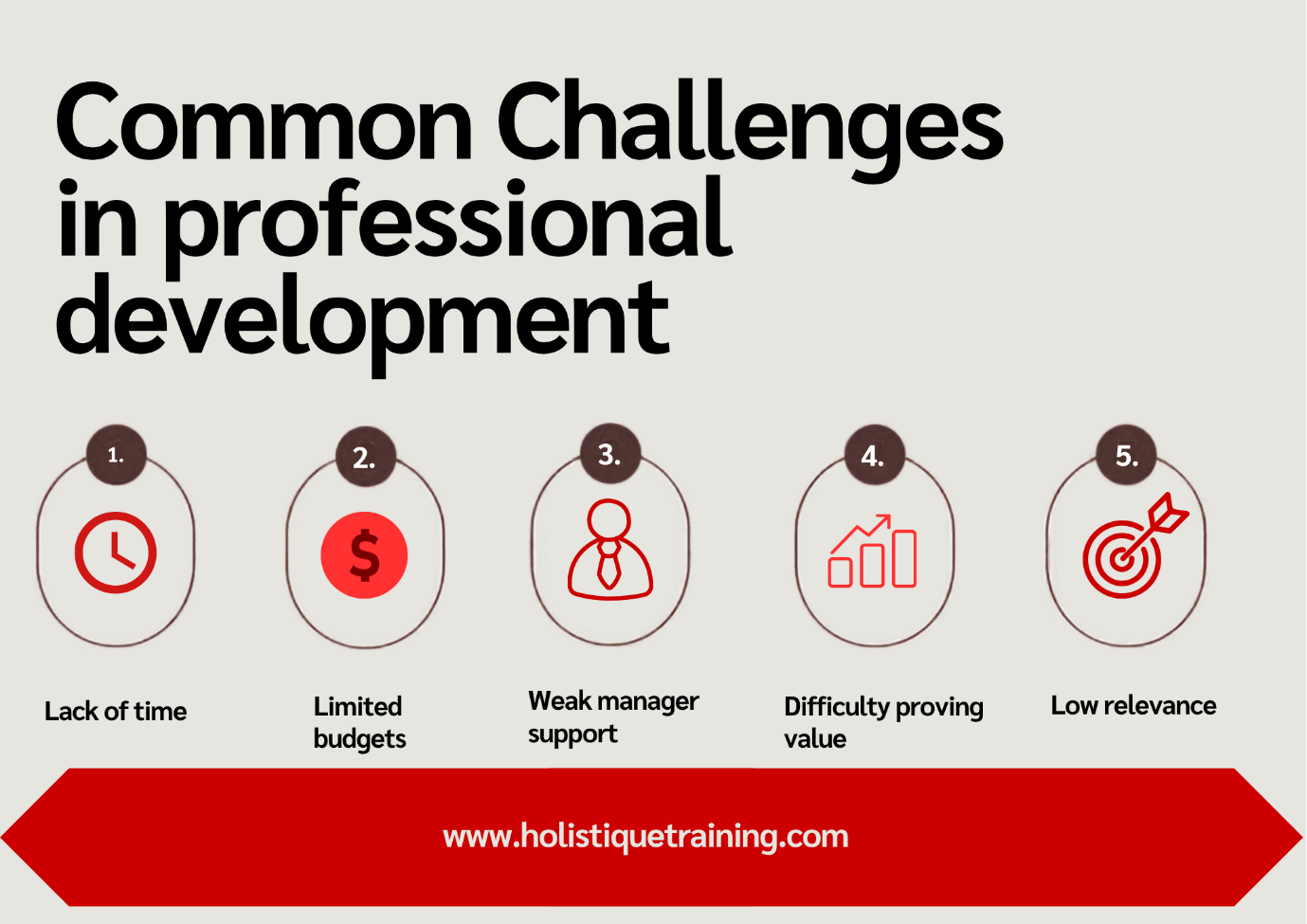
Even well-designed programmes face obstacles, and capacity is one of the most persistent. The CIPD's Learning at Work survey, based on responses from 1,108 people responsible for supporting learning, found that only 59 per cent of practitioners agreed they could respond with agility to changing skills needs, compared with 69 per cent in 2021. This suggests that many teams are stretched. The most common challenges, along with practical responses, are set out below.
1- Lack of time:
Employees often cite workload as the main barrier. Protecting learning time in calendars, offering microlearning and treating development as part of the job rather than an extra can ease the pressure.
2- Limited budgets:
Where funding is tight, organisations can prioritise high-impact needs, use internal experts, encourage peer learning and make use of low-cost digital resources.
3- Weak manager support:
Training managers in coaching, including development goals in their own objectives and sharing good practice help move support from inconsistent to dependable.
4- Low relevance:
Learning that does not connect to real tasks is quickly forgotten. Involving employees in choosing activities and linking each one to a work challenge improves uptake.
5- Difficulty proving value:
Setting measurable objectives from the start and tracking behaviour and results, not just attendance, helps demonstrate return on investment.
Addressing these challenges is rarely a one-off task. Programmes that succeed treat obstacles as signals to refine the approach, gathering feedback from learners and managers each year and adjusting priorities accordingly. Small, visible improvements, such as protected learning hours or a simpler recording process, often build the momentum needed for larger changes.
14- Future Trends in Continuous Professional Development
Skills-Based Careers and Internal Mobility
Organisations are moving from rigid job ladders towards skills-based models in which people progress by building and demonstrating capabilities. CPD sits at the heart of this shift, because it supplies the skills that make lateral moves, project assignments and role redesign possible. Internal talent marketplaces and structured career paths are likely to become more common as a result.
Stackable and Bite-Sized Credentials
Short, focused credentials that can be combined over time are gaining ground alongside traditional qualifications. They allow professionals to build recognised expertise in stages and to update it as needs change. For employers, they offer a flexible way to verify skills without removing people from work for long periods.
Learning Embedded in Daily Work
The boundary between learning and working continues to blur. Prompts, checklists and guidance delivered inside everyday systems allow employees to learn at the moment of need. Combined with analytics that highlight skills gaps early, this approach turns CPD from a scheduled activity into a natural part of how work gets done.
15- Conclusion
Continuous professional development has moved from a desirable extra to an operational necessity. Skills are changing faster than formal education can keep up, employees expect clear routes to grow, and organisations that fail to develop their people risk losing both talent and competitiveness. CPD answers these pressures by turning learning into a continuous, planned and reflective habit.
Success depends on several connected elements: a strategy anchored in business needs, a balanced mix of formal, informal and social learning, managers who coach, HR teams that provide structure, and measurement that looks beyond attendance. No single tool or platform can deliver this alone. Organisations that treat CPD as a shared responsibility between employer and employee, and that review it regularly, will be best placed to build capability that lasts.