
- Table of Contents
- Introduction
- 1- What Is Safety and Health Training?
- Definition and Purpose
- Safety Training vs Health Training
- Training, Instruction, and Information
- 2- Why Safety and Health Training Matters
- The Human Cost of Workplace Harm
- The Business Case
- Impact on Morale and Retention
- The Ethical and Legal Dimension
- 3- Legal and Regulatory Foundations
- 4- Main Types of Safety and Health Training
- 5- Who Needs Safety and Health Training?
- 6- Training Needs Analysis and Hazard Identification
- Starting With the Risk
- Using Incident and Statistical Data
- Consulting Workers
- 7- Delivery Methods for Safety and Health Training
- Practical Assessment Matters
- 8- Designing Effective Training Programmes
- Evidence of What Works
- Adapting to the Audience
- Principles of Good Design
- 9- Building a Safety Culture Through Training
- Leadership Visibility
- Psychological Safety and Reporting
- Recognition and Reinforcement
- 10- Measuring Training Effectiveness
- Setting Baselines
- Leading and Lagging Indicators
- Continuous Improvement
- 11- Common Challenges and How to Overcome Them
- 12- Collaboration Between Safety, HR, and L&D Teams
- Shared Responsibilities
- Developing the Trainers
- 13- The Future of Safety and Health Training
- 14- Conclusion
Introduction
Every working day, millions of people leave home to do jobs that expose them to some form of risk. Some face obvious dangers such as heights, machinery, or hazardous chemicals. Others meet quieter threats, including repetitive strain, long hours, and sustained pressure. Safety and health training is the main way organisations help people recognise those risks, respond to them correctly, and return home well at the end of every shift. It is also one of the few workplace investments that protects people, strengthens compliance, and supports performance at the same time.
For health and safety officers, training is the practical expression of policy. A procedure that is written but never taught remains a document, whereas a procedure that is understood, practised, and reinforced becomes a habit. For HR and L&D professionals, safety and health training sits at the intersection of legal duty, employee wellbeing, and organisational capability. Both groups share the same challenge: designing programmes that people remember and apply, rather than sit through and forget.
In this article, we will discuss what safety and health training is, why it matters, the legal foundations behind it, the main types of training, who needs which programme, how to identify training needs, the delivery methods available, how to design effective programmes, how training builds a safety culture, how to measure results, the most common challenges, how safety, HR, and L&D teams can work together, and where the field is heading.
1- What Is Safety and Health Training?
Definition and Purpose
Safety and health training is a structured set of learning activities that gives workers, supervisors, and managers the knowledge, skills, and attitudes needed to prevent injury, illness, and incidents at work. It covers how to identify hazards, how to carry out tasks safely, how to use equipment and protective measures, and how to respond when something goes wrong. Its purpose is not simply to satisfy an inspector. It is to change what people know and do in the moments that matter most.
Safety Training vs Health Training
Although the two terms are often combined, they address different parts of the same problem. Safety training focuses mainly on preventing sudden events such as falls, fires, electric shocks, and machinery incidents. Health training focuses on conditions that develop over time, including noise-induced hearing loss, respiratory disease, musculoskeletal disorders, and work-related stress. Effective programmes treat both together, because a worker who is exhausted, anxious, or in pain is far more likely to make an unsafe decision.
Training, Instruction, and Information
It also helps to separate training from the wider family of communication activities. Information tells people what the risk is, instruction tells them what to do, and training builds the competence to do it reliably under real conditions. Most workplaces need all three, but only training produces lasting behavioural change.
2- Why Safety and Health Training Matters
The Human Cost of Workplace Harm
The scale of work-related harm is difficult to overstate, and it extends well beyond visible accidents. According to the International Labour Organization, more than 840,000 people die every year from health conditions linked to psychosocial risks at work, such as long working hours, job insecurity, and harassment. These deaths are mainly associated with cardiovascular disease and mental disorders. The finding is a reminder that modern safety and health training must cover how work is organised and managed, not only physical hazards.
The Business Case
Beyond the human cost, poor safety performance is expensive. Incidents lead to lost time, damaged equipment, investigations, higher insurance premiums, legal exposure, and reputational harm. Absence and turnover rise when people feel unsafe, and morale falls when a serious event occurs. Well-run training reduces these costs by preventing incidents and by helping workers return to productive work sooner. Employers that invest consistently usually find that safety performance and operational performance improve together.
Impact on Morale and Retention
Workers notice whether an employer takes their safety seriously. Visible investment in training tells people they are valued, which supports engagement, loyalty, and retention. Employees who feel confident handling hazards also tend to report problems earlier and take more pride in their work, creating a positive cycle that benefits both wellbeing and productivity.
The Ethical and Legal Dimension
There is also a simple ethical argument. Employers ask people to bring their skills and time to the workplace, and in return they owe them a reasonable chance of leaving unharmed. Training is one of the clearest ways to honour that duty, and in most jurisdictions it is also a legal requirement.
3- Legal and Regulatory Foundations
Safety and health training is shaped by national legislation, international standards, and sector-specific rules. Requirements differ from country to country, but several principles appear almost everywhere, and the most important are listed below.
1-Employer duty of care:
Most legal systems require employers to provide a safe workplace, and training is treated as part of that duty. Employers must ensure workers understand the hazards of their job and the controls in place, in a language and format they can follow.
2-International labour standards:
The ILO’s Occupational Safety and Health Convention (No. 155) and its Promotional Framework Convention (No. 187) encourage governments to require preventive systems that include worker information and training. Many national laws reflect these principles.
3-Management system standards:
ISO 45001 sets out requirements for an occupational health and safety management system and expects organisations to make sure workers are competent on the basis of education, training, or experience.
4-Sector and hazard-specific rules:
Regulations on working at height, confined spaces, hazardous substances, electrical work, lifting operations, and fire safety often specify minimum training content or certification.
5-Record-keeping and evidence:
Regulators and auditors expect organisations to show who was trained, when, on what, and how competence was confirmed. Good records also protect employers when incidents are investigated.
Safety officers should map these obligations for each jurisdiction and activity in which the organisation operates, and HR and L&D teams should build them into the learning calendar so that statutory training never lapses.

Occupational health and safety standards are used internationally by organisations to ensure the safety and care of employees. It’s essential that all companies understand how to accurately carry out risk assessments, employ individuals who are sufficiently trained in first aid, and have strict policies and
4- Main Types of Safety and Health Training
No single programme can cover every risk, so organisations normally build a portfolio of training types matched to their hazards. The most common categories are described below.
1-Induction training:
Delivered on a worker’s first day, it introduces site rules, emergency arrangements, reporting routes, welfare facilities, and the main hazards of the workplace. Strong induction sets expectations early and stops newcomers, who face higher risk, from learning by trial and error.
2-Task-specific training:
This teaches the safe method for a particular job, such as operating a forklift, using a power tool, or cleaning a production line. It combines demonstration, supervised practice, and a final competence check.
3-Fire safety and emergency response:
Staff learn evacuation routes, assembly points, alarm procedures, and the correct use of extinguishers. Fire wardens and first aiders receive deeper training and regular drills.
4-Manual handling and ergonomics:
Workers learn to assess loads, use lifting aids, adjust workstations, and recognise early signs of strain, which helps reduce musculoskeletal injury.
5-Hazardous substances training:
Employees learn to read labels and safety data sheets, understand exposure routes, use ventilation and protective equipment, and deal with spills.
6-Mental health and psychosocial risk awareness:
This covers workload, stress, bullying, and support routes, and equips managers to spot warning signs and respond appropriately.
7-Supervisory and leadership training:
Managers learn how to supervise safely, investigate incidents, coach workers, and model the behaviour they expect.
8-Refresher and update training:
Skills fade and rules change, so periodic refreshers and updates after incidents, process changes, or new equipment keep competence current.
The right mix depends on the organisation’s risk profile. A warehouse will weight manual handling and vehicle safety heavily, an office will emphasise ergonomics, fire safety, and wellbeing, and a laboratory will concentrate on chemical and biological hazards. Regular review ensures the portfolio keeps pace with change.
5- Who Needs Safety and Health Training?
Everyone in an organisation needs some level of training, but the depth and focus differ by role. Giving every employee the same generic course wastes time and leaves critical gaps. The table below summarises typical needs.
Role | Core Training Focus | Typical Frequency |
Frontline workers | Task-specific safe methods, hazard reporting, emergency procedures | On induction, then annual refreshers |
Supervisors and team leaders | Risk assessment basics, incident reporting, coaching, enforcing rules | On appointment, then every one to three years |
Managers and executives | Legal duties, leadership accountability, performance data, culture | On appointment, then periodic updates |
Health and safety officers | Risk assessment, auditing, investigation, legislation, management systems | Continuous professional development |
Contractors and visitors | Site rules, restricted areas, emergency arrangements | Before every site entry |
HR and L&D professionals | Training needs analysis, compliance records, wellbeing programmes | Annual review and updates |
Contractors, temporary workers, and young or new employees deserve special attention. They are often the least familiar with the workplace and the most likely to meet unfamiliar hazards, yet they are also the easiest groups to overlook.
6- Training Needs Analysis and Hazard Identification
Starting With the Risk
Effective training begins with evidence, not assumption. A training needs analysis compares the competence the organisation requires with what workers currently have, and the difference defines what must be taught. Hazard identification and risk assessment supply the evidence, because they show which tasks, locations, and exposures present the greatest danger.

Learn how Hazard Identification Studies (HAZID) promote safety in projects and systems. Explore their benefits, when to conduct them, and the step-by-step process for comprehensive hazard identification.
Using Incident and Statistical Data
Incident reports, near-miss logs, inspection findings, and national statistics all help to prioritise content. For example, according to figures from the Health and Safety Executive reported by the British Safety Council, 126 workers were killed in work-related incidents in Great Britain in 2025/26. Falls from height caused 31 of those deaths, around a quarter of the total. Data like this shows why working at height deserves dedicated, practical training wherever it features in a worker’s duties.
Consulting Workers
Workers who do the job every day often know where the real hazards lie. Surveys, toolbox discussions, and safety committee feedback reveal gaps that formal assessments can miss, and they build ownership of the resulting programme.
7- Delivery Methods for Safety and Health Training
Choosing the right delivery method matters as much as choosing the right content. Each approach has strengths and limitations, and most organisations combine several.
Method | Best Suited To | Key Strength | Main Limitation |
Classroom | Complex topics, discussion, new managers | Interaction and immediate questions | Cost and time away from work |
E-learning | Awareness topics, compliance refreshers | Scalable, trackable, flexible | Limited hands-on practice |
On-the-job coaching | Task-specific skills | Real context and instant feedback | Quality depends on the coach |
Simulation and VR | High-risk or rare scenarios | Safe practice of dangerous situations | Set-up cost and technology needs |
Toolbox talks | Short reminders, incident lessons | Frequent, relevant, low cost | Shallow depth if used alone |
Blended programmes usually perform best. An e-learning module can deliver the underlying knowledge, a practical session can build the skill, and a supervisor sign-off can confirm competence on site. Language, literacy, and accessibility must also be considered, so that materials are understood by every worker, including those with disabilities or limited access to digital devices.
Practical Assessment Matters
Practical sessions deserve particular emphasis for physical tasks. A worker can pass a written quiz on harness use and still fit the equipment incorrectly, which is why observed demonstration should be part of the sign-off wherever the consequences of error are serious.
8- Designing Effective Training Programmes
Evidence of What Works
The research base for safety training is encouraging, with an important caveat. A meta-analysis published in the Journal of Applied Psychology in February 2026 found that safety training has a clearly positive effect overall. The study reported especially strong effects on what trainees learn, with smaller but still positive effects on organisational safety and individual health outcomes. In practice, this means training reliably builds knowledge, but results on the shop floor depend on how well learning is transferred and supported afterwards.
Adapting to the Audience
Learners differ in experience, language, age, and confidence. Experienced workers respond well to scenario-based discussion that respects what they already know, while new starters need clear step-by-step guidance. Adjusting examples and pacing to the audience improves both engagement and retention.
Principles of Good Design
Programmes that transfer well tend to share a number of features, which are set out below.
1-Clear, measurable objectives:
Each session should state what participants will be able to do afterwards, such as complete a pre-use inspection or isolate equipment correctly.
2-Relevance to real tasks:
Examples, images, and scenarios should come from the learners’ own workplace, so the connection to daily work is obvious.
3-Active learning:
Demonstrations, role play, case studies, and hands-on practice lead to better retention than passive presentations.
4-Short, focused segments:
Breaking content into manageable units limits overload and allows reinforcement through spaced repetition.
5-Competence assessment:
Practical observation, scenario questions, or short quizzes confirm that learning has occurred before a worker is signed off.
6-Support after training:
Supervisors who coach, answer questions, and reinforce correct methods help turn knowledge into habit.
Health and safety within your organisation aren’t just requirements; they provide beneficial training, processes, and procedures to help your business progress. They also help you remain within legislative guidelines to manage risks and profile disasters, guaranteeing the continuation of your business.
9- Building a Safety Culture Through Training
Safety culture is the shared set of values, attitudes, and behaviours that determine how safety is treated when nobody is watching. Training contributes to it in ways that go beyond knowledge. When leaders attend sessions, when workers are encouraged to stop unsafe work, and when mistakes are discussed openly, training signals that safety is a genuine priority.
Leadership Visibility
Managers who take part in training and visibly follow the same rules send a powerful message. Conversely, when senior staff are exempt from induction or ignore protective equipment, no amount of classroom instruction can offset the example.
Psychological Safety and Reporting
Workers report hazards and near misses only if they believe they will be heard rather than blamed. Training supervisors to respond to concerns constructively therefore has a direct effect on the quality of incident data and on the organisation’s ability to learn.
Recognition and Reinforcement
Celebrating good catches, sharing lessons from incidents, and recognising teams that maintain high standards keep safety visible between formal training sessions.
10- Measuring Training Effectiveness
Attendance figures show that training happened, not that it worked. A credible evaluation looks at several levels, and the Kirkpatrick model offers a practical structure.
Level | What It Measures | Example Indicators |
Reaction | How participants experienced the training | Feedback forms, engagement, relevance ratings |
Learning | Knowledge and skills gained | Test scores, practical assessments, scenario responses |
Behaviour | Whether practice changes on the job | Observation audits, permit compliance, hazard reports |
Results | Impact on safety outcomes | Incident rates, near-miss reporting, absence, claims costs |
Setting Baselines
Evaluation is only meaningful if a starting point exists. Record current incident rates, audit scores, and observed behaviours before a programme launches, so that later changes can be attributed to training with reasonable confidence rather than assumed.
Leading and Lagging Indicators
Lagging indicators, such as injury rates and lost time, show what has already happened and can fluctuate widely in small workforces. Leading indicators, including the number of hazards reported, completed inspections, and observed safe behaviours, show whether prevention is working. A balanced scorecard uses both, and it allows safety and HR teams to demonstrate value to senior leaders in the language of business results.
Continuous Improvement
Evaluation should feed back into design. If audits show workers still bypassing a guard, the training, the equipment, or the production pressure behind that behaviour needs to be re-examined.
11- Common Challenges and How to Overcome Them
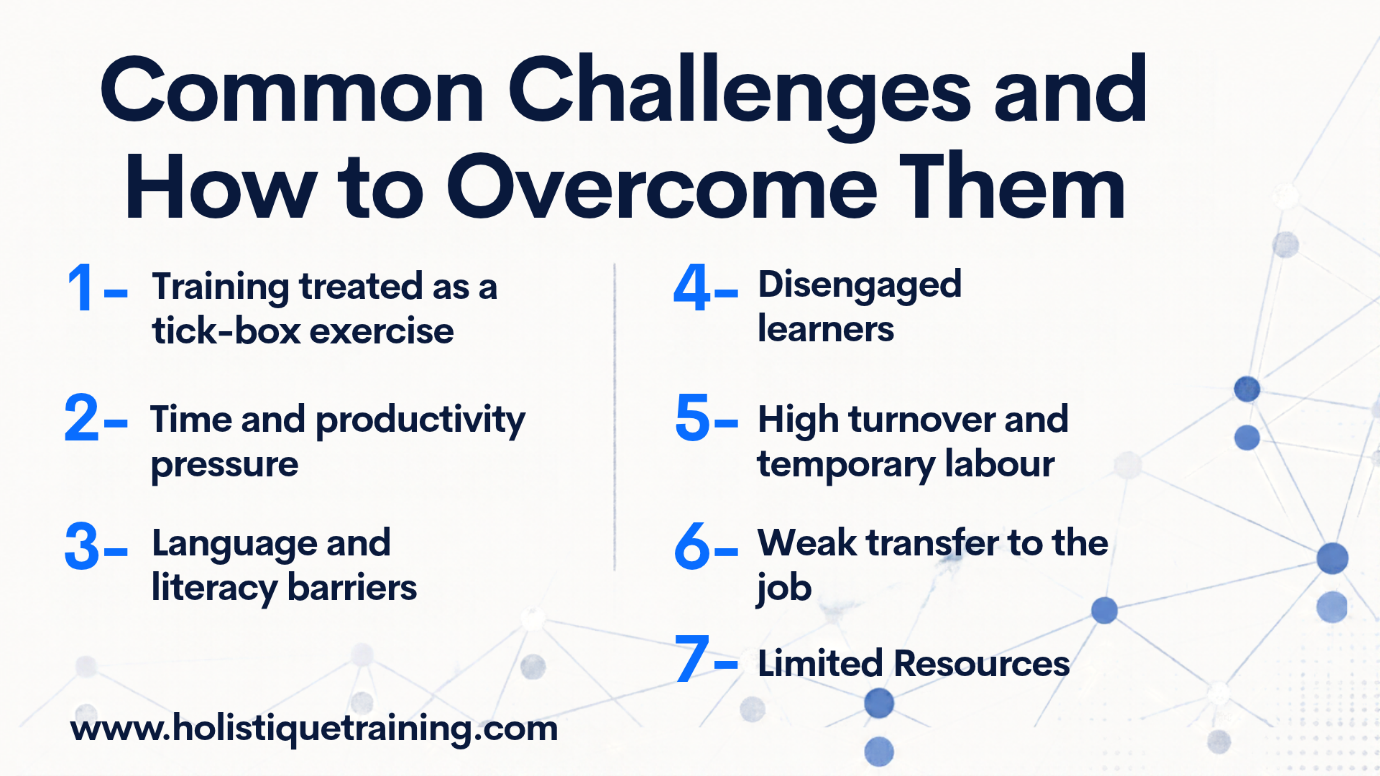
Even well-intentioned programmes meet obstacles. The following challenges appear most often, together with practical responses.
1-Training treated as a tick-box exercise:
When completion is the only goal, content becomes generic and forgettable. Link every course to specific hazards and require practical demonstration of competence.
2-Time and productivity pressure:
Supervisors may resist releasing workers. Short modules, scheduled training windows, and visible leadership support help protect learning time.
3-Language and literacy barriers:
Use plain language, visuals, translation, and interpreters where needed, and replace written tests with verbal or practical checks for some groups.
4-Disengaged learners:
Long slide presentations lose attention quickly. Stories from real incidents, discussion, and hands-on activities restore interest.
5-High turnover and temporary labour:
Standard induction packs, digital records, and portable competence cards make sure newcomers are trained before starting work.
6-Weak transfer to the job:
Without follow-up, learning fades. Supervisor coaching, job aids, and refresher prompts sustain it.
7-Limited resources:
Smaller organisations can prioritise the highest risks, use external providers selectively, and share materials across sites.
12- Collaboration Between Safety, HR, and L&D Teams
Safety and health training works best when three functions cooperate. Health and safety officers contribute technical expertise and an understanding of risk. HR professionals manage recruitment, contracts, absence data, and wellbeing programmes that interact with safety. L&D professionals bring instructional design skills, learning platforms, and evaluation methods.
Shared Responsibilities
A joint training plan, agreed annually, aligns statutory requirements with development priorities. Safety officers define the content and competence standards, L&D teams shape the learning experience, and HR ensures training is built into onboarding, promotion, and performance conversations.
Developing the Trainers
The people who deliver training also need development. Subject experts are not automatically effective teachers, so investing in facilitation skills, assessment methods, and recognised safety qualifications strengthens the whole programme.

The International General Certificate in Occupational Health and Safety is part of the 2019 syllabus for workplace health and safety regulations. Achieving this certification sets you apart in your career and demonstrates your commitment to a safe and compliant working environment.
13- The Future of Safety and Health Training
Several developments are already reshaping how organisations prepare people for safe work, and the most significant are outlined below.
1-Immersive technology:
Virtual and augmented reality allow workers to rehearse emergencies, such as fires or equipment failure, without real danger.
2-Artificial intelligence and personalisation:
Systems can analyse incident data and individual performance to recommend targeted training at the moment it is needed.
3-Microlearning in the flow of work:
Short prompts delivered through mobile devices and digital tools reinforce key points just before a task begins.
4-Greater focus on psychosocial risk:
Following global attention on work design and mental health, programmes increasingly cover workload, autonomy, and respectful behaviour.
5-Data-driven evaluation:
Digital inspections, wearable sensors, and analytics connect training to real behaviour and outcomes more directly.
These trends will not remove the need for sound fundamentals. Technology can deliver content more efficiently, but credible trainers, supportive supervisors, and committed leaders remain the foundation of every successful programme.
14- Conclusion
Safety and health training is far more than a compliance requirement. It is the means by which an organisation turns policy into practice, converts hazard knowledge into everyday habits, and shows its people that their wellbeing matters. The strongest programmes begin with a clear understanding of risk, match content to roles, use varied delivery methods, and measure what changes on the job rather than who attended.
For health and safety officers and for HR and L&D professionals, the opportunity lies in working together. Shared planning, consistent evaluation, and visible leadership commitment turn isolated courses into a coherent system. Organisations that treat training as a continuous investment, rather than an annual event, are better placed to prevent harm, meet their legal duties, and build workplaces where people can perform well and stay well.