
- Table of Contents
- Introduction
- 1. What Is a Skills Gap Analysis?
- Core Definition
- Skills Gap, Skills Shortage and Skills Mismatch
- How It Differs from Related Processes
- 2. Why Skills Gap Analysis Matters
- 1- Better targeted investment:
- 2- Stronger recruitment decisions:
- 3- Improved retention and engagement:
- 4- Reduced operational and compliance risk:
- 5- Greater strategic agility:
- 3. Types of Skills Gaps
- 1- Technical skills gaps:
- 2- Digital and AI skills gaps:
- 3- Leadership and management gaps:
- 4- Soft skills gaps:
- 5- Compliance and regulatory gaps:
- 6- Experience and knowledge gaps:
- 4. When to Conduct a Skills Gap Analysis
- 5. The Step-by-Step Process
- Step 1: Define Objectives and Scope
- Step 2: Identify Required Skills
- Step 3: Assess Current Skills
- Step 4: Measure and Prioritise the Gaps
- Step 5: Choose Interventions and Review
- 6. Data Collection Methods
- 7. Building a Skills Framework and Rating Scale
- Creating a Common Skills Language
- Designing the Proficiency Scale
- Using a Skills Matrix
- 8. Analysing and Prioritising the Gaps
- Calculating Gap Size
- Applying a Prioritisation Framework
- Testing the Root Cause
- Presenting Findings to Stakeholders
- 9. Linking Skills Gap Analysis to Workforce Planning
- 10. Strategies for Closing Skills Gaps
- 11. The Role of Technology and AI
- 12. Common Mistakes to Avoid
- 1- Starting without a clear business objective:
- 2- Relying on self-assessment alone:
- 3- Ignoring soft skills:
- 4- Treating every gap as a training need:
- 5- Failing to involve managers and employees:
- 6- Conducting a one-off exercise:
- 7- Collecting data without acting on it:
- 13. Measuring the Impact of Your Analysis
- Building a Continuous Improvement Cycle
- Conclusion
Introduction
Few workforce challenges are as persistent or as costly as the distance between the skills an organisation needs and the skills its people actually have. Technology reshapes roles faster than most training calendars can respond, new regulations create fresh compliance demands, and strategic priorities shift with every market cycle. In that environment, guessing which capabilities are missing is no longer a viable approach for HR and learning and development professionals.
A skills gap analysis offers a structured alternative. It compares the capabilities required to deliver business objectives with those that exist today, then translates the difference into clear, prioritised actions. Done well, it directs training budgets towards genuine need, informs recruitment and succession decisions, and gives managers a shared language for talking about development. Done poorly, it produces a spreadsheet that nobody uses.
In this article, we will discuss what a skills gap analysis is, why it matters, the main types of skills gaps, when to carry out an analysis, the step-by-step process, data collection methods, how to build a skills framework, how to analyse and prioritise findings, how analysis connects to workforce planning, strategies for closing gaps, the role of technology, common mistakes to avoid, and how to measure success.
1. What Is a Skills Gap Analysis?
Core Definition
A skills gap analysis is a systematic process for identifying the difference between the skills an organisation, team or role requires and the skills currently present in the workforce. It answers three practical questions: which capabilities the business needs to achieve its goals, which capabilities employees currently demonstrate, and how large the difference is. The output is not simply a list of weaknesses. It is a prioritised picture of where capability is strong, where it is thin, and where it is missing altogether.
Skills Gap, Skills Shortage and Skills Mismatch
These terms are often used interchangeably, yet they describe different problems. A skills gap exists when current employees lack proficiency in capabilities their roles demand. A skills shortage exists when the external labour market cannot supply enough qualified people. A skills mismatch occurs when employees hold valid skills that are poorly matched to the work they are doing. Each problem calls for a different response, which is why accurate diagnosis matters before any budget is committed.
How It Differs from Related Processes
Skills gap analysis sits alongside several other people development tools. The table below clarifies how they differ in purpose and output.
Process | Primary Question | Typical Scope | Main Output |
|---|---|---|---|
Skills gap analysis | Which capabilities are missing against what the business needs? | Organisation, team or role | Prioritised list of capability gaps |
Training needs analysis | Which learning interventions will close the identified gaps? | Individuals and groups | Training plan and priorities |
Competency mapping | Which skills and behaviours define success in each role? | Role families | Competency framework |
Performance gap analysis | Why is performance below expectation? | Individuals or processes | Root-cause diagnosis |
A skills gap analysis typically comes first because it establishes where capability falls short. A training needs analysis then determines which learning solutions suit those gaps, taking account of learner preferences, budgets and delivery formats. Treating the two as a connected sequence prevents organisations from buying training before they understand the problem it is meant to solve.
2. Why Skills Gap Analysis Matters
Skills requirements are shifting for reasons that no single organisation controls. Automation and artificial intelligence are changing task content in almost every profession, regulatory expectations continue to expand, and customer demands evolve quickly. At the same time, competition for talent remains intense. According to ManpowerGroup's 2026 Talent Shortage Survey, which gathered responses from 39,000 employers across 41 countries, 72 per cent of employers reported difficulty filling roles, with demand for AI capabilities now overtaking engineering and traditional IT skills.
These pressures make evidence-based decision making essential. A skills gap analysis delivers value in several distinct ways, which can be summarised as follows.
1- Better targeted investment:
Training budgets are finite. An analysis shows which gaps carry the greatest operational or strategic risk, so money is spent where it will change outcomes rather than spread across generic programmes.
2- Stronger recruitment decisions:
When leaders know which capabilities can be developed internally and which must be hired, job descriptions become sharper and hiring becomes faster and more accurate.
3- Improved retention and engagement:
Employees are more likely to stay when development is linked to a visible career path. Analysis findings feed individual development plans that show people how to progress.
4- Reduced operational and compliance risk:
Gaps in safety, regulatory or security knowledge can lead to costly errors. Identifying them early allows corrective action before incidents occur.
5- Greater strategic agility:
Organisations that review capability regularly can respond to new technologies and market opportunities without scrambling to catch up.
3. Types of Skills Gaps
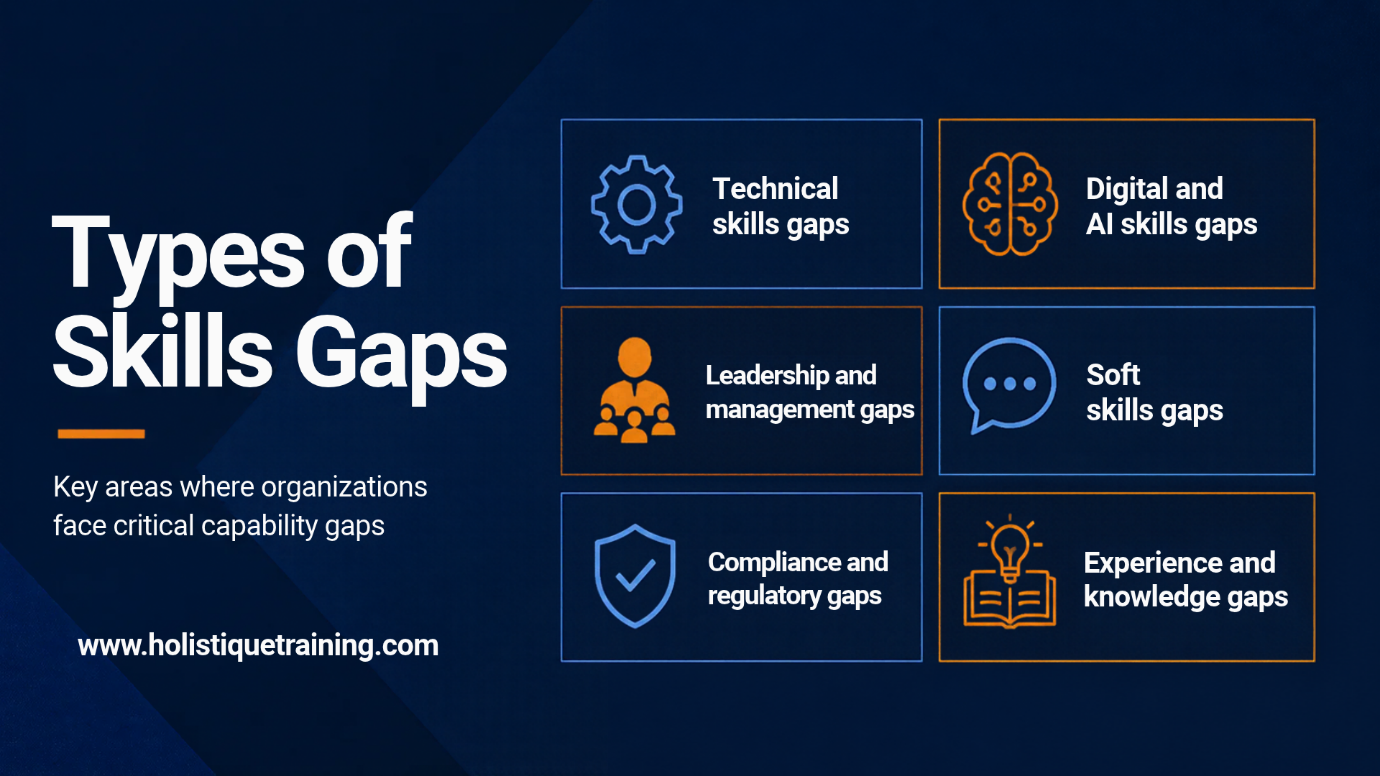
Not all gaps are alike, and categorising them helps managers choose suitable responses. The most common categories are described below.
1- Technical skills gaps:
These concern job-specific knowledge such as software proficiency, financial modelling, engineering methods or data analysis. They are usually the easiest to measure because proficiency can be tested directly.
2- Digital and AI skills gaps:
As tools evolve, employees need the confidence to use new platforms, interpret data and work alongside automated systems. These gaps often cut across every department rather than sitting in a single function.
3- Leadership and management gaps:
Managers promoted for technical excellence often lack skills in coaching, delegation and performance conversations. Because these gaps affect entire teams, their impact is magnified.
4- Soft skills gaps:
Communication, collaboration, adaptability and critical thinking are harder to measure but frequently determine whether technical expertise translates into results.
5- Compliance and regulatory gaps:
Sectors such as finance, healthcare and energy depend on current knowledge of legal and safety requirements, and lapses carry direct financial and reputational consequences.
6- Experience and knowledge gaps:
When experienced employees retire or leave, tacit knowledge goes with them. Mapping where such knowledge is concentrated reveals succession risks before they become urgent.
Evidence suggests that gaps are now close to universal. According to the Skills Report 2026 published by Skills Dynamics, which examined capability across supply chain organisations, over 90 per cent of respondents reported at least one critical skills gap, and although 83 per cent said they felt prepared for AI, AI and automation still ranked as the leading shortfall.
Whichever categories apply, it helps to separate gaps in knowledge, skill and behaviour. Knowledge gaps arise when people do not know what to do and can usually be closed through instruction. Skill gaps arise when people know what to do but cannot yet do it fluently, which calls for practice and feedback. Behavioural gaps arise when people can perform but do not, often because of culture, incentives or leadership, and these respond best to coaching and changes in the working environment.
4. When to Conduct a Skills Gap Analysis
Many organisations treat analysis as an annual exercise, which is a sensible baseline. Certain events, however, make an immediate review essential. The most important triggers are listed below.
1- Strategic change: A new market entry, merger, product launch or restructure alters the capabilities required. Analysis before implementation prevents avoidable delays.
2- Technology adoption: Introducing a new system or automation tool changes how work is done. Assessing readiness beforehand shows where support is required.
3- Performance concerns: Persistent quality problems, missed targets or rising error rates may indicate a capability issue, although they should be tested against other causes such as process design.
4- Workforce changes: Retirements, high turnover or rapid growth reshape the skills mix, and analysis highlights where cover is thin.
5- Succession and promotion planning: Comparing candidate capability with role requirements reveals the development needed before someone steps into a critical position.
Whatever the trigger, treating analysis as a recurring discipline rather than a one-off project keeps findings current and builds organisational confidence in the process.
5. The Step-by-Step Process
A reliable analysis follows a repeatable sequence. The steps below can be scaled for a single team or an entire organisation.
Step 1: Define Objectives and Scope
Begin by deciding why the analysis is being conducted and which part of the organisation it covers. Link objectives directly to business priorities, such as launching a service, improving quality or preparing for digital transformation. A narrow, well-defined scope produces actionable results faster than an ambitious exercise that never finishes.
Step 2: Identify Required Skills
Work with department heads and subject matter experts to list the skills each role requires now and within the planning horizon. Draw on job descriptions, strategic plans, industry standards and labour market data. Distinguish between essential skills and those that are merely desirable, since this distinction drives prioritisation later.
Step 3: Assess Current Skills
Gather evidence of existing capability from several sources so that no single opinion dominates the picture. The methods available are examined in the next section.
Step 4: Measure and Prioritise the Gaps
Compare required proficiency with current proficiency for each skill, using a consistent rating scale. Then rank the results according to business impact, urgency, the number of employees affected and the risk of inaction.
Step 5: Choose Interventions and Review
Match each priority gap to a suitable response, assign owners, set timelines and define success measures. Review progress at regular intervals and repeat the analysis as conditions change.
6. Data Collection Methods
The credibility of an analysis depends on the quality of its evidence. Self-assessment alone tends to be inflated for some employees and understated for others, so combining methods gives a more balanced view. The table below summarises the most common approaches.
Method | Best Used For | Main Strength | Main Limitation |
|---|---|---|---|
Self-assessment surveys | Broad coverage across large groups | Fast and inexpensive | Ratings can be inflated or too modest |
Manager assessments | Role-specific capability | Linked to observed performance | Depends on manager objectivity |
360-degree feedback | Leadership and behavioural skills | Offers multiple perspectives | Time-consuming to administer |
Practical tests and simulations | Technical and digital skills | Objective proof of proficiency | Can be costly to design |
Performance data and KPIs | Outcome-linked capability | Based on real results | Hard to attribute to specific skills |
Interviews and focus groups | Understanding causes and context | Rich qualitative insight | Difficult to scale |
The strongest analyses triangulate. An organisation might use a short survey for breadth, validate results with manager ratings, and then test critical technical skills through practical assessment. Where sources disagree, the disagreement is itself informative and merits a follow-up conversation.
7. Building a Skills Framework and Rating Scale
Creating a Common Skills Language
Consistency is the foundation of meaningful comparison. A skills framework defines each skill, explains what proficiency looks like at different levels, and ensures that managers in different departments interpret ratings in the same way. Without it, a rating of advanced in one team may mean something very different in another.
Designing the Proficiency Scale
A four or five level scale usually works best. Descriptors should be behavioural and observable, distinguishing for example between someone who performs a task with guidance, someone who performs it independently, and someone who can teach it to others. Pilot the scale with a small group before wider rollout so that unclear wording can be corrected early.
Using a Skills Matrix
A skills matrix lists roles or individuals on one axis and skills on the other, recording required and current proficiency in each cell. Colour coding turns the matrix into a visual heat map in which concentrations of risk become immediately visible to senior stakeholders. It also reveals hidden strengths, since employees may hold capabilities that their current roles do not use.
8. Analysing and Prioritising the Gaps
Calculating Gap Size
Subtract current proficiency from required proficiency for each skill, then aggregate results by team, function or location. Patterns soon emerge, such as a department that lags in digital capability or a region with a leadership shortfall. Averages can hide extremes, so review the distribution as well as the mean.
Applying a Prioritisation Framework
Plot gaps against two dimensions: business impact and urgency. Gaps that rank high on both belong in an immediate action plan, those with high impact but lower urgency are scheduled for the medium term, and those with limited impact are simply monitored. Where resources are limited, this discipline prevents effort from being diluted across too many initiatives.
Testing the Root Cause
Not every gap is a training problem. Weak performance may stem from unclear processes, inadequate tools, low motivation or insufficient authority. Before committing to learning solutions, ask whether employees could perform the task if the right conditions were in place. Where the answer is yes, a non-training solution is likely to deliver faster and cheaper results.
Presenting Findings to Stakeholders
Findings only create change when decision makers understand them. Summarise results in a short report that leads with the three or four gaps carrying the highest business risk, shows how they were identified, and states the recommended action and cost for each. Visual summaries such as heat maps and trend charts help busy executives absorb the message quickly, while team-level breakdowns give line managers something practical to act on.

In this training course, you will discover how to accurately track analytical people data and process strategic decisions to build successful business models and work towards improving company practices. You will uncover how HR data is used to demonstrate an
9. Linking Skills Gap Analysis to Workforce Planning
Gap analysis reveals current shortfalls, but its greater value lies in anticipating future ones. Workforce planning translates strategic ambitions into projections of the roles and capabilities required over the coming one to five years. When analysis findings are combined with forecasts of growth, attrition and technological change, leaders can decide early whether to build, buy or borrow capability.
Integrating the two disciplines also strengthens succession planning. By comparing the skills of potential successors with the requirements of critical roles, organisations can create targeted development pathways and reduce the risk of leadership vacuums. Scenario planning adds a further layer, testing how capability needs would change under alternative futures such as rapid expansion or accelerated automation.

In today’s dynamic business environment, Human Resources (HR) has evolved from a support function into a strategic driver of organisational success. This course empowers HR professionals to adopt a strategic mindset, align talent initiatives with business goals, and lead transformative HR practices that shape culture, performance, and long-term
10. Strategies for Closing Skills Gaps
Once priorities are set, organisations can draw on a range of strategies. The most suitable choice depends on the size of the gap, the time available and the cost involved.
Strategy | Best Suited To | Typical Timeframe | Key Consideration |
|---|---|---|---|
Formal training and certification | Technical and compliance gaps | Weeks to months | Needs clear learning objectives |
Coaching and mentoring | Leadership and behavioural gaps | Months | Depends on the quality of mentors |
On-the-job learning and rotation | Practical, experience-based skills | Months | Requires supervision and structured goals |
Recruitment | Skills absent from the organisation | Weeks to months | Higher cost and integration risk |
Contracting or partnerships | Short-term or specialist needs | Immediate | Knowledge may leave with the contractor |
Process or technology change | Gaps caused by tools or workflow | Variable | May create new learning needs |
Employers appear to be leaning towards developing the people they already have. According to the 2026 Workforce Decoded Report from Western Governors University, which surveyed 3,128 hiring professionals in the United States, 42 per cent of employers expect to close skills gaps mainly by upskilling current employees, nearly double the 22 per cent who plan to rely mainly on new hires.
Building capability internally tends to be easier to integrate and supports retention, though it works best when development is built into daily work rather than treated as a separate event. Blended approaches, such as combining formal instruction with practical application and coaching, generally produce stronger results than any single method.
Whichever strategy is chosen, translate organisational findings into individual development plans. A plan that names the skill to be developed, the method, the support available and the target date gives each employee ownership of progress, and it gives managers a clear basis for regular development conversations throughout the year.

Becoming a training and development expert requires education, experience, and skills. These roles identify the organisation's skill gaps and learning needs. Conducting thorough assessments can determine where employees require training to enhance their performance and contribute more effectively to the company's goals. Dedicated training
11. The Role of Technology and AI
Digital tools have made analysis faster and more precise. Learning management systems and talent platforms store assessment results and learning histories, allowing HR teams to see capability trends across the organisation. Skills intelligence platforms can infer skills from job data and employee records, offering a baseline that is updated continuously rather than annually.
Artificial intelligence adds predictive capability. It can recommend learning content based on identified gaps, flag emerging skills in the labour market and highlight roles at risk of future shortfalls. These functions should support human judgement rather than replace it. Inferred skills need validation, algorithmic recommendations should be reviewed for bias, and employees should understand how their data is used, because transparent governance builds the trust on which participation depends.
Visualisation tools are equally valuable. Dashboards that present gap data in clear formats help senior leaders grasp priorities quickly, which increases the likelihood that findings translate into funded action. Integration with existing HR systems also matters, since data that must be re-entered manually is rarely kept up to date and quickly loses credibility.
12. Common Mistakes to Avoid
Even well-intentioned analyses can fail. The most frequent errors are as follows.
1- Starting without a clear business objective:
Without a defined purpose, data collection becomes aimless and findings lack relevance to decision makers.
2- Relying on self-assessment alone:
Employees may over or underestimate their abilities, so single-source data produces distorted results.
3- Ignoring soft skills:
Concentrating only on technical capability overlooks communication, adaptability and leadership, which often determine whether expertise is applied effectively.
4- Treating every gap as a training need:
Some gaps stem from process or resource problems that training cannot fix.
5- Failing to involve managers and employees:
Analysis done to people rather than with them generates resistance and unreliable data.
6- Conducting a one-off exercise:
Skills requirements change continuously, so a single snapshot quickly becomes obsolete.
7- Collecting data without acting on it:
Nothing erodes trust faster than an assessment that produces no visible change. Communicate findings and commit to follow-through.
13. Measuring the Impact of Your Analysis
Analysis is only valuable if it changes outcomes, so success measures should be defined at the start. Useful indicators include the reduction in size of priority gaps across successive assessments, improvements in performance metrics linked to targeted skills, time to proficiency for new hires, internal promotion rates, retention of employees in development programmes, and the return on training spend.
Evaluation frameworks such as Kirkpatrick's four levels, which examine reaction, learning, behaviour and results, help connect development activity to organisational impact. Report progress to leadership regularly and use the evidence to refine the next cycle. Over time, a repeated analysis becomes a living picture of organisational capability rather than a periodic audit.
Building a Continuous Improvement Cycle
The most mature organisations run analysis as a cycle of assess, act, review and refine. Each round builds on the last, with lessons from earlier interventions shaping the next set of priorities. Assigning a named owner, publishing a simple calendar of review dates, and embedding skills conversations into regular performance discussions keeps momentum alive between formal assessments.
Conclusion
A skills gap analysis gives organisations something they rarely have: an accurate, evidence-based view of the distance between current capability and future ambition. It turns vague concerns about skills into specific, prioritised findings that leaders can act on, and it ensures that scarce training and recruitment budgets are directed where they matter most.
The most effective analyses share common traits. They begin with clear business objectives, use a consistent skills framework, draw evidence from more than one source, test root causes before prescribing training, and connect findings to workforce planning and measurable outcomes. Above all, they are repeated. Skills requirements will keep changing, and organisations that treat analysis as a continuous discipline will adapt faster and retain talent more reliably than those that treat it as an occasional audit.