

- Table of Contents
- Introduction
- 1- What Are Non-Renewable Energy Resources?
- Definition and Core Characteristics
- Why Replenishment Takes So Long
- Fossil Fuels and Non-Renewable Energy: Clearing Up the Terms
- 2- The Main Types of Non-Renewable Energy Resources
- 3- How Non-Renewable Energy Resources Are Used in the Global Economy
- 4- How Much Does the World Still Rely on Non-Renewable Energy?
- The Scale of Global Dependence
- What the Figures Mean for Decision-Makers
- Differences Between Regions
- 5- Coal, Oil and Natural Gas: Recent Market Developments
- Coal Demand Reaches New Highs
- Oil and Natural Gas Under Pressure
- What Recent Events Mean for Businesses
- 6- Nuclear Energy: A Low-Carbon but Non-Renewable Resource
- Why Uranium Is Classed as Non-Renewable
- Record Output and Growing Ambitions
- Fuel Supply, Waste and Delivery Challenges
- 7- Advantages of Non-Renewable Energy Resources
- Why These Strengths Persist
- 8- Disadvantages and Environmental Impact
- How These Impacts Shape Policy and Investment
- 9- Non-Renewable vs Renewable Energy Resources
- Key Differences at a Glance
- A Managed Transition
- 10- What Non-Renewable Energy Means for Business Decisions
- Managing Energy Risk
- Practical Steps for Organisations
- Building Energy Literacy Across the Workforce
- Conclusion
Introduction
Energy underpins almost every part of modern economic life, from the electricity that powers offices and factories to the fuel that moves goods across borders. For business leaders, policymakers and informed readers, understanding where that energy comes from is no longer a specialist concern. It shapes operating costs, supply chain resilience, regulatory exposure and long-term strategy. A central question in that discussion is a simple one: what are the non-renewable energy resources, and why do they still matter so much?
Non-renewable energy resources are natural sources of energy that exist in finite quantities and cannot be replaced within a human timescale. They include coal, crude oil, natural gas and the uranium used in nuclear power. Together they have powered industrial growth for more than two centuries, and they continue to supply the majority of the world’s energy today. At the same time, they raise serious questions about price volatility, geopolitical dependence, air quality and climate change, which is why governments and companies are reassessing how they use them.
In this article, we will discuss what non-renewable energy resources are, the main types, how they are formed and used, how heavily the world still relies on them, the latest developments in coal and nuclear power, their advantages and drawbacks, how they compare with renewable energy, and what they mean for business decisions in the years ahead.
1- What Are Non-Renewable Energy Resources?
Definition and Core Characteristics
Non-renewable energy resources are energy sources that are extracted from the Earth and consumed faster than nature can replace them. Once a deposit of coal, oil or natural gas has been burned, it cannot be restored within any timeframe that matters to human society. This finite quality is what separates them from renewable resources such as solar, wind and hydropower, which are replenished continuously by natural processes.
Most non-renewable energy resources share several characteristics. They are energy dense, meaning a small quantity releases a large amount of usable energy. They are concentrated in specific geographic locations, which creates trade dependencies between producing and consuming countries. They also require extraction, processing and transport infrastructure before they can be used, which makes them capital intensive and exposed to market and political shocks.
Why Replenishment Takes So Long
Fossil fuels formed from the remains of plants and microscopic organisms that were buried and exposed to heat and pressure over millions of years. Coal originates mainly from ancient plant material accumulated in swampy environments, while oil and natural gas come largely from marine organisms deposited on seabeds and later covered by sediment. Uranium is different, because it is a naturally occurring metal found in rock and mined rather than formed from living matter. In every case, the geological timescale involved is vastly longer than human consumption patterns, which is why these resources are classed as non-renewable.
Fossil Fuels and Non-Renewable Energy: Clearing Up the Terms
The terms fossil fuels and non-renewable energy are often used interchangeably, but they are not identical. Every fossil fuel is non-renewable, yet not every non-renewable resource is a fossil fuel. Uranium is the clearest example, since it is a metal rather than the remains of ancient life. Understanding this distinction helps business readers interpret energy statistics correctly, because some reports group only coal, oil and gas together, while others include nuclear power in a wider non-renewable category.
2- The Main Types of Non-Renewable Energy Resources
There are four principal categories of non-renewable energy resources, and each plays a distinct role in the global energy system.
1- Coal:
Coal is a solid fossil fuel formed from compressed plant matter and is mined from underground seams or open pits. It is graded by carbon content, ranging from lignite and sub-bituminous coal to bituminous coal and anthracite. It is burned mainly to generate electricity and is also essential in steelmaking, where coking coal supplies the heat and carbon needed to produce iron. Coal is abundant and widely distributed, but it is the most carbon-intensive of the major fossil fuels.
2- Crude Oil:
Crude oil is a liquid fossil fuel extracted from underground reservoirs, offshore fields and, increasingly, unconventional sources such as shale formations and oil sands. Refineries convert it into petrol, diesel, jet fuel, heating oil and the feedstocks used in plastics and chemicals. Its high energy density and ease of transport explain its dominance in road, sea and air transport, although its price is highly sensitive to political events.
3- Natural Gas:
Natural gas is a gaseous fossil fuel composed mainly of methane. It is used for power generation, home and industrial heating, cooking and as a raw material for fertilisers. It burns more cleanly than coal or oil at the point of use, and it can be moved by pipeline or cooled into liquefied natural gas and shipped by sea. This flexibility has turned gas into a truly global commodity.
4- Uranium and Nuclear Fuel:
Uranium is a metal mined from ore deposits and processed into fuel for nuclear reactors, where fission releases heat that is converted into electricity. Nuclear power produces very low carbon emissions during operation, yet uranium remains a finite resource, so it is classified as non-renewable. Waste management, high construction costs and long project timelines are its main challenges.
The table below compares these four resources across their origin, main uses and principal concern.
Resource | Origin | Main Uses | Principal Concern |
|---|---|---|---|
Coal | Ancient plant matter | Electricity, steelmaking, cement | High carbon emissions and air pollution |
Crude oil | Ancient marine organisms | Transport fuels, petrochemicals | Price volatility and supply dependence |
Natural gas | Ancient marine organisms | Heating, power, fertilisers | Methane leaks and import reliance |
Uranium | Mineral deposits in rock | Nuclear electricity generation | Waste management and high capital cost |
It is also worth distinguishing between resources and reserves. Resources describe everything that is believed to exist in the ground, while reserves are the portion that can be extracted profitably with current technology and prices. As technology improves and prices change, reserves can grow or shrink even though the physical quantity of the resource is fixed. This is why headline figures about how long supplies will last vary so widely between sources and should always be read with caution.
3- How Non-Renewable Energy Resources Are Used in the Global Economy
Non-renewable energy resources are embedded in almost every sector of the economy, and their uses extend well beyond simple fuel.
1- Electricity Generation:
Coal, natural gas and nuclear power stations supply a large share of the world’s electricity, providing the steady output that grids depend on. Generation of this kind can be adjusted to meet demand, which remains a valuable feature as power systems become more complex.
2- Transport:
Petrol, diesel, jet fuel and marine fuel oil move people and goods by road, air and sea. Transport remains one of the hardest sectors to decarbonise, and oil continues to dominate it because of the energy density and global distribution network already in place.
3- Industrial Processes:
Heavy industry uses fossil fuels both for heat and as a chemical input. Coal is central to steelmaking, natural gas supports fertiliser and chemicals production, and fuel oil and gas power cement kilns and refineries.
4- Heating and Cooking:
Natural gas and liquefied petroleum gas heat homes, offices and hospitals, and fuel cooking in many regions. This use makes household and commercial energy bills sensitive to wholesale gas markets.
5- Petrochemicals and Materials:
Oil and gas are the raw materials for plastics, synthetic fibres, lubricants, solvents and packaging. Even if fuel use falls, demand for these materials means hydrocarbons will remain part of the economy for some time.
Taken together, these uses show why non-renewable energy cannot be switched off quickly. A change in one fuel affects electricity prices, transport costs, industrial output and household budgets at the same time, which is why energy planning requires a whole-system view.
4- How Much Does the World Still Rely on Non-Renewable Energy?
The Scale of Global Dependence
Despite the rapid expansion of wind and solar power, non-renewable energy resources remain the foundation of the global energy supply. The scale of that dependence is easiest to see in the latest international data. According to the Energy Institute’s Statistical Review of World Energy 2026, total energy supply exceeded 600 exajoules in 2025, a rise of 1.7 per cent on the previous year. The review found that fossil fuels accounted for 86 per cent of that supply and continued to grow in absolute terms, even though renewables, led by solar, were the largest source of new energy for the first time outside a recession.
What the Figures Mean for Decision-Makers
These findings carry an important lesson. Clean energy is growing quickly, but total energy demand is also rising, so much of the new renewable supply is meeting additional demand rather than replacing existing fossil fuel use. New electricity needs from electric vehicles, data centres and industrial growth add to that pressure. For businesses, this means non-renewable energy will remain part of the supply picture for years to come, and planning must reflect both its continued presence and its gradual decline in share.
Differences Between Regions
Dependence on non-renewable energy is not evenly spread. Asia Pacific is the largest energy-consuming region, and several major economies import most of their oil and a significant share of their gas from other countries. Producing regions such as North America and the Middle East, by contrast, use domestic resources to support both supply and export revenue. These differences explain why countries make very different energy choices, even when they share the same goal of secure and affordable supply.
5- Coal, Oil and Natural Gas: Recent Market Developments
Coal Demand Reaches New Highs
Coal illustrates how quickly circumstances can change. According to the International Energy Agency’s Coal Mid-Year Update 2026, global coal demand rose by 0.3 per cent in 2025 to 8.84 billion tonnes, narrowly exceeding the previous record. The agency now expects demand to grow by a further 1.2 per cent in 2026 to 8.94 billion tonnes, reversing an earlier forecast of decline. It links the change to higher natural gas prices connected to the conflict in the Middle East, which have encouraged some countries to burn more coal for electricity.
Oil and Natural Gas Under Pressure
Oil and natural gas have faced similar volatility. Both depend on a small number of producing regions and a handful of critical shipping routes, so disruption in one location quickly appears in prices elsewhere. Importing economies are especially exposed, because they rely on supplies that must pass through contested waters. These events show that non-renewable energy resources are not only an environmental issue but also an economic and security issue, and that their availability depends as much on geopolitics as on geology.
What Recent Events Mean for Businesses
For commercial decision-makers, the lesson is that fuel switching can happen quickly and in unexpected directions. A rise in gas prices can push power producers toward coal, while a supply shock in oil can affect freight, aviation and manufacturing costs within weeks. Companies that treat energy as a fixed overhead rather than a managed risk are more likely to be caught off guard.
6- Nuclear Energy: A Low-Carbon but Non-Renewable Resource
Why Uranium Is Classed as Non-Renewable
Nuclear energy often causes confusion because it produces very little carbon dioxide during operation. However, the fuel it relies on, uranium, is a finite mineral resource that must be mined, processed and enriched. For that reason, nuclear power is considered non-renewable, even though it is widely treated as a low-carbon source in climate policy.
Record Output and Growing Ambitions
Nuclear generation is growing again. According to the World Nuclear Association’s World Nuclear Outlook Report 2026, global nuclear output reached a record of around 2,700 terawatt-hours in 2025 and supplied roughly 9 per cent of the world’s electricity. The report also found that government ambitions are collectively sufficient to triple nuclear capacity by 2050, although construction rates would need to rise sharply to achieve it.
Fuel Supply, Waste and Delivery Challenges
Delivering that growth depends on financing, licensing, skilled workers and secure fuel supply chains. Uranium must be mined, converted, enriched and fabricated into fuel before it reaches a reactor, and each step requires early investment because of long lead times. Spent fuel and decommissioning also require funded long-term plans. These challenges explain why nuclear power, although low carbon, is treated as a long-term infrastructure commitment rather than a quick fix.
7- Advantages of Non-Renewable Energy Resources
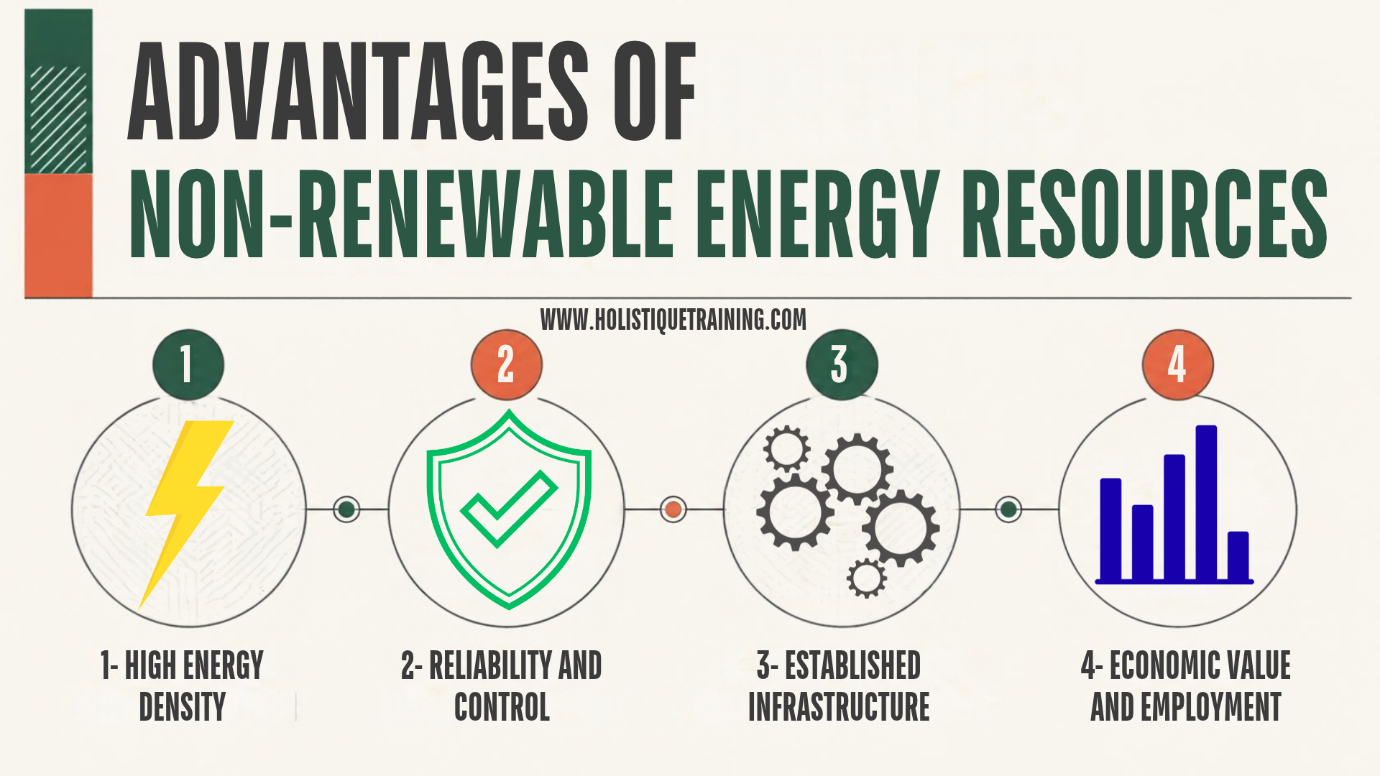
Despite their drawbacks, non-renewable energy resources have remained dominant for good reasons, and any serious discussion of the energy transition must recognise them.
1- High Energy Density: A small volume of coal, oil, gas or uranium releases a large amount of energy, which makes transport and storage efficient and supports industries that need intense, concentrated heat.
2- Reliability and Control: Power stations running on fossil fuels or nuclear fuel can generate electricity continuously and adjust output to demand, which supports grid stability.
3- Established Infrastructure: Pipelines, refineries, ports, power stations and distribution networks already exist at global scale, so using them requires far less new investment than building replacement systems.
4- Economic Value and Employment: Extraction, processing and power generation support millions of jobs and provide significant revenue for producing countries.
Why These Strengths Persist
These advantages explain why non-renewable energy has been difficult to replace. Any alternative must match not only the energy output but also the reliability, scale and affordability that existing systems already deliver, and it must do so without disrupting the services that people and businesses depend on every day.
8- Disadvantages and Environmental Impact
The same resources that support modern economies also create significant environmental and economic challenges.
1- Greenhouse Gas Emissions:
Burning coal, oil and natural gas releases carbon dioxide, the main driver of human-caused climate change. Coal is the most carbon intensive of the three, while methane leaks from gas systems add a further warming effect.
2- Air and Water Pollution:
Combustion releases particulates, sulphur dioxide and nitrogen oxides that harm public health, while mining and drilling can contaminate water and damage land and habitats.
3- Finite Supply:
Easily accessible reserves are gradually depleted, so extraction tends to move toward more difficult and costly locations, raising production costs over time.
4- Price Volatility and Supply Risk:
Prices respond sharply to conflict, sanctions, weather and shifts in demand, making budgeting difficult for energy-intensive businesses and for importing countries.
Local communities often bear the most direct costs. Areas near mines, refineries and coal-fired plants can face poorer air quality, land disruption and health burdens, while regions that depend heavily on extraction can struggle when markets turn. These social effects are increasingly part of how investors, regulators and employees judge corporate energy decisions.
How These Impacts Shape Policy and Investment
These impacts explain why climate policy, carbon pricing and investor expectations increasingly shape energy decisions. Governments set emissions targets, financial institutions ask for climate disclosures and customers expect credible plans to cut carbon. Organisations that understand how energy systems interact with climate risk are better placed to anticipate regulation, protect their reputation and manage exposure.
https://holistiquetraining.com/en/course/energy-transition-and-climate-resilience
9- Non-Renewable vs Renewable Energy Resources
Key Differences at a Glance
The key differences between the two categories are summarised in the table below.
Feature | Non-Renewable Resources | Renewable Resources |
|---|---|---|
Supply | Finite and depleted by use | Naturally replenished |
Emissions in use | High for fossil fuels, low for nuclear | Very low |
Output pattern | Controllable on demand | Often variable with sun and wind |
Infrastructure | Mature and global | Expanding, needs grid and storage upgrades |
Price exposure | Linked to commodity markets | Mostly upfront capital cost |
Location | Concentrated in producing regions | More widely distributed |
A Managed Transition
The comparison shows that neither category is perfect. Non-renewable resources provide controllable and proven supply, while renewable resources offer lower emissions and greater independence from fuel markets. The practical future for most economies is a managed transition in which renewables expand quickly while existing non-renewable assets are used more efficiently, retired in an orderly way or paired with new technologies. Building the skills to manage that change is a priority for employers and professionals alike.
In many power systems, the two categories already work together. Natural gas plants can balance variable wind and solar output, while nuclear stations provide steady low-carbon electricity alongside them. Over time, storage, stronger grids and demand management are expected to reduce the need for fossil fuel back-up, but that process takes sustained investment and careful planning.
The global energy landscape is undergoing a major transformation as countries, industries, and communities seek cleaner, more resilient, and sustainable energy systems. This course introduces participants to the core principles, technologies, and policy mechanisms that are driving the global shift toward renewable energy. It explores how replacing fossil
10- What Non-Renewable Energy Means for Business Decisions
Managing Energy Risk
For organisations, the practical question is not whether non-renewable energy will disappear overnight, but how to manage exposure while the energy system changes. Energy costs, regulation, customer expectations and reputational risk all influence how companies should approach their fuel and power choices. The table below links common risks to practical responses.
Business Area | Typical Risk | Practical Response |
|---|---|---|
Operating costs | Fuel and electricity price spikes | Energy efficiency and long-term supply contracts |
Supply chains | Disruption to fuel and materials | Diversify suppliers and routes |
Regulation | Carbon pricing and emissions rules | Track policy, measure and report emissions |
Reputation | Investor and customer scrutiny | Credible transition plans and disclosure |
Workforce | Skills gaps in energy and sustainability | Targeted training and development |
Practical Steps for Organisations
Practical steps start with measurement. Companies that know how much energy they use, where it comes from and what it costs can identify savings and risks quickly. From there, they can improve efficiency, diversify energy sources and build sustainability into everyday operations. These measures cut costs and reduce emissions at the same time, and they prepare the business for stricter rules and shifting market conditions.
Procurement and reporting also deserve attention. Choosing suppliers with transparent emissions data, asking for energy-efficient equipment and tracking energy use in regular management reports all turn abstract commitments into measurable action. Over time, this evidence supports better budgeting, stronger relationships with investors and clearer communication with customers who want to understand the footprint of the products and services they buy.
Building Energy Literacy Across the Workforce
Technology alone does not change energy performance. Employees decide how equipment is used, how processes are designed and how suppliers are selected, so energy awareness needs to extend beyond the facilities team. Training that explains where energy comes from, what it costs and how it affects emissions helps staff spot waste, support new initiatives and contribute ideas. Organisations that invest in these skills tend to implement sustainability programmes faster and with fewer obstacles.

Empower your workforce with sustainability training. Build eco-conscious habits, ethical practices, and corporate responsibility for lasting impact.
Conclusion
Non-renewable energy resources are the finite fuels and minerals that the world has relied on for generations: coal, crude oil, natural gas and uranium. They remain dominant because they are energy dense, reliable and supported by established infrastructure, and the latest data confirms that fossil fuels still provide the great majority of global energy supply. Yet their limits are clear. They are finite, fossil fuels produce greenhouse gas emissions and local pollution, and all of them expose economies and businesses to price and supply shocks.
The most realistic path forward is neither an abrupt exit nor an indefinite continuation. Renewable energy will keep growing, nuclear power is expanding in many countries, and coal, oil and gas will remain part of the mix while the transition unfolds. For business readers, the priority is to understand these resources clearly, measure exposure and plan with flexibility. Those who do will be better equipped to control costs, meet regulation and stay resilient in an uncertain energy landscape.

The energy industry has existed for many years and has remained relatively stationary as far as types of energy sources go. However, modern times have seen a vast development in the technologies surrounding energy. Great pressure from a variety of external and internal influences has