

- Table of Contents
- Introduction
- 1. What Are Nano-Degrees?
- How Nano-Degrees Differ from Degrees, Diplomas, and Certificates
- 2. Why Nano-Degrees Emerged
- Rapid Technological Change
- Skills Gaps in the Labour Market
- Rising Tuition Fees
- Demand for Shorter, More Flexible Learning Pathways
- Growth of Online Education Platforms
- 3. How Nano-Degrees Differ from Traditional Higher Education
- Duration
- Cost
- Flexibility
- Curriculum Depth
- Teaching Methods
- Assessment Style
- Career Focus vs Academic Breadth
- 4. The Role of Employers in Driving Nano-Degree Popularity
- Demand for Practical, Job-Ready Skills
- Preference for Specific Technical Competencies
- Partnerships Between Companies and Learning Platforms
- Hiring Based on Skills Rather Than Only Formal Degrees
- 5. Benefits of Nano-Degrees for Learners
- Affordable Compared to University Degrees
- Accessible from Anywhere
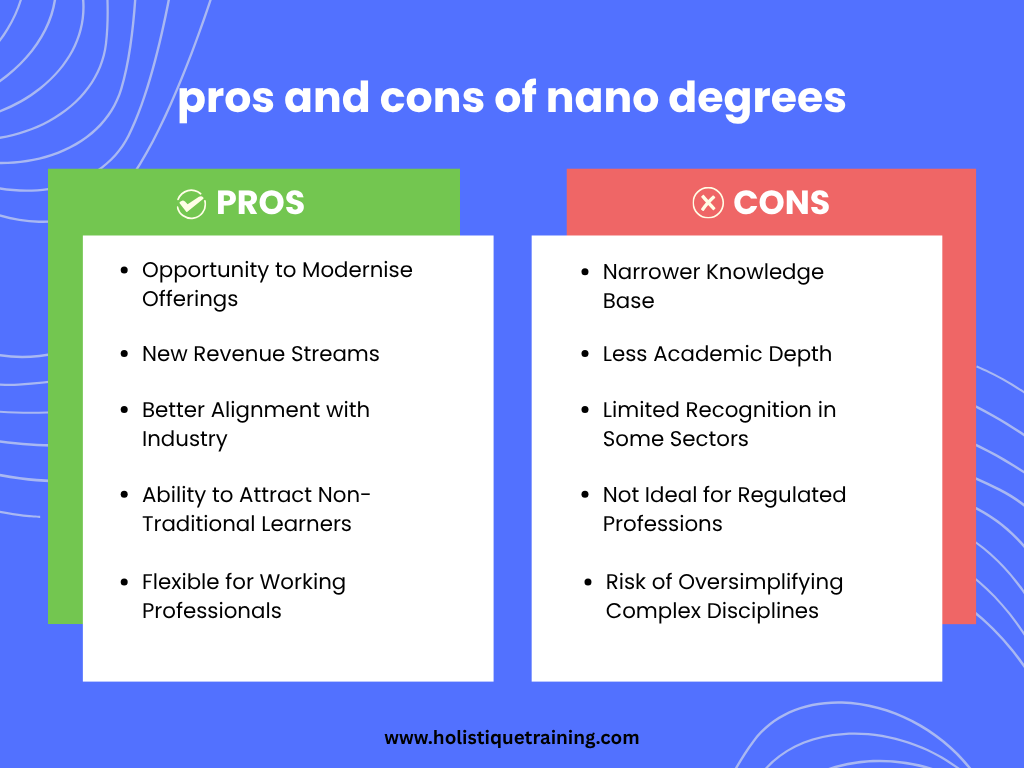
- Flexible for Working Professionals
- Faster Route to Upskilling or Reskilling
- Useful for Career Changers
- Focused, Practical Content
- 6. Benefits of Nano-Degrees for Universities and Education Providers
- Opportunity to Modernise Offerings
- New Revenue Streams
- Better Alignment with Industry
- Ability to Attract Non-Traditional Learners
- Expansion into Lifelong Learning Markets
- 7. The Link Between Nano-Degrees and the Future of Work
- Automation and AI
- Constant Need for Reskilling
- Lifelong Learning as a Necessity
- Shift from One-Time Education to Continuous Education
- Relevance in Fast-Changing Industries
- 8. Are Nano-Degrees Credible?
- Recognition by Employers
- Accreditation Concerns
- Differences in Quality Across Providers
- Do They Carry the Same Weight as University Qualifications?
- Trust and Legitimacy Issues
- 9. The Limitations of Nano-Degrees
- Narrower Knowledge Base
- Less Academic Depth
- Limited Recognition in Some Sectors
- Not Ideal for Regulated Professions
- Risk of Oversimplifying Complex Disciplines
- Unequal Quality Standards
- 10. Who Benefits Most from Nano-Degrees?
- Working Professionals
- Career Switchers
- Recent Graduates Needing Extra Skills
- Freelancers
- Learners in Developing Regions
- People Who Cannot Commit to Full-Time University Study
- 11. Can Nano-Degrees Replace University Degrees?
- Arguments for Replacement
- Arguments Against Replacement
- Why They May Complement Rather Than Replace Traditional Education
- Which Fields Are More Suitable?
- 12. Nano-Degrees and Equity in Education
- 13. The Role of Technology Platforms in Shaping Education
- Platform-Based Learning
- AI-Powered Personalised Education
- Industry-Designed Curricula
- Micro-Credentials and Stackable Learning Models
- 14. How Universities Are Responding
- Universities Launching Micro-Credentials
- Hybrid Models Combining Degrees with Short Credentials
- Partnerships with EdTech Providers
- Pressure on Higher Education Institutions to Adapt
- 15. Conclusion
Introduction
Higher education is changing under pressure from several directions at once. Employers want graduates who can contribute quickly, learners want more affordable and flexible study options, and universities are being asked to prove that their programmes still match the pace of economic and technological change. In that context, nano-degrees have attracted serious attention. Once seen as a niche digital offering, they are now part of a much wider discussion about employability, lifelong learning, and the future structure of higher education itself. International bodies such as UNESCO, the European Commission, and the OECD have all explored micro-credentials and related short-form learning models as part of a broader move towards flexible learning pathways.
Nano-degrees are appealing because they promise something traditional higher education has often struggled to deliver: targeted learning, faster completion, lower cost, and close alignment with labour market needs. At the same time, they raise difficult questions. Can short-form credentials carry the same credibility as a university degree? Are they a tool for widening access or simply another layer of inequality for those without devices, connectivity, or recognised providers? And should they be understood as a replacement for university education, or as one component in a more flexible, hybrid learning ecosystem?
In this article, we will discuss what nano-degrees are, why they emerged, how they differ from traditional higher education, the role of employers, benefits for learners and institutions, their connection to the future of work, credibility concerns, limitations, who benefits most, whether they can replace university degrees, equity issues, the role of technology platforms, how universities are responding, and what the future may look like .
1. What Are Nano-Degrees?
Nano-degrees are short, focused learning programmes designed to help learners build specific knowledge and practical skills in a targeted area. In most cases, they are more career-oriented than academically broad. They are usually delivered online, structured around defined outcomes, and designed to be completed in a relatively short period. Although the label “nano-degree” is used by some providers more than others, the concept overlaps with the wider family of micro-credentials. UNESCO defines micro-credentials as a record of focused learning achievement that verifies what a learner knows, understands, or can do; they are assessed against clearly defined standards, awarded by a trusted provider, and may stand alone or complement larger qualifications.
In simple terms, a nano-degree is meant to certify practical learning that is narrower than a full degree but more structured than casual self-study. Their popularity has grown because they fit the realities of modern work: many learners do not need a full three- or four-year academic programme to gain a new digital skill, enter a related field, or update their existing expertise. UNESCO has also noted that short courses, micro-credentials, and flexible learning pathways are increasingly likely to become a regular, and even dominant, part of global education and training systems.
How Nano-Degrees Differ from Degrees, Diplomas, and Certificates
Traditional academic awards differ in scope, depth, and purpose. Nano-degrees sit closer to targeted professional development than to full higher education qualifications.
Credential Type | Typical Scope | Duration | Main Focus | Outcome |
Nano-degree / micro-credential | Narrow and targeted | Weeks to months | Practical, job-relevant skills | Fast upskilling or reskilling |
Certificate | Narrow to moderate | Weeks to months | Specific topic or competency | Recognition of short-course completion |
Diploma | Broader than a certificate | Several months to 2 years | Applied study and vocational learning | Occupational preparation |
Bachelor’s degree | Broad and academically deep | 3–4 years | Theory, research, and broad disciplinary study | Full higher education qualification |
Master’s degree | Advanced and specialised | 1–2 years | Advanced academic or professional study | Postgraduate qualification |
Nano-degrees have become more popular in recent years because they offer a practical response to economic urgency. They are shorter, easier to access remotely, and better aligned with fast-moving sectors such as data, software, AI, cybersecurity, and digital marketing. The European Commission ’s approach to micro-credentials explicitly frames them as flexible, targeted tools for personal and professional development and for building trust across providers, sectors, and borders.
2. Why Nano-Degrees Emerged
Rapid Technological Change
The digital economy changes faster than traditional curriculum design cycles. New tools, platforms, and professional roles appear in short timeframes, especially in AI, data, cloud systems, and digital business. The World Economic Forum reports that technology-related roles are among the fastest-growing globally, while AI, big data, cybersecurity, and technological literacy are among the fastest-growing skills.
Skills Gaps in the Labour Market
Many organisations report difficulty finding people with the exact competencies they need. This has pushed education closer to workforce training. Nano-degrees emerged partly because they can be built around clear skills rather than broad disciplinary identity. According to the World Economic Forum, if the global workforce were represented by 100 people, 59 would need training by 2030.
Rising Tuition Fees
The cost of full university study remains a major issue for learners and families. Even where public systems subsidise education, long programmes still involve tuition, living costs, and opportunity costs. College Board data for 2025–26 show average published tuition and fees of $11,950 at US public four-year in-state institutions and $45,000 at private non-profit four-year institutions. While this is only one national market, it illustrates why short, lower-cost alternatives attract attention globally.
Demand for Shorter, More Flexible Learning Pathways
Not everyone can pause work or family responsibilities to study full time. Nano-degrees respond to this constraint by making learning modular. UNESCO has argued that flexible learning pathways are becoming central to the future of education, especially for learners who cannot or do not want to commit to a full-time degree.
Growth of Online Education Platforms
The rise of large-scale online learning platforms made nano-degrees commercially and technically viable. Once platforms developed reliable systems for content delivery, assessment, learner analytics, and digital certification, short-form credentials became easier to scale. This infrastructure also helped connect learning directly to employer demand.
Coursera’s 2025 Micro-Credentials Impact Report states that 96% of employers believe micro-credentials strengthen a candidate’s job application, while 94% of students say these credentials fast-track skill development.
3. How Nano-Degrees Differ from Traditional Higher Education
Nano-degrees and traditional higher education serve overlapping but distinct purposes. The difference is not only one of length, but also of philosophy.
Duration
A bachelor’s or master’s degree is designed around sustained intellectual development over years. A nano-degree is built for concentrated, outcome-led learning over weeks or months.
Cost
Because nano-degrees are shorter and often digital-first, they generally cost far less than full university programmes. This makes them appealing for learners seeking immediate skills rather than a full academic journey.
Flexibility
Traditional higher education often works around semester systems, fixed timetables, and formal admissions. Nano-degrees are usually more flexible, allowing self-paced or part-time participation.
Curriculum Depth
University programmes aim to build conceptual depth, intellectual context, and analytical maturity. Nano-degrees usually focus more tightly on a specific skill set or occupational need.
Teaching Methods
Traditional programmes rely on lectures, seminars, laboratories, supervision, and campus life. Nano-degrees tend to rely on digital modules, project work, simulations, and applied tasks.
Assessment Style
University assessment may include essays, exams, dissertations, and extended projects. Nano-degrees often use portfolio work, practical exercises, quizzes, and skill demonstrations.
Career Focus vs Academic Breadth
Nano-degrees are usually more directly tied to employability. Traditional higher education often balances professional preparation with wider intellectual formation.
Dimension | Nano-Degrees | Traditional Higher Education |
Duration | Short-term | Multi-year |
Cost | Lower | Higher |
Flexibility | High | Moderate to low |
Depth | Targeted | Broad and deep |
Delivery | Often online | Campus, blended, or online |
Assessment | Practical and competency-based | Mixed academic assessment |
Purpose | Immediate skills | Qualification and broad development |
4. The Role of Employers in Driving Nano-Degree Popularity
Demand for Practical, Job-Ready Skills
Employers increasingly want evidence that candidates can perform tasks, not simply discuss concepts. Nano-degrees are attractive because they often include project-based work linked to real tools and workflows.
Preference for Specific Technical Competencies
In fields such as software development, analytics, AI, design, and digital advertising, employers often need very specific capabilities. Short-form credentials let learners acquire those capabilities without committing to a full additional degree.
Partnerships Between Companies and Learning Platforms
Many nano-degree ecosystems are built through collaboration between industry and education providers. This helps ensure course content is relevant to current practice rather than outdated theory.
Hiring Based on Skills Rather Than Only Formal Degrees
The spread of skills-based hiring has created favourable conditions for nano-degrees. According to NACE’s Job Outlook 2026 survey, 70% of employers report using skills-based hiring, up from 65% the previous year. This does not mean degrees no longer matter, but it does show that demonstrable capability is becoming more important.

The 21st century demands more than just subject knowledge — learners need a set of future skills to thrive in an ever-changing, technology-driven, and interconnected world. These skills — often called “soft” or “essential” — include creativity, critical thinking, digital literacy, collaboration, and resilience.This course equips
5. Benefits of Nano-Degrees for Learners
Affordable Compared to University Degrees
For many people, affordability is the most obvious advantage. A short credential with a defined skill outcome can be far more realistic than paying for a full degree. This matters especially for adults funding their own education.
Accessible from Anywhere
Because most nano-degrees are delivered online, learners can participate regardless of geography. This is particularly valuable for people in remote areas or regions with limited higher education infrastructure.
Flexible for Working Professionals
A full-time professional may not be able to leave employment to study. Nano-degrees allow learners to study part time while continuing to work.
Faster Route to Upskilling or Reskilling
When job requirements change, speed matters. The World Economic Forum notes substantial skill transformation and rising reskilling needs across the global workforce. Nano-degrees match that urgency better than long programmes.
Useful for Career Changers
Someone moving from administration into digital marketing, or from finance into data analytics, may need focused bridge learning rather than a full second degree.
Focused, Practical Content
Many learners value direct relevance. Instead of studying a wide body of theory, they can concentrate on competencies that can be applied immediately in the workplace.
6. Benefits of Nano-Degrees for Universities and Education Providers
Opportunity to Modernise Offerings
Nano-degrees give universities a way to update their portfolio without redesigning every full degree. They allow institutions to respond faster to new labour market demands.
New Revenue Streams
Short-form credentials can diversify institutional income, especially in continuing education, executive education, and international online delivery.
Better Alignment with Industry
By co-designing content with employers, institutions can strengthen their workforce relevance and improve graduate employability.
Ability to Attract Non-Traditional Learners
Nano-degrees appeal to adults, part-time learners, parents, freelancers, and professionals who might never enrol in a traditional programme.
Expansion into Lifelong Learning Markets
The lifelong learning economy is becoming increasingly important. OECD and UNESCO both frame micro-credentials as part of a wider system of flexible, ongoing education rather than one-off, front-loaded university study.
7. The Link Between Nano-Degrees and the Future of Work
Automation and AI
Automation is changing tasks within jobs, not only eliminating jobs altogether. This creates demand for workers who can adapt quickly and gain new technical literacies.

The rise of artificial intelligence is reshaping how we think, learn, and solve problems. In today’s fast-changing world, learning is no longer a linear process—it’s a dynamic interaction between human insight and machine intelligence. This course introduces the concept of hybrid intelligence and empowers participants to
Constant Need for Reskilling
Workers can no longer assume that one qualification earned early in life will remain sufficient for decades. Reskilling is becoming recurrent.
Lifelong Learning as a Necessity
Lifelong learning is no longer just a policy slogan. It is increasingly a labour market requirement, especially in knowledge-intensive sectors.

Learn how to create an effective career development plan—assess skills, set goals, seek mentorship, and build a clear path for continuous growth.
Shift from One-Time Education to Continuous Education
Higher education is moving from a single long phase at the start of adulthood towards recurring educational engagement over a lifetime.
Relevance in Fast-Changing Industries
Nano-degrees are especially relevant in sectors like technology, data, digital marketing, business analytics, and cybersecurity, where toolsets and employer expectations change quickly.
The World Economic Forum states that workers can expect 39% of their existing skill sets to be transformed or become outdated between 2025 and 2030, and that 59 out of 100 workers will need training by 2030.
8. Are Nano-Degrees Credible?
Recognition by Employers
Employer recognition is growing, especially in digital sectors. The strength of recognition depends heavily on the provider, the field, and whether the programme demonstrates real competencies. Coursera’s 2025 report suggests employers are increasingly receptive to these credentials.
Accreditation Concerns
One of the biggest issues is quality assurance. UNESCO has stressed that quality assurance for micro-credentials should cover content, pedagogy, delivery modes, and accrediting requirements.
Differences in Quality Across Providers
Not all nano-degrees are designed to the same standard. Some are rigorous, assessed, and aligned with recognised frameworks. Others are little more than branded short courses.
Do They Carry the Same Weight as University Qualifications?
Usually not. A nano-degree can be highly valuable, but it rarely has the same academic, social, and signalling value as a full university degree.
Trust and Legitimacy Issues
Trust grows when programmes are transparent, assessed, quality assured, and connected to recognised frameworks. The European Commission’s 2022 approach specifically aims to improve comparability and trust across borders and providers.
Coursera reports that 96% of employers say micro-credentials strengthen a candidate’s application, but that should be read as a sign of growing value rather than proof that they are equivalent to a full degree.
9. The Limitations of Nano-Degrees
Narrower Knowledge Base
Nano-degrees are intentionally focused, but that also means they may leave important conceptual gaps.
Less Academic Depth
They rarely provide the theoretical grounding, critical inquiry, or sustained intellectual development associated with university study.
Limited Recognition in Some Sectors
Some employers and sectors still place strong emphasis on traditional degrees, particularly where professional identity matters.
Not Ideal for Regulated Professions
Fields such as medicine, pharmacy, engineering, law, and formal teacher education require recognised qualifications, accreditation, and extensive supervised training. Nano-degrees cannot replace that structure.
Risk of Oversimplifying Complex Disciplines
Some areas of knowledge cannot be reduced into brief modules without losing nuance and rigour.
Unequal Quality Standards
Because the market is varied, learners may struggle to judge which credentials carry real value.
10. Who Benefits Most from Nano-Degrees?
Working Professionals
They can update their skills without interrupting employment.
Career Switchers
They can test and enter new fields through targeted learning.

Feeling stuck or unfulfilled at work? Discover the key signs it’s time for a career change—like burnout, stalled growth, and shifting values—and how to take action.
Recent Graduates Needing Extra Skills
A graduate with a general degree may add a nano-degree in data visualisation, project management, or digital strategy to improve employability.
Freelancers
Freelancers often need quick, marketable skills that can immediately improve client work.
Learners in Developing Regions
UNESCO notes that micro-credentials may widen access for those who cannot commit to full-time degrees.
People Who Cannot Commit to Full-Time University Study
Parents, people with disabilities, and adults with financial constraints may find short-form learning more realistic.
11. Can Nano-Degrees Replace University Degrees?
This is the central question, and the fairest answer is not fully, but increasingly in part.
Arguments for Replacement
Supporters argue that nano-degrees are more affordable, more relevant to current jobs, and more responsive to market change.
Arguments Against Replacement
Critics point out that university education offers something broader: depth, context, research skills, social development, and intellectual formation.
Why They May Complement Rather Than Replace Traditional Education
The strongest case is not replacement but complementarity. Nano-degrees can sit alongside degrees, extend them, refresh them, or make them more employment-focused.
Which Fields Are More Suitable?
More Suitable for Nano-Degrees | Less Suitable for Nano-Degrees Alone |
Digital marketing | Medicine |
Data analytics | Nursing |
UX design | Law |
Project management tools | Pharmacy |
Cybersecurity fundamentals | Architecture licensure pathways |
Business software skills | Chartered engineering routes |
Nano-degrees work best in fields where competencies can be clearly defined, updated quickly, and demonstrated through applied tasks.
12. Nano-Degrees and Equity in Education
Nano-degrees can help democratise access by lowering cost barriers and expanding geography-independent study. They may be especially useful for underserved learners who need flexibility and cannot relocate or study full time. UNESCO has explicitly linked micro-credentials to equitable access for learners who cannot or do not want to pursue a full-time degree.
However, equity is not guaranteed. Digital divides remain serious. A learner still needs a device, stable internet, digital literacy, and often English proficiency. There is also a reputational divide: learners with access to recognised providers benefit more than those completing low-value credentials from unknown platforms. So while nano-degrees can widen access, they can also reproduce inequality if infrastructure and recognition are uneven.
13. The Role of Technology Platforms in Shaping Education
Platform-Based Learning
Technology platforms have made short-form learning scalable, searchable, and easier to personalise.
AI-Powered Personalised Education
AI tools can recommend modules, identify weak areas, and adapt content pacing. This makes nano-degrees more responsive to individual need.
Industry-Designed Curricula
Platforms increasingly collaborate with employers to design practical curricula based on actual job tasks.
Micro-Credentials and Stackable Learning Models
A major innovation is stackability: short credentials that can build towards larger qualifications. UNESCO and the European Commission both recognise the importance of linking smaller learning units to broader systems of recognition and quality assurance.
14. How Universities Are Responding
Universities Launching Micro-Credentials
Many universities now offer short online credentials in business, technology, leadership, and professional skills.
Hybrid Models Combining Degrees with Short Credentials
Some institutions are embedding short credentials within larger degree pathways, allowing learners to exit and re-enter education more flexibly.
Partnerships with EdTech Providers
Universities increasingly work with digital platforms to expand reach and align with market demand.
Pressure on Higher Education Institutions to Adapt
The pressure is strategic as well as pedagogical. Institutions are being asked to serve school leavers, adult returners, employers, and lifelong learners at once. OECD notes that the number and diversity of micro-credential offerings have expanded substantially in recent years, while UNESCO argues that short courses and flexible learning pathways may become a regular and even dominant feature of education and training globally.
15. Conclusion
Nano-degrees are not a passing trend. They have emerged because they answer real pressures in modern education and employment: rapid technological change, reskilling needs, affordability concerns, and demand for flexibility. Their strongest value lies in speed, accessibility, and relevance. They are particularly effective when learners need targeted competencies in fast-moving sectors and when institutions and employers collaborate to ensure quality and recognition.
At the same time, nano-degrees are not a universal substitute for university education. They do not usually offer the same academic depth, social experience, or professional legitimacy as a full degree, especially in regulated fields. The most realistic future is therefore a hybrid education ecosystem in which stackable credentials, skills-based hiring, and traditional university pathways coexist. Universities are likely to remain central, but their role will increasingly include shorter, modular, career-linked offerings alongside full degrees. In that sense, nano-degrees may not replace higher education, but they are very likely to reshape it.
To stay informed about emerging education trends, subscribe to our newsletter and explore our specialised courses designed to help professionals and organisations build future-ready skills.