

- Table of Contents
- Introduction
- 1- What Is Authoritarian Leadership?
- Key Characteristics of Authoritarian Leadership
- Common Misconceptions About Authoritarian Leadership
- 2- How Authoritarian Leadership Differs From Other Styles
- Authoritarian vs Democratic Leadership
- Authoritarian vs Laissez-Faire Leadership
- Authoritarian vs Transformational Leadership
- 3- Theoretical Foundations of Authoritarian Leadership
- Kurt Lewin's Leadership Climate Studies
- Scientific Management and Taylorism
- Trait and Behavioural Leadership Theories
- 4- Advantages of Authoritarian Leadership
- 1-Faster decision-making.
- 2-Clarity of roles and expectations.
- 3-Consistency and predictability.
- 4-Effectiveness with inexperienced or newly formed teams.
- 5-Reduced ambiguity in high-stakes environments.
- 5- Disadvantages of Authoritarian Leadership
- 1-Suppressed creativity and innovation.
- 2-Lower morale and engagement.
- 3-Higher turnover and talent attrition.
- 4-Dependency on the leader.
- 6- When Authoritarian Leadership Works Best
- Crisis and Emergency Response
- Highly Regulated and Safety-Critical Industries
- New or Inexperienced Teams
- Turnaround and Restructuring Situations
- 7- Cultural and Organisational Context
- Power Distance and National Culture
- Organisational Culture and Industry Norms
- 8- Practical Guidance for Leaders Using an Authoritarian Style
- 9- Authoritarian Leadership Across Different Sectors
- Manufacturing and Operations
- Military and Emergency Services
- Healthcare
- Non-Profit and Humanitarian Operations
- 10- Common Myths and Misconceptions
- Conclusion
Introduction
Every organisation eventually confronts a defining question: how much authority should sit with one person, and how much should be shared across a team? Few leadership styles bring that tension into sharper focus than authoritarian leadership. Long associated with military command structures and factory-floor supervision, the authoritarian style has re-entered mainstream management conversation as organisations navigate economic uncertainty, rapid technological disruption, and, in some sectors, genuine emergencies where speed of decision-making can outweigh consensus. Understanding the strengths and pitfalls of this leadership style is essential for HR professionals, supervisors, and business leaders seeking to match management behaviour to organisational need rather than habit.
This article examines what authoritarian leadership is, how it differs from other recognised leadership styles, the theoretical foundations that explain its persistence, its genuine advantages, its well-documented disadvantages, the situations in which it performs best, the cultural and organisational factors that shape its reception, practical guidance for leaders who rely on it, how it plays out across different sectors, and the common misconceptions that surround it.
1- What Is Authoritarian Leadership?
Authoritarian leadership, sometimes referred to as autocratic leadership, describes a management approach in which one individual holds concentrated decision-making authority, sets expectations unilaterally, and expects compliance with limited consultation. Communication tends to flow in one direction, from leader to team, with instructions, standards, and deadlines determined largely without negotiation. This is distinct from harsher, more punitive styles such as despotic leadership, although the two are sometimes conflated in academic literature; authoritarian leadership does not necessarily involve hostility, but it does involve a clear and largely unchallenged concentration of authority.
Key Characteristics of Authoritarian Leadership
Several recurring traits distinguish authoritarian leaders from those practising more participative approaches.
1-Centralised decision-making, where the leader retains control over strategic and operational choices rather than delegating them to the wider team.
2-Clear, detailed instructions, with limited room for employees to interpret how tasks should be completed.
3-Strict adherence to rules, procedures, and hierarchy, often reinforced through close supervision.
4-Limited two-way feedback, with communication channels favouring top-down direction over open dialogue.
5-A strong emphasis on discipline and consistency, prioritising predictable outcomes over experimentation.
If you want to expand your understanding of how an authoritarian leader communicates with authority while maintaining a safe working environment, our course exploring the voice, tone, and delivery techniques behind this style offers a structured route into the subject.

There are countless factors that influence an organisation's success, including external and internal aspects. One of the most crucial factors is the presence of strong and powerful leadership. An effective leader stems from their ability to communicate within their role to
Common Misconceptions About Authoritarian Leadership
The term authoritarian carries negative connotations for many readers, largely because it is often confused with authoritarian personality traits or with outright hostility towards employees. In management terms, however, authoritarian leadership describes a structure of decision-making rather than a personality type. A leader can be firm, directive, and fully in control of decisions while still treating employees with courtesy and respect. Equally, the style is not inherently linked to poor performance; its outcomes depend heavily on how, and how consistently, it is applied. Confusing the structural definition with the emotional tone of a particular leader is one of the most common errors made when evaluating this style.
2- How Authoritarian Leadership Differs From Other Styles
Leadership styles exist on a spectrum, and authoritarian leadership sits at one end of that spectrum, defined by its low tolerance for shared decision-making.
Authoritarian vs Democratic Leadership
Democratic leadership actively invites input from team members before decisions are finalised, distributing a degree of ownership across the group. Authoritarian leadership, by contrast, concentrates that ownership with the leader alone, which can accelerate decisions but reduces the sense of shared responsibility.
Authoritarian vs Laissez-Faire Leadership
Laissez-faire leadership sits at the opposite extreme, offering minimal supervision and maximum autonomy. Authoritarian leadership reverses this entirely, replacing autonomy with detailed direction and close oversight.
Authoritarian vs Transformational Leadership
Transformational leadership motivates through vision, inspiration, and personal development, encouraging employees to exceed expectations voluntarily. Authoritarian leadership instead relies on positional authority and compliance, which can achieve short-term consistency but rarely cultivates the same discretionary effort.
Table 1: Comparing Authoritarian, Democratic, and Laissez-Faire Leadership
Dimension | Authoritarian | Democratic | Laissez-Faire |
|---|---|---|---|
Decision-making authority | Centralised with the leader | Shared with the team | Delegated almost entirely |
Communication flow | Top-down | Two-way | Minimal, as needed |
Best suited for | Crises, unskilled or new teams | Collaborative, skilled teams | Highly skilled, self-motivated teams |
Main risk | Low morale, dependency | Slower decisions | Lack of direction |
Employee autonomy | Low | Moderate to high | High |
For a wider comparison of how these leadership approaches sit alongside one another, and guidance on identifying which one best matches your own management persona, see our overview of finding the right leadership style.

Discover the importance of knowing your leadership style in this comprehensive blog post. Learn about various management leadership styles and how to identify the one that suits you best. Uncover the key to becoming an exceptional leader, empowering your team, and fostering a positive work environment.
3- Theoretical Foundations of Authoritarian Leadership
Authoritarian leadership did not emerge from contemporary management theory alone; it has deep roots in some of the earliest formal studies of workplace behaviour.
Kurt Lewin's Leadership Climate Studies
In the late 1930s, psychologist Kurt Lewin and his colleagues conducted experiments comparing autocratic, democratic, and laissez-faire leadership climates among groups of children. The autocratic groups produced high output while the leader was present but showed more dependency, less initiative, and lower morale once supervision was removed, an early indication of the trade-offs that continue to define the style today.
Scientific Management and Taylorism
Frederick Winslow Taylor's scientific management movement, developed in the early twentieth century, reinforced centralised control by breaking tasks into strictly defined procedures overseen by managers rather than workers, a philosophy that still underpins many authoritarian management practices in manufacturing and logistics.
Trait and Behavioural Leadership Theories
Later behavioural theories, including the Ohio State and Michigan leadership studies, placed authoritarian behaviour on a broader continuum of task-oriented versus people-oriented leadership, helping explain why the style persists in task-heavy, high-stakes environments even as people-oriented approaches have gained prominence elsewhere.
For readers who want to place authoritarian leadership within the fuller landscape of recognised leadership models, our comprehensive guide to the most common leadership styles offers useful additional context.

Discover the 6 most common leadership styles, their strengths, risks, and how to adapt your approach for any team or situation.
4- Advantages of Authoritarian Leadership
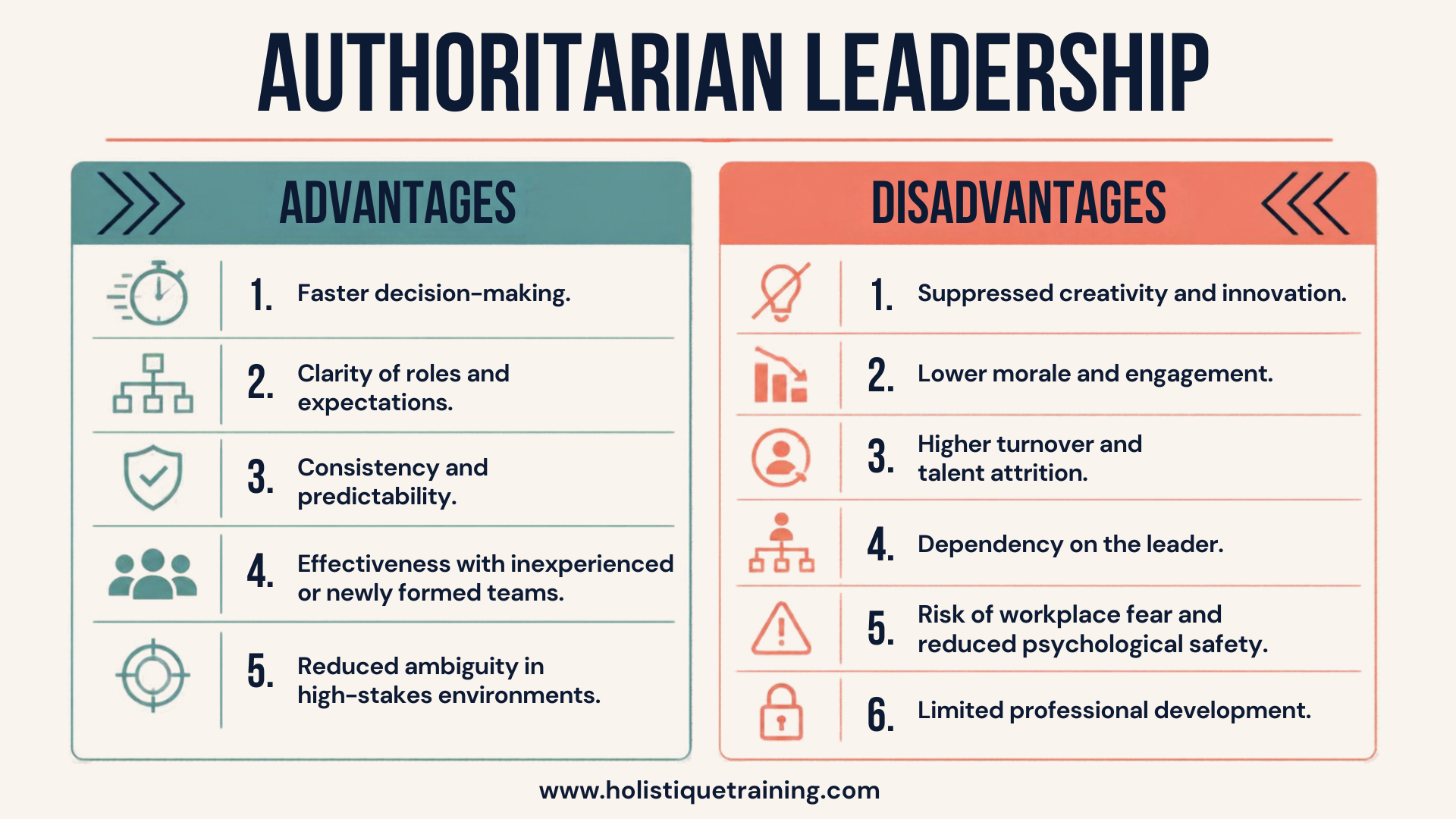
Despite its reputation, authoritarian leadership offers genuine, evidence-supported benefits in the right context.
1-Faster decision-making.
When a leader does not need to consult a wider group, decisions can be made and implemented quickly, which is particularly valuable when time pressure is severe. Academic research on crisis management teams found that directive leadership produced measurably faster decisions than participative leadership when the team was already familiar with the type of crisis it faced, alongside comparable or improved accuracy in those familiar situations, according to a study published in the peer-reviewed journal Small Group Research.
2-Clarity of roles and expectations.
Because instructions are detailed and unambiguous, employees rarely have to guess what is expected of them, which reduces confusion in fast-moving or high-risk operations and can shorten the learning curve for tasks that must be performed to a strict standard.
3-Consistency and predictability.
Standardised procedures, closely enforced, tend to produce uniform outcomes, an advantage in regulated industries where deviation carries safety or compliance risk, and one that auditors, regulators, and quality assurance teams typically value highly.
4-Effectiveness with inexperienced or newly formed teams.
Employees who are new to a role or organisation often benefit from close guidance until they build the confidence and competence to work more independently.
5-Reduced ambiguity in high-stakes environments.
In emergency services, aviation, and certain manufacturing settings, a single point of accountable authority can prevent the delay and confusion that group deliberation might otherwise introduce.
Professionals seeking to combine this decisiveness with a compelling organisational vision, rather than control for its own sake, may find our course on applying authoritarian techniques to achieve a shared vision a useful next step.

Business leadership is an intricate and demanding endeavour. While many professionals spend years striving to ascend the ranks, only a few achieve top leadership positions. Effective leaders can align their personal and business goals with the overarching organisational culture and inspire a shared vision among
5- Disadvantages of Authoritarian Leadership
The same features that make authoritarian leadership fast and consistent can also generate lasting organisational costs.
1-Suppressed creativity and innovation.
When employees are not invited to contribute ideas, valuable insights from the front line often go unheard, and the organisation loses the benefit of collective problem-solving, a particular disadvantage in knowledge-intensive sectors where innovation is closely tied to competitive advantage.
2-Lower morale and engagement.
Employees who feel excluded from decisions that affect their work frequently report reduced motivation, particularly over extended periods rather than short bursts of directive leadership, and diminished morale often spreads beyond the individuals directly affected to the wider team.
3-Higher turnover and talent attrition.
Employees, especially those with in-demand skills, tend to seek environments where their contributions are valued. A study examining leadership styles and turnover intentions found a positive association between authoritarian leadership and employees' intention to leave their organisation, a pattern the author linked to reduced perceived autonomy and diminished job satisfaction.
4-Dependency on the leader.
Teams accustomed to constant direction may struggle to make decisions independently, creating a bottleneck whenever the leader is unavailable and limiting succession planning.
5-Risk of workplace fear and reduced psychological safety. Strict, one-directional communication can discourage employees from raising concerns, reporting mistakes, or flagging risks early, which is particularly damaging in safety-critical or client-facing roles.
6-Limited professional development. With minimal delegation, employees are exposed to fewer stretch opportunities, which can slow their skill development and career progression over time.
6- When Authoritarian Leadership Works Best
Context, more than personality, tends to determine whether authoritarian leadership succeeds or backfires.
Crisis and Emergency Response
Situations involving immediate danger, such as natural disasters, medical emergencies, or serious safety incidents, often benefit from a single point of clear authority that can issue instructions without delay.
Highly Regulated and Safety-Critical Industries
Sectors such as aviation, nuclear energy, construction, and pharmaceuticals rely on strict adherence to protocol, where authoritarian oversight helps enforce compliance and reduce the risk of costly or dangerous deviation.
New or Inexperienced Teams
Employees early in their careers, or teams newly formed for a specific project, often need more structured guidance before they are ready to operate with greater autonomy.
New supervisors in particular tend to benefit from understanding when a more directive approach is appropriate and when it should give way to a lighter touch, a balance explored in depth in our course designed specifically for those stepping into their first leadership roles.

When it comes to an organisation, particularly a large organisation, many levels of management and leadership are established to ensure that every aspect of the business functions as efficiently as possible. The role of a supervisor is to ensure their team’s productivity
Turnaround and Restructuring Situations
Organisations facing financial distress, significant underperformance, or the need for rapid restructuring sometimes benefit temporarily from a more authoritarian style. When quick, unpopular decisions are unavoidable, a single accountable leader can move faster than a consensus-driven process, although this approach tends to work best as a defined, time-limited phase rather than a permanent operating model, with a clear plan to return to more collaborative management once stability has been restored.
Table 2: Contexts Where Authoritarian Leadership Tends to Succeed or Struggle
Context | Likely to Succeed | Likely to Struggle |
|---|---|---|
Time pressure | High-pressure, time-critical decisions | Long-term strategic planning |
Team experience | New, untrained, or transient teams | Highly skilled, autonomous professionals |
Industry type | Safety-critical, regulated sectors | Creative, knowledge-intensive sectors |
Organisational goal | Compliance and consistency | Innovation and continuous improvement |
7- Cultural and Organisational Context
Acceptance of authoritarian leadership varies considerably across cultures and organisations, shaped by deeper assumptions about hierarchy and authority.
Power Distance and National Culture
Cultural researcher Geert Hofstede's power distance index measures how comfortably a society accepts an unequal distribution of authority. According to Hofstede Insights, the United Kingdom scores relatively low on this index, at 35 out of 100, indicating a general cultural preference for more consultative management, whereas countries with considerably higher scores tend to view a directive, top-down leadership style as both normal and expected.
Organisational Culture and Industry Norms
Beyond national culture, organisational history matters. Businesses built around strict quality control, or those operating in unionised or heavily regulated environments, often retain elements of authoritarian leadership even as broader management trends shift towards more participative approaches. Newer organisations, particularly those in technology and professional services, tend to move away from centralised control far more quickly, reflecting both younger workforces and a stronger emphasis on individual autonomy as a driver of engagement.
8- Practical Guidance for Leaders Using an Authoritarian Style
Authoritarian leadership does not have to be a blunt instrument. Leaders who understand both its strengths and its risks are far better placed to deploy it deliberately, rather than defaulting to it out of habit or discomfort with delegation. The guidance below is drawn from the situational and cultural factors discussed above, and is intended to help leaders retain the benefits of decisiveness without accumulating the longer-term costs to morale and retention.
1-Reserve firm direction for situations that genuinely require it, such as emergencies or safety-critical tasks, rather than applying it as a default across all decisions.
2-Explain the reasoning behind instructions where time allows, since employees who understand the purpose behind a directive are more likely to comply willingly rather than resentfully.
3-Create structured opportunities for feedback, even within a largely top-down structure, so that valuable frontline insight is not permanently lost.
4-Recognise and reward compliance and performance visibly, since authoritarian environments can otherwise feel transactional and unappreciated.
5-Periodically reassess whether the team has developed sufficient skill and confidence to be granted greater autonomy, avoiding indefinite dependency.
6-Pair authoritarian decision-making with genuine respect and professionalism, since firmness and basic dignity are not mutually exclusive.
9- Authoritarian Leadership Across Different Sectors
The suitability of authoritarian leadership shifts considerably depending on the operational demands of a given sector.
Manufacturing and Operations
Production environments with strict quality and safety standards often retain elements of authoritarian supervision, particularly on assembly lines where deviation from procedure carries measurable risk.
Military and Emergency Services
Command structures in military and emergency response organisations remain firmly authoritarian by design, reflecting the life-or-death stakes and time constraints inherent to the work.
Healthcare
Clinical settings often blend authoritarian and collaborative elements, applying directive authority during acute emergencies while relying on more consultative approaches for ongoing patient care planning.
Non-Profit and Humanitarian Operations
Humanitarian and development organisations present a particularly interesting case. Field operations, especially during rapid-onset emergencies, natural disasters, or security incidents, often require a clear chain of command so that resources, safety decisions, and logistics can move quickly. Away from those acute moments, however, the same organisations typically rely on highly consultative, community-centred, and partnership-driven approaches, reflecting the collaborative culture that dominates the wider non-profit and NGO sector. Leaders in this space therefore need to be particularly skilled at recognising the moment when a directive, authoritarian approach is warranted and the moment when it should give way to broader consultation with colleagues, partners, and the communities being served.
Table 3: Authoritarian Leadership Suitability by Sector
Sector | Typical Reliance on Authoritarian Leadership | Rationale |
|---|---|---|
Military and emergency services | High | Life-critical, time-sensitive decisions |
Manufacturing | Moderate to high | Safety and quality control |
Healthcare | Situational | Emergencies versus long-term care |
Technology and creative industries | Low | Reliance on innovation and autonomy |
Non-profit and humanitarian work | Low to moderate | Coordination under pressure, but consultative field culture |
10- Common Myths and Misconceptions
Because authoritarian leadership is widely discussed but rarely examined in detail, several persistent myths tend to distort how it is judged.
1-Myth: authoritarian leaders are always harsh or unkind. In reality, firmness and basic respect are not mutually exclusive, and the defining feature of the style is where decision-making authority sits, not the leader's tone or temperament.
2-Myth: authoritarian leadership has no place in modern workplaces. In reality, it remains standard practice in time-critical and safety-critical fields, including emergency services, aviation, and certain manufacturing environments.
3-Myth: authoritarian and authoritative leadership are the same thing. In reality, they differ fundamentally, since authoritative leadership relies on an inspiring vision while authoritarian leadership relies on control and compliance.
4-Myth: once adopted, an authoritarian style cannot evolve. In reality, many capable leaders deliberately shift towards more participative approaches as their team's competence and confidence grow, treating authoritarian leadership as a starting point rather than a permanent destination.
Conclusion
Authoritarian leadership is neither an outdated relic nor a universally applicable solution; it is a tool whose value depends entirely on context. Used deliberately, in moments that genuinely call for speed, consistency, or firm direction, it can outperform more participative alternatives. Applied indiscriminately, however, it risks suppressing creativity, eroding morale, and accelerating the departure of an organisation's most capable people. The most effective leaders tend not to be purely authoritarian or purely democratic; they are those who can accurately read a situation and adjust their authority accordingly, reserving directive control for the moments that truly require it while defaulting to a more collaborative approach once the immediate pressure has passed. Organisations that invest in helping their leaders recognise this distinction, rather than treating leadership style as a fixed personal trait, are generally better placed to combine the speed of authoritarian decision-making with the loyalty and innovation that more participative approaches tend to sustain over the long term.