
- Table of Contents
- Introduction
- 1- Why Assistant Managers Need Structured Training
- The Gap Between Promotion and Preparation
- What the 2026 Data Shows
- Why the Assistant Manager Role Is Different
- 2- How to Judge a Course Before You Enrol
- 3- Best Leadership Courses for Assistant Managers
- How to Choose Between Leadership Programmes
- Why Emotional Intelligence Matters
- 4- Best Communication Courses for Assistant Managers
- Why Written and Spoken Skills Both Count
- 5- Best Business Skills Courses for Assistant Managers
- Choose Skills Based on Your Gaps
- 6- Accredited Qualifications That Add Credibility
- CMI Level 3 in First Line Management
- Progressing Beyond Level 3
- Why Certification Pays Off
- 7- Free, Paid and Accredited Courses Compared
- 8- How to Build a Personal Learning Plan
- 9- How to Apply What You Learn at Work
- Practise Straight Away
- Common Mistakes to Avoid
- 10- Conclusion
Introduction
Stepping into an assistant manager role is one of the most demanding career moves in any organisation. You are expected to support the manager, supervise the team, resolve problems quickly and keep daily operations running, often before anyone has shown you how. The right assistant manager courses can close that gap. They give you proven frameworks for leading people, communicating clearly and understanding the business, so that you spend less time guessing and more time performing.
The challenge is choosing well. Thousands of leadership courses, communication programmes and business skills certificates are available online and in the classroom, and their quality varies widely. Some are built by leading universities and professional bodies, while others are little more than recorded slideshows. Assistant managers rarely have spare time or budget, so every course needs to earn its place in a busy working week.
In this article, we will discuss why structured training matters for assistant managers, how to judge a course before you enrol, the best leadership courses, the best communication courses, the best business skills courses, accredited qualifications that add credibility, how free, paid and accredited formats compare, how to build a personal learning plan, and how to apply what you learn at work.
1- Why Assistant Managers Need Structured Training
The Gap Between Promotion and Preparation
Most assistant managers are promoted because they performed well as team members, not because they were trained to lead. The skills that earned the promotion, such as technical competence and reliability, are only part of the new job. The rest involves coaching colleagues, giving feedback, handling conflict, reading performance data and representing the manager when they are absent. Without structured learning, many people work these skills out through trial and error, and their teams often pay the price while they do.
What the 2026 Data Shows
Recent research confirms how common this gap is. According to the 2026 State of Management report from Manager Method, which surveyed HR leaders at 301 organisations, 35% of new managers receive no leadership training at all, while only 9% receive structured, ongoing training. The same report found that a further 42% rely on ad hoc support, which depends heavily on how much time their own manager can spare. For an assistant manager, this means that taking charge of your own development is not a luxury. It is often the only reliable route to becoming effective in the role.
Why the Assistant Manager Role Is Different
Assistant managers sit in a particular middle position. You carry real responsibility for results, yet you usually have less authority than the manager you support. This makes influence, communication and judgement more important than formal power. Courses designed for this level should therefore focus on practical, everyday skills rather than abstract strategy, and they should help you work effectively with peers, direct reports and senior colleagues at the same time.
The consequences of skipping this preparation are easy to recognise. Unclear expectations lead to repeated mistakes, small disagreements grow into lasting tensions, and talented team members lose confidence in the person guiding them. Investing in the right course early protects your reputation, your team’s morale and your own wellbeing, because you stop carrying the stress of improvising every difficult decision.
2- How to Judge a Course Before You Enrol
Before spending money or time, it helps to apply a few simple tests. These checks separate genuinely useful assistant manager courses from those that merely look impressive on a landing page. Use the following five questions to compare every option on your shortlist.
1- Institution credibility:
Check who designed and delivers the course. Universities, business schools and chartered professional bodies are subject to quality assurance, and their names carry weight with employers. Look at the instructors too, and ask whether they combine academic knowledge with real workplace experience.
2- Practical focus:
Strong courses include role-plays, case studies, assignments and feedback rather than only video lectures. As an assistant manager, you should be able to apply each module to your own team within a week of completing it.
3- Recognised certification:
A shareable certificate or professional qualification gives you evidence to show your manager or a future employer. Check whether the credential is awarded by the provider, a university or an external professional body, because this affects how widely it is recognised.
4- Time and cost fit:
Compare the weekly hours, total duration and fees with your real schedule. A shorter course that you finish is far more valuable than an ambitious programme you abandon after two weeks of shift changes and deadlines.
5- Current content:
Management practice changes quickly, particularly with hybrid working and AI tools now part of daily operations. Confirm that the syllabus has been updated recently, and read reviews from learners in similar roles.
Applying these five tests will save you time and prevent costly mistakes. Course details and prices change regularly, so always confirm the current syllabus and fees on the provider’s own page before you enrol.
3- Best Leadership Courses for Assistant Managers
Leadership remains one of the most requested development areas in organisations of every size. According to the TalentLMS 2026 L&D Report, 64% of the HR managers surveyed plan to make leadership training a priority this year. That demand has produced a strong choice of programmes, and the following three stand out for assistant managers because they combine reputable providers with practical, applicable content.
1- Leading People and Teams Specialization (University of Michigan, Coursera):
Created by faculty at the Ross School of Business, this beginner-level specialisation teaches you to create and communicate a vision, manage talent to improve performance and retention, and build a team charter. It suits assistant managers because it is flexible, needs no prior experience and gives you tools you can try with your own team straight away.
2- Exercising Leadership: Foundational Principles (HarvardX, edX):
This course forms part of the Leadership and Communication professional certificate from Harvard Online. It helps new leaders understand how to build trust, motivate colleagues and handle difficult challenges and change. It is a strong choice if you want to understand the human side of leadership rather than only management techniques.
3- The New Manager’s Toolkit (Indiana University, edX):
This professional certificate from the Kelley School of Business contains three courses: Becoming a People Manager, Effective Management and Communication, and Developing Your Personal Leadership Style. Its short, tool-focused lessons suit busy professionals who want practical methods they can transfer directly into their day-to-day work.
Course | Provider | Platform | Best For |
|---|---|---|---|
Leading People and Teams | University of Michigan | Coursera | Core leadership habits |
Exercising Leadership | HarvardX | edX | Trust, motivation and change |
The New Manager’s Toolkit | Indiana University | edX | Practical tools for new managers |
How to Choose Between Leadership Programmes
The three programmes above overlap, so compare them on format and depth. Leading People and Teams offers the most structured path, with a capstone that asks you to apply ideas to real management challenges. Exercising Leadership is more reflective and suits learners who want to examine their own behaviour. The New Manager’s Toolkit is the most practical and works well when you need quick wins. Consider which of these styles matches how you prefer to learn, and start there.
Why Emotional Intelligence Matters
Whichever programme you choose, look for modules on emotional intelligence and adapting your leadership style. Assistant managers deal with a wide range of personalities, from experienced colleagues who resist change to new starters who need reassurance. The ability to read a situation, stay calm and adjust your approach is often what separates respected leaders from reluctant ones.

This specialised training course explores Daniel Goleman’s six leadership styles, rooted in emotional intelligence, and their practical application in diverse organisational contexts. Participants will learn how to assess situations, adapt their leadership approach, and build emotionally intelligent teams that deliver sustained performance.By combining theoretical insights with real-world
4- Best Communication Courses for Assistant Managers
Communication is the skill assistant managers use most often. You pass instructions down, escalate issues up and hold conversations with colleagues, customers and suppliers throughout the day. A single unclear message can create rework, conflict or missed targets, which is why these courses build the skill from several different angles.
1- Effective Communication for Today’s Leader (Tecnológico de Monterrey, edX):
This four-week course covers listening levels, assertive communication, empathy and performance feedback. It is well suited to assistant managers who need to give honest feedback without damaging working relationships, and its short length makes it easy to fit around shifts.
2- Improving Communication Skills (University of Pennsylvania, Coursera):
Delivered through the Wharton School, this course offers practical frameworks for speaking, writing and listening in professional settings. It helps you prepare clearer messages, present ideas with more confidence and adapt your style to different audiences.
3- Successful Negotiation: Essential Strategies and Skills (University of Michigan, Coursera):
Assistant managers negotiate more often than they realise, whether they are agreeing shift changes, allocating resources or resolving disputes between colleagues. This course teaches preparation, bargaining and agreement-building, all of which strengthen your influence without relying on formal authority.
Listening deserves special attention in this list. Assistant managers often hear concerns first, before they reach the manager, and the way you respond shapes whether people raise problems early or stay silent. Each course above includes some element of active listening, so use it as a practical test of every conversation you have during the programme.
Why Written and Spoken Skills Both Count
Many people focus only on speaking, yet written communication matters just as much in a role that involves handover notes, reports and emails to senior managers. A balanced course, or a combination of two, should cover both. It should also include feedback on your own practice, because communication improves fastest when someone reviews how you actually deliver a message.

Leadership, innovation, and communication are integral components of any organisation's success. Effective leadership provides direction, inspires confidence, and fosters a cohesive work environment. The guiding force sets the tone for innovation, encouraging teams to think creatively and embrace change.
5- Best Business Skills Courses for Assistant Managers
Leadership and communication are not enough on their own. Assistant managers are also expected to understand budgets, performance data and how their team contributes to organisational goals. Business skills courses give you that wider commercial awareness, which makes you more credible when you discuss decisions with your manager and more prepared for promotion.
1- Business Foundations Specialization (University of Pennsylvania, Coursera):
This introductory programme from the Wharton School covers marketing, accounting, finance and operations. It is ideal if you have strong practical experience but little formal business education, because it explains the language that senior leaders use.
2- Excel Skills for Business (Macquarie University, Coursera):
Spreadsheets sit behind most rosters, budgets and performance reports. This series builds the skills to organise data, create formulas and present findings clearly, which saves time and improves the quality of the information you share.
3- Management Foundations (LinkedIn Learning):
This short video course covers core management fundamentals such as setting expectations, delegating and giving feedback. It works well as a first step or a refresher, particularly if your employer already provides access to the platform.
Business skills also support better decisions about people. When you understand how labour costs, customer demand and operational targets connect, you can explain why a schedule changes or a target moves, rather than simply passing instructions down. That clarity builds trust with your team and shows senior colleagues that you think beyond the daily to-do list.
Choose Skills Based on Your Gaps
It is tempting to enrol in the most popular course, but the best choice depends on what you find hardest today. If you struggle to delegate, start with a leadership programme. If feedback conversations make you nervous, begin with communication. If budget meetings leave you lost, a business skills course will give the quickest return. The table below links common gaps to suitable options from this guide.

Effective task and time management skills are essential to remaining competitive, working successfully with colleagues on shared goals, and meeting client and stakeholder needs. Any project requires you to manage challenges promptly and creatively. This course provides the framework for
Skill Gap | Suggested Course | Provider |
|---|---|---|
Leading the team | Leading People and Teams | University of Michigan |
Difficult feedback | Effective Communication for Today’s Leader | Tecnológico de Monterrey |
Commercial awareness | Business Foundations Specialization | University of Pennsylvania |
Reporting and data | Excel Skills for Business | Macquarie University |
6- Accredited Qualifications That Add Credibility
Online certificates are useful, but a formal qualification can carry more weight, especially if you plan to move into a full manager role. In the UK and many other countries, the Chartered Management Institute (CMI) is one of the most widely recognised bodies for management qualifications.
CMI Level 3 in First Line Management
The CMI Level 3 Award, Certificate and Diploma in Principles of Management and Leadership are designed for aspiring, newly appointed and practising first line managers. Modules include Approaches to Managing and Leading People and Teams and Stakeholder Communication for First Line Managers, so a single qualification covers leadership and communication together. Learners who complete the Level 3 qualifications may become eligible for Foundation Chartered Manager status, subject to CMI membership, and the Diploma can lead on to Level 5. Colleges and training providers deliver it in classroom, blended and online formats, so check which suits you.
Progressing Beyond Level 3
Once you are comfortable at Level 3, the next step is usually a Level 5 qualification in management and leadership, which focuses on managing resources, people and information at a more senior level. This staged structure is attractive because each qualification builds on the last, and you can pause between stages as your responsibilities grow. Many employers also recognise CMI membership, which adds access to learning resources and a professional network.
Why Certification Pays Off
Evidence suggests that formal preparation makes a measurable difference. A survey conducted by Campbellsville University in July 2026, covering 609 working adults, found that 51% of managers who received formal training said the role advanced their career, compared with 14% of those who received none. The same survey reported that 60% of respondents believe formal leadership education makes someone a more effective manager. Although the sample is based in the United States, the pattern is a useful reminder for assistant managers everywhere that recognised training can support progression.
7- Free, Paid and Accredited Courses Compared
Courses fall into three broad formats, and each serves a different purpose. Understanding the trade-offs helps you invest your time and money where they will make the most difference.
Cost and recognition tend to rise together, but the relationship is not perfect. A well-designed university course on a major platform can outperform an expensive programme from an unknown provider, so judge quality by the institution, the assessment and the learner reviews rather than by price alone.
Format | Typical Cost | Recognition | Best For |
|---|---|---|---|
Free or audit course | Low or free | Limited | Testing a new topic |
Paid platform certificate | Moderate | Good and shareable | Building a specific skill |
Accredited qualification | Higher | Strong and formal | Career progression |
No single format is best. Many assistant managers combine them, starting with a free module to test their interest, completing a paid certificate to build a skill, and then committing to an accredited qualification once they are sure of their direction. It is also worth asking your employer about funding, since many organisations will pay for recognised qualifications or provide platform access when you can explain how the learning will benefit the team.
8- How to Build a Personal Learning Plan
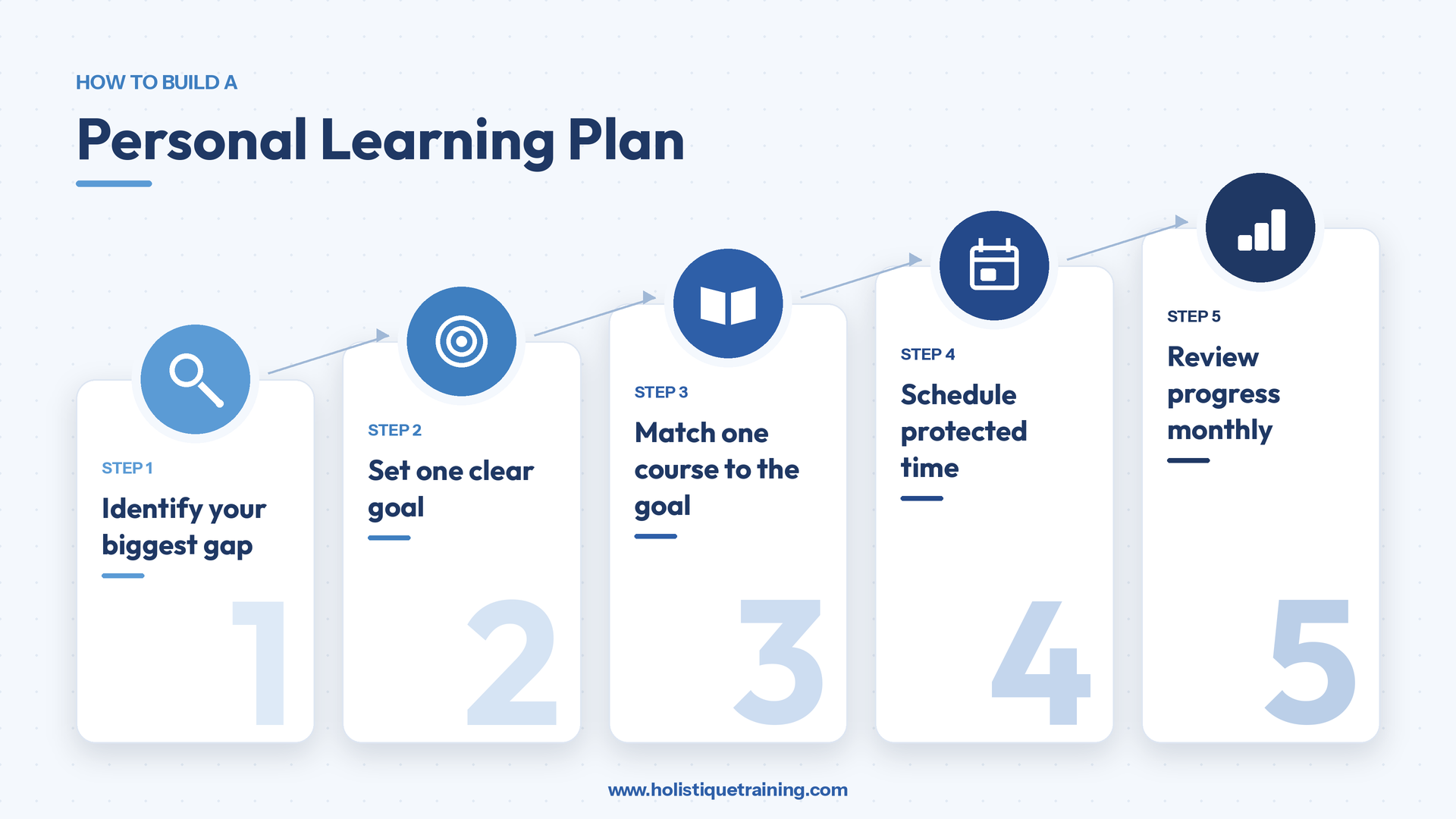
A course only helps if it fits a clear plan. Without one, it is easy to enrol, lose momentum and never return. The following five steps turn a long list of options into a realistic programme you can complete.
1- Identify your biggest gap:
Ask your manager and team for honest feedback, review recent appraisals and note the situations where you felt least prepared. The pattern that emerges shows where learning will pay off first.
2- Set one clear goal:
For example, you might aim to lead weekly team meetings with confidence, or to give structured feedback within three months. A specific goal makes it easier to choose the right course.
3- Match one course to the goal:
Select a single programme from this guide that targets the goal, rather than enrolling in several at once. Finishing one course builds the habit and the confidence to take on the next.
4- Schedule protected time:
Block short, regular sessions in your calendar, and treat them like meetings with your manager. Thirty minutes three times a week usually works better than one long weekend session.
5- Review progress monthly:
Check whether your behaviour at work has changed, not only whether you have finished modules. Ask a colleague whether they have noticed any difference.
Keep the plan visible. A simple note on your desk or phone listing the goal, the chosen course and the next session date is often enough to keep you on track during busy weeks, and it makes it easier to explain your priorities when your manager asks how your development is going.
Reviewing and refreshing your plan regularly is part of a wider habit of continuous professional development. Skills that matter today may look different in a year, and the most effective assistant managers keep learning as their roles evolve.
9- How to Apply What You Learn at Work
The real value of any course appears only when you use it. Learning that stays in your notes does nothing for your team, so build application into the programme from the first week.
Practise Straight Away
After each module, choose one technique and use it within 48 hours. If you have just studied feedback, hold one structured conversation. If you have covered delegation, hand over one task with clear expectations and a deadline. Small, immediate practice turns knowledge into habit and gives you real examples to reflect on and share with your manager.
Keep a short learning log as you go. Write down what you tried, what happened and what you would change next time. These notes become valuable evidence in appraisals and promotion discussions, because they show concrete results rather than simply a list of completed courses.
Common Mistakes to Avoid
1- Collecting certificates without applying them: A long list of credentials impresses nobody if your team cannot see a change in how you lead. Always link each course to a visible workplace action.
2- Taking too many courses at once: Overloading yourself leads to partial completion and shallow learning. It is better to finish one programme properly than to start four.
3- Ignoring feedback: Courses provide frameworks, but your colleagues tell you whether the frameworks work. Ask for feedback regularly and adjust your approach.
4- Keeping your goals private: When your manager knows what you are learning, they can offer relevant tasks, introductions and encouragement. Sharing your plan also shows initiative, which supports future promotion.

Practical workplace tips for young professionals: communication, time management, networking and wellbeing to build a confident career.
10- Conclusion
The best courses for assistant managers combine reputable providers, practical content and recognition that employers value. Leadership programmes such as Leading People and Teams and The New Manager’s Toolkit build the foundations for guiding a team. Communication courses sharpen feedback, negotiation and everyday messages. Business skills courses add the commercial awareness that makes you credible with senior colleagues, while CMI qualifications provide formal recognition that supports promotion.
The most important step is to choose deliberately. Identify your biggest skill gap, select one suitable course, protect time to complete it and apply each lesson at work within days. With this approach, even a short programme can change how your team experiences your leadership. To stay informed about professional development trends, subscribe to our newsletter and explore our specialised courses designed to help professionals and organisations build future-ready skills.