

- Table of Contents
- Introduction
- 1- What Is Communication Training in the Workplace?
- Defining the Scope
- How It Differs From General Soft-Skills Training
- 2- Why Communication Training Matters for Organisations
- The Link Between Communication and Engagement
- Reducing Errors, Rework and Conflict
- 3- Core Skills Every Communication Training Programme Should Develop
- 1- Active listening:
- 2- Clear and concise messaging:
- 3- Questioning and clarifying:
- 4- Giving and receiving feedback:
- 5- Assertive communication:
- 6- Written and digital communication:
- Why These Skills Are Becoming More Valuable
- 4- Types of Communication Training
- Verbal Communication Training
- Written Communication Training
- Non-Verbal Communication Training
- Digital and Etiquette Training
- 5- Conducting a Training Needs Analysis
- 6- Designing an Effective Communication Training Programme
- Setting Clear Learning Objectives
- Building Content Around Real Work
- Sequencing Practice and Feedback
- Securing Leadership Sponsorship
- Designing for Inclusion and Accessibility
- 7- Choosing the Right Delivery Method
- 8- Communication Training for Managers and Leaders
- 9- Cross-Cultural, Hybrid and Remote Communication
- 10- Common Barriers to Effective Communication Training
- 1- Perceived lack of time:
- 2- Resistance and defensiveness:
- 3- Poor transfer to the workplace:
- 4- Inconsistent role modelling:
- 5- Difficulty demonstrating return on investment:
- 11- Measuring the Effectiveness of Communication Training
- 12- Future Trends in Communication Training
- Conclusion
Introduction
Few capabilities shape organisational performance as quietly and as powerfully as communication. Every decision, handover, performance conversation, client call and team meeting depends on people exchanging information accurately and respectfully. When that exchange works, projects move faster, errors fall and colleagues trust one another. When it fails, the consequences appear as missed deadlines, duplicated effort, strained relationships and disengaged employees. For HR and learning and development professionals, this makes communication training in the workplace one of the most practical investments available.
Yet communication is often treated as something people either have or lack, rather than a set of skills that can be taught, practised and measured. Organisations may fund technical upskilling without recognising that technical expertise delivers little value if it cannot be explained, challenged or applied through clear dialogue. Modern working conditions raise the stakes further. Hybrid teams, multiple digital channels, cross-border collaboration and generational differences all increase the room for misunderstanding.
In this article, we will discuss what communication training is, why it matters, the core skills it should develop, the main types of training, how to analyse needs and design a programme, delivery methods, the particular needs of managers and leaders, cross-cultural and remote communication, common barriers, how to measure effectiveness, and the trends shaping the future of the field.
1- What Is Communication Training in the Workplace?
Communication training is a structured learning intervention that helps employees send, receive and interpret messages more effectively in a professional setting. It goes well beyond public speaking or grammar. A well-designed programme addresses how people listen, question, explain, persuade, give feedback, write and manage difficult conversations, and it connects each skill to the realities of the participant's role.
Defining the Scope
The scope of communication training covers four broad channels: spoken, written, non-verbal and digital. It applies to every level of an organisation, from new starters learning to write a professional email to senior leaders communicating strategy during periods of change. Its defining feature is that it treats communication as a behaviour that can be observed, practised and improved, rather than as a fixed personality trait.
How It Differs From General Soft-Skills Training
Communication training is sometimes grouped with general soft-skills development, but the two are not identical. Soft-skills programmes tend to be broad, covering attitude, teamwork and resilience. Communication training is narrower and more practical, concentrating on the specific exchanges that determine whether work gets done well. The table below sets out the differences.
Aspect | Communication Training | General Soft-Skills Training | Technical Training |
|---|---|---|---|
Primary focus | Message clarity, listening and dialogue | Broad interpersonal behaviours | Tools, systems and procedures |
Typical outcome | Fewer misunderstandings and stronger relationships | Improved teamwork and attitude | Task-specific competence |
Practice method | Role-play, feedback and real scenarios | Workshops and reflection | Demonstrations and assessments |
Link to performance | Direct and visible in daily exchanges | Indirect and cumulative | Direct but narrow in scope |
2- Why Communication Training Matters for Organisations
Communication is the infrastructure on which every other organisational capability runs. Strategy only becomes action when it is explained clearly, feedback only improves performance when it is delivered and received well, and collaboration only works when colleagues share information openly. Treating communication as a trainable skill, rather than a personality trait, allows organisations to raise the baseline across every team rather than relying on a few naturally gifted communicators.
The Link Between Communication and Engagement
The most visible effect of better communication is on engagement, and the manager is the main channel through which it travels. According to Gallup, managers account for 70% of the variance in team engagement, yet its 2025 State of the Global Workplace report found that only 44% of managers globally had ever received management training. That gap matters for HR teams, because many people are promoted for technical strength and then expected to coach, motivate and handle conflict without being taught how to hold the conversations those tasks require.
Reducing Errors, Rework and Conflict
Poor communication has a direct operational cost. Ambiguous instructions produce rework, unspoken assumptions create duplicated or dropped tasks, and unaddressed tension turns into formal grievances. Training gives employees shared techniques, such as confirming understanding, summarising agreements and asking clarifying questions, that cut through these problems at source. Teams that agree how they communicate spend less time interpreting one another and more time delivering work.

Team coordination is a critical element of success in any organisation. It involves synchronising the efforts of individual team members to achieve common objectives efficiently and effectively. The "Team Coordination Training (TCT)" course provides participants with the tools and techniques necessary to enhance
Communication training also supports retention and employer brand. Employees who feel heard and who understand what is expected of them are more likely to remain committed, and clear internal communication makes change programmes, restructures and policy updates far easier to land without damaging trust.
3- Core Skills Every Communication Training Programme Should Develop
A credible programme does not attempt to teach everything at once. It concentrates on a defined set of observable skills that employees can practise and that managers can reinforce. The following six skills form the foundation of most effective communication training in the workplace.
1- Active listening:
Active listening means giving full attention to the speaker, noticing tone and body language, and checking understanding by paraphrasing before responding. It prevents the common pattern of waiting to speak rather than listening, and it is the skill most closely linked to trust.
2- Clear and concise messaging:
Employees learn to structure messages so that the purpose, key points and requested action are obvious. Techniques such as leading with the conclusion, avoiding jargon and matching detail to the audience reduce confusion in emails, briefings and presentations.
3- Questioning and clarifying:
Open and probing questions uncover assumptions and surface problems early. Training shows participants when to ask closed questions to confirm facts and when to ask open questions to explore perspectives.
4- Giving and receiving feedback:
Feedback is where communication most often breaks down. Participants practise describing behaviour and its impact rather than judging character, and they learn to receive criticism without becoming defensive.
5- Assertive communication:
Assertiveness allows employees to state needs, disagree and set boundaries respectfully, avoiding both passivity and aggression. It is particularly valuable in negotiation, stakeholder management and upward communication.
6- Written and digital communication:
Much workplace communication now happens through email, chat and collaboration platforms. Training covers tone, structure, channel choice and etiquette so that messages are not misread in the absence of vocal and visual cues.
Why These Skills Are Becoming More Valuable
The demand for interpersonal capability is rising rather than falling. According to the World Economic Forum's Future of Jobs Report 2025, empathy and active listening sits within the top ten core skills that employers say workers require today. The same report, drawing on research with Indeed, found that skills rooted in human interaction, including empathy and active listening, currently show no potential for substitution by generative AI. For learning teams, this is a strong argument for treating communication as a long-term capability rather than a short-term fix.
Emotional intelligence underpins several of these skills. Employees who recognise their own reactions and read those of colleagues are better placed to listen without interrupting, give feedback with care and de-escalate tension. Many organisations therefore weave short emotional intelligence exercises, such as reflective check-ins and perspective-taking activities, into their communication programmes.

Boost workplace harmony with emotional intelligence activities. Foster empathy, communication, and regulation for stronger teams and success.
4- Types of Communication Training
Communication training is not a single product. Different roles and channels call for different emphases, and a needs-based programme usually combines several of the following types. Content within each type should also be adjusted for seniority, since a graduate learning to structure an email has very different needs from a director preparing a board presentation.
Verbal Communication Training
This type covers speaking clearly in meetings, presenting to stakeholders, handling telephone and video calls, and leading conversations. Typical content includes structuring a message, controlling pace and tone, and managing nerves under pressure.
Written Communication Training
Written training focuses on emails, reports, proposals and instant messages. Participants learn to plan before writing, edit for brevity and adopt a tone suited to the relationship and context. Because written messages create a permanent record, accuracy and professionalism carry particular weight.
Non-Verbal Communication Training
Posture, eye contact, facial expression and gestures all shape how messages land, often more strongly than the words themselves. Training builds awareness of these signals and shows how to align them with the intended message, particularly in face-to-face meetings and on video calls.
Digital and Etiquette Training
Digital training addresses channel selection, response expectations, virtual meeting conduct and the professional use of collaboration tools. Etiquette modules reinforce respect, punctuality, inclusive language and responsiveness, all of which shape how colleagues and clients perceive an organisation.

Mastering business etiquette and protocol is fundamental to fostering a professional image and advancing in today’s globally interconnected business world. This comprehensive course offers an in-depth exploration into business etiquette's critical role, covering etiquette principles in professional, social, and multicultural contexts. Through this training, participants
5- Conducting a Training Needs Analysis
Programmes that skip diagnosis often teach skills people already have while missing those they lack. A training needs analysis identifies where communication problems actually occur, who is affected and what they cost, so that content can be targeted and its impact later demonstrated. Several methods can be combined to build an accurate picture.
1- Employee and manager surveys:
Short surveys reveal how people rate communication within and between teams, and where they feel information is withheld or unclear.
2- Structured interviews and focus groups:
Conversations with representative groups explain the reasons behind survey scores and surface examples that numbers cannot.
3- Observation of real interactions:
Sitting in on meetings, client calls and handovers shows the gap between how people believe they communicate and how they actually do.
4- Performance and operational data:
Error rates, complaint volumes, rework, grievance numbers and exit-interview themes show where communication failures are costing the organisation.
The findings should be segmented by role and level, because the needs of a new graduate, a team leader and a senior director differ considerably.
6- Designing an Effective Communication Training Programme
Setting Clear Learning Objectives
Objectives should describe observable behaviour rather than vague awareness. A statement such as participants will be able to open a performance conversation by describing a specific behaviour and its impact is far more useful than participants will understand feedback. Behavioural objectives guide content, shape assessment and make evaluation possible.
Building Content Around Real Work
Adults learn best when material is immediately relevant. Scenarios should be drawn from situations participants genuinely face, such as handling an unclear brief, challenging a senior colleague or responding to a complaint. Models and frameworks are useful, but only when learners can see how to apply them the next day.
Sequencing Practice and Feedback
Skills develop through repetition and feedback rather than through information alone. Effective programmes combine short input with practice in pairs or small groups, structured feedback and a chance to try again. Spacing sessions over several weeks supports retention far better than a single intensive day.
Securing Leadership Sponsorship
Programmes succeed when senior leaders take part, model the behaviours and expect them from others. Without visible sponsorship, participants return to workplaces where old habits continue to be rewarded.
Designing for Inclusion and Accessibility
Programmes should work for everyone, including neurodivergent employees, people with hearing or visual impairments and colleagues working in a second language. Offering materials in several formats, allowing different ways to participate and avoiding assumptions about what good communication looks like ensures that training supports inclusion rather than imposing a single style.
7- Choosing the Right Delivery Method
The right delivery method depends on audience size, location, budget and the nature of the skill. Listening and feedback are best learned through live interaction, while email writing and etiquette can be taught effectively online. The table below compares the most common formats. Cost and scale also influence the decision. Classroom workshops suit small groups of managers who need intensive practice, whereas self-paced modules can reach thousands of employees at low cost. A sensible approach is to match the most resource-intensive formats to the roles where communication carries the greatest consequence, and to use scalable formats to establish a common baseline for everyone else.
Format | Best Suited To | Key Strength | Main Limitation |
|---|---|---|---|
Instructor-led classroom | Interpersonal skills and leadership | Rich practice and immediate feedback | Higher cost and scheduling demands |
Virtual instructor-led | Distributed or hybrid teams | Live interaction without travel | Weaker engagement if poorly facilitated |
Self-paced e-learning | Written and digital skills | Flexible, scalable and low cost | Limited practice and feedback |
One-to-one coaching | Senior leaders and specific challenges | Highly personalised support | Costly and hard to scale |
Microlearning | Reinforcement and refreshers | Short, frequent and easy to apply | Unsuitable for complex skills alone |
Most organisations achieve the strongest results through blended approaches. A workshop may introduce a framework, short digital modules reinforce it, and coaching or peer practice embeds it in daily work. Reinforcement after the initial event is critical, because skills fade quickly without application.
8- Communication Training for Managers and Leaders
Managers deserve particular attention because they communicate more often, and with more consequence, than any other group. They translate strategy, allocate work, give feedback, handle conflict and set the emotional tone of a team. Leadership-focused communication training therefore goes further than basic skills. It covers running effective one-to-one conversations, delivering difficult messages with empathy, communicating change and inviting dissent so that problems are raised early.
Both the frequency and the quality of manager communication matter. According to Gallup, employees who receive daily feedback from their manager are three times more likely to be engaged than those who receive feedback once a year or less. This challenges the annual review model and suggests that managers need practical habits, such as brief weekly check-ins and informal daily contact, as well as the skills to make those exchanges meaningful.
Informal approaches can complement structured conversations. Leaders who regularly walk the floor, ask open questions and listen to what they hear build a richer picture of operations and give employees easier access to raise concerns. Training should therefore include how to hold unplanned conversations purposefully and how to follow up on what is heard, so that employees see their input leads to action.
9- Cross-Cultural, Hybrid and Remote Communication
Modern workforces communicate across time zones, languages and cultures, often without meeting in person. Cultural differences influence how directly people express disagreement, how they interpret silence, how much context they expect and how they view hierarchy. A message that feels efficient in one culture can feel abrupt or disrespectful in another.
Training in this area develops cultural awareness, plain-language writing that supports non-native speakers and the discipline of checking understanding rather than assuming it. It should also address the realities of hybrid work: choosing the right channel, setting response expectations, running inclusive video meetings and deliberately sharing information that office-based colleagues might otherwise pass on informally.

In today’s connected world, leadership is no longer limited to one culture, country, or mindset. Leaders must understand how to navigate and lead across cultures, time zones, and ways of thinking. This training course helps you develop the mindset and skills to lead effectively in diverse,
Language is another consideration. Idioms, acronyms and humour that feel natural to one group can exclude others, especially in international teams where English may be a second language. Training can help employees recognise these patterns, choose simpler wording and invite questions without embarrassment, which improves understanding for everyone, not only for non-native speakers.
Remote communication demands greater explicitness. Without corridor conversations, leaders must create regular, structured opportunities for dialogue, while colleagues must learn to write messages that stand alone without additional explanation.
10- Common Barriers to Effective Communication Training
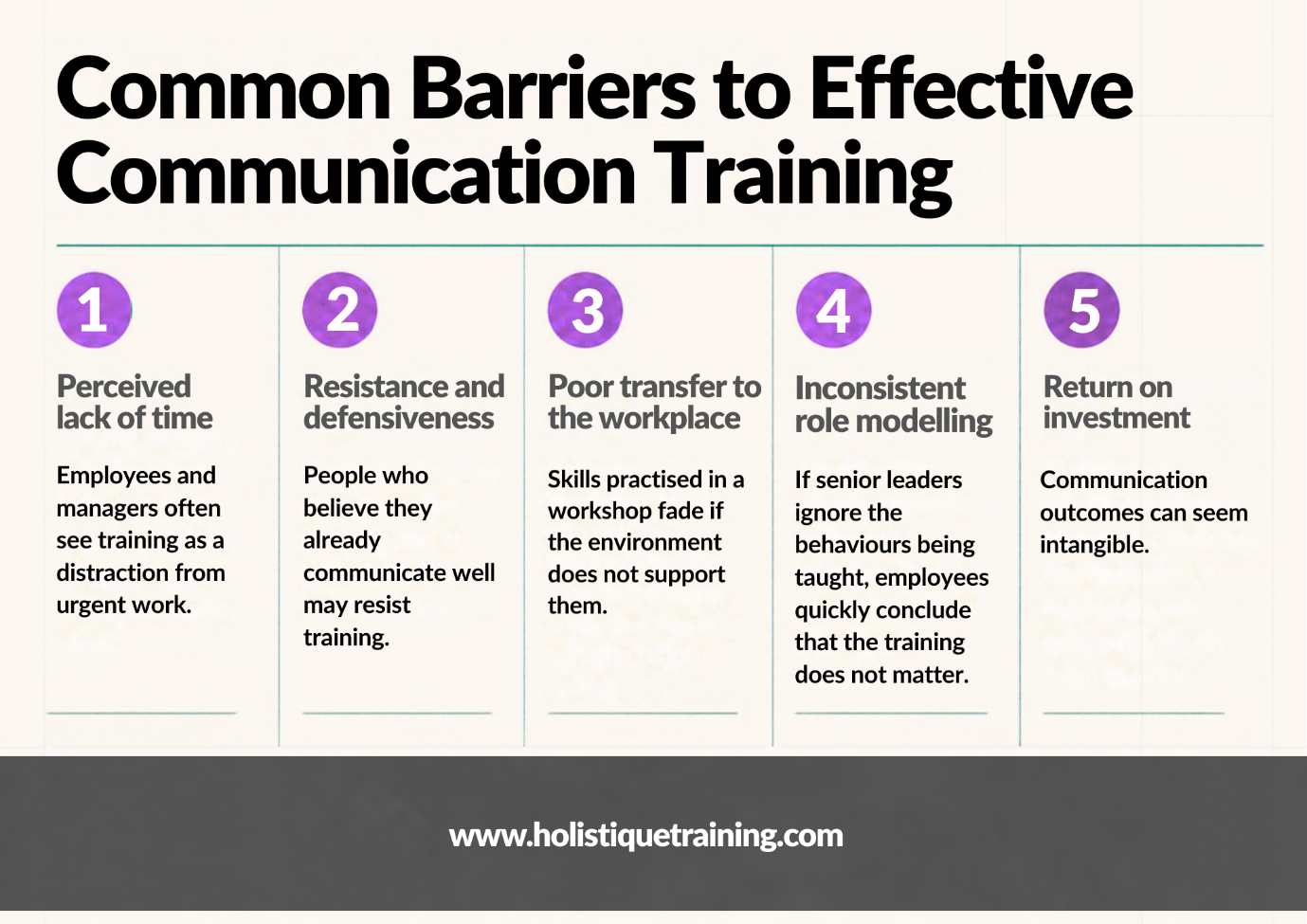
Even well-designed programmes encounter obstacles. Recognising them early helps HR and L&D teams plan around them.
1- Perceived lack of time:
Employees and managers often see training as a distraction from urgent work. Short formats, protected learning time and tasks tied to current projects make participation easier to justify.
2- Resistance and defensiveness:
People who believe they already communicate well may resist training. Starting with data from the needs analysis, and using real examples rather than criticism, helps participants recognise the value for themselves.
3- Poor transfer to the workplace:
Skills practised in a workshop fade if the environment does not support them. Manager reinforcement, follow-up exercises and peer accountability help bridge the gap between learning and behaviour.
4- Inconsistent role modelling:
If senior leaders ignore the behaviours being taught, employees quickly conclude that the training does not matter. Leadership participation is essential.
5- Difficulty demonstrating return on investment:
Communication outcomes can seem intangible. Defining indicators before the programme begins, rather than afterwards, makes measurement credible.
11- Measuring the Effectiveness of Communication Training
Measurement turns communication training from a cost into a demonstrable investment. The Kirkpatrick model, widely used in learning and development, offers a practical structure by evaluating training at four levels, from immediate reaction to organisational results.
Level | What It Measures | Example Communication Indicator |
|---|---|---|
1 - Reaction | Participant satisfaction and perceived relevance | Post-session survey on the usefulness of techniques |
2 - Learning | Knowledge and skill gained | Role-play assessment scored against a rubric |
3 - Behaviour | Change in on-the-job conduct | Manager observation and 360-degree feedback |
4 - Results | Impact on organisational outcomes | Reduced rework, fewer grievances, higher engagement scores |
Baseline data collected during the needs analysis should be compared with results three to six months after the programme. Because many factors influence performance, evaluation is most credible when it combines quantitative indicators with qualitative evidence, such as manager testimonies and examples of improved outcomes. Reporting findings to leadership also sustains support and informs how future programmes are refined.
It is also worth gathering evidence from outside the training team. Line managers can report whether meetings are shorter and decisions clearer, while HR can track whether conflict escalations, exit-interview comments on communication and internal survey scores move in the right direction. Short pulse surveys repeated each quarter provide an early warning if skills are fading and show where refresher sessions are needed.
12- Future Trends in Communication Training
Communication training is evolving as technology and working patterns change. Three developments deserve attention from HR and L&D professionals.
1- AI-supported practice and coaching:
Conversational simulations allow employees to rehearse difficult discussions privately, receive instant feedback on clarity and tone, and repeat scenarios until they feel confident. These tools extend practice beyond the classroom, although they work best alongside human facilitation.
2- Learning in the flow of work:
Short prompts, templates and guidance embedded in email, messaging and meeting tools deliver support at the moment of need, reinforcing skills when they are most likely to be applied.
3- Greater emphasis on human skills:
As automation takes on routine tasks, capabilities such as empathy, persuasion and judgement in conversation become more distinctive. Organisations are likely to place increasing weight on these skills in recruitment, development and promotion.
These trends do not remove the need for good design. Technology can widen access and personalise practice, but it cannot replace clear objectives, skilled facilitation and managerial reinforcement. The programmes that perform best will combine new tools with the proven principles of relevance, practice and feedback.
Conclusion
Communication training in the workplace is not a soft extra reserved for good times. It is a practical, measurable way of improving engagement, reducing errors, strengthening management and preparing organisations for hybrid, global and increasingly automated work. Its value comes from focus: a clear needs analysis, a small set of observable skills, realistic practice and consistent reinforcement from leaders.
The organisations that benefit most treat communication as a capability to be built continuously rather than a problem to be fixed once. They train managers first, blend delivery methods, measure results against baselines and keep refining content as channels and expectations change. For HR and L&D professionals, the opportunity is clear. In a labour market where adaptability and interpersonal skill are increasingly prized, investing in how people communicate is also an investment in how well the organisation learns, collaborates and retains talent. Better conversations lead to better decisions, stronger relationships and more resilient organisations.