
- Table of Contents
- Introduction
- 1- What Wealth Management Courses Actually Cover
- Core Technical Knowledge Areas
- Client-Facing and Advisory Skills
- 2- Why Wealth Management Training Has Become an L&D Priority
- 3- Types of Wealth Management Courses and Certifications
- 4- Matching Courses to Roles and Career Stages
- Junior and Graduate Advisors
- Experienced Relationship Managers
- Senior Private Bankers and Leadership
- 5- Course Delivery Formats: What Works for Distributed Teams
- 6- Core Skills a Good Wealth Management Programme Should Build
- 7- The Changing Client Base Driving New Training Needs
- 8- Regulatory and Cross-Border Considerations
- 9- Building a Blended Learning Pathway
- 10- Measuring the ROI of Wealth Management Training
- 11- Common Pitfalls When Sourcing Training for Teams
- 12- The Future of Wealth Management Learning
- Conclusion
Introduction
Wealth management has moved well beyond the traditional image of a single relationship manager quietly overseeing a portfolio. Today it spans investment advice, tax planning, estate structuring, philanthropy, digital platforms, and increasingly complex regulatory obligations across multiple jurisdictions. For organisations that employ or train advisors, planners, and client-facing staff, this complexity creates a genuine learning and development challenge: which courses actually build the right capabilities, which certifications carry weight with clients and regulators, and how a training budget should be allocated across graduate hires, experienced relationship managers, and senior leadership.
This article sets out the main categories of wealth management courses available internationally, how they differ, which roles they suit, and how L&D teams can build a coherent, cost-effective training pathway rather than a scattered list of one-off courses.
1- What Wealth Management Courses Actually Cover
Wealth management training is broader than investment theory alone. Most reputable programmes combine technical financial knowledge with the relationship and advisory skills that determine whether that knowledge is ever put to good use with a client.
Core Technical Knowledge Areas
The technical core of most courses includes asset allocation and portfolio construction, tax-efficient investing, retirement and pension planning, estate and succession planning, and increasingly, sustainable and impact investing. Some programmes also cover alternative assets such as private equity, private credit, and real assets, reflecting their growing share of client portfolios.
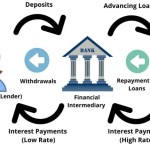
Banks and financial institutions play a major role in the development of modern society. It is important to understand the services banks provide, and how these can benefit personal and private clients. Financial intermediation has become a crucial factor within the banking industry.
Client-Facing and Advisory Skills
Technical knowledge alone rarely produces a trusted advisor. Strong courses also build skills in financial goal-setting conversations, risk profiling, behavioural coaching during volatile markets, and clear communication of complex products to non-specialist clients. For teams that serve multi-generational families, courses increasingly include modules on succession conversations and preparing heirs for future responsibility.
The strongest programmes also test whether learners can translate technical analysis into a conversation a client without a finance background can follow. A course that only assesses spreadsheet-based modelling, without ever asking a learner to explain that model in plain language, leaves a meaningful gap in day-to-day advisory capability. For this reason, many L&D teams now weight case-study assessments and role-play exercises as heavily as written exams when comparing course providers.
2- Why Wealth Management Training Has Become an L&D Priority
Several forces are pushing wealth management training higher up the corporate agenda. Client portfolios are growing in scale and complexity, regulatory scrutiny is increasing across most major markets, and competition for experienced advisors is intense enough that many firms now prefer to build capability internally rather than rely solely on external hiring.
Global assets under management in the wealth management sector are projected to reach 160.15 trillion US dollars in 2026, rising to 176.54 trillion US dollars by 2030, according to Statista's market forecast. That scale of growth means firms without a structured advisor training pipeline risk being unable to service the volume and complexity of assets under their care.
There is also a retention argument for internal training. Advisors who feel their employer is investing in their long-term development are generally less likely to leave for a competitor, and clients who have built a relationship with a specific advisor are less likely to move their assets when that advisor stays in place. For organisations competing on service quality rather than price alone, a visible commitment to structured training can become part of the value proposition offered to prospective clients, not simply an internal HR matter.
3- Types of Wealth Management Courses and Certifications
Course options generally fall into three groups: professional certifications with formal examinations, university or business school programmes, and shorter provider-led courses aimed at specific skills or products. Choosing between them depends on the seniority of the learner, the regulatory environment they operate in, and how quickly the organisation needs the capability in place.
1- Chartered Financial Analyst (CFA) Programme. A rigorous, multi-level qualification covering investment analysis, portfolio management, and ethics, widely recognised across asset and wealth management globally.
2- Certified Financial Planner (CFP) Certification. Focused on holistic personal financial planning, including retirement, tax, and estate matters, commonly required for client-facing planning roles.
3- CISI Wealth and Investment Management Qualifications. A UK-originated but internationally recognised pathway covering investment products, regulation, and client relationship management.
4- Chartered Alternative Investment Analyst (CAIA) Designation. Specialised in alternative assets such as hedge funds, private equity, and real assets, useful for teams advising higher-net-worth clients.
5- Short Corporate Courses on ESG and Sustainable Wealth Management. Increasingly requested by clients who want portfolios aligned with sustainability goals, these shorter courses update existing advisors rather than replacing core certifications.
Certification | Typical Audience | Duration | Primary Focus |
CFA Programme | Analysts, portfolio managers | 2-4 years | Investment analysis and portfolio management |
CFP Certification | Financial planners | 6-18 months | Holistic personal financial planning |
CISI Wealth Pathway | Wealth managers, advisors | 6-12 months | Products, regulation, client relationships |
CAIA Designation | Alternative asset specialists | 12-18 months | Alternative and private market assets |
The Chartered Financial Analyst (CFA) Certification training course is a comprehensive programme designed to prepare finance professionals for the prestigious CFA credential, a globally recognised qualification in investment management and financial analysis. The CFA designation is highly respected in the financial industry and
4- Matching Courses to Roles and Career Stages
Not every course suits every employee, and one of the most common mistakes L&D teams make is applying the same training pathway regardless of seniority or role.
Junior and Graduate Advisors
Early-career staff generally benefit most from foundational qualifications such as CISI entry-level pathways or CFP groundwork, combined with structured mentoring. These programmes build the technical vocabulary and regulatory awareness needed before staff take on direct client responsibility.
Experienced Relationship Managers
Mid-career advisors typically need targeted skill updates rather than full requalification. Courses on alternative assets, cross-border tax considerations, or client communication during market volatility tend to deliver the most immediate return for this group.
Senior Private Bankers and Leadership
At senior levels, training shifts towards strategic topics such as family governance, succession planning for ultra-high-net-worth clients, and leading advisory teams through periods of significant organisational or market change.
Treating these three groups as a single training population is one of the most common ways L&D budgets are wasted. A generic course purchased in bulk may satisfy a compliance checkbox for everyone, but it rarely builds the specific capability each group actually needs at that stage of their career.
5- Course Delivery Formats: What Works for Distributed Teams
Wealth management teams are often spread across regions and time zones, which makes delivery format as important as course content when planning training at scale.
Format | Best Suited For | Key Trade-Off |
In-person intensive | Senior leadership, small cohorts | High cost, strong networking value |
Fully online self-paced | Distributed global teams | Flexible but requires self-discipline |
Blended (online plus live sessions) | Most mid-size advisory teams | Balances cost and engagement |
Corporate bootcamp | New hire cohorts | Fast onboarding, resource-intensive to run |
Time zone spread is often underestimated when firms select a format. A live session scheduled conveniently for a European head office may fall in the middle of the night for colleagues in Asia-Pacific markets, quietly reducing attendance and engagement without this becoming obvious in completion statistics. Recording live sessions and rotating scheduling across regions are simple adjustments that meaningfully improve equity of access across a global advisory team.
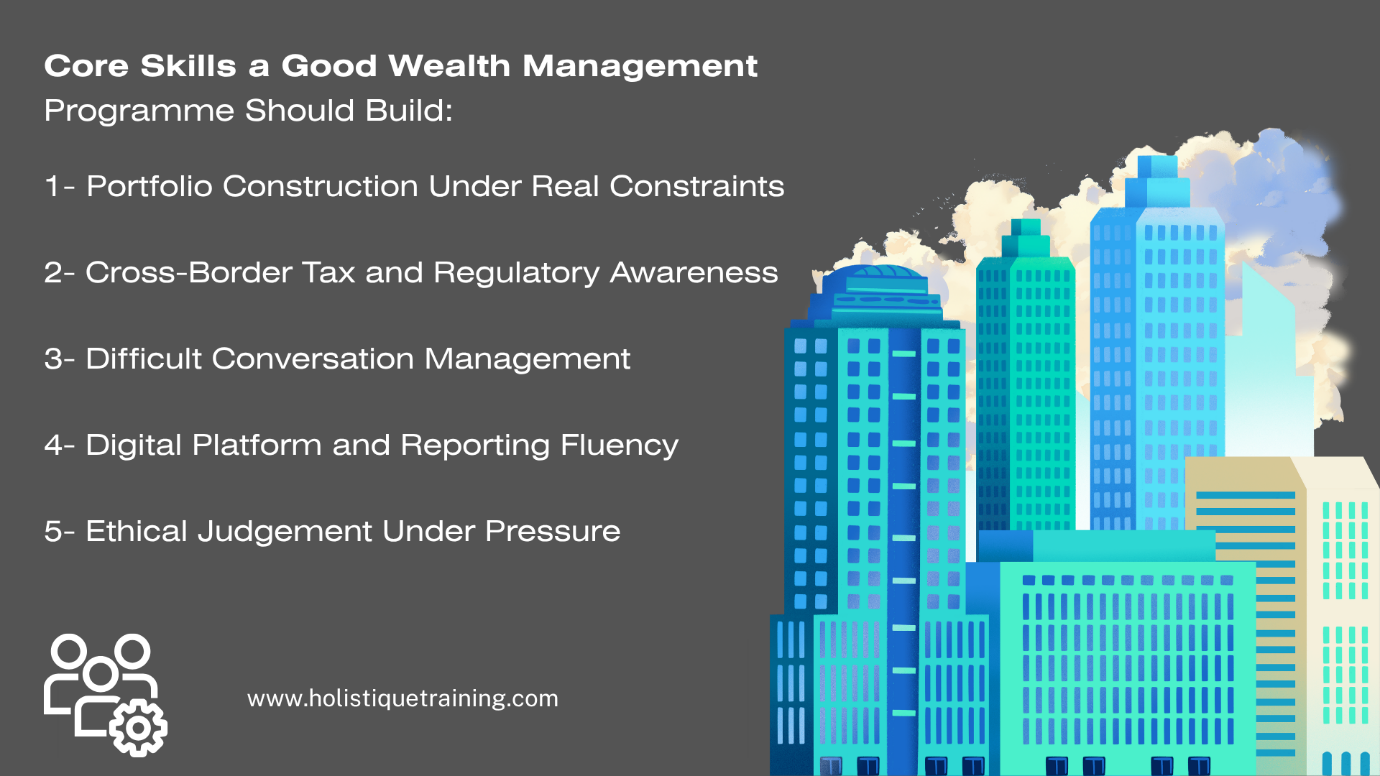
6- Core Skills a Good Wealth Management Programme Should Build
Beyond the certification title on a certificate, L&D teams should assess whether a course genuinely builds the following practical capabilities.
1- Portfolio Construction Under Real Constraints. The ability to build diversified portfolios that reflect a client's actual liquidity needs, tax position, and risk tolerance, not just theoretical models.
2- Cross-Border Tax and Regulatory Awareness. Increasingly essential as clients hold assets, residency, or family members across multiple jurisdictions.
3- Difficult Conversation Management. Preparing advisors to discuss underperformance, family disagreements over inheritance, or reduced risk appetite during market stress.
4- Digital Platform and Reporting Fluency. Comfort using the client portals, reporting tools, and data dashboards that increasingly shape how advice is delivered and reviewed.
5- Ethical Judgement Under Pressure. Recognising conflicts of interest and maintaining fiduciary standards even where commercial incentives might suggest otherwise.

Learn how investment strategies can help you achieve financial success. Explore the top 7 types of strategies, find the best fit for your goals, and understand the key components that form a robust investment approach.
7- The Changing Client Base Driving New Training Needs
Training priorities are evolving not only because financial products and regulations are becoming more complex, but because the people receiving wealth management services are changing rapidly. One of the most significant developments is the unprecedented intergenerational transfer of wealth currently underway. According to Cerulli Associates, approximately US$124 trillion is expected to transfer between generations in the United States through 2048, with most of those assets moving from baby boomers and older generations to heirs, spouses, and charitable organisations. This represents one of the largest shifts in private wealth ever recorded and will fundamentally reshape the client profiles that advisors serve.
For wealth management firms, this means many long-standing client relationships will transition to younger beneficiaries whose financial priorities, communication preferences, and expectations often differ substantially from those of the original wealth creators. Advisors who have built their careers serving one generation may increasingly find themselves working with clients who expect more frequent digital communication, greater transparency around investment decisions, and broader discussions about sustainability, social impact, or alternative investments. Preparing advisors for these conversations requires more than technical expertise—it requires training in behavioural finance, intergenerational communication, relationship management, and succession planning.
Another major trend is the growing financial influence of women. As wealth transfers accelerate and female entrepreneurship and workforce participation continue to increase, women are expected to control a substantially larger proportion of global investable assets. Research published by CFA Institute suggests that this shift is accompanied by changing expectations around advisor relationships. Rather than seeking simplified advice, many female investors place greater emphasis on collaborative decision-making, transparent portfolio explanations, holistic financial planning, and long-term trust. Advisors therefore need the communication skills to explain investment strategies clearly while building relationships that recognise individual goals and values rather than relying on outdated assumptions about investor preferences.
Demographic changes are also increasing the diversity of wealth management clients more broadly. Younger high-net-worth individuals often have internationally mobile careers, more complex digital assets, greater interest in environmental and social investing, and different attitudes towards inheritance and philanthropy. Families are also becoming more geographically dispersed, creating additional complexity around taxation, estate planning, and cross-border wealth management. As client needs become more varied, training programmes that reflect these evolving realities rather than assuming continuity with a firm's traditional client base are becoming an important competitive differentiator.
8- Regulatory and Cross-Border Considerations
Global wealth management firms face an increasingly complex training landscape because regulatory requirements differ significantly between jurisdictions. While investment principles may be broadly transferable, licensing rules, professional standards, disclosure obligations, and compliance expectations are often determined at the national or regional level. A qualification that fully satisfies regulatory requirements in one country may not automatically be recognised elsewhere, or it may require supplementary examinations, local compliance modules, or continuing professional development before advisors are authorised to provide regulated advice.
This creates an important responsibility for Learning and Development teams operating across multiple offices. Rather than assuming that one globally recognised certification will satisfy every location, organisations should map training programmes against the specific regulatory frameworks governing each market in which advisors operate. This becomes particularly important for firms expanding internationally, establishing regional offices, or supporting advisors who regularly work with internationally mobile clients. In many cases, local regulatory training must complement—not replace—broader professional wealth management qualifications.
Cross-border advisory work introduces further complexity beyond licensing alone. Advisors may need working knowledge of multiple tax regimes, international estate planning considerations, anti-money laundering (AML) obligations, sanctions compliance, client suitability rules, and differing investor protection requirements. Even where formal licensing is not required, misunderstanding local regulations can expose both advisors and firms to significant legal and reputational risks. Training therefore increasingly extends beyond technical investment knowledge to include jurisdiction-specific compliance, ethical decision-making, and practical case studies based on international client scenarios.
It is equally important to distinguish between the academic quality of a qualification and its regulatory recognition. A programme may offer excellent technical education, experienced instructors, and highly relevant case studies while still not satisfying a regulator's licensing requirements. Conversely, a mandatory regulatory qualification may fulfil legal obligations without providing the broader advisory skills needed to serve sophisticated clients effectively. Learning and Development teams should therefore evaluate both dimensions independently. Whenever advisors will be licensed to provide advice across multiple jurisdictions, regulatory recognition should be confirmed directly with the relevant professional body or regulator rather than relying solely on marketing materials produced by training providers.
9- Building a Blended Learning Pathway
Rather than viewing certifications, technical courses, and professional development programmes as isolated training decisions, many organisations are adopting structured learning pathways that support advisors throughout their careers. This approach recognises that the knowledge and skills required by a graduate entering wealth management differ significantly from those needed by experienced advisors managing complex portfolios or senior leaders overseeing advisory teams. Sequencing training in a logical progression allows organisations to build expertise gradually while reinforcing previous learning.
Career Stage | Recommended Focus | Example Course Type |
Graduate or entry-level | Foundational knowledge and regulation | CISI entry pathway, CFP groundwork |
Established advisor | Specialisation and client complexity | CAIA modules, cross-border tax courses |
Senior or leadership | Strategy, governance, team leadership | Family governance, succession planning courses |
A blended learning pathway typically combines formal certifications with shorter specialist courses, mentoring, coaching, digital learning modules, practical workshops, and supervised client experience. This variety allows advisors to strengthen technical knowledge while simultaneously developing communication, negotiation, leadership, and relationship management skills that cannot easily be acquired through examination-based qualifications alone. Continuous learning also enables advisors to respond more effectively as regulations, financial products, and client expectations evolve.
Structured pathways benefit organisations as well as individual employees. Employees who can clearly see how each learning milestone contributes to future career progression are generally more motivated to engage with training, particularly when certifications require significant time commitments. Clear progression frameworks also improve talent retention by demonstrating long-term investment in employee development. Instead of viewing training as a compliance requirement, advisors are more likely to perceive it as a meaningful step towards promotion, increased responsibility, or specialist expertise.
For Learning and Development teams, pathway-based training also supports succession planning. Organisations gain greater visibility over future leadership pipelines, specialist capabilities, and emerging skill gaps, allowing training investments to align more closely with long-term business strategy rather than reacting solely to immediate regulatory requirements.
10. Measuring the ROI of Wealth Management Training
Look Beyond Completion Rates
Professional certifications and specialist training programmes often represent substantial investments in both direct costs and employee time. Measuring their effectiveness therefore requires organisations to evaluate business outcomes rather than relying solely on course completion statistics or examination pass rates. While these metrics indicate participation, they provide limited evidence of whether learning has translated into improved advisor performance or stronger client outcomes.
A more comprehensive evaluation framework should incorporate operational and commercial indicators alongside learning metrics. These may include client retention rates among advisors who completed specific training programmes, changes in assets under management, growth in new client acquisition, cross-selling of appropriate financial products, internal promotion rates, and employee retention. Comparing these indicators against similar advisors who have not yet completed the same training can help organisations better understand the practical value generated by particular programmes.
Measure Client Impact
Client-focused measures are equally valuable. Improvements in client satisfaction scores, trust surveys, referral rates, complaint volumes, or net promoter scores can provide meaningful evidence that advisors are applying newly acquired skills in real client interactions. Where data systems allow, organisations can link training completion records with client outcomes to identify which programmes consistently deliver measurable improvements in service quality and long-term relationship management.
Use Early Feedback Loops
Evaluation should also occur much earlier than annual business reviews. Waiting twelve months for changes in revenue or assets under management may delay recognition that a training programme is failing to deliver value. Instead, Learning and Development teams can introduce shorter feedback cycles by observing supervised client meetings, conducting role-play assessments, gathering manager evaluations, and collecting participant feedback within weeks of course completion. These early indicators allow organisations to refine provider selection, course content, and delivery methods before additional cohorts begin training.
Ultimately, measuring return on investment should focus on behavioural change rather than credentials alone. The objective is not simply to produce more certified advisors, but to develop professionals who communicate more effectively, build stronger client relationships, manage increasingly complex financial situations with confidence, and contribute directly to long-term business performance.
11. Common Pitfalls When Sourcing Training for Teams
Prioritising Reputation Over Relevance
One of the most common mistakes organisations make is selecting courses primarily because of brand recognition or industry reputation rather than assessing whether the content aligns with the firm's regulatory environment, client demographics, and strategic objectives. A prestigious qualification may carry considerable professional credibility while offering relatively limited practical value for advisors working within a highly specialised market or regulatory framework.
Failing to Allocate Time for Learning
Another frequent challenge is underestimating the time commitment required for successful completion. Long professional certifications demand sustained study alongside demanding client responsibilities. Without realistic workload planning, protected study time, or managerial support, employees often struggle to complete programmes, leading to lower completion rates, unnecessary costs, and reduced enthusiasm for future learning initiatives. Organisations that formally allocate study time and recognise learning as part of normal working responsibilities generally achieve stronger outcomes.
Focusing Too Heavily on Technical Skills
Firms may also place disproportionate emphasis on technical expertise while overlooking the interpersonal skills that ultimately shape the client experience. Investment knowledge is essential, but successful wealth management increasingly depends upon active listening, emotional intelligence, behavioural coaching, conflict resolution, and the ability to explain complex financial concepts in accessible language. Technical competence alone does not guarantee that clients feel understood, confident, or willing to maintain long-term advisory relationships.
Neglecting Continuous Course Evaluation
Another overlooked issue is failing to update training programmes as markets evolve. Wealth management is influenced by continuous changes in regulation, taxation, technology, financial products, sustainability reporting, and digital investment platforms. Training content that was highly relevant only a few years ago may no longer fully prepare advisors for current client needs. Regular reviews of provider content, curriculum updates, and emerging industry trends help ensure that learning investments remain relevant over time.
Organisations should also evaluate providers beyond the point of purchase. Establishing clear success measures—including learner satisfaction, knowledge retention, behavioural change, and business outcomes—enables Learning and Development teams to make more informed decisions about renewing, adapting, or replacing training programmes.
12. The Future of Wealth Management Learning
Continuous Learning Will Replace One-Off Training
Wealth management education is likely to continue evolving as financial markets, technology, regulation, and client expectations become increasingly interconnected. Rather than relying exclusively on lengthy professional qualifications completed early in an advisor's career, many organisations are adopting continuous learning models that combine foundational certifications with shorter, regularly updated learning modules. This approach enables advisors to respond more quickly to changing legislation, emerging investment products, evolving tax rules, and new client priorities without repeatedly undertaking lengthy qualification programmes.
Artificial Intelligence Will Become a Core Training Topic
Technology is expected to play an increasingly important role in both advisory practice and professional development. Artificial intelligence is already supporting activities such as portfolio analysis, client segmentation, document preparation, compliance monitoring, and research. As these tools become more widely integrated into advisory workflows, training will increasingly focus on helping advisors use AI responsibly, critically evaluate automated outputs, recognise potential biases, protect sensitive client information, and explain AI-assisted recommendations in clear, understandable language. Human judgement, ethical reasoning, and transparent communication will remain central even as technology becomes more sophisticated.
Specialist Knowledge Will Continue to Expand
The growing complexity of client needs will also continue to reshape learning priorities. Advisors are increasingly expected to understand sustainable investing, private markets, digital assets, international taxation, family governance, behavioural finance, philanthropic planning, and cross-generational wealth transfer. Few professionals can develop deep expertise across all these areas through a single qualification, reinforcing the importance of ongoing specialist education throughout an advisor's career.
More Flexible Learning Models
Learning delivery methods are becoming increasingly flexible through digital platforms, microlearning, virtual simulations, adaptive learning technologies, peer communities, and blended classroom models. These approaches allow advisors to fit professional development around demanding client schedules while providing more personalised learning experiences. Many organisations are also incorporating coaching, mentoring, and collaborative learning into formal training pathways to reinforce practical application beyond examination success.
Ultimately, the most successful Learning and Development strategies will treat wealth management education as a continuous process rather than a one-time certification exercise. Firms that invest in ongoing development will be better positioned to help advisors adapt to changing regulations, increasingly sophisticated clients, advancing technology, and evolving business priorities.
Conclusion
Choosing the right courses for a wealth management team is rarely a single decision. It requires matching certification type to role and seniority, considering delivery format against a distributed workforce, and building a pathway that evolves as both client expectations and regulation change. Organisations that treat wealth management training as a structured, ongoing investment, rather than a box-ticking exercise tied to a single certification, are best positioned to retain client trust as the industry continues to grow and diversify.

Within the world of finance, there are many methods one could utilise to increase their wealth. Investing may be the ideal solution for those who desire to generate an income passively. Despite the passive element, investing is a complex process that requires great competency to