
- Table of Contents
- Introduction
- 1- What Is Environmental Health and Safety?
- Environmental Management
- Occupational Health and Safety
- Where the Two Disciplines Meet
- 2- Why Environmental Health and Safety Matters
- Protecting People and Communities
- Protecting the Business
- Supporting Sustainability Goals
- 3- Core Components of an EHS Programme
- 4- Common Hazards in the Workplace and the Environment
- 5- Environmental Management Systems and ISO 14001
- Why Certification Is Worth Considering
- 6- Occupational Health, ISO 45001 and Psychosocial Risk
- Managing Psychosocial Risk in Practice
- 7- Risk Assessment and the Hierarchy of Controls
- 8- Emergency Preparedness and Incident Investigation
- Investigating Incidents and Near Misses
- Reporting and Learning
- 9- Legal Compliance and Regulatory Frameworks
- Permits, Licences and Reporting Duties
- Contractors and Supply Chains
- 10- Building a Strong EHS Culture
- 11- Training, Competence and Career Development
- Building a Training Plan
- Professional Qualifications
- 12- Technology and Data in EHS
- 13- Measuring EHS Performance
- 14- Future Trends in Environmental Health and Safety
- 15- Conclusion
Introduction
Environmental health and safety, usually shortened to EHS, is the discipline that protects people, communities and ecosystems from the harm that business activity can cause. It brings together three connected concerns: the health of the natural environment, the health of workers and neighbouring communities, and the physical safety of the places where work happens. For organisations of every size, EHS has moved from a technical compliance task to a core part of risk management, reputation and long-term resilience.
Regulators, investors, insurers and employees now expect clear evidence that hazards are identified, controlled and reviewed. A single incident, whether a chemical spill, a fatal fall or a breach of an emissions permit, can lead to prosecutions, lost contracts and lasting damage to trust. At the same time, organisations that manage environmental health and safety well tend to see fewer disruptions, lower insurance and waste costs, and a more engaged workforce.
This article is written for health and safety officers and explains what environmental health and safety means, why it matters, and how its main components fit together. It covers the core elements of an EHS programme, workplace and environmental hazards, environmental management systems and ISO 14001, occupational health and psychosocial risk, the hierarchy of controls, emergency response, legal compliance, safety culture, training, technology, performance measurement and the trends likely to shape the field.
1- What Is Environmental Health and Safety?
Environmental health and safety is a multidisciplinary field that aims to prevent injury, illness and environmental damage arising from work activities. Organisations often group the three strands in one function because the underlying methods are shared: identify what could cause harm, assess how likely and severe it is, put controls in place, and check that those controls work. The term EHS is used interchangeably with HSE and SHE in many regions, and the practical differences are mostly a matter of emphasis.
Environmental Management
Environmental management focuses on how operations affect air, water, soil, energy, waste and biodiversity. Typical concerns include emissions to air, wastewater discharge, hazardous waste handling, resource consumption and the control of spills.
Occupational Health and Safety
Occupational health and safety focuses on the people doing the work. It addresses accidents and injuries, exposure to hazardous substances, noise, ergonomics, fatigue and the mental health effects of how work is organised.
Where the Two Disciplines Meet
The two strands overlap constantly. A chemical storage area is both a worker exposure risk and a potential source of land and water contamination. A dust control system protects lungs inside the building and air quality outside it. Treating these risks together helps officers avoid fixing one problem while creating another. The table below compares the three main areas of focus.
Aspect | Environmental Management | Occupational Safety | Occupational Health |
|---|---|---|---|
Main concern | Impact of operations on air, water, soil and ecosystems | Prevention of accidents and injuries at work | Prevention of illness caused by work exposures |
Typical hazards | Emissions, spills, waste and resource use | Machinery, falls, fire and electricity | Dust, noise, chemicals and stress |
Common controls | Permits, monitoring, waste segregation and containment | Guarding, permits to work and inspections | Exposure monitoring, health surveillance and ergonomics |
Key standard | ISO 14001 | ISO 45001 | ISO 45001 |
2- Why Environmental Health and Safety Matters
The case for EHS rests on human, legal and financial grounds. The environment people live and work in is one of the strongest influences on their health, and workplaces are one of the main places where environmental hazards turn into personal harm. Poor air quality, contaminated water, unsafe chemicals and unmanaged waste do not stay inside a site boundary, and neither do their consequences.
According to the World Health Organization's World Health Statistics 2026 report, air pollution contributed to 6.6 million deaths worldwide in 2021, while inadequate water, sanitation and hygiene caused a further 1.4 million deaths in 2019. These figures show why environmental health and safety is treated as a public health priority and not only a site-level concern.
Protecting People and Communities
Workers are usually the first to be exposed to hazards, but neighbours, contractors, visitors and customers can be affected too. Good EHS practice therefore extends beyond the fence line, considering dust, odour, noise, traffic and the risk of off-site releases.
Protecting the Business
Incidents interrupt production, trigger investigations and raise insurance premiums. Strong environmental health and safety performance also supports tenders, financing and supply chain approval, because customers and lenders increasingly ask for evidence of control. Organisations that reduce waste, energy use and accidents often discover that EHS investment pays for itself through lower operating costs.
Supporting Sustainability Goals
Many organisations now set targets for emissions, waste and water use. EHS teams supply the monitoring, controls and records that make those targets credible, which is why environmental health and safety increasingly sits alongside sustainability reporting.
3- Core Components of an EHS Programme
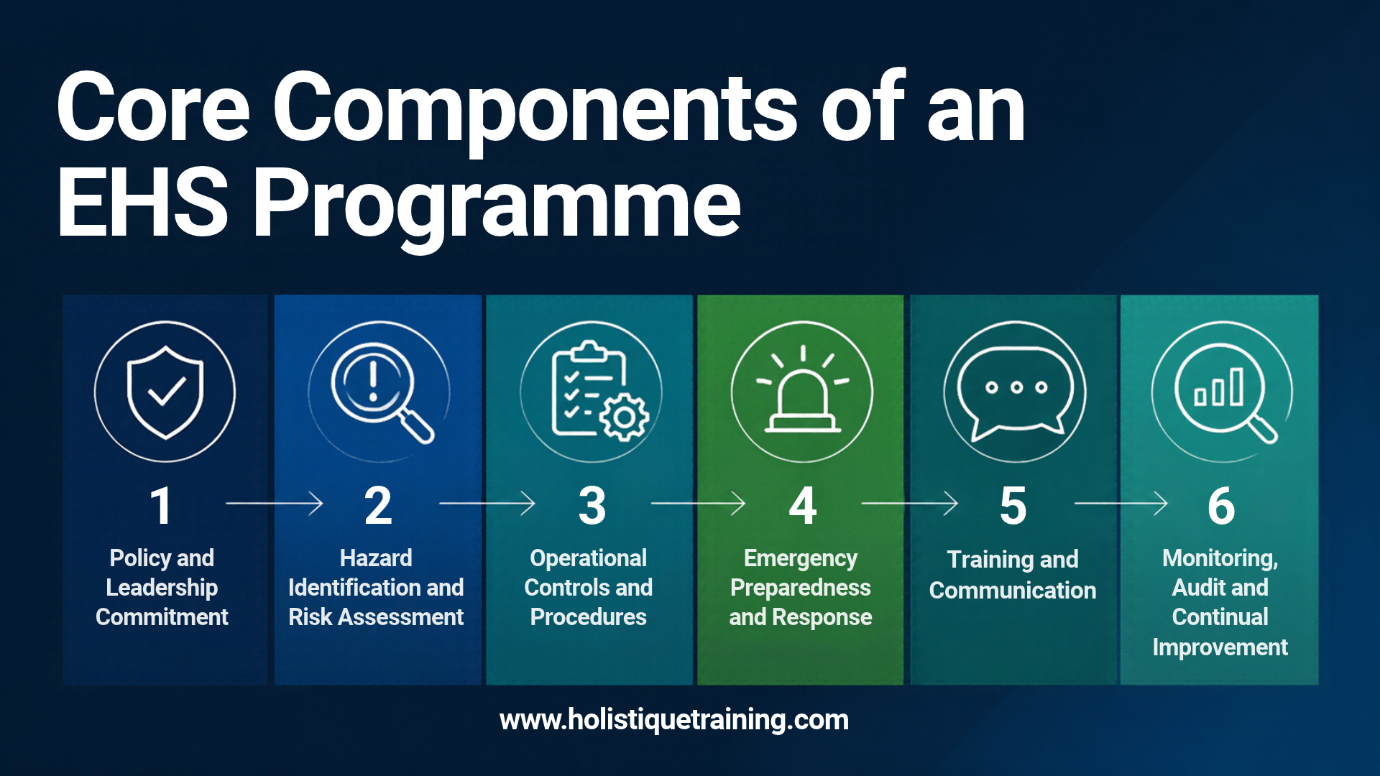
An effective environmental health and safety programme is more than a folder of policies. It is a set of connected activities that are planned, resourced and reviewed. Although the detail varies by sector, most mature programmes include the following six components.
Policy and leadership commitment:
A clear policy, signed by senior leaders, sets expectations and shows that EHS has authority and budget. Without visible commitment, procedures are often treated as optional.
Hazard identification and risk assessment:
Systematic review of tasks, substances, equipment and environmental aspects finds what could cause harm and ranks risks by severity and likelihood.
Operational controls and procedures:
Written methods, permits to work, inspection routines and maintenance schedules keep identified risks under control during normal and abnormal conditions.
Emergency preparedness and response:
Plans, drills and equipment for fires, spills, medical emergencies and extreme weather include links with local emergency services.
Training and communication:
Induction, job-specific training and regular refreshers are supported by toolbox talks, signage and two-way reporting channels.
Monitoring, audit and continual improvement:
Inspections, incident investigations, internal audits and management reviews feed corrective actions back into the system.
These components follow the plan, do, check, act cycle used by international management system standards, which is why they integrate easily into existing quality and risk processes.

Health, Safety, Security, and Environment (HSSE) guidelines and actions are taken to establish and maintain safe and secure working conditions. HSSE reduces the risk of injury and illness, lowers insurance premiums, and enhances employee morale. This course provides an overview of
4- Common Hazards in the Workplace and the Environment
Hazard identification is the starting point for every control measure. Hazards in an EHS context fall into several families, and most sites face a combination of them. The following examples show how each family appears in practice.
Chemical hazards:
Solvents, acids, fuels, pesticides and process chemicals can cause burns, poisoning, respiratory disease and long-term illness, and spills can contaminate soil and watercourses. Safety data sheets, labelling, ventilation and secure storage are the basic controls.
Physical hazards:
Noise, vibration, heat, radiation, slips, falls from height, moving machinery and electrical faults remain leading causes of serious injury across construction, manufacturing and logistics.
Biological hazards:
Bacteria, viruses, mould and animal-borne diseases affect healthcare, agriculture, waste management and food production, and poor ventilation can raise exposure even in ordinary offices.
Ergonomic hazards:
Repetitive tasks, awkward postures and manual handling cause musculoskeletal disorders, which are a major source of absence and long-term disability.
Environmental hazards:
Air emissions, wastewater, hazardous waste, noise nuisance and the effects of extreme weather can harm neighbouring communities and trigger regulatory action.
Psychosocial hazards:
Excessive workload, long hours, harassment and job insecurity affect mental and physical health, and are covered in more detail later in this article.
Hazards also change over time. A new material, a modified process, a change in staffing or a period of extreme weather can alter the risk profile quickly, so hazard registers should be reviewed whenever conditions change and at least once a year.
Hazard identification should combine walk-through inspections, task analysis, worker consultation and structured studies such as hazard identification workshops for larger projects. Involving the people who do the work is essential, because they often notice risks that desk-based reviews miss.

Learn how Hazard Identification Studies (HAZID) promote safety in projects and systems. Explore their benefits, when to conduct them, and the step-by-step process for comprehensive hazard identification.
5- Environmental Management Systems and ISO 14001
An environmental management system provides the framework an organisation uses to understand its environmental impacts, meet legal obligations and improve performance over time. ISO 14001 is the most widely recognised standard for this purpose, and it is built around identifying environmental aspects, setting objectives, operating controls, evaluating compliance and reviewing results at leadership level.
According to the International Organization for Standardization, a research project led by the Standards Council of Canada analysed data from 83 countries between 1999 and 2022 and found that a 1% increase in ISO 14001 certifications was associated with a 0.14% decrease in greenhouse gas emissions per unit of GDP. ISO also reports that more than 670,000 organisations worldwide use the standard, and that a new edition, ISO 14001:2026, was launched in April 2026 to reflect priorities such as climate change and biodiversity.

As organisations have started including environmental policies and addressing governmental regulations, environmental management systems (EMS) are crucial to improving energy efficiency and environmental sustainability. An environmental management system is the framework used to achieve your environmental goals to help your organisation cut costs, reduce risks,
Why Certification Is Worth Considering
Certification is not compulsory in most jurisdictions, yet it gives customers, regulators and investors independent assurance. Even organisations that never certify often use the standard as a benchmark. For health and safety officers, an environmental management system also helps because its documentation, audit and corrective action routines can be shared with occupational health and safety systems.
6- Occupational Health, ISO 45001 and Psychosocial Risk
Occupational health covers the prevention of work-related illness, not only injury. Dust, fumes, noise, vibration and chemicals can cause conditions that appear years after exposure, so health surveillance, exposure monitoring and fitness for work assessments are as important as machine guarding. ISO 45001 provides an international framework for occupational health and safety management systems, and it aligns closely with ISO 14001 through a common structure.
Mental health is now firmly part of this agenda. According to a 2026 report from the International Labour Organization, more than 840,000 deaths each year are linked to psychosocial risks at work, and the resulting loss of productivity is equal to about 1.37% of global GDP. The report also found that around 35% of workers exceed 48 working hours a week, a level associated with a higher risk of stroke and heart disease.
Managing Psychosocial Risk in Practice
Prevention works best when it addresses how work is designed and managed, not only how individuals cope with it. For EHS teams this means including workload, role clarity, working hours, harassment and leadership behaviour in risk assessments, and consulting workers on the findings.
7- Risk Assessment and the Hierarchy of Controls
Risk assessment is the backbone of environmental health and safety. It asks four practical questions: what can go wrong, who or what could be harmed, how likely and serious is the harm, and what should be done about it. Results are normally recorded in a risk register, ranked using a matrix of likelihood and severity, and reviewed whenever processes, materials or people change.
Once risks are ranked, the hierarchy of controls guides the choice of measures. It places the most reliable controls first and personal protective equipment last, because protective equipment depends on human behaviour and does not remove the hazard. The five levels are explained below.
- Elimination: Remove the hazard altogether, for example by designing out a hazardous process or avoiding work at height.
- Substitution: Replace the hazard with a safer alternative, such as a water-based cleaner instead of a solvent.
- Engineering controls: Isolate people or the environment from the hazard using guarding, local exhaust ventilation, bunding or noise enclosures.
- Administrative controls: Change the way work is organised through procedures, permits, job rotation, signage and training.
- Personal protective equipment: Provide gloves, respirators, hearing protection or harnesses as a final layer, with fit testing and maintenance.
The table below compares the five levels, showing why officers should always look higher up the hierarchy before relying on equipment or instructions.
Control Level | Reliability | Dependence on Behaviour | Typical Cost Profile |
|---|---|---|---|
Elimination | Very high | Very low | Often low if designed in early |
Substitution | High | Low | Moderate, depends on the alternative |
Engineering controls | High | Low to moderate | Higher upfront, lower ongoing |
Administrative controls | Moderate | High | Low upfront, ongoing effort |
Personal protective equipment | Lowest | Very high | Low upfront, recurring replacement |
Risk assessments should be proportionate to the hazard. A simple office task may need a short checklist, while a chemical process or a major construction project needs a detailed, documented assessment prepared by competent people and reviewed by those who will carry out the work.
8- Emergency Preparedness and Incident Investigation
Even well-run sites experience incidents, near misses and emergencies, and how an organisation responds determines how much harm follows. Emergency preparedness begins with identifying credible scenarios, such as fires, chemical releases, structural failures, severe weather and medical emergencies, and then agreeing roles, equipment, communication routes and evacuation arrangements for each one. Drills should be realistic, observed and followed by a debrief so that weaknesses are corrected.
Investigating Incidents and Near Misses
Investigations should focus on causes and not blame. A good investigation collects evidence quickly, interviews witnesses, maps the sequence of events and looks past the immediate failure to underlying factors such as design, supervision, workload, maintenance or unclear procedures. Corrective actions need owners and deadlines, and their completion should be verified.
Reporting and Learning
Serious incidents may need to be reported to regulators within fixed timescales, so officers should know the thresholds that apply to each site. Sharing lessons across sites and departments turns a single event into protection for the whole organisation.
9- Legal Compliance and Regulatory Frameworks
Legal requirements differ from one country to another, yet most systems share common principles. Employers must provide safe systems of work, assess risks, consult workers, report serious incidents and control emissions, discharges and waste in line with permits and licences. Many jurisdictions also require competent persons to oversee specific hazards such as asbestos, confined spaces, radiation or major accident sites.
Because many organisations operate under several legal regimes at once, a legal register is a practical tool. It lists each applicable law, permit and standard, who is responsible for compliance and when it is next reviewed. Health and safety officers should schedule regular legal updates, since regulations on chemicals, climate reporting and worker protection continue to evolve.
Permits, Licences and Reporting Duties
Environmental permits set limits on emissions, discharges and waste storage, and breaching them can lead to enforcement notices, fines and loss of the licence to operate. Officers should track renewal dates, monitoring requirements and reporting deadlines in a single calendar so that nothing lapses unnoticed.
Contractors and Supply Chains
Responsibility does not stop at direct employees. Contractors, temporary workers and suppliers can create risk on site or through their own operations, so selection criteria, induction, supervision and performance reviews should apply to them as well.
10- Building a Strong EHS Culture
Procedures only work when people follow them, and that depends on culture. A strong safety culture is one where leaders visibly prioritise safety, workers feel able to report concerns without blame, and near misses are treated as free lessons rather than embarrassments. Four practices consistently help organisations move in that direction.
- Visible leadership: Managers who attend safety walks, ask questions and act on findings show that EHS is part of running the business and not a separate function.
- Worker participation: Safety committees, representatives and regular consultation give employees a genuine voice in risk assessments and procedure design.
- Fair reporting: A just culture separates honest mistakes from reckless behaviour, so that people report hazards and near misses without fear.
- Recognition and learning: Celebrating good catches and sharing lessons learned reinforces the behaviours that prevent incidents.
Culture changes slowly, so it should be measured through surveys, observations and reporting rates, and reviewed alongside technical performance.
11- Training, Competence and Career Development
Competence is a legal expectation and a practical necessity. Every role needs a defined level of EHS knowledge, from site induction for new starters to advanced technical training for those who manage high-risk activities. Health and safety officers also need continuing professional development to keep pace with new standards, hazardous materials and digital tools.
Building a Training Plan
A training needs analysis compares the skills each role requires with those people currently hold. The resulting plan should include inductions, task-specific training, emergency drills, refreshers and assessment of understanding, with records kept for audits.
Professional Qualifications
Recognised certificates and diplomas in occupational health and safety, environmental management and auditing give officers credibility and a structured body of knowledge, and many employers now list them as requirements for EHS roles.
https://holistiquetraining.com/en/course/certificate-in-occupational-health-safety
12- Technology and Data in EHS
Digital tools are changing how environmental health and safety is managed. Mobile inspection apps, incident reporting platforms and permit-to-work software replace paper forms and make trends visible. Wearable sensors can detect heat stress, gas exposure or lone worker emergencies, while drones and remote cameras reduce the need for people to enter confined or elevated spaces.
Environmental monitoring has advanced in the same way. Continuous emissions monitors, smart meters and cloud dashboards give near real-time data on energy, water and waste, helping organisations catch problems before they breach permits. Artificial intelligence is starting to analyse inspection photographs and incident narratives, although its outputs still need competent human review, and data protection rules apply to any system that tracks workers.
Technology should support sound judgement and not replace it. Before adopting a new platform, officers should define the problem it solves, test it with the people who will use it, and check that data can be exported for audits and management reviews.
13- Measuring EHS Performance
What gets measured gets managed, but only if the measures are meaningful. Counting injuries alone says little about how well risks are controlled, so mature organisations combine lagging indicators, which record what has already happened, with leading indicators, which show whether preventive activity is taking place.
Indicator Type | Examples | What It Tells You |
|---|---|---|
Lagging | Injury rate, lost time days, reportable spills and permit breaches | How often harm or non-compliance has already occurred |
Leading | Inspections completed, actions closed on time, training completed and near misses reported | Whether preventive activity is happening before harm occurs |
Environmental | Energy, water and waste per unit of output and emissions against permit limits | Whether environmental performance is improving over time |
Targets should be realistic, discussed with the people responsible, and reviewed in management meetings. Health and safety officers should also take care not to reward low reported injury numbers in ways that discourage honest reporting.
14- Future Trends in Environmental Health and Safety
Several trends are shaping the next decade of EHS work. Climate adaptation is bringing heat stress, flooding and wildfire smoke into routine risk assessments. Reporting expectations on emissions, waste and water are growing, so reliable data collection will matter more. Psychosocial risk, hybrid working and the use of artificial intelligence in management are expanding the scope of occupational health, and the updated ISO 14001 edition signals closer integration between environmental, climate and biodiversity management.
For health and safety officers the direction is clear: broader scope, more data and closer collaboration with sustainability, human resources and operations teams. Those who build both technical depth and communication skills will be best placed to lead.
15- Conclusion
Environmental health and safety brings together the protection of workers, communities and the natural environment under one disciplined approach. Its foundations are consistent: identify hazards, assess risks, apply the most reliable controls, prepare for emergencies, comply with the law and keep checking whether the system works. International standards such as ISO 14001 and ISO 45001 give organisations a proven structure, while data, technology and strong leadership make that structure effective day to day.
For health and safety officers, the opportunity is to move EHS from a checklist activity to a source of business value. That means widening risk assessments to include psychosocial and environmental factors, measuring leading indicators as well as incident numbers, investing in competence and building a culture in which people speak up. Organisations that do this protect lives and ecosystems while strengthening their own resilience.