
- Table of Contents
- Introduction
- 1- What Is Ethical Leadership?
- Defining Ethical Leadership
- Ethics, Compliance and the Law
- Where the Concept Comes From
- 2- Why Ethical Leadership Matters Now
- Trust as a Strategic Asset
- The Cost of Ethical Failure
- Rising Expectations from Every Stakeholder
- 3- The Core Principles of Ethical Leadership
- 1- Integrity:
- 2- Fairness:
- 3- Accountability:
- 4- Transparency:
- 5- Respect for people:
- 6- Responsibility to stakeholders:
- 4- Ethical Leadership Compared with Other Leadership Styles
- 5- How Ethical Leaders Shape Organisational Culture
- Setting the Tone from the Top
- The Pivotal Role of Line Managers
- Embedding Values in Systems
- 6- Ethical Decision-Making in Practice
- Why Capable People Make Poor Ethical Choices
- A Practical Framework for Difficult Decisions
- 7- Building a Speak-Up Culture
- Why Employees Stay Silent
- What Leaders Can Do
- 8- Ethical Leadership and Corporate Governance
- The Role of Boards and Senior Executives
- Ethics Committees and Independent Assurance
- Aligning Incentives with Values
- 9- Common Ethical Challenges Leaders Face
- 10- Ethical Leadership in Times of Crisis and Change
- 11- Barriers to Ethical Leadership and How to Develop Ethical Leaders
- Common Barriers
- Developing Ethical Leaders
- 12- Conclusion
Introduction
Leadership has never been judged on results alone, but the standard has risen sharply. Corporate scandals, data misuse, workplace harassment cases and high-profile governance failures have shown that how an organisation achieves its goals matters as much as the goals themselves. Investors, employees, regulators and customers now expect leaders to act with integrity, and they are increasingly willing to hold organisations to account when that integrity is missing. In this environment, ethical leadership has moved from the margins of corporate responsibility to the centre of strategy, risk management and talent retention.
Ethical leadership is not a matter of good intentions or polished values statements. It is a consistent pattern of behaviour in which leaders make fair, transparent and accountable decisions, and encourage the people around them to do the same. It shapes culture, protects reputation, reduces risk and, when practised well, strengthens performance. It is also demanding, because it requires leaders to resist short-term pressures, speak honestly about difficult trade-offs and accept scrutiny of their own conduct.
In this article, we will discuss what ethical leadership is, why it matters now, its core principles, how it differs from other leadership styles, its influence on organisational culture, ethical decision-making, speak-up cultures, governance, common ethical challenges, crisis leadership, the barriers leaders face, how to develop ethical leaders, and what organisations should take away from the evidence.
1- What Is Ethical Leadership?
Defining Ethical Leadership
Ethical leadership is the practice of guiding people and organisations in a way that reflects sound moral principles, both in the decisions leaders make and in the way they conduct themselves. It combines two dimensions. The first is the leader as a moral person, whose honesty, integrity and consideration for others are visible and consistent. The second is the leader as a moral manager, who actively promotes ethical conduct by setting standards, communicating expectations, rewarding good behaviour and addressing wrongdoing. A leader who is personally honest but passive about misconduct in the team is only half an ethical leader.
Ethics, Compliance and the Law
Ethical leadership goes beyond compliance. The law sets a minimum standard of acceptable conduct, while ethics asks what is right, fair and responsible in situations the law may not address. A decision can be legal and still damage trust, harm employees or exploit customers. Ethical leaders therefore ask two questions: whether an action is permitted, and whether it is the right thing to do. The distinction matters most where regulation lags behind practice, such as artificial intelligence, data analytics and complex global supply chains.
Where the Concept Comes From
The idea has deep roots in moral philosophy, including virtue ethics, which focuses on character, and duty-based and consequence-based traditions, which focus on obligations and outcomes. In management research it gained momentum in the early 2000s, when scholars defined ethical leadership as the demonstration of appropriate conduct through personal actions and relationships, and the promotion of that conduct among followers. Today the concept is embedded in corporate codes of conduct, governance codes and leadership competency frameworks across the world.
2- Why Ethical Leadership Matters Now
Trust as a Strategic Asset
Trust is the currency on which every commercial relationship depends. Customers choose brands they believe will treat them fairly, employees commit to employers they believe will keep their promises, and investors allocate capital to organisations they believe are well governed. According to the 2026 Edelman Trust Barometer, which surveyed nearly 34,000 people across 28 countries, business is the only institution that people globally see as both ethical and competent. The same research found that people's trust in their own chief executive rose by nine points, while trust in national government leaders fell by sixteen. For business leaders this is both an opportunity and a responsibility, because the trust placed in them is conditional on how they behave.
The Cost of Ethical Failure
Ethical lapses are expensive. Direct costs include fines, litigation, remediation and the loss of contracts, while indirect costs include falling morale, higher staff turnover, difficulty recruiting talent and long-term reputational damage. Organisations can take years to recover the trust lost in a single scandal, and leaders who presided over misconduct often lose their positions even when they did not personally break the rules. Ethical leadership is therefore a form of risk management as well as a statement of values.
Rising Expectations from Every Stakeholder
Expectations have risen across the board. Employees, particularly younger professionals, increasingly judge employers on their values as well as their pay. Regulators have introduced stronger rules on whistleblowing, anti-bribery, data protection and sustainability reporting. Investors apply environmental, social and governance criteria when allocating capital, and social media allows customers and staff to amplify concerns within hours. Leaders now operate in a climate of permanent visibility, in which conduct once treated as private or tolerable is exposed and judged.
3- The Core Principles of Ethical Leadership
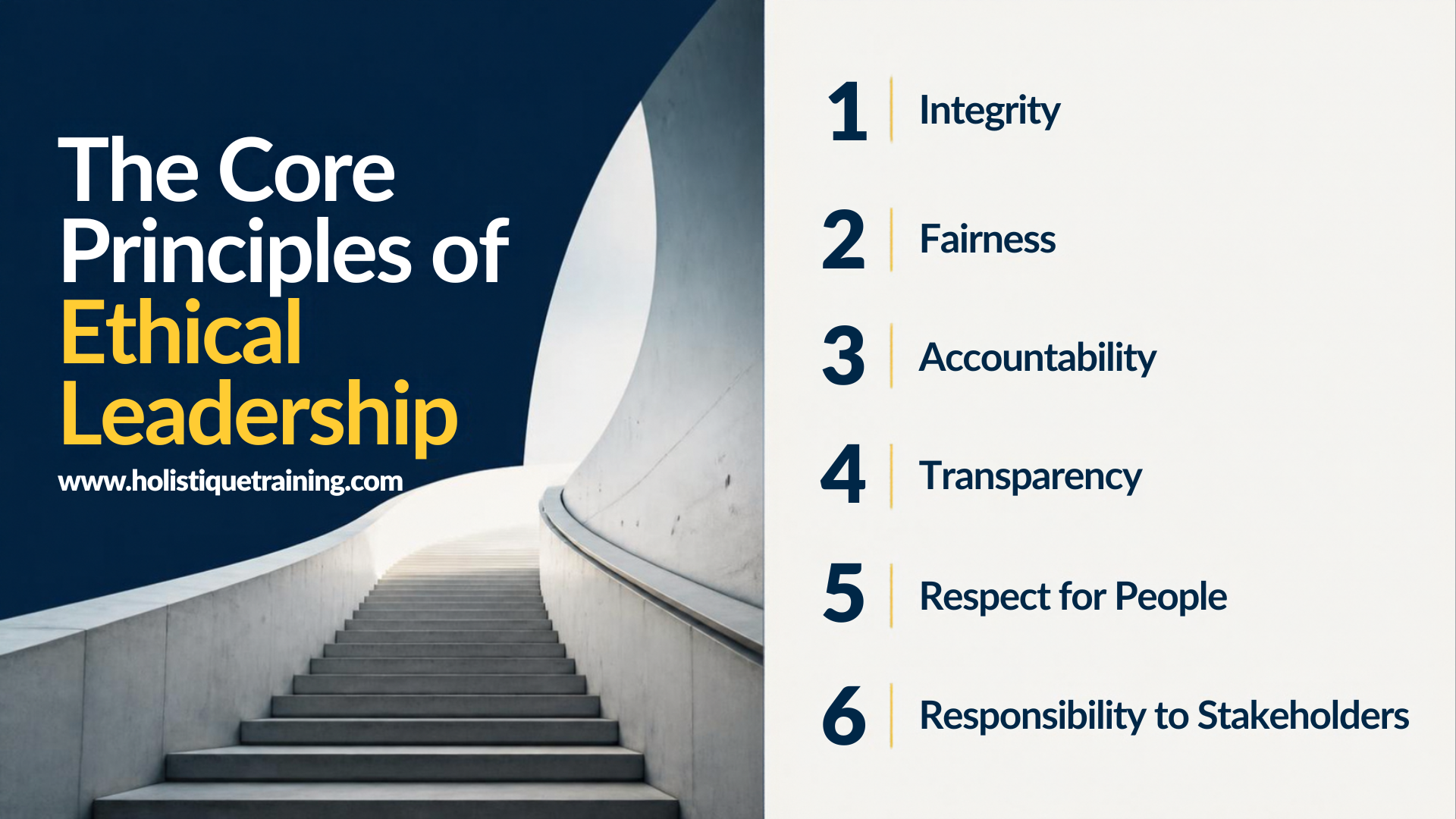
Although frameworks differ, most descriptions of ethical leadership rest on a consistent set of principles. Each of the following shapes how a leader behaves day to day, and each can be observed and assessed by the people who work with them.
1- Integrity:
Ethical leaders align their words and actions. They keep promises, admit mistakes and refuse to bend standards when it would be convenient to do so. Integrity is the foundation on which every other principle rests, because without it statements about values carry no credibility.
2- Fairness:
Ethical leaders apply rules consistently, distribute opportunities and rewards on merit, and avoid favouritism. Fairness in promotions, pay, workload and discipline is among the most visible signals of a leader's character.
3- Accountability:
Ethical leaders accept responsibility for outcomes, including failures, and expect the same of others. They do not push blame downwards, and they recognise that seniority increases rather than reduces the duty to answer for decisions.
4- Transparency:
Ethical leaders explain the reasoning behind decisions, share relevant information openly and acknowledge uncertainty. Transparency does not mean disclosing everything, but it does mean never misleading people about matters that affect them.
5- Respect for people:
Ethical leaders treat colleagues, customers and suppliers with dignity, listen to dissenting views and protect psychological safety. They understand that power creates vulnerability in others and handle it with care.
6- Responsibility to stakeholders:
Ethical leaders weigh the impact of decisions on employees, customers, communities and the environment as well as shareholders, and they take a long-term view of value creation.
Taken together, these principles work as a system rather than a checklist. A leader who is transparent but unfair, or accountable but disrespectful, will struggle to earn trust, because people judge the whole pattern of behaviour rather than isolated qualities. Ethical leadership therefore requires consistency across all six principles, especially when the pressure to compromise is greatest.
The table below contrasts how these principles appear in everyday behaviour compared with their opposite.
Dimension | Ethical Leadership | Unethical Leadership |
Decision-making | Considers the impact on all stakeholders | Prioritises personal or short-term gain |
Communication | Honest, timely and open | Selective, evasive or misleading |
Response to mistakes | Admits errors and corrects them | Conceals problems or blames others |
Treatment of dissent | Welcomes challenge and feedback | Ignores or punishes criticism |
Use of power | Serves the organisation and its people | Serves self-interest |
4- Ethical Leadership Compared with Other Leadership Styles
Ethical leadership overlaps with several well-known styles, but it is distinct. Its defining feature is that moral conduct is the central test of leadership, rather than a desirable by-product. The following table sets out how it relates to four other widely discussed approaches.
Leadership Style | Core Focus | Relationship to Ethical Leadership |
Ethical | Moral conduct and fairness | Ethics is the defining test of leadership |
Authentic | Self-awareness and consistency | Supports ethics but does not guarantee it |
Servant | Serving and developing followers | Strongly aligned through care for people |
Transformational | Inspiring change and vision | Ethical only when the vision serves others |
Transactional | Rewards and targets | Can be ethical if rules and incentives are fair |
Authentic leadership is closest in spirit. A leader who knows their values and acts consistently with them is more likely to behave ethically, yet authenticity alone is not enough, because a leader can be consistently true to flawed values. Ethical leadership adds an external standard: fairness, honesty and concern for others.

Unlock the potential of authentic leadership as it cultivates trust, engagement, and employee well-being. Discover how to nurture authenticity, explore the key traits of authentic leaders, and tap into the empowering nature of servant leadership to inspire positive change within teams and organisations.
Transformational leadership offers a useful warning. Charismatic leaders can inspire loyalty and drive change, but without an ethical anchor the same influence can be used to pressure people, suppress dissent or justify questionable means. The most effective leaders combine vision with moral discipline, so that the ambition they inspire is pursued in ways that people can respect.
5- How Ethical Leaders Shape Organisational Culture
Setting the Tone from the Top
Culture is shaped by what leaders tolerate, reward and ignore far more than by what policies say. Employees watch senior leaders closely for signals about what is really valued. When an executive who misses targets is criticised while another who inflates results is promoted, the message is clear whatever the code of conduct states. Ethical leaders understand that every decision about hiring, promotion, pay and discipline communicates priorities, and they make those decisions with that in mind.
The Pivotal Role of Line Managers
The tone set at the top only becomes real when it is reinforced by the managers who work most closely with employees. According to Gallup, managers account for at least 70 per cent of the variance in team engagement, yet only 20 per cent of employees worldwide were engaged at work in 2025. Since ethical conduct and engagement both depend on the quality of the relationship between manager and team, organisations cannot rely on senior leaders alone. They must equip line managers to model fairness, listen to concerns and handle ethical issues confidently.
Embedding Values in Systems
Values endure when they are built into the systems that govern work. Recruitment processes can test for integrity, performance reviews can assess how results were achieved, and promotion criteria can reward ethical conduct alongside commercial success. Onboarding, training and communication can reinforce the same messages, so that employees encounter consistent standards at every stage of their careers rather than a single induction session.
6- Ethical Decision-Making in Practice
Why Capable People Make Poor Ethical Choices
Most ethical failures do not begin with bad people making obviously bad choices. They emerge from pressure, ambiguity and small compromises that accumulate. Aggressive targets, time constraints and fear of losing status can push leaders to rationalise decisions they would otherwise reject. Groupthink can silence doubts, and a gradual lowering of standards can make questionable conduct feel normal. Ethical leaders recognise these risks and design safeguards against them, rather than assuming that good character will always be enough.
A Practical Framework for Difficult Decisions
A structured approach helps leaders slow down and think clearly when stakes are high. The following five steps provide a simple and repeatable framework.
1- Define the issue clearly: State what decision is required, who is affected and which values or obligations are in tension. Many ethical problems persist because they are never described plainly.
2- Gather the facts and perspectives: Seek out information from those closest to the issue, including people who may disagree. Decisions made on partial information are more likely to cause unintended harm.
3- Test the options: Ask whether each option is legal, consistent with the organisation's values and fair to those affected. A useful final check is whether the decision could be explained comfortably to colleagues, customers and the public.
4- Decide and explain: Make the decision, take ownership of it and communicate the reasoning honestly, including the trade-offs involved.
5- Review the outcome: Revisit the decision to learn what worked, correct mistakes and refine the organisation's guidance for similar situations.
Communication is central to this process. Leaders who explain their reasoning, invite challenge and respond openly to feedback build the credibility needed for ethical decisions to be understood and accepted, even when they are unpopular.

Leadership, innovation, and communication are integral components of any organisation's success. Effective leadership provides direction, inspires confidence, and fosters a cohesive work environment. The guiding force sets the tone for innovation, encouraging teams to think creatively and embrace change.
7- Building a Speak-Up Culture
Why Employees Stay Silent
An ethical organisation is one in which problems surface early. That depends on employees believing they can raise concerns safely, yet the evidence suggests that many do not. According to the 2023 Global Business Ethics Survey from the Ethics & Compliance Initiative, which gathered views from more than 70,000 employees in 42 countries, 65 per cent of employees had observed misconduct and 72 per cent of those had reported it. However, 46 per cent of those who reported experienced retaliation, and only 13 per cent said they worked in a strong ethical culture. These figures show that reporting is rising but that fear of reprisal remains a serious barrier.
What Leaders Can Do
Leaders can make speaking up safer and more effective through deliberate action. The following practices are among the most important.
1- Respond constructively: How a leader reacts to the first piece of bad news sets the pattern for everything that follows. Thanking people for raising concerns, even uncomfortable ones, encourages others to do the same.
2- Protect those who report: Retaliation must be treated as a serious breach in its own right. Leaders should monitor how reporters are treated after they come forward and act swiftly if there are signs of reprisal.
3- Provide trusted channels: Employees need several routes for raising concerns, including line managers, compliance teams and confidential or anonymous options, so that no one is forced to report to the person they are worried about.
4- Close the loop: People are more willing to report when they see that concerns are investigated and that outcomes, within the limits of confidentiality, are communicated. Silence after a report suggests that nothing was done.
5- Demonstrate consistency: Disciplinary decisions must be applied fairly, irrespective of seniority or performance. A single case in which a high performer escapes sanction can undermine years of messaging.

This advanced training course equips current and aspiring Chief Compliance Officers (CCOs) with the knowledge and leadership skills required to effectively manage enterprise-wide compliance functions. As global regulatory frameworks become more complex and stakeholder expectations grow, the CCO plays a strategic role in upholding integrity, ensuring
8- Ethical Leadership and Corporate Governance
The Role of Boards and Senior Executives
Governance provides the structure within which ethical leadership operates. Boards are responsible for setting the organisation's purpose and values, appointing leaders of sound character, overseeing risk and ensuring that management is held accountable. Effective boards ask probing questions about culture as well as finance, review ethics and compliance data alongside commercial performance, and ensure that the chief executive and senior team are assessed on the way they lead as well as on what they deliver.
Ethics Committees and Independent Assurance
Many organisations support board oversight with dedicated ethics or risk committees, internal audit functions and independent whistleblowing hotlines. These mechanisms give directors a direct line of sight into culture, rather than relying solely on management reports. They are most effective when they have genuine independence, adequate resources and clear authority to escalate concerns, and when their findings lead to visible action rather than reports that are quietly filed away.
Aligning Incentives with Values
Incentives are among the most powerful signals an organisation sends. Reward systems that focus exclusively on short-term financial targets can encourage risk-taking, concealment and corner-cutting, even among well-intentioned people. Ethical organisations balance financial measures with indicators such as customer outcomes, employee feedback, compliance records and the quality of risk management. They also ensure that executive remuneration can be adjusted where misconduct has occurred, reinforcing the message that results achieved improperly do not deserve reward.

The Chief Executive Officer (CEO) Leadership Program is an intensive and comprehensive course designed for aspiring and current CEOs who aim to enhance their leadership skills and drive organisational success. This program provides participants with the tools, frameworks, and strategies needed to lead complex organisations
9- Common Ethical Challenges Leaders Face
Ethical dilemmas rarely announce themselves. They often arrive disguised as routine business decisions, which is why leaders benefit from anticipating the most common pressure points. The table below summarises several recurring challenges, the risks they create and the responses that ethical leaders typically adopt.
Challenge | Main Risk | Ethical Response |
Pressure to hit targets | Cutting corners or inflating results | Set realistic goals and reward how results are achieved |
Conflicts of interest | Biased or self-serving decisions | Require disclosure and remove conflicted individuals from decisions |
Data and AI use | Privacy breaches and unfair outcomes | Establish clear policies, oversight and accountability |
Third-party conduct | Hidden bribery or labour abuses | Carry out due diligence and regular audits |
Restructuring and redundancy | Unfair treatment and lost trust | Use fair criteria, communicate honestly and support those affected |
None of these challenges can be resolved by policy alone. Each requires judgement, courage and a willingness to place long-term integrity above short-term convenience, which is why the personal example of leaders carries so much weight.
10- Ethical Leadership in Times of Crisis and Change
Crises test ethical leadership more severely than stable periods. Pressure intensifies, information is incomplete and the temptation to protect reputation by controlling the narrative can be strong. Leaders who maintain honesty under such conditions earn lasting credibility. They acknowledge what is not yet known, communicate frequently, take responsibility for errors and prioritise the wellbeing of employees and customers over the preservation of their own image.
Periods of organisational change create similar risks. Restructuring, mergers and rapid growth can blur accountability and encourage people to cut corners. Ethical leaders respond by reaffirming standards explicitly, checking that changes do not weaken controls and staying visible and approachable. In this sense, ethical leadership and resilience are closely linked, since organisations are best able to weather turbulence when their leaders can be trusted to act with integrity.
Practical preparation makes a difference. Leaders can agree in advance who makes decisions under pressure, establish a clear route for escalating ethical concerns and rehearse communication plans so that honesty is not sacrificed to speed. Those who prepare in this way are far less likely to improvise in ways they later regret.
11- Barriers to Ethical Leadership and How to Develop Ethical Leaders
Common Barriers
Several obstacles can prevent leaders from acting ethically even when they wish to. Ethics washing, in which organisations promote values without changing behaviour, erodes credibility and breeds cynicism. Cultural differences can complicate decisions in multinational settings, where norms around gifts, hierarchy and disclosure vary. Personal blind spots, such as overconfidence and a belief in one's own moral superiority, can prevent leaders from recognising their own lapses. Awareness of these barriers is the first step towards overcoming them.
Time pressure and heavy workloads also play a part, since stretched leaders have less capacity to reflect, consult colleagues and challenge their own assumptions.
Developing Ethical Leaders
Ethical leadership can be learned, practised and strengthened. Organisations that treat it as a core competency rather than a personality trait tend to achieve the strongest results. The following approaches are particularly effective.
1- Select for character: Recruitment and promotion processes should test for integrity, humility and sound judgement, alongside technical skill and commercial success.
2- Train through realistic scenarios: Case studies, simulations and facilitated discussion help leaders practise handling dilemmas before they face them in real situations.
3- Encourage reflection and feedback: Regular, honest feedback from colleagues, including anonymous upward feedback, helps leaders see how their conduct is perceived.
4- Measure and review: Culture surveys, exit interviews and reporting data can reveal whether leaders are living up to their stated values and where further support is needed.
12- Conclusion
Ethical leadership has become a defining test of effective management rather than an optional extra. It rests on integrity, fairness, accountability, transparency and respect, and it is demonstrated through the everyday decisions that leaders make about people, performance and risk. The evidence shows that trust in business leaders can be a genuine strategic asset, that line managers exert enormous influence over team culture and that many employees still fear the consequences of speaking up.
For organisations, the implications are practical. Boards should oversee culture as seriously as finance. Incentives should reward how results are achieved. Managers should be equipped to handle ethical issues, and employees should be protected when they raise concerns. For individual leaders, the challenge is consistent personal example, since people judge leadership by what is done far more than by what is said. Those who meet this challenge build organisations that are more resilient, more trusted and better prepared for the scrutiny that every leader now faces.