
- Table of Contents
- Introduction
- 1- What Does Health and Safety Executive Mean?
- Why the Same Abbreviation Causes Confusion
- 2- The History and Legal Foundation of the HSE
- The Robens Report and the 1974 Act
- A Goal-Setting Approach
- The 2008 Merger
- 3- How the HSE Is Structured and Who It Reports To
- Shared Enforcement Responsibilities
- 4- What the HSE Does: Core Functions
- Collecting and Publishing Statistics
- 5- HSE Enforcement Powers and Penalties
- Notices and Prosecution
- Recent Enforcement Activity
- 6- Duties Under HSE Guidance and Legislation
- Director and Manager Liability
- Key Regulations Officers Work With
- 7- Managing for Health and Safety: HSG65 and Risk Assessment
- The Five Steps to Risk Assessment
- 8- What Is a Health and Safety Executive in the Workplace?
- Typical Duties
- How the Role Compares With Related Positions
- 9- Skills, Qualifications and Training for the Role
- Core Skills
- Competence and Early-Career Training
- 10- Working With HSE Inspectors and Reporting Under RIDDOR
- Preparing for an Inspection
- Reporting Under RIDDOR
- Where the HSE Is Heading Next
- Conclusion
Introduction
The phrase health and safety executive has two common meanings in the United Kingdom, and confusing them can cause real problems for professionals, employers and job seekers. In its first sense, the Health and Safety Executive, usually shortened to HSE, is the national regulator responsible for workplace health and safety in Great Britain. In its second sense, a health and safety executive is a job title given to a practitioner who helps an organisation meet its legal duties, manage risk and protect people at work. Both meanings matter to anyone in occupational safety, because the regulator sets the expectations and the practitioner delivers them day to day.
For health and safety officers, understanding the regulator is not an academic exercise. The HSE shapes the legislation you work under, publishes the guidance you rely on, inspects the sites you manage and investigates the incidents you hope never to see. Knowing how it works makes it far easier to build systems that stand up to scrutiny.
In this article, we will discuss what the term means, the history and legal foundation of the HSE, how it is structured, what it does, its enforcement powers, the duties it places on employers and workers, the management systems it promotes, the role of a health and safety executive in the workplace, the skills and qualifications involved, how to work with inspectors and report under RIDDOR, and where the regulator is heading next.
1- What Does Health and Safety Executive Mean?
The Health and Safety Executive is a non-departmental public body that regulates workplace health and safety across England, Scotland and Wales. Its stated purpose is to protect people and places and to help everyone lead safer and healthier lives. The word executive reflects its legal origins: the organisation was created as the operational arm that would carry out policy set by a separate commission, and the name survived even after the two bodies later merged.
Why the Same Abbreviation Causes Confusion
The abbreviation HSE is used in several settings, which is why searches for health and safety executive meaning return mixed results. Four uses are worth separating.
1- The Health and Safety Executive: the British regulator described above, responsible for enforcing the Health and Safety at Work etc. Act 1974 and related regulations in Great Britain.
2- A health and safety executive as a job title: a practitioner, usually in an early or mid-career advisory position, who supports compliance within a single organisation.
3- Health, Safety and Environment: in oil and gas, construction and engineering businesses, particularly overseas, HSE describes a department or professional discipline rather than a regulator.
4- The Health Service Executive: in Ireland, an entirely different body that runs public health and social care services. Irish workplace safety is regulated by the Health and Safety Authority.
This article concentrates on the first two meanings, with the regulator as the main thread.
2- The History and Legal Foundation of the HSE
The Robens Report and the 1974 Act
The modern system grew out of the Robens Committee, which reported in 1972 after reviewing the provisions for people at work. It found that the patchwork of industry-specific statutes was fragmented and recommended a unified framework that placed primary responsibility on those who create risk and those who work with it. Parliament responded with the Health and Safety at Work etc. Act 1974, which remains the principal legislation and established both the Health and Safety Commission and the Health and Safety Executive. The Executive began operating in 1975.
A Goal-Setting Approach
A defining feature of the 1974 Act is its goal-setting design. Rather than prescribing every control measure, it sets general duties and expects duty holders to decide what is reasonably practicable in their circumstances. Regulations made under the Act, supported by Approved Codes of Practice and HSE guidance, add detail for specific hazards. Approved codes carry special legal status: failure to follow one is not automatically an offence, but a duty holder may then need to show they complied with the law in another way.
The 2008 Merger
In 2008 the Commission and the Executive were merged into a single body that kept the name Health and Safety Executive. The change simplified governance and gave the organisation one voice. The HSE marked its 50th anniversary in 2025.
3- How the HSE Is Structured and Who It Reports To
The HSE is sponsored by the Department for Work and Pensions and is led by a board with a chair and a chief executive, who also acts as accounting officer. It operates throughout Great Britain from its headquarters in Bootle, Merseyside, with inspectors, specialists and scientists based in offices and laboratories across the country. Northern Ireland has its own regulator, the Health and Safety Executive for Northern Ireland, which works under separate legislation.
Shared Enforcement Responsibilities
The HSE does not regulate every workplace directly. Under the Health and Safety (Enforcing Authority) Regulations 1998, responsibility is divided between the HSE and local authorities according to the main activity carried out at the premises, while specialist regulators cover sectors such as nuclear and rail. The table below summarises the main enforcing bodies.
Enforcing Body | Area Covered | Typical Workplaces |
|---|---|---|
Health and Safety Executive | Great Britain | Construction sites, farms, factories, mines, chemical plants and offshore installations |
Local authorities | England, Scotland and Wales | Offices, shops, hotels, restaurants and leisure venues |
HSE for Northern Ireland | Northern Ireland | Workplaces across most sectors in the region |
Office for Nuclear Regulation | Great Britain | Licensed nuclear sites |
Office of Rail and Road | Great Britain | Railway operators and infrastructure managers |
Knowing which regulator has jurisdiction determines who is likely to inspect your site and which sector priorities apply.
4- What the HSE Does: Core Functions
The work of the HSE can be grouped into six core functions, each of which affects how health and safety officers plan their own activities.
1- Setting standards and producing guidance: the HSE develops regulations, Approved Codes of Practice and practical guidance, so officers have a recognised benchmark for what good looks like.
2- Inspecting workplaces: inspectors carry out proactive visits targeted at higher-risk sectors and issues, and they respond to complaints and intelligence from workers and the public.
3- Investigating incidents: serious accidents, dangerous occurrences and cases of occupational ill health are examined to establish causes and decide whether enforcement is appropriate.
4- Enforcing the law: the regulator uses advice, notices, cost recovery and prosecution in proportion to the risk and the seriousness of the breach.
5- Gathering evidence and research: scientific and laboratory work builds the evidence base on hazards ranging from asbestos and silica to workplace stress.
6- Influencing and engaging: campaigns and partnerships with industry bodies, trade unions and professional institutions promote better practice beyond what inspection alone can achieve.
Collecting and Publishing Statistics
The HSE is also the official source of national workplace injury and ill health statistics. According to the HSE, 126 workers were killed in work-related incidents in Great Britain in 2025/26, which is provisionally the lowest annual figure recorded outside the years affected by the coronavirus pandemic. The same release shows that falls from height remained the most common cause of fatal injury, accounting for 31 deaths, and that the regulator compared Great Britain with 35 other countries for the first time. These findings help officers see where fatal risk remains concentrated.
5- HSE Enforcement Powers and Penalties
HSE inspectors are appointed under section 19 of the 1974 Act and hold wide powers under section 20. They may enter premises at any reasonable time, usually without notice, and they can examine and take samples, take photographs and measurements, require documents and records, and interview people. Obstructing an inspector is itself an offence.
Notices and Prosecution
Inspectors choose the enforcement tool that fits the risk. The table below compares the main options.
Enforcement Action | Purpose | Typical Trigger |
|---|---|---|
Improvement notice | Requires a breach to be put right within a set period | A contravention of the law that does not present immediate danger |
Prohibition notice | Stops an activity or the use of equipment, immediately or after a set time | A risk of serious personal injury |
Prosecution | Brings criminal proceedings against a duty holder | Serious breaches, fatalities, repeated breaches or persistent poor compliance |
Fee for Intervention | Recovers HSE costs from duty holders found in material breach | A material breach identified during an inspection or investigation |
Penalties can be severe. Courts can impose unlimited fines in the Crown Court for most health and safety offences, and individuals, including directors and managers, may face imprisonment of up to two years in the most serious cases.
Recent Enforcement Activity
According to law firm Gordons LLP's summary of the HSE's 2026 Annual General Meeting, work-related ill health was a key focus, with almost 15,000 proactive inspections conducted over the past year. The same summary reports 250 prosecutions, an 88 per cent conviction rate and £34.5 million in fines over the last 12 months. For health and safety officers, those figures confirm that inspection and enforcement remain active, and that ill health, including stress, silica, asbestos and musculoskeletal disorders, is firmly on the regulator's agenda.
6- Duties Under HSE Guidance and Legislation
Under section 2 of the 1974 Act, employers must ensure, so far as is reasonably practicable, the health, safety and welfare at work of their employees. Section 3 extends the duty to people affected by the business who are not employees, such as contractors and visitors, while section 7 requires employees to take reasonable care of themselves and others and to cooperate with their employer. The phrase so far as is reasonably practicable allows a proportionate balance between the size of a risk and the cost, time and trouble of controlling it, but it is not a loophole, because the burden of proving that more could not reasonably have been done rests with the duty holder.
Director and Manager Liability
Section 37 makes directors, managers and similar officers personally liable where an offence by a company was committed with their consent or connivance, or was due to their neglect. This is why officers should ensure senior leaders receive accurate, regular information on risk and performance.
Key Regulations Officers Work With
Beyond the Act itself, officers work daily with a core set of regulations. Six of the most frequently used are listed below.
1- Management of Health and Safety at Work Regulations 1999: these require suitable and sufficient risk assessments, competent help, emergency arrangements, and information and training for workers.
2- Reporting of Injuries, Diseases and Dangerous Occurrences Regulations 2013 (RIDDOR): these set out which incidents and illnesses must be reported to the enforcing authority.
3- Control of Substances Hazardous to Health Regulations 2002 (COSHH): these require employers to assess and control exposure to hazardous substances such as dusts, fumes and chemicals.
4- Provision and Use of Work Equipment Regulations 1998 (PUWER): these require equipment to be suitable, properly maintained and used safely by trained people.
5- Work at Height Regulations 2005: these require work at height to be planned, supervised and carried out by competent people using appropriate equipment.
6- Construction (Design and Management) Regulations 2015: these allocate duties to clients, designers, principal contractors and contractors across the life of a construction project.
Officers need a firm grasp of how the general duties in the Act connect to these specific requirements.
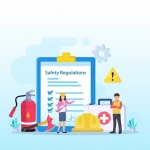
Health and safety within your organisation aren’t just requirements; they provide beneficial training, processes, and procedures to help your business progress. They also help you remain within legislative guidelines to manage risks and profile disasters, guaranteeing the continuation of your business.
7- Managing for Health and Safety: HSG65 and Risk Assessment
HSE guidance titled Managing for health and safety, known as HSG65, sets out a practical model built on the Plan, Do, Check, Act cycle. Organisations plan by setting a policy and identifying risks, do by organising, controlling and communicating, check by measuring performance and investigating incidents, and act by reviewing and improving. The model is deliberately proportionate, so a small office and a large chemical site apply the same logic at different scales, and it emphasises leadership, worker involvement and competence.
Explore Health & Safety Management—its importance and 10 guiding principles to protect well-being, ensure compliance, and drive safer workplaces.
The Five Steps to Risk Assessment
The HSE promotes a simple, repeatable approach to risk assessment that officers can use as the backbone of their work.
1- Identify the hazards: walk the workplace, talk to workers and review incident and maintenance records to find what could cause harm.
2- Decide who might be harmed and how: consider employees, contractors, visitors and members of the public, paying particular attention to young workers, new starters and those with specific needs.
3- Evaluate the risks and decide on precautions: judge how likely harm is and how serious it could be, then check whether existing controls are enough or whether more are needed.
4- Record the significant findings and put them into action: employers with five or more employees must record their findings, and the controls must actually be implemented rather than simply written down.
5- Review the assessment and update it when necessary: revisit it after incidents, near misses, changes to equipment, processes or staffing, and on a planned schedule.
Written procedures turn these assessments into everyday practice. Clear, concise and accessible procedures tell workers what to do, who is responsible and what to do when something goes wrong, and they give officers evidence that arrangements are in place if an inspector asks to see them.

Regardless of the type of organisation or industry, health and safety must always be a priority. Maintaining health and safety is crucial to the welfare of all working within an organisation. It encompasses identifying risks, implementing preventative measures, and producing health and safety procedures when
8- What Is a Health and Safety Executive in the Workplace?
In recruitment, a health and safety executive is a practitioner who supports an organisation in meeting its legal duties and reducing harm. The title is common in British job advertisements, particularly in construction, facilities management, manufacturing, logistics, retail and the public sector. It generally sits between an assistant role and a health and safety manager, although titles vary widely between employers, so the responsibilities matter more than the label.
Typical Duties
While each employer defines the role differently, the following duties appear in most job descriptions.
1- Risk assessment and safe systems of work: preparing and reviewing risk assessments, method statements and safe working procedures for routine and non-routine tasks.
2- Audits and inspections: carrying out scheduled site inspections and compliance audits, recording findings and tracking corrective actions to completion.
3- Incident investigation and reporting: investigating accidents and near misses, identifying root causes and submitting RIDDOR reports where the law requires.
4- Training and inductions: delivering or arranging inductions, toolbox talks and refresher training so workers understand hazards and controls.
5- Policies and records: maintaining the health and safety policy, training records, equipment examination certificates and other documentary evidence.
6- Liaison with regulators and stakeholders: acting as the point of contact for HSE inspectors, local authority officers, insurers, contractors and worker representatives.
How the Role Compares With Related Positions
Job titles in health and safety overlap, and executive and officer are often used interchangeably. The table below shows how the positions typically differ.
Role | Typical Focus | Level of Responsibility |
|---|---|---|
Health and safety assistant | Administration, record keeping and basic inspections | Entry level, supervised |
Health and safety executive or officer | Day-to-day compliance, audits, training and incident follow-up | Practitioner level, largely independent |
Health and safety manager | Strategy, budgets, team leadership and reporting to senior leaders | Managerial, accountable for the safety management system |
Head of health and safety or director | Organisation-wide policy, governance and board advice | Senior leadership |
9- Skills, Qualifications and Training for the Role
Most employers expect a recognised qualification. The NEBOSH National General Certificate in Occupational Health and Safety is a common entry point, while the NEBOSH National Diploma and the professional membership grades of IOSH, progressing towards chartered status, support progression to senior positions. Employers also value sector experience, particularly in construction, manufacturing and facilities management.

The International General Certificate in Occupational Health and Safety is part of the 2019 syllabus for workplace health and safety regulations. Achieving this certification sets you apart in your career and demonstrates your commitment to a safe and compliant working environment.
Core Skills
Qualifications open doors, but the following skills determine how effective a practitioner becomes.
1- Sound risk judgement: the ability to weigh likelihood and severity, avoid both complacency and over-caution, and justify decisions with evidence.
2- Communication and influence: explaining requirements clearly to operatives, supervisors and directors, and persuading people to change behaviour without relying on authority alone.
3- Technical and legal knowledge: keeping up to date with regulations, guidance and sector standards, and understanding how they apply on a particular site.
4- Data analysis: using inspection findings, near-miss reports and incident trends to identify patterns and direct limited resources where they matter most.
5- Integrity and resilience: holding firm when commercial pressure conflicts with safety, and staying calm and methodical after an incident.
Competence and Early-Career Training
A 2026 IOSH survey carried out by YouGov among 500 UK workers aged 18 to 25 found that 48 per cent believe their employer prioritises targets and performance over their health and wellbeing. The same research found that 42 per cent left education without a clear understanding of health, safety and wellbeing. For practitioners, those findings reinforce why inductions, supervision and ongoing training are central parts of the role, since many new starters arrive with gaps in knowledge and uncertainty about their rights.
Continuing professional development keeps practitioners credible with inspectors, colleagues and workers, and ensures that knowledge keeps pace with emerging hazards.
10- Working With HSE Inspectors and Reporting Under RIDDOR
Preparing for an Inspection
Inspectors can arrive unannounced, so readiness should be a permanent state. Risk assessments, training records, maintenance and examination certificates, accident records and the written health and safety policy, which employers with five or more employees must have, should be current and easy to find. During a visit, officers should accompany the inspector, answer questions honestly and ask for any requirements to be confirmed in writing.
Reporting Under RIDDOR
RIDDOR requires the responsible person, usually the employer, self-employed person or person in control of premises, to report certain events to the enforcing authority. Five categories apply.
1- Work-related deaths: any death arising from a work-related accident must be reported without delay.
2- Specified injuries to workers: this covers serious injuries such as fractures, amputations and loss of sight, which also require prompt reporting.
3- Over-seven-day incapacitation: where a worker is unable to do their normal work for more than seven consecutive days, the report is due within 15 days.
4- Occupational diseases: certain work-related illnesses diagnosed by a doctor, such as some cancers and dermatitis, must be reported.
5- Dangerous occurrences: near-miss events with the potential to cause serious harm, such as the collapse of a scaffold or an explosion, must be reported even if nobody is hurt.
Requirements can change, so officers should always check the HSE's current reporting guidance before submitting a report.
Where the HSE Is Heading Next
The HSE's long-term strategy, Protecting People and Places 2022 to 2032, sets the direction for the regulator. Its priorities include reducing work-related ill health, introducing emerging technologies safely and maintaining Great Britain's strong record on fatal injuries, with mental health, dusts, asbestos and musculoskeletal risks likely to remain prominent.
For health and safety officers, the practical lesson is to watch regulator announcements, consultations and sector campaigns closely, and to treat guidance as a living resource rather than a fixed rulebook.
Conclusion
The meaning of health and safety executive depends on context. As a regulator, the Health and Safety Executive is Britain's national authority for workplace health and safety, founded on the Health and Safety at Work etc. Act 1974, structured to work alongside local authorities and specialist regulators, and equipped with powers to inspect, investigate, serve notices and prosecute. As a job title, a health and safety executive is a practitioner who turns the law and guidance into safe systems, trained people and credible records.
For health and safety officers, the most valuable step is to treat the two meanings as connected. Understanding how the regulator thinks and enforces helps practitioners design proportionate controls, prepare confidently for inspections and report accurately. Continuous learning, leadership support and a focus on prevention remain the foundations of a safe workplace.