
- Table of Contents
- Introduction
- 1- What Is the Link Between Training and Organisational Performance?
- Defining Organisational Performance
- Training as a Strategic Lever
- 2- Why Training Matters More Than Ever
- Accelerating Change and Skills Instability
- The Cost of Skills Gaps
- Training and Talent Retention
- 3- How Training Improves Organisational Performance
- Linking Training Outcomes to Business Results
- 4- Identifying Training Needs Before Investing
- Why Needs Analysis Comes First
- Three Levels of Analysis
- Gathering Reliable Evidence
- Prioritising What to Address First
- 5- Choosing the Right Training Methods
- Building a Blended Approach
- 6- Aligning Training with Business Strategy
- Linking Learning Objectives to Business Goals
- Securing Leadership Sponsorship
- Coordinating Across Functions
- 7- The Role of Managers in Making Training Work
- Managers as Learning Enablers
- Reinforcing Learning After the Course
- Developing Managers Themselves
- 8- Building a Culture of Continuous Learning
- Making Learning Part of Everyday Work
- Psychological Safety and Knowledge Sharing
- Recognising and Rewarding Development
- 9- Measuring Training Effectiveness
- Using the Kirkpatrick Model
- Selecting Meaningful Indicators
- Demonstrating Return on Investment
- Reporting Results to Stakeholders
- 10- Common Challenges and How to Overcome Them
- 11- Emerging Trends in Workplace Training
- AI-Enabled Personalisation
- Skills-Based Development
- Learning in the Flow of Work
- Immersive and Simulated Learning
- 12- Conclusion
Introduction
Organisations rarely struggle because they lack ambition. They struggle because the capabilities of their people do not keep pace with the demands placed on them. New technologies, tighter regulation, shifting customer expectations and fierce competition for talent all mean that the skills which delivered results last year may not deliver them next year. In that environment, training has moved from a periodic administrative task to one of the most practical levers available to leaders who want to strengthen results.
Improving organisational performance through training is not about running more courses. It is about building the right knowledge, behaviours and habits in the right people at the right time, and then confirming that those changes translate into measurable outcomes such as higher productivity, better quality, stronger retention and faster adaptation. When training is planned and evaluated with the same discipline as any other business investment, it becomes a source of competitive advantage rather than a cost to be minimised.
In this article, we will discuss what organisational performance means, why training matters more than ever, how training improves results, how to identify genuine learning needs, which delivery methods suit which objectives, how to align training with strategy, the role of managers, how to build a learning culture, how to measure effectiveness, common challenges, and the trends shaping the future of workplace learning.
1- What Is the Link Between Training and Organisational Performance?
Defining Organisational Performance
Organisational performance describes how effectively an organisation achieves its objectives. It is usually assessed across several dimensions, including financial results, operational efficiency, quality, customer satisfaction, employee engagement and the capacity to innovate. No single indicator tells the whole story. A business may post strong profits while quietly losing experienced staff, or deliver excellent service while operating at an unsustainable cost. Mature organisations therefore track a balanced set of measures and recognise that each of them depends, in the end, on what people know and what they are able to do.
Training as a Strategic Lever
Training is the structured process of developing the knowledge, skills and behaviours that employees need to perform their roles and to progress beyond them. Its link to performance operates at three levels. At the individual level, it improves competence and confidence. At the team level, it creates shared standards, a common language and smoother collaboration. At the organisational level, it embeds capabilities that are difficult for competitors to copy, such as superior service routines, technical expertise or data literacy. The distinction between training that merely informs and training that changes performance is crucial, because only the second type justifies sustained investment.
2- Why Training Matters More Than Ever
Accelerating Change and Skills Instability
The shelf life of professional skills is shrinking. Digital tools, automation and artificial intelligence are reshaping tasks within almost every role, which means that employees must update their capabilities repeatedly across a career rather than once at the start. Organisations that treat learning as a one-off event during onboarding find that their workforce gradually drifts out of step with the work.
The pace of change also affects management capability. Leaders must now guide teams through new tools, hybrid working patterns and evolving customer expectations, often while their own roles are changing. Organisations that invest in regular development for employees at every level are better placed to absorb these shifts without a drop in output, because their people already have the confidence and the habits needed to learn on demand.
The Cost of Skills Gaps
Skills gaps carry real commercial consequences. They slow the adoption of new systems, increase error rates, limit the ability to enter new markets and place additional pressure on the most capable employees, who absorb the work that others cannot yet do. Left unaddressed, they also damage morale, because people who feel under-equipped tend to disengage or leave. According to the World Economic Forum’s Future of Jobs Report 2025, which draws on the views of more than 1,000 leading global employers, 63 percent of employers identify skills gaps as the biggest barrier to business transformation between 2025 and 2030, and 85 percent plan to prioritise upskilling their workforce.
Training and Talent Retention
Development opportunities are also central to retention. Employees consistently cite growth as a reason for staying with an employer, and replacing a skilled colleague is expensive in recruitment fees, lost knowledge and reduced team output. Training therefore protects performance in two ways: it builds capability, and it keeps the capability that the organisation has already built.
3- How Training Improves Organisational Performance
Training influences results through several distinct channels. The most important are set out below, and each can be tracked with practical indicators.
1- Higher productivity.
Employees who are trained to use tools, systems and processes properly complete tasks faster, make fewer errors and need less supervision. Time to proficiency for new starters also falls when onboarding is structured, which brings new recruits to full output sooner.
2- Better quality and fewer errors.
Standardised training establishes a common definition of good work. Consistent procedures reduce rework, defects, complaints and warranty costs, and they make quality easier to audit.
3- Stronger engagement and retention.
People who see their employer investing in their development tend to feel more valued and more committed. Greater engagement lowers absenteeism and voluntary turnover, which reduces recruitment and replacement costs.
4- Improved customer experience.
Customer-facing teams trained in product knowledge, communication and problem-solving resolve issues more effectively at first contact, which supports satisfaction scores, loyalty and repeat business.
5- Greater innovation and adaptability.
Training in analytical thinking, digital tools and change management gives employees the confidence to test new approaches and adopt new technology without prolonged disruption.
6- Reduced risk and stronger compliance.
Regular training in health and safety, data protection, financial regulation and ethical conduct lowers the likelihood of incidents, fines and reputational damage.
The commercial importance of engagement is well documented. According to Gallup’s meta-analysis of its engagement research, teams in the top quartile for engagement achieve 18 percent higher sales productivity and 14 percent higher productivity in production records and evaluations than teams in the bottom quartile, along with 23 percent higher profitability. Because development is one of the workplace conditions that Gallup associates with engagement, training contributes to performance both directly, through skills, and indirectly, through motivation.
Linking Training Outcomes to Business Results
The table below summarises how common training priorities translate into organisational results and which indicators can be used to confirm the effect.
Training Focus | Typical Organisational Result | Example Indicator |
Technical and systems training | Faster, more accurate work | Output per employee, error rate |
Onboarding programmes | Quicker contribution from new starters | Time to proficiency |
Customer service training | Better customer experience | First-contact resolution, satisfaction score |
Leadership and management training | Stronger teams and decisions | Engagement scores, team retention |
Compliance and safety training | Lower risk exposure | Incident rates, audit findings |
4- Identifying Training Needs Before Investing
Why Needs Analysis Comes First
Many training programmes disappoint not because the content is weak but because it addresses the wrong problem. A training needs analysis establishes the gap between current and required performance, determines whether that gap is caused by missing skills or by other factors such as unclear processes, poor tools or weak incentives, and identifies who needs which kind of development. Without it, organisations risk spending heavily on generic programmes that do not shift results.
Three Levels of Analysis
A thorough assessment examines needs at three levels. Organisational analysis looks at strategic goals, performance data and upcoming changes to see where capability matters most. Task analysis defines what competent performance looks like in each role. Individual analysis compares each employee’s current skills with those standards through appraisals, observation, surveys and manager input. Combining these perspectives prevents both over-training, where people receive learning they do not need, and under-training, where critical gaps remain hidden.
Gathering Reliable Evidence
Sound conclusions require more than opinion. Surveys and self-assessments reveal how confident employees feel, interviews and focus groups explain the reasons behind performance problems, and direct observation shows what actually happens at the workstation or in the customer conversation. Performance appraisals, quality data and customer feedback add an objective layer. Using at least two or three of these sources, and comparing what they say, reduces the risk of acting on assumptions.
Prioritising What to Address First
Not every gap deserves immediate attention. Leaders should rank needs by business impact, urgency, the number of employees affected and the level of risk involved. Safety-critical and compliance-related gaps usually come first, followed by those that directly constrain revenue or service quality, with longer-term development planned alongside.

Becoming a training and development expert requires education, experience, and skills. These roles identify the organisation's skill gaps and learning needs. Conducting thorough assessments can determine where employees require training to enhance their performance and contribute more effectively to the company's goals. Dedicated training
5- Choosing the Right Training Methods
There is no single best format. The most effective programmes combine methods according to the type of capability being developed, the number of people involved and the working patterns of the organisation. The most common approaches are described below.
1- Instructor-led workshops.
Classroom and virtual sessions led by an expert suit complex topics, leadership development and skills that benefit from discussion, practice and immediate feedback. They are valuable but time-intensive and harder to scale.
2- E-learning modules.
Self-paced digital courses deliver consistent content to large or dispersed workforces at low marginal cost. They work best for knowledge, compliance and foundation skills, and they are most effective when paired with practical application.
3- On-the-job training.
Learning while performing real tasks, supported by a supervisor or experienced colleague, builds practical competence quickly and ensures that training reflects genuine working conditions.
4- Coaching and mentoring.
One-to-one support helps employees apply new skills, work through specific challenges and develop judgement, which formal courses rarely provide on their own.
5- Microlearning.
Short, focused learning units delivered in minutes fit naturally into the working day and support retention through spaced repetition. They suit procedural knowledge and refreshers.
6- Simulations and case studies.
Realistic scenarios allow employees to practise decisions in a safe environment, which is particularly valuable in healthcare, finance, safety-critical operations and management.
Building a Blended Approach
In practice, the strongest results come from blended designs. A manager might begin with a short e-learning module to establish concepts, follow it with a workshop for practice, and reinforce the learning through coaching and on-the-job projects. This sequence mirrors how adults learn best: through understanding, practice, feedback and repeated application. The table below compares the main methods.
Method | Best Suited To | Main Strength | Main Limitation |
Instructor-led workshops | Complex or interpersonal skills | Discussion and live feedback | Cost and scheduling |
E-learning | Knowledge and compliance | Scale and consistency | Limited practice |
On-the-job training | Practical, role-specific skills | Immediate relevance | Depends on supervisor quality |
Coaching and mentoring | Leadership and judgement | Personalised support | Time-intensive |
Microlearning | Refreshers and procedures | Fits the working day | Limited depth |
6- Aligning Training with Business Strategy
Linking Learning Objectives to Business Goals
Training delivers the greatest return when its objectives are derived directly from strategy. If an organisation intends to expand into new markets, improve customer retention or digitise its operations, the learning plan should identify the specific capabilities those ambitions require and build programmes around them. Objectives should be written in terms of performance, such as reducing processing errors or shortening onboarding time, rather than in terms of attendance or hours completed. Goal-setting theory supports this approach, since employees perform better when they understand how their development contributes to organisational objectives.

Explore key performance theories, 9 powerful strategies, tech tools, and remote trends shaping the future of performance management.
Securing Leadership Sponsorship
Programmes that lack visible senior backing tend to lose momentum. Executives can sponsor training by explaining its strategic purpose, protecting time for participation, taking part themselves and reviewing outcomes alongside other business results. Their involvement signals that development is part of how the organisation operates rather than an optional extra.
Coordinating Across Functions
Human resources and learning teams should work closely with operational leaders, finance and technology colleagues. Operational leaders understand the real performance gaps, finance can validate the value of improvements, and technology teams can integrate learning into the systems that employees already use. A shared planning calendar and regular review meetings keep these groups aligned, so that training priorities change in step with business priorities rather than lagging behind them.
7- The Role of Managers in Making Training Work
Managers as Learning Enablers
Line managers have more influence over whether training changes behaviour than any course designer. They help identify development needs, agree learning objectives with team members, release employees to attend and, critically, create opportunities to apply new skills afterwards. When managers are indifferent or treat training as a distraction, employees quickly conclude that the learning does not matter.
Reinforcing Learning After the Course
Much of the value of training is lost in the weeks after it ends. Managers can protect that value by holding a short conversation before and after each programme, assigning a practical task that uses the new skill, offering feedback and revisiting the topic in regular one-to-one meetings. These simple habits turn knowledge into routine practice.
Peer support can strengthen this effect. Pairing colleagues who have completed the same programme, or inviting them to present what they learned at a team meeting, encourages accountability and spreads good practice beyond the original participants.
Developing Managers Themselves
Because managers shape so much of the learning environment, their own development deserves priority. Training in coaching, delegation, feedback and empowerment equips them to develop others, and it raises the quality of day-to-day leadership across the organisation.

Many forward-thinking business owners realise that simply giving orders isn't the most effective way to get work done. Research shows that employees are more motivated and productive when they are free to make their own choices and follow paths they enjoy.
8- Building a Culture of Continuous Learning
Making Learning Part of Everyday Work
A learning culture is one in which employees expect to develop continuously and feel supported in doing so. It is built through practical mechanisms such as time set aside each week for development, easy access to digital resources, communities of practice, job rotation, project-based learning and opportunities to share lessons from success and failure. When learning is woven into daily routines, performance improves steadily rather than in occasional bursts.
Psychological Safety and Knowledge Sharing
Employees learn faster when they can ask questions and admit mistakes without fear of blame. Leaders can encourage this by treating errors as sources of insight, recognising those who share knowledge and creating forums, such as short team reviews, where lessons are exchanged openly. Over time, this reduces repeated mistakes and accelerates improvement across teams.
Recognising and Rewarding Development
Recognition reinforces behaviour. Celebrating completed qualifications, promoting people who build new capabilities and linking development goals to performance conversations all show that learning is valued. Continuous improvement initiatives, such as lean or quality programmes, also depend on staff who are trained to identify and solve problems, so learning and operational excellence strengthen one another.
9- Measuring Training Effectiveness
Using the Kirkpatrick Model
The Kirkpatrick model remains the most widely used framework for evaluating training. It examines four levels, each building on the last, and helps organisations move beyond satisfaction surveys towards genuine evidence of impact.
Level | Key Question | Example Measures |
1 - Reaction | Did participants find the training relevant? | Feedback scores, participation levels |
2 - Learning | Did they gain knowledge or skills? | Test results, practical assessments |
3 - Behaviour | Are they applying it at work? | Observation, manager feedback |
4 - Results | Has organisational performance improved? | Productivity, quality, retention, revenue |
Selecting Meaningful Indicators
Indicators should be agreed before training begins and linked to the original performance gap. Useful measures include time to proficiency, error and rework rates, customer satisfaction, internal promotion rates, retention of trained employees compared with those who have not been trained, and cost per learner. Where possible, compare trained and untrained groups, or measure performance before and after, to separate the effect of the programme from other influences.

In this training course, you will discover how to accurately track analytical people data and process strategic decisions to build successful business models and work towards improving company practices. You will uncover how HR data is used to demonstrate an
Demonstrating Return on Investment
Executives increasingly expect evidence of return. A simple calculation divides the net financial benefit of a programme, such as the value of reduced errors or avoided turnover, by its total cost, and expresses the result as a percentage. Not every benefit can be monetised, but an honest combination of financial and non-financial evidence is far more persuasive than activity statistics alone. According to LinkedIn Learning’s 2025 Workplace Learning Report, 49 percent of learning and talent development professionals say their executives are concerned that employees do not have the right skills to execute the business strategy, and employee engagement and retention are the most common ways of measuring the business impact of career development.
Reporting Results to Stakeholders
Evaluation only influences decisions when its findings reach the right people in a usable form. Concise dashboards that connect training activity to the business measures leaders already follow, supported by short case examples from individual teams, are more effective than lengthy reports. Sharing both successes and shortfalls builds credibility and creates a basis for refining programmes in the next planning cycle.
10- Common Challenges and How to Overcome Them
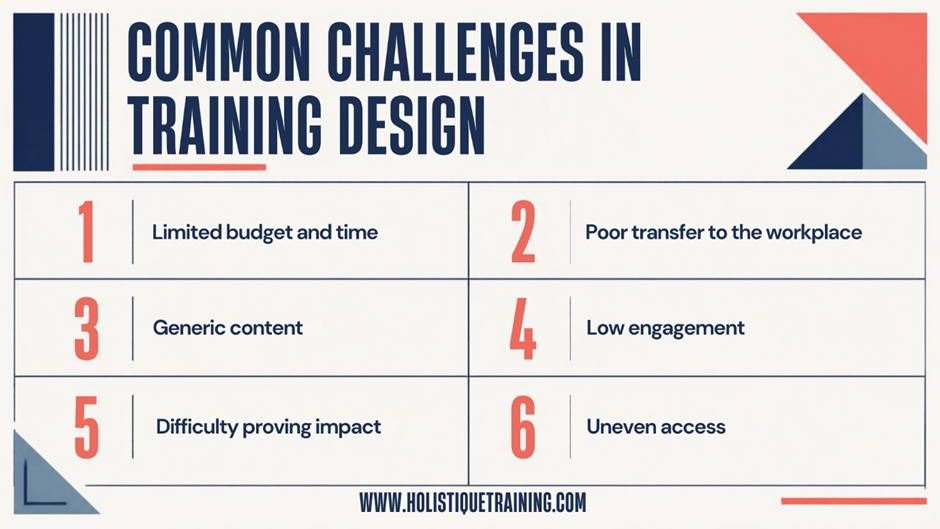
Even well-designed programmes encounter obstacles. The most frequent are listed below, together with practical responses.
1- Limited budget and time.
Prioritise needs with the greatest impact, use blended and digital formats to reduce cost, and schedule short learning sessions that fit around operational demands.
2- Poor transfer to the workplace.
Include practical exercises, set application tasks, involve managers in follow-up and provide job aids that support new behaviours.
3- Generic content.
Tailor examples, scenarios and case studies to the organisation’s own processes, tools and customers so that employees see immediate relevance.
4- Low engagement.
Involve employees in identifying needs, offer choice in how they learn and communicate clearly how development links to career progression.
5- Difficulty proving impact.
Define indicators in advance, collect baseline data and report results in language that executives can use for decisions.
6- Uneven access.
Ensure that frontline, remote and part-time employees can reach training through mobile-friendly formats and flexible timing.
11- Emerging Trends in Workplace Training
AI-Enabled Personalisation
Artificial intelligence makes it possible to recommend learning based on role, performance data and career goals, adapt difficulty to each learner and identify emerging skills gaps before they affect results. Human oversight remains essential to ensure relevance and fairness.
Skills-Based Development
Organisations are shifting from job descriptions towards skills inventories, which allow them to see capability across the workforce, redeploy people more effectively and target development precisely.
Learning in the Flow of Work
Short, task-specific guidance embedded in everyday systems reduces disruption and supports immediate application, an approach that suits busy operational environments.
Immersive and Simulated Learning
Virtual and augmented reality tools allow employees to rehearse high-risk or complex tasks without real-world consequences, from emergency procedures to difficult customer conversations. As these technologies become more affordable, they offer a practical route to hands-on practice at scale.
12- Conclusion
Improving organisational performance through training depends on discipline rather than volume. The organisations that benefit most begin with a clear understanding of their strategic goals, diagnose genuine skills gaps through structured analysis, and choose delivery methods that fit the capability being developed. They secure visible sponsorship from senior leaders, equip managers to reinforce learning, and build a culture in which development is part of daily work.
Equally important, they measure what happens next. By tracking behaviour change and business results rather than attendance alone, they can demonstrate the value of training, refine weak programmes and justify continued investment. In a labour market defined by rapid change and persistent skills gaps, training is not a discretionary extra. It is one of the most reliable ways to build an organisation that performs well today and adapts successfully tomorrow.