
- Table of Contents
- Introduction
- 1- What Are MEWPs and Why They Matter
- IPAF Categories of MEWPs
- 2- Understanding IPAF and Its Global Role
- 3- Why Managers Need MEWP Training, Not Just Operators
- 4- What the MEWPs for Managers Course Covers
- 5- Legal and Duty-of-Care Responsibilities
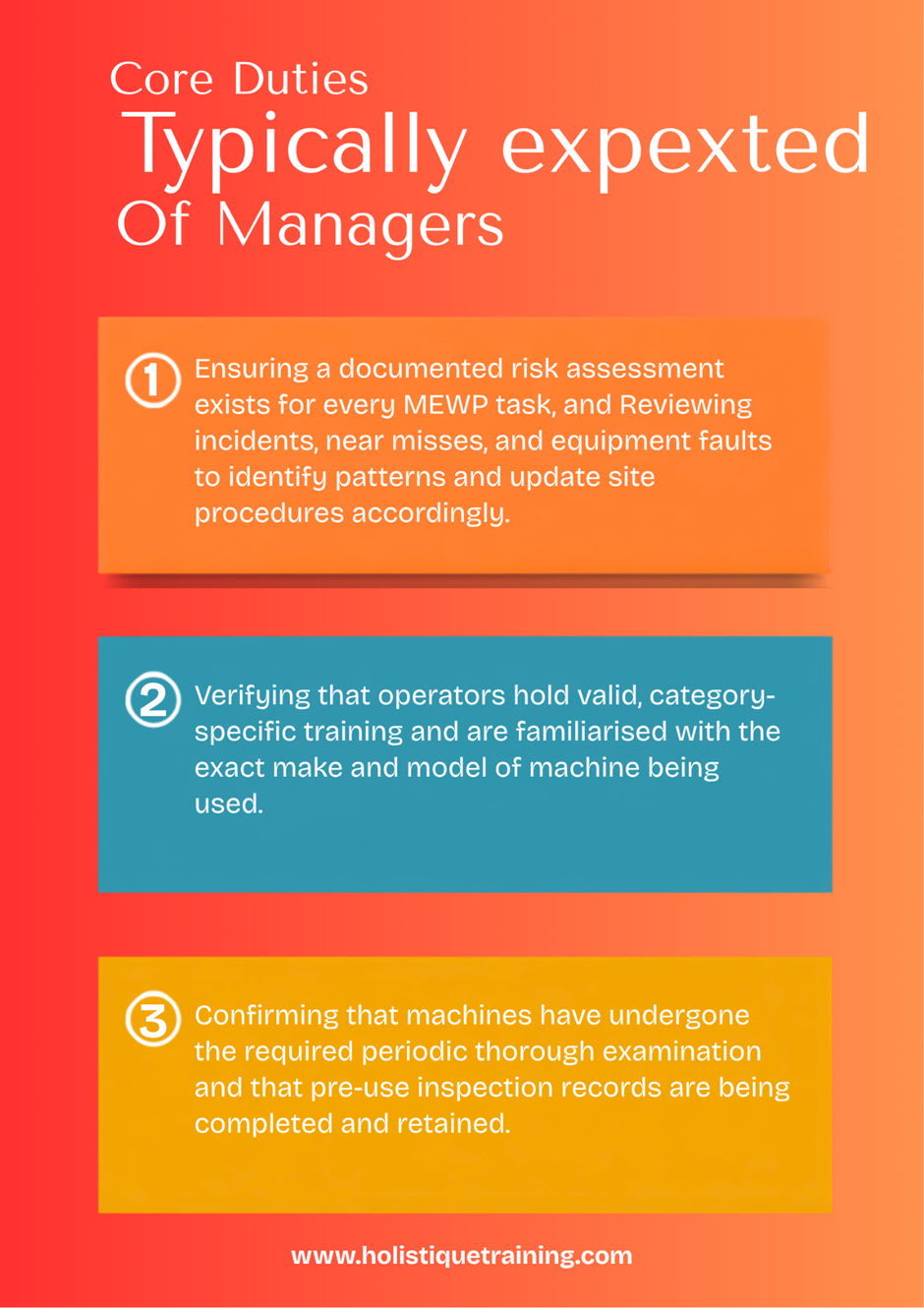
- Core Duties Typically Expected of Managers
- 6- Selecting the Right MEWP for the Job
- 7- Common MEWP Hazards Managers Must Understand
- 8- Building a Safety Culture Around MEWP Use
- 9- The PAL Card, Records, and Verification
- 10- Training Pathways and Renewal
- 11- The Business Case for Manager-Level IPAF Training
- 12- Conclusion
Introduction
Mobile Elevating Work Platforms, more widely known as MEWPs, have become one of the most common pieces of access equipment used across construction, facilities management, logistics, events, and industrial maintenance worldwide. Wherever work must be carried out at height, from warehouse racking to building facades, a MEWP is often the safest and most efficient way to get a person to the task. Yet the safe use of this equipment depends on far more than the skill of the operator standing in the basket. It depends on the decisions made before the platform is ever switched on, decisions about equipment selection, site conditions, supervision, and planning that are made by managers rather than operators.
This is precisely the gap that IPAF, the International Powered Access Federation, designed its MEWPs for Managers course to close. While operator training focuses on how to control a machine safely, manager-level training focuses on how to plan, authorise, and oversee MEWP work so that operators are set up to succeed. For managers who never step into a platform themselves, understanding categories, ground conditions, pre-use checks, and legal duties is still essential, because responsibility for a safe outcome ultimately sits with them.
In this article, we explore what MEWPs are and how IPAF categorises them, why manager-level training matters as much as operator training, what the MEWPs for Managers course typically covers, the legal and duty-of-care responsibilities managers carry, how to select the right machine for a job, the most common hazards involved in powered access work, how to build a lasting safety culture around MEWP use, and what the training and certification pathway looks like in practice.
1- What Are MEWPs and Why They Matter
A Mobile Elevating Work Platform is any device designed to move people, tools, and materials to a working position at height. This includes scissor lifts, boom lifts, vertical masts, and vehicle or trailer-mounted platforms. Unlike scaffolding or fixed access equipment, MEWPs are mobile, quick to deploy, and adjustable to a wide range of working heights, which is why they have become the default solution for temporary work at height across so many industries.
For managers, the appeal of MEWPs is obvious: they reduce the time needed to erect access equipment, they can be repositioned quickly, and they generally require fewer people to operate safely than traditional scaffolding. However, this same flexibility introduces risk. A MEWP is a piece of mobile plant operating with a person elevated above it, often on uneven ground, near overhead obstructions, or close to vehicle traffic. Getting the equipment choice and site planning wrong can turn a routine task into a serious incident.
IPAF Categories of MEWPs
IPAF classifies MEWPs using a simple system based on how the platform moves and how it is powered. Understanding these categories allows managers to specify the right machine for a task without relying solely on a supplier's recommendation.
IPAF Category | Description | Typical Use Case |
1a | Static, vertical movement only, cannot be driven while elevated | Indoor maintenance, low-level access in controlled areas |
1b | Static or mobile, vertical or boom movement, cannot travel while elevated | Vehicle-mounted and trailer-mounted platforms, tree work |
3a | Mobile, vertical movement, can be driven while elevated | Warehousing, retail fit-outs, indoor facilities work |
3b | Mobile, vertical or boom movement, can be driven while elevated | Construction, outdoor maintenance, complex site access |
2- Understanding IPAF and Its Global Role
IPAF is a not-for-profit organisation representing manufacturers, rental companies, distributors, and users of powered access equipment across more than eighty countries. Its purpose is to promote the safe and effective use of MEWPs worldwide through training, guidance, and accident data collection. IPAF training is recognised internationally and typically leads to the issue of a Powered Access Licence, commonly known as a PAL Card, which acts as proof that an individual has completed a recognised course.
While IPAF operator courses are aimed at the people who physically control a MEWP, the organisation has long recognised that operator competence alone is not sufficient to prevent incidents. Decisions about which machine to hire, how a task is planned, and how ground conditions are assessed are typically made by supervisors and managers who may never operate the equipment themselves. This is the reasoning behind the MEWPs for Managers course, which is aimed squarely at those who plan, authorise, or oversee powered access work.
IPAF also maintains an accident reporting portal that collects anonymised incident data from member organisations across the world. This global dataset allows the federation to identify recurring patterns in how and why MEWP incidents occur, rather than relying on isolated national statistics. For managers, this matters because the guidance and course content produced by IPAF is not theoretical; it is shaped directly by real incident trends, updated as new patterns emerge, and reflected in revisions to both operator and manager-level training.
3- Why Managers Need MEWP Training, Not Just Operators
It is a common misconception that MEWP safety is solely the responsibility of the person operating the platform. In practice, many of the decisions that determine whether a task is carried out safely are made long before an operator steps onto the platform. Selecting an appropriate category of machine, assessing whether the ground can bear its weight, checking for overhead hazards, and confirming that the operator holds valid, relevant training are all managerial responsibilities.
IPAF's own accident data underlines why this matters. According to IPAF's Global Safety Report 2025, global fatalities linked to powered access equipment fell by 26 percent in 2024 compared with the previous year, a decrease attributed in part to improved training, machine design, and awareness across the sector.
At the same time, the same reporting cycle found that most serious incidents continue to occur in predictable environments. According to Access Briefing's analysis of the Global Safety Report 2025, most incidents occurred on construction sites, accounting for 37 percent of cases, followed by the arboriculture and electrical sectors at 13 percent each.
These figures point to a consistent pattern: incidents cluster in environments where planning, ground assessment, and site supervision are weakest, which is precisely where a trained manager can make the greatest difference. A manager who understands MEWP categories, ground-bearing requirements, and pre-use inspection expectations is far better placed to challenge unsafe practices before they escalate.
4- What the MEWPs for Managers Course Covers
The MEWPs for Managers course is not a hands-on operator qualification. Instead, it is a classroom-based course designed to give supervisors, site managers, health and safety officers, and facilities managers the knowledge needed to plan and oversee MEWP operations responsibly. Typical course content covers the following areas, which managers are expected to be able to explain and apply after completion.
1- Understanding the range of MEWP categories and their appropriate applications, so that the right machine is specified for the right task rather than whatever happens to be available.
2- Legal duties and responsibilities relevant to work at height, including the roles of employers, duty holders, and supervisors in ensuring safe systems of work.
3- Planning MEWP operations, including site surveys, ground condition assessments, and identifying overhead and underground hazards before work begins.
4- Rescue planning, ensuring that a documented plan exists for retrieving an operator safely in the event of a breakdown, entrapment, or medical emergency.
5- Understanding pre-use inspection requirements and thorough examination intervals, so that managers can verify equipment is fit for purpose before it is deployed.
6- Recognising the limits of operator competence, including how to verify PAL Card validity and ensure operators are familiarised with the specific machine being used.
5- Legal and Duty-of-Care Responsibilities
Although work-at-height legislation varies by country, the underlying principles are broadly consistent across most jurisdictions that follow International Labour Organisation guidance and recognised standards such as ISO 18878, which governs MEWP operator training. Employers and managers generally carry a duty to ensure that work at height is properly planned, that appropriate equipment is selected, that personnel are competent, and that emergency arrangements are in place before work begins.
Core Duties Typically Expected of Managers
1- Ensuring a documented risk assessment exists for every MEWP task, covering ground conditions, overhead hazards, weather, and proximity to other site activities.
2- Verifying that operators hold valid, category-specific training and are familiarised with the exact make and model of machine being used.
3- Confirming that machines have undergone the required periodic thorough examination and that pre-use inspection records are being completed and retained.
4- Maintaining an up-to-date rescue plan that has been communicated to everyone involved in the task, not just the operator.
5- Reviewing incidents, near misses, and equipment faults to identify patterns and update site procedures accordingly.
Failure to meet these duties does not only expose an organisation to legal and financial risk. It directly increases the likelihood of the kind of ground-related incidents that continue to dominate global accident statistics. IPAF's own guidance, developed following its 2025 Global Safety Campaign, notes that fatal overturns increased by 50 percent between January 2021 and December 2023, with unsuitable ground conditions identified as a leading contributing factor.
Building a strong organisational safety management system, of the kind described in established health and safety frameworks, gives managers the structure needed to embed these duties into everyday practice rather than treating them as a one-off compliance exercise.
6- Selecting the Right MEWP for the Job
Choosing the correct category of MEWP is one of the most consequential decisions a manager makes, and it should never be left purely to a hire desk. The decision depends on the working height required, the ground conditions on site, whether the machine needs to travel while elevated, and whether the environment is indoor or outdoor. The comparison below summarises how managers might weigh up common operational scenarios.
Operational Scenario | Recommended Category | Key Consideration |
Indoor warehouse racking access | 3a scissor or vertical lift | Smooth, level flooring and tight aisle widths |
Outdoor construction facade work | 3b boom lift | Uneven ground, outreach, and wind exposure |
Tree surgery and arboriculture | 1b spider or tracked lift | Soft or sloped terrain, narrow access points |
Event rigging and low-level maintenance | 1a static platform | Confined, controlled indoor environments |
Beyond category selection, managers should also confirm platform capacity, outreach requirements, and whether the site has adequate space for outriggers or stabilisers to be deployed safely. Rushing this stage of planning is a recurring theme in incident investigations, and it is an area where manager-level training provides the most tangible improvement in day-to-day decision-making.
7- Common MEWP Hazards Managers Must Understand
Managers do not need to operate a MEWP to understand the hazards associated with its use. In fact, understanding these hazards is arguably more important for managers than for operators, since it is the manager's planning that determines whether these risks are controlled before work begins. The following hazards are consistently identified across IPAF's accident reporting and industry guidance.
1- Overturns caused by unsuitable or unassessed ground conditions, particularly when 3a or 3b category machines travel across uneven surfaces in the elevated position.
2- Entrapment between the platform guardrail and a fixed structure such as a ceiling, beam, or racking system, often resulting from inadequate exclusion zones.
3- Falls from the platform due to failure to use a harness where required, or due to leaning or climbing on guardrails during work.
4- Collisions with vehicles, pedestrians, or other plant, especially on shared construction sites where MEWP movement is not clearly coordinated with other trades.
5- Electrical contact hazards when working near overhead power lines or unmarked underground services that have not been identified during site surveys.
6- Equipment failure due to missed thorough examinations or inadequate pre-use inspections, which can leave defects undetected until they cause an incident.
A structured approach to identifying and mitigating hazards of this kind, similar to the hazard and operability methodology used across complex industrial processes, gives managers a repeatable framework for reviewing MEWP tasks before authorising them.
Delve into the methodology of HAZOP analysis and its vital role in identifying potential hazards, optimising operability, and fostering a safety-conscious culture across industries, particularly the oil and gas sector.
It is worth noting that these hazards rarely occur in isolation. An overturn caused by poor ground assessment, for example, often follows a chain of smaller failures: a rushed site survey, an operator who was not familiarised with the specific machine, and a lack of clear communication between the manager who authorised the task and the team executing it. Recognising this chain of causation is one of the most valuable outcomes of manager-level training, because it shifts the focus from blaming the operator after an incident towards strengthening the planning stage where the real point of failure usually lies.
8- Building a Safety Culture Around MEWP Use
Training alone does not guarantee safe outcomes. A genuine safety culture depends on managers modelling the behaviours they expect from their teams, following through on toolbox talks, and treating near misses as valuable information rather than embarrassments to be minimised. Where managers are visibly engaged in site inspections, ground assessments, and pre-use checks, operators are far more likely to follow the same standard themselves.
This cultural dimension is particularly important given how concentrated MEWP incidents are within specific sectors. Construction environments, where multiple trades operate simultaneously under time pressure, remain the most frequent setting for serious incidents, reinforcing the need for site-wide coordination rather than isolated compliance by individual operators.
Managers overseeing multi-contractor sites benefit from formal training in coordinating safety responsibilities across teams, ensuring that MEWP work is properly sequenced alongside other site activities rather than treated as an isolated task.
It can be said that a team is only as good as those who lead it, particularly regarding construction site management. Whether you are the lead manager or a supervisor, you will be aware that construction is a more significant part of the
9- The PAL Card, Records, and Verification
One of the simplest and most effective controls available to a manager is verifying operator credentials before work begins. IPAF-trained operators are issued a Powered Access Licence, commonly known as a PAL Card, which records the categories of MEWP they are qualified to operate and the expiry date of that qualification. Managers should treat this verification step as a non-negotiable part of task authorisation, alongside confirmation that the operator has been familiarised with the specific machine model being used.
Good record-keeping extends beyond the PAL Card itself. Pre-use inspection logs, thorough examination certificates, and rescue plan documentation should all be readily available on site and reviewed periodically, rather than filed away and forgotten once a project begins.
10- Training Pathways and Renewal
The MEWPs for Managers course typically runs as a short, focused classroom session, often completed within a single day, reflecting its purpose as a knowledge-based course rather than a hands-on skills qualification. Unlike operator PAL Cards, which are generally valid for five years and require a renewal course involving both theory and practical assessment, manager-level training tends to focus on refreshing knowledge of regulatory changes, updated guidance, and emerging best practice.
Organisations that manage a broad portfolio of health, safety, and operational risk often find it more effective to build MEWP awareness into a wider health and safety management programme, ensuring that powered access sits alongside other work-at-height and plant-related risks within a single, consistent framework.
Health and safety within your organisation aren’t just requirements; they provide beneficial training, processes, and procedures to help your business progress. They also help you remain within legislative guidelines to manage risks and profile disasters, guaranteeing the continuation of your business.
For organisations operating in high-risk sectors such as oil, gas, and energy, where MEWPs are frequently used alongside other complex plant and equipment, broader safety management training provides useful context for how powered access fits into a wider operational risk framework.
This comprehensive course aims to equip participants with in-depth knowledge and practical skills to manage and enhance industrial safety within the oil and gas sector. It focuses on the latest safety practices, risk management techniques, and regulatory compliance to ensure a safe working environment.
11- The Business Case for Manager-Level IPAF Training
Beyond regulatory compliance, there is a clear operational argument for investing in manager-level MEWP training. Incidents involving powered access equipment carry significant costs, including project delays, equipment damage, increased insurance premiums, and reputational harm, quite apart from the human cost of injury or fatality. A manager equipped to challenge poor practice before it results in an incident protects both people and the organisation's broader operational performance.
The clustering of incidents within construction, arboriculture, and electrical work also suggests that organisations operating in these sectors have the most to gain from prioritising manager-level training, since even modest improvements in planning and supervision translate into a proportionally larger reduction in risk exposure.
There is also a talent and retention dimension to this investment. Skilled operators and supervisors increasingly expect to work for organisations that take equipment safety seriously, and a visible commitment to structured MEWP planning can support recruitment and retention in sectors where experienced powered access personnel are in short supply. Conversely, organisations with a poor safety record on powered access work often find it harder to secure preferred rates from equipment hire companies and insurers, who increasingly factor safety performance into commercial terms.
12- Conclusion
MEWPs have transformed how organisations approach work at height, offering speed and flexibility that traditional access methods cannot match. But that flexibility depends entirely on sound decisions made before a machine is ever switched on, decisions about category selection, ground conditions, operator competence, and rescue planning that sit squarely within a manager's remit. IPAF's MEWPs for Managers course exists precisely to equip non-operators with the knowledge needed to make those decisions well.
As global accident data continues to show, the environments where incidents cluster, construction sites, arboriculture, and outdoor industrial settings, are also the environments where planning and supervision matter most. Managers who understand IPAF categories, verify PAL Cards, insist on documented risk assessments, and treat ground conditions as a first-order safety concern are directly reducing the likelihood of the kind of incidents that continue to affect the powered access sector worldwide. Investing in that knowledge is not a bureaucratic formality; it is one of the most direct ways an organisation can protect its people.