
- Table of Contents
- Introduction
- 1- What Is Occupational Safety and Health?
- Safety Versus Health
- Who Is Protected
- 2- Why Occupational Safety and Health Matters
- 3- The Global Legal and Regulatory Framework
- International Labour Standards
- ISO 45001
- National Legislation
- 4- Workplace Hazards Every Officer Must Recognise
- 1- Mechanical and structural hazards:
- 2- Physical hazards:
- 3- Chemical hazards:
- 4- Biological hazards:
- 5- Ergonomic hazards:
- 6- Psychosocial hazards:
- 5- Risk Assessment and the Hierarchy of Controls
- The Hierarchy of Controls
- 6- Occupational Safety and Health Management Systems
- 7- Safe Systems of Work and Emergency Preparedness
- Written Procedures
- Permit-to-Work and Isolation
- Emergency Preparedness
- 8- Training, Competence and Vulnerable Workers
- Groups Needing Extra Attention
- 9- Psychosocial Risks and Mental Wellbeing
- 10- Measuring Safety Performance
- 11- Emerging Trends Shaping Occupational Safety and Health
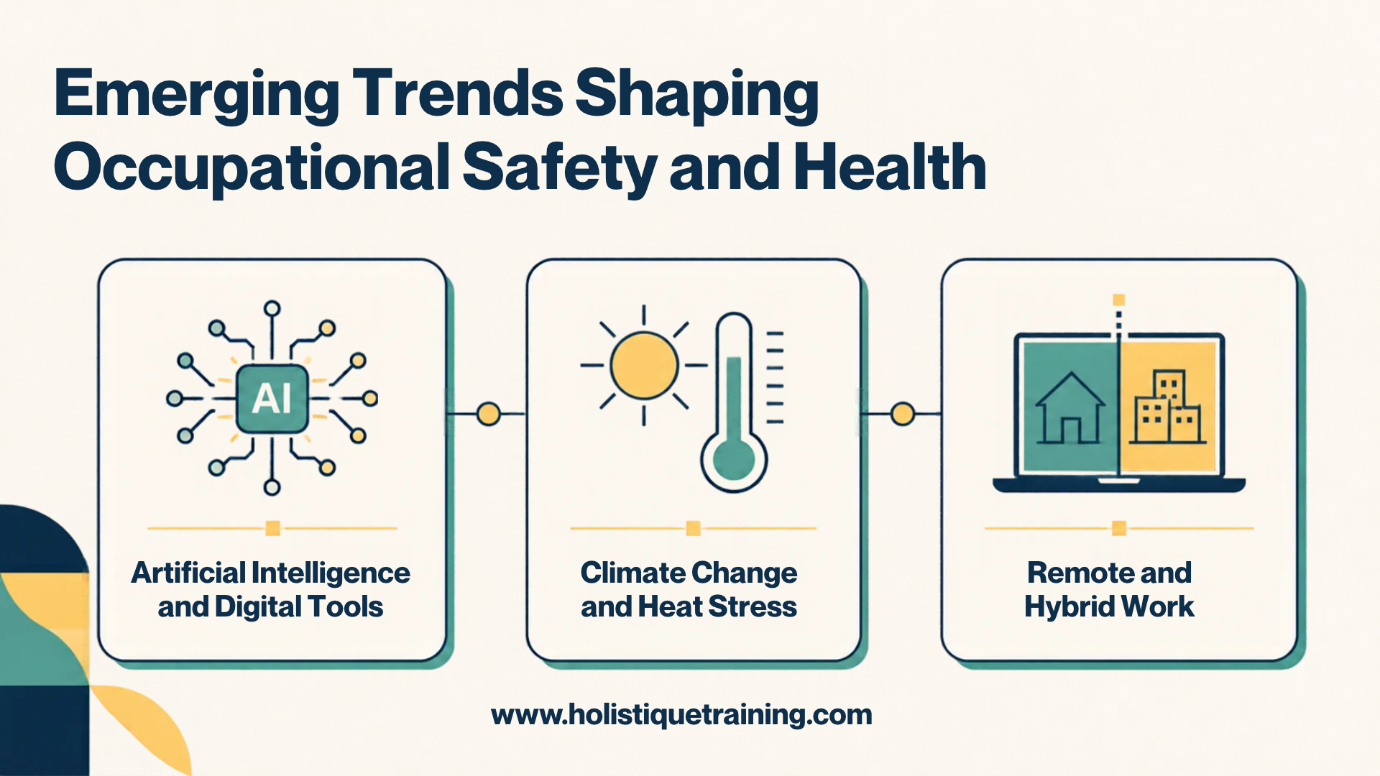
- Artificial Intelligence and Digital Tools
- Climate Change and Heat Stress
- Remote and Hybrid Work
- 12- Building a Strong Safety Culture
- 13- Conclusion
Introduction
Occupational safety and health sits at the centre of responsible organisational management. Every working day, millions of people operate machinery, handle chemicals, drive vehicles, care for patients, sit at desks and manage demanding workloads, and each of these activities carries some degree of risk. The discipline exists to ensure that work does not cost people their lives, their physical health or their mental wellbeing. For health and safety officers, it is both a technical profession and a moral responsibility.
The field is also changing rapidly. Traditional concerns such as falls, machinery accidents and hazardous substances remain urgent, yet they now sit alongside psychosocial risks, climate-related heat exposure, digital monitoring and artificial intelligence in the workplace. Regulators, insurers, investors and employees increasingly expect organisations to demonstrate that safety is managed systematically rather than reactively. A single serious incident can harm workers, trigger enforcement action, damage reputation and disrupt operations for months.
In this article, we will discuss what occupational safety and health means, why it matters, the global legal framework, the main categories of workplace hazards, risk assessment and the hierarchy of controls, management systems, safe systems of work, training and competence, psychosocial risks, performance measurement, emerging trends, and how officers can build a lasting safety culture.
1- What Is Occupational Safety and Health?
Occupational safety and health, often shortened to OSH, is the discipline concerned with preventing work-related injury and disease and with protecting and promoting the health of workers. It covers the physical environment, the way work is organised and managed, and the behaviours and systems that shape everyday decisions. Its purpose is practical: to anticipate hazards, evaluate the risks they create, and put controls in place before harm occurs.
Safety Versus Health
Although the two terms are used together, they describe different concerns. Safety focuses on preventing sudden events such as falls, crushing injuries, fires and electrical contact. Health focuses on conditions that develop gradually through repeated exposure, including noise-induced hearing loss, respiratory disease, musculoskeletal disorders and stress-related illness. The distinction matters because each requires different controls and different monitoring methods. An officer who tracks only accidents may overlook the cumulative harm that never appears in an incident log.
Who Is Protected
Occupational safety and health applies to every sector and every form of work. Duties normally extend beyond permanent employees to contractors, agency staff, volunteers, self-employed workers and visitors who may be affected by work activities. Increasingly, they also reach remote workers and those engaged through digital platforms, whose working environments are harder to inspect but no less capable of causing harm.
2- Why Occupational Safety and Health Matters
The human case for occupational safety and health is the most compelling. Every fatality, amputation or case of occupational cancer represents a life changed for the worker, their family and their colleagues. Many of these outcomes are entirely preventable through sound design, planning and supervision, which is why prevention rather than compensation sits at the heart of modern regulation.
According to the International Labour Organization's 2026 global report on the psychosocial working environment, more than 840,000 people die each year from health conditions linked to psychosocial risks at work, and these risks account for nearly 45 million healthy life years lost annually. The same report estimates that the resulting losses are equivalent to 1.37 per cent of global GDP each year. These figures show that poor working conditions are not only a welfare concern but also a macroeconomic one.
The business case is equally strong. Direct costs include medical treatment, compensation, replacement labour, investigation time, legal fees, fines and higher insurance premiums. Indirect costs are often larger and less visible, including lost productivity, delayed projects, damaged morale, reputational harm and difficulty recruiting skilled staff. Organisations with mature safety performance typically report lower absence, stronger engagement and better retention, which means that investment in prevention supports commercial resilience as well as compliance.
3- The Global Legal and Regulatory Framework
There is no single global occupational safety and health law. Instead, international instruments establish principles that national governments translate into binding legislation, and voluntary standards help organisations structure their own management systems. Health and safety officers working across borders need to understand how these layers fit together.
Instrument | Issuing Body | Main Focus |
|---|---|---|
ILO Convention No. 155 | International Labour Organization | National policy and the duties of governments, employers and workers |
ILO Convention No. 187 | International Labour Organization | Promotional framework, national systems and continuous improvement |
ISO 45001 | International Organization for Standardization | Certifiable occupational health and safety management systems |
National OSH legislation | Governments and regulators | Binding duties, inspection, enforcement and penalties |
International Labour Standards
The International Labour Organization has adopted a series of conventions on occupational safety and health. Convention No. 155 requires member states to develop a coherent national policy and defines the responsibilities of governments, employers and workers. Convention No. 187 promotes continuous improvement through national systems, profiles and programmes. In 2022, the International Labour Conference went further by recognising a safe and healthy working environment as a fundamental principle and right at work, which elevated its status across the entire ILO membership.
ISO 45001
ISO 45001, published in 2018, is the first international standard for occupational health and safety management systems and replaced the earlier OHSAS 18001 specification. It is voluntary and certifiable, and it follows the same high-level structure as other ISO management standards, which makes integration with quality and environmental systems straightforward.
National Legislation
National laws typically set out employer duties, worker rights, inspection powers and penalties. Their detail varies considerably, from prescriptive rules on specific hazards to goal-setting frameworks that require organisations to manage risks so far as is reasonably practicable. Officers should therefore treat international instruments as a baseline and always verify the specific legal requirements of every jurisdiction in which they operate. Enforcement approaches also differ, ranging from advisory visits and improvement notices to prosecution, so officers should understand how inspectors in their jurisdictions typically operate.
4- Workplace Hazards Every Officer Must Recognise
Hazard identification is the starting point of every prevention programme. A hazard is anything with the potential to cause harm, and most workplaces contain several categories at once. Officers should be able to recognise each category and understand how it typically causes injury or illness.
1- Mechanical and structural hazards:
These include falls from height, moving machinery, unguarded equipment, vehicle movements, falling objects and unstable structures. They are responsible for many of the most serious acute injuries, particularly in construction, agriculture, warehousing and manufacturing.
2- Physical hazards:
Noise, vibration, extreme temperatures, radiation and poor lighting fall into this group. Their effects, such as hearing loss, hand-arm vibration syndrome or heat illness, often develop gradually and are easily underestimated.
3- Chemical hazards:
Dusts, fumes, vapours, solvents and acids can harm through inhalation, skin contact or ingestion. Asbestos, silica and welding fumes remain major causes of occupational disease and require strict exposure control.
4- Biological hazards:
Bacteria, viruses, fungi and animal-borne diseases affect healthcare, laboratory, agricultural, waste and sanitation workers in particular. Effective controls include vaccination, hygiene, containment and appropriate protective equipment.
5- Ergonomic hazards:
Heavy lifting, repetitive tasks, awkward postures and poorly designed workstations lead to musculoskeletal disorders, which are among the most common causes of long-term work-related ill health across all sectors.
6- Psychosocial hazards:
Excessive workload, long hours, job insecurity, lack of control, bullying and harassment can damage mental and physical health. These hazards are now recognised as a core part of occupational safety and health rather than a separate wellbeing issue.
According to the Health and Safety Executive, 126 workers were killed in work-related incidents in Great Britain in 2025/26, and falls from height were the most common cause with 31 deaths, around a quarter of the total. Construction recorded 25 deaths and agriculture, forestry and fishing 22, while agriculture had the highest fatal injury rate at 8.09 per 100,000 workers compared with an all-industry average of 0.37. These statistics demonstrate that the hazards which dominated workplaces decades ago continue to claim lives even where regulation and enforcement are mature.
5- Risk Assessment and the Hierarchy of Controls
Risk assessment converts hazard identification into decisions. It evaluates the likelihood that a hazard will cause harm and the severity of that harm, then determines whether existing controls are adequate. A structured approach keeps assessments consistent and defensible, and the following five steps are widely used across jurisdictions.
1- Identify the hazards: Walk the workplace, review task descriptions, consult workers and examine incident, near-miss and absence records to build a realistic picture of what could cause harm.
2- Decide who might be harmed and how: Consider employees, contractors, visitors and vulnerable groups such as new starters, young workers, pregnant workers and people with disabilities.
3- Evaluate the risks and select controls: Estimate likelihood and severity, compare existing precautions with good practice and decide what further action is necessary.
4- Record and implement findings: Document significant findings, assign responsibilities and deadlines, and communicate the results clearly to those who need to act on them.
5- Review and update: Reassess whenever work processes, equipment, personnel or legislation change, and after any incident or near miss.
The Hierarchy of Controls
Once risks are evaluated, controls should be selected according to the hierarchy of controls. The principle is simple: the higher a control sits in the hierarchy, the less it depends on human behaviour and the more reliably it protects workers. Relying on the lowest levels alone is one of the most common weaknesses found in poorly managed workplaces.
Control Level | Approach | Workplace Example |
|---|---|---|
Elimination | Remove the hazard completely | Redesigning a task so that work at height is no longer required |
Substitution | Replace with a less hazardous alternative | Using a water-based cleaning agent instead of a solvent |
Engineering controls | Isolate people from the hazard | Machine guarding and local exhaust ventilation |
Administrative controls | Change how people work | Job rotation, safe procedures and warning signs |
Personal protective equipment | Protect the individual as a last resort | Respirators, safety footwear and hearing protection |
Personal protective equipment is essential in many situations, but it should never be the first choice. It protects only the wearer, depends on correct selection, fit and use, and does nothing to remove the hazard itself. A well-run programme combines controls from several levels while prioritising elimination and engineering solutions wherever they are reasonably practicable. Documenting why a particular control was chosen, and why higher-level options were rejected, also gives officers a defensible record if regulators or auditors later question the decision.

The International General Certificate in Occupational Health and Safety is part of the 2019 syllabus for workplace health and safety regulations. Achieving this certification sets you apart in your career and demonstrates your commitment to a safe and compliant working environment.
6- Occupational Safety and Health Management Systems
A management system turns isolated good practice into a consistent, repeatable way of working. Most systems follow the Plan, Do, Check, Act cycle: organisations plan by setting policy and objectives, do by implementing controls, check by monitoring performance and act by correcting weaknesses. ISO 45001 builds on this logic and identifies several elements that officers should be able to evaluate and strengthen.
1- Leadership and commitment: Senior managers must set the policy, allocate resources and visibly take responsibility for safety performance. Without genuine leadership, procedures remain paperwork.
2- Worker consultation and participation: Workers know where processes break down. Safety committees, representatives and open reporting channels turn that knowledge into earlier warnings.
3- Planning and risk-based thinking: Organisations identify hazards, legal requirements, risks and opportunities, then set measurable objectives to address them.
4- Performance evaluation and improvement: Monitoring, internal audits and management reviews reveal whether controls work, and corrective actions close the gaps.
Officers play a central role in each element by advising leaders, facilitating consultation, supporting assessments and reporting honestly on performance. A mature system also integrates safety into procurement, project design, contractor selection and change management, so that risks are addressed before they reach the shop floor. Management reviews should be scheduled, minuted and followed by action, because a system that is never reviewed gradually drifts away from the reality of the work.
Health and safety within your organisation aren’t just requirements; they provide beneficial training, processes, and procedures to help your business progress. They also help you remain within legislative guidelines to manage risks and profile disasters, guaranteeing the continuation of your business.
7- Safe Systems of Work and Emergency Preparedness
Written Procedures
Safe systems of work translate risk assessment findings into clear instructions. Good procedures describe the task step by step, identify hazards and controls, specify required equipment and state what to do if something goes wrong. They should be written in plain language, tested with the people who perform the work and revised when practice changes.

Regardless of the type of organisation or industry, health and safety must always be a priority. Maintaining health and safety is crucial to the welfare of all working within an organisation. It encompasses identifying risks, implementing preventative measures, and producing health and safety procedures when
Permit-to-Work and Isolation
High-risk activities such as hot work, confined space entry, work at height and electrical maintenance require additional control. A permit-to-work system ensures that hazards are assessed, isolations are applied and verified, and responsibilities are clearly assigned before work begins. Lockout and tagout procedures prevent equipment from being energised unexpectedly while maintenance is in progress.
Emergency Preparedness
Even well-controlled workplaces need effective emergency arrangements. These include evacuation plans, trained first aiders, fire detection and firefighting equipment, spill response and clear communication routes. Regular drills reveal weaknesses that plans on paper never expose, and post-drill reviews should lead to documented improvements.
8- Training, Competence and Vulnerable Workers
Competence is the link between a well-designed system and safe behaviour. Induction training should cover site hazards, emergency arrangements and reporting routes before a worker starts independent work. Task-specific training, refresher sessions and regular toolbox talks then maintain awareness. Training should be evaluated through observation and assessment rather than attendance records alone, since a signature on a register does not prove understanding.
According to Travelers' 2026 Injury Impact Report, which analysed more than 1.2 million workers' compensation claims from 2021 to 2025, first-year employees generate more than a third of all injuries despite making up a smaller share of the workforce. New employees account for roughly 44 per cent of injuries in construction and about half in restaurants, while injured workers aged 60 and over need an average of 97 days to recover compared with 80 days overall.
Groups Needing Extra Attention
Some workers face higher risk and need tailored protection. Young and inexperienced workers may lack hazard awareness and hesitate to raise concerns. Older workers may take longer to recover from injury and be more exposed to certain risks. Migrant, agency and temporary workers often receive less training and have weaker access to representation, while lone workers face delays in obtaining help during emergencies. Risk assessments should explicitly consider each of these groups. Adjusting induction content, supervision levels and communication methods for them is far more effective than expecting every worker to adapt to a single standard approach.
9- Psychosocial Risks and Mental Wellbeing
Psychosocial risks arise from the way work is designed, organised and managed. They include excessive workload, long working hours, unclear roles, low autonomy, job insecurity, poor management support, and bullying or harassment. The ILO findings discussed earlier show that these factors contribute to cardiovascular disease and mental ill health on a large scale, which is why they must be handled through the same systematic process as any other hazard.
Effective management begins with assessing the risk at organisational level rather than treating stress as an individual weakness. Officers should work with human resources, line managers and worker representatives to identify patterns in absence, turnover, grievances and survey results, then agree practical actions. The following measures are among the most effective.
1- Redesign workload and working time: Set realistic staffing levels, manage overtime and protect rest periods so that demands match capacity.
2- Clarify roles and expectations: Clear responsibilities and consistent communication reduce ambiguity, one of the most frequent sources of work-related stress.
3- Strengthen support and autonomy: Trained managers who give feedback, recognition and reasonable control over how work is done reduce strain significantly.
4- Prevent violence and harassment: Clear policies, confidential reporting channels, prompt investigation and visible consequences show that unacceptable behaviour will not be tolerated.
Because psychosocial risks interact with physical ones, for example when fatigue increases the chance of an accident, integrating them into existing risk assessments produces better results than creating a separate programme.
10- Measuring Safety Performance
What gets measured gets managed, but only if the right things are measured. Many organisations still rely heavily on lagging indicators such as injury rates, which describe harm that has already occurred. Leading indicators describe the activities and conditions that prevent harm, giving officers an opportunity to intervene earlier. A balanced scorecard uses both, together with measures of safety culture.
Indicator Type | Examples | Main Purpose |
|---|---|---|
Lagging | Lost-time injury rate, fatalities, ill-health cases and days lost | Show past outcomes and progress against targets |
Leading | Hazard reports closed on time, inspections completed and training completion | Predict and prevent future incidents |
Culture | Survey results, near-miss reporting rates and worker participation | Reveal the strength of trust and safety culture |
Incident investigation completes the picture. Investigations should seek root causes in systems, design, supervision and resources rather than stopping at operator error. Encouraging near-miss reporting is particularly valuable because near misses occur far more often than injuries and share the same underlying causes. Reporting rates rise only when workers trust that their reports lead to improvement rather than blame.
11- Emerging Trends Shaping Occupational Safety and Health
Artificial Intelligence and Digital Tools
Wearable sensors, computer vision, drones and predictive analytics can detect hazards, monitor fatigue and gas exposure, and flag unsafe conditions in real time. These tools promise earlier intervention, but they also raise questions about privacy, data protection and algorithmic management that can themselves become psychosocial hazards. Officers should involve workers in deciding how technology is introduced and how data is used.
Climate Change and Heat Stress
Rising temperatures, extreme weather and wildfire smoke expose outdoor and indoor workers to greater risk of heat illness, dehydration and respiratory problems. Employers should assess heat exposure, adjust work schedules, provide shade, water and rest, and acclimatise new or returning workers gradually.
Remote and Hybrid Work
Home working shifts safety duties to environments that employers cannot easily inspect. Display screen assessments, guidance on posture and breaks, and attention to isolation and the blurring of boundaries between work and home help maintain protection without excessive intrusion.
12- Building a Strong Safety Culture
Safety culture is the shared set of values, attitudes and behaviours that determine how safety is handled when no one is watching. It cannot be imposed by procedure alone. Cultures improve when leaders act consistently, when workers are involved in decisions, and when reporting problems is rewarded rather than punished. Officers influence culture through everyday credibility as much as technical expertise.
1- Lead by example: Managers who follow the rules, stop unsafe work and join safety walks demonstrate that safety takes priority over speed.
2- Listen and respond: Act visibly on reports and suggestions, and tell workers what changed as a result.
3- Recognise good practice: Celebrate proactive behaviour such as early hazard reporting, not only the absence of injuries.
4- Keep learning: Share lessons from incidents, audits and industry events, and invest in the continuing professional development of safety staff.
13- Conclusion
Occupational safety and health is a discipline that protects people, sustains organisations and supports economic development. The evidence from the ILO, national regulators and insurers shows that progress is real, yet serious harm persists in familiar forms such as falls and in newer forms such as psychosocial risk. Effective prevention depends on understanding hazards, assessing risks honestly, applying the hierarchy of controls, and embedding these practices in a management system led from the top.
For health and safety officers, the challenge is to combine technical rigour with influence. That means translating legal requirements into workable procedures, measuring both leading and lagging indicators, supporting vulnerable workers, and adapting to developments such as artificial intelligence, climate risk and new ways of working. Organisations that make safety a shared value rather than a compliance exercise will be best placed to keep their people safe and their operations resilient.
Explore Health & Safety Management—its importance and 10 guiding principles to protect well-being, ensure compliance, and drive safer workplaces.