
- Table of Contents
- Introduction
- 1- What Is Self-Directed Learning?
- The Core Elements of Self-Directed Learning
- Self-Directed Learning Compared With Traditional Training
- 2- Why Self-Directed Learning Matters Now
- 3- The Theories Behind Self-Directed Learning
- Andragogy
- Self-Determination Theory
- Self-Regulated Learning
- Grow’s Staged Model
- 4- Essential Skills for Self-Directed Learners
- 5- Building a Personal Learning Plan
- 6- Tools and Resources for Independent Learning
- Structured Online Courses
- Books, Podcasts, and Professional Publications
- Communities, Mentors, and Peer Groups
- AI Assistants and Adaptive Tools
- 7- Benefits of Self-Directed Learning
- Benefits for Individuals
- Benefits for Organisations
- Creating a Culture That Supports Learning
- 8- Challenges and Limitations
- 9- Overcoming Barriers and Measuring Progress
- Practical Strategies
- Blending Independent and Formal Learning
- Measuring Progress
- 10- The Future of Self-Directed Learning
- Conclusion
Introduction
Few workplace skills have gained as much attention in recent years as the ability to learn without being told what, when, or how to study. Technology now reshapes job roles faster than formal qualifications can be updated, and employers increasingly expect their people to keep pace on their own initiative. At the same time, professionals are balancing demanding schedules, tighter training budgets, and an overwhelming supply of online content. In this context, self-directed learning has moved from a personal hobby to a core professional capability.
Self-directed learning describes a process in which individuals take the lead in diagnosing their learning needs, setting goals, choosing resources, applying strategies, and judging their own progress. It does not mean learning in isolation, and it does not replace teachers, mentors, or formal programmes. Instead, it places the learner in the driving seat while drawing on whatever support proves useful. That shift in responsibility raises important questions. What makes some people far more effective at it than others? How can organisations encourage it without losing quality control? And where does independent study fall short?
In this article, we will discuss what self-directed learning is, why it matters now, the theories behind it, the skills learners need, how to build a personal learning plan, useful tools and resources, benefits for individuals and organisations, common challenges, practical ways to overcome them, how to measure progress, and where the approach is heading.
1- What Is Self-Directed Learning?
Self-directed learning is an approach in which the learner takes primary responsibility for planning, carrying out, and evaluating their own learning. The educator Malcolm Knowles described it as a process in which individuals, with or without the help of others, diagnose their learning needs, formulate goals, identify resources, choose strategies, and evaluate outcomes. This definition is useful because it separates the approach from simple self-study. A person reading a book at random is studying alone, whereas a self-directed learner works towards a defined purpose and checks whether it has been achieved.
Self-direction also exists on a spectrum. Few people plan every detail of their learning, and most combine independent effort with structured input from courses, managers, or peers. The approach is best understood as a question of who makes the key decisions, not whether other people are involved.
The idea is not new. Educators have discussed learner autonomy since the 1970s, and the concept has since spread from adult education into corporate training, higher education, and community programmes. What has changed is the scale of available resources. A professional today can access lectures, simulations, expert communities, and practice tools in minutes, which has made independent learning practical for far more people than ever before.
The Core Elements of Self-Directed Learning
Most descriptions of the approach share five core elements, which together form a repeating cycle.
- Needs diagnosis:The learner identifies the gap between current and required capability, often by reviewing job demands, colleague feedback, or long-term career goals.
- Goal setting:Broad ambitions are turned into specific outcomes with deadlines, such as completing a data analysis project within eight weeks.
- Resource selection:The learner chooses the courses, books, mentors, or practice tasks that fit the goal, rather than relying on whatever has been assigned.
- Strategy and action:Time, methods, and practice routines are planned and followed, from daily reading blocks to weekly projects.
- Evaluation and reflection:Progress is judged against the original goals, and the lessons feed directly into the next cycle.
Self-Directed Learning Compared With Traditional Training
The differences become clearer when the two approaches are placed side by side.
Dimension | Self-Directed Learning | Instructor-Led Training |
|---|---|---|
Who sets the goals | The learner | The trainer or organisation |
Pace | Flexible and personal | Fixed by the timetable |
Content selection | Chosen by the learner | Set by the curriculum |
Feedback | Self-assessment, peers, or mentors | Provided by the instructor |
Cost | Often lower | Usually higher |
Main risk | Knowledge gaps and drift | Limited relevance and flexibility |
The comparison does not suggest that one approach is better. Instructor-led training remains valuable for regulated topics, complex practical skills, and situations where consistency matters. Self-directed learning is strongest where needs are personal, fast-changing, or difficult to predict, and many organisations now use the two together.
2- Why Self-Directed Learning Matters Now
Work is changing faster than most training cycles can follow. Automation, artificial intelligence, and shifting business models mean that the skills needed for a role can alter within a few years. Professionals who wait for their employer to schedule a course risk falling behind, and employers cannot realistically design a programme for every emerging need. Self-directed learning fills that space by letting people respond to change as it happens.
According to the World Economic Forum’s Future of Jobs Report 2025, employers expect 39% of existing skill sets to be transformed or become outdated between 2025 and 2030. The same report found that 63% of employers see skill gaps as the biggest barrier to business transformation, and that curiosity and lifelong learning are among the skills expected to grow in importance. These findings show that continuous learning is now a business requirement rather than a personal preference.
There is also an economic argument. Formal programmes are valuable, but they are expensive, time-consuming, and often slow to update. Independent learning allows professionals to add targeted skills in weeks, test their interest in a new field before committing money, and continue earning while they study. For freelancers and small businesses with no training budget, it is often the only realistic route to development.
Learning habits are also changing inside the workplace. Short, task-focused modules, embedded prompts, and on-demand guidance let employees learn while working instead of stepping away from it. This model rewards people who can identify their own needs in the moment and act on them, which is exactly what self-directed learners do well.
3- The Theories Behind Self-Directed Learning
Several established theories explain why self-directed learning works and how the ability develops.
Andragogy
Knowles’ theory of adult learning argues that adults are self-directed, draw on accumulated experience, and are motivated most strongly by problems they need to solve now. This explains why professionals often learn fastest when the material connects directly to a live task.
Self-Determination Theory
Developed by Edward Deci and Richard Ryan, this theory holds that motivation flourishes when people feel autonomy, competence, and relatedness. Self-directed learning supports autonomy by giving learners choice, builds competence through visible progress, and can support relatedness through study groups and mentoring.
Self-Regulated Learning
Barry Zimmerman’s model describes learning as a cycle of forethought, performance, and self-reflection. Learners plan and set goals, monitor their attention and methods while they work, and then judge the results and adjust. Strong self-regulation is widely seen as central to independent learning success.
Grow’s Staged Model
Gerald Grow proposed that self-direction is a skill developed in stages rather than a fixed trait. A learner who is highly independent in one subject may be a complete beginner in another, and needs different support at each point.
Stage | Learner Profile | Most Helpful Support |
|---|---|---|
1- Dependent | Needs clear instruction and direction | A coach who gives explicit guidance |
2- Interested | Motivated, but still reliant on guidance | A guide who inspires and explains |
3- Involved | Has skills and confidence, and learns as a partner | A facilitator who collaborates |
4- Self-directed | Sets personal goals and standards | A consultant who advises on request |
This staged view is helpful for managers, who often assume that everyone should be equally ready for independence. Taken together, these theories point to a practical conclusion. Independent learning succeeds when people have choice, see progress, and receive support that matches their current level of confidence, not when they are simply left alone with a reading list.
4- Essential Skills for Self-Directed Learners
Self-direction is a set of learnable skills, not a personality trait. Six of them matter most.
- Goal setting and planning: The ability to define specific outcomes, often using SMART criteria, and to break them into manageable stages.
- Time management: Protecting regular study slots and weighing learning against competing workload, so that progress continues in busy weeks.
- Information literacy: Finding, judging, and combining sources by asking who wrote them, what evidence supports them, and how recent they are.
- Self-motivation and persistence: Sustaining effort without external deadlines, drawing on curiosity, personal purpose, and small visible wins.
- Reflection and self-assessment: Honestly judging understanding through quizzes, written summaries, or explaining a concept to a colleague.
- Help-seeking and networking: Knowing when to ask a mentor, join a community, or request feedback, because independent does not mean alone.
None of these skills is fixed, and each improves with deliberate practice. Time management is often the deciding factor, because even highly motivated learners struggle when study competes with a full workload. Learners and managers can also treat these skills as a checklist for development conversations. A manager might, for example, ask which of the six a team member finds hardest and agree one small action to strengthen it over the next quarter.

This program emphasises the critical role of productivity in achieving personal success and organisational excellence. Effective task management, team collaboration, and continuous assessment of improvement areas are essential to staying ahead of the competition. Adhering to strict deadlines is crucial to maintaining momentum and progress.
5- Building a Personal Learning Plan
A plan turns good intentions into a routine that survives a busy week. A simple six-step process works for most professionals.
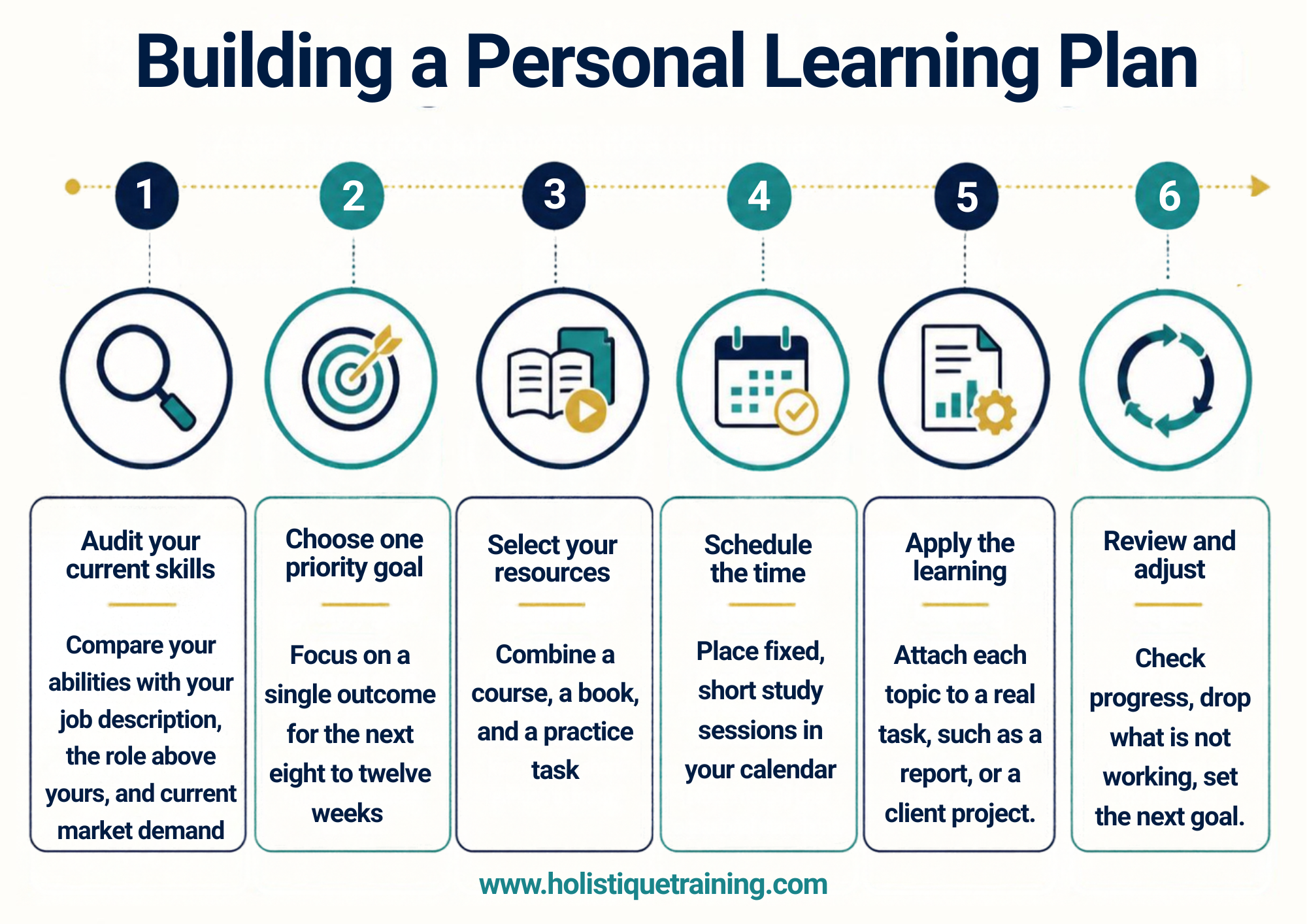
- Audit your current skills:Compare your abilities with your job description, the role above yours, and current market demand, and ask a trusted colleague for an honest view.
- Choose one priority goal:Focus on a single outcome for the next eight to twelve weeks instead of trying to improve five areas at once.
- Select your resources:Combine a course, a book, and a practice task, and keep the list short enough to finish.
- Schedule the time:Place fixed, short study sessions in your calendar, because regular thirty-minute blocks usually beat occasional marathons.
- Apply the learning:Attach each topic to a real task, such as a report, a presentation, or a client project.
- Review and adjust:Check progress monthly, drop what is not working, and set the next goal.
Consider a marketing manager who wants to become confident with data analysis. Their audit shows strong campaign knowledge but weak spreadsheet and reporting skills. They set one goal, to build a monthly performance dashboard within ten weeks, choose an online course and a reference book, and block two lunchtime sessions each week. Each new technique is applied to real campaign data, so learning and work reinforce each other.
Writing the plan down matters. A one-page document with the goal, resources, schedule, and review dates makes progress visible and creates a natural point for discussion with a manager or mentor. Sharing the plan also creates light accountability, which many independent learners lack.

Learn how to create an effective career development plan—assess skills, set goals, seek mentorship, and build a clear path for continuous growth.
6- Tools and Resources for Independent Learning
The range of learning resources has never been wider, so the challenge is choosing well rather than finding content.
Structured Online Courses
Online courses and open platforms offer clear sequences, assessments, and sometimes recognised certificates, which suit learners who need structure. Learners should check that a course includes practical tasks and some form of assessment, since watching videos alone rarely builds skill.
Books, Podcasts, and Professional Publications
Books provide depth, while podcasts and industry publications keep learners aware of current practice during commutes or short breaks. Reading a small number of well-regarded sources in depth is usually more valuable than skimming many.
Communities, Mentors, and Peer Groups
Professional networks, online forums, and mentors supply feedback and context that no course can, and they help learners test ideas against real experience. Even one regular conversation with an experienced colleague can reveal blind spots that months of solo study would miss.
AI Assistants and Adaptive Tools
AI tools can explain concepts, generate practice questions, and suggest next steps. They are useful, but their answers should always be checked against reliable sources. A useful habit is to ask the tool for an explanation, verify the key claims, and then apply them to a real example.
Resource Type | Best For | Main Limitation |
|---|---|---|
Online courses | Structured learning of a new subject | Easy to start and abandon |
Books and long articles | Depth and conceptual understanding | Slower to reflect new developments |
Podcasts and videos | Learning in short gaps in the day | Passive, so understanding is harder to test |
Communities and mentors | Feedback and practical context | Quality depends on the people involved |
AI assistants | Instant explanations and practice | Answers can be inaccurate |
Whatever the mix, the aim is to match the resource to the goal. A learner building broad understanding may lean on books and courses, while someone solving an immediate workplace problem may prefer short videos and peer advice.
7- Benefits of Self-Directed Learning
Benefits for Individuals
Professionals who learn independently gain advantages that build over time.
- Greater adaptability:People who already know how to acquire new knowledge adjust more easily when roles, tools, or industries change.
- Increased confidence:Setting and reaching personal goals builds a sense of competence that carries into other areas of work.
- Control over pace and cost:Learners decide what to study and when, and can often do so at little or no expense.
- Better retention:Knowledge is remembered more reliably when it is applied to real tasks straight away.
- A visible career advantage:Employers increasingly look for evidence that people keep their skills current, and independent learners can show it through projects, portfolios, and results rather than certificates alone.
Taken together, these benefits explain why investing in knowledge at a personal level pays off for both learners and the organisations that employ them.
Benefits for Organisations
Organisations gain a workforce that closes many of its own skill gaps, adopts new tools faster, and needs less formal training for every change. Teams that learn independently can adopt new software, processes, and regulations more quickly, and they place less demand on central training budgets. Learning that is chosen also tends to be more engaging. However, many employers have not yet built the support around it. LinkedIn’s 2025 Workplace Learning Report found that only 36% of organisations qualify as career development champions with robust programmes that deliver business results. Another 31% have programmes with limited adoption, and 33% have no initiatives or are only starting.
Creating a Culture That Supports Learning
Independence works best when the organisation makes it easy. Managers can protect learning time, recognise progress in performance conversations, and give employees a real say in their development. Learning teams can support this by curating pathways, mapping skills, and building simple systems for sharing what people have learned, rather than pushing generic content to everyone.

Many forward-thinking business owners realise that simply giving orders isn't the most effective way to get work done. Research shows that employees are more motivated and productive when they are free to make their own choices and follow paths they enjoy.
8- Challenges and Limitations
Independent learning is powerful, but it has weaknesses that learners and organisations should understand.
- Procrastination and drift:Without deadlines or an instructor, study is easily pushed aside by urgent work.
- Unknown unknowns:Learners cannot always see what they are missing, so they may skip foundational ideas and build on weak ground.
- Information overload and weak sources:The volume of content makes it hard to separate reliable guidance from confident but poor advice.
- Limited feedback:Misunderstandings can go uncorrected for months when nobody reviews the learner’s work.
- Unequal access:Independent learning needs time, devices, connectivity, and confidence, and people in lower-paid or more demanding roles often have the least of each.
The Learning and Work Institute’s Adult Participation in Learning Survey 2025 found that 42% of UK adults had taken part in learning in the previous three years, down from 52% in 2024. It also found that only 21% were currently learning, compared with 30% the year before, and that employed people recorded some of the sharpest falls. These figures suggest that opportunity, and not just willingness, shapes who gets to learn.
For organisations, the implication is clear. Leaving learning entirely to individual initiative tends to favour those who already have time, confidence, and support. Deliberate encouragement, protected time, and fair access are needed if self-directed learning is to benefit everyone.
9- Overcoming Barriers and Measuring Progress
Practical Strategies
Most barriers respond to simple design. Four practical strategies help most learners.
- Fixed routines:Regular study slots reduce reliance on willpower and make learning a habit rather than a decision made each day.
- Accountability partners:Sharing goals with a colleague or mentor adds gentle pressure and a second perspective on progress.
- Early feedback:Asking a manager or peer to review a draft, plan, or project after each stage catches misunderstandings before they harden.
- Selective sources:Choosing two or three trusted sources and ignoring the rest until the goal is met reduces information overload.
Blending Independent and Formal Learning
The strongest results often come from combining approaches. A learner might use a structured course to build foundations, independent projects to practise, and periodic mentor reviews to check quality. Some organisations formalise this through learning agreements, in which the employee and manager agree goals, resources, and review dates in advance. This keeps the freedom of self-direction while adding a light layer of structure and support.
Measuring Progress
Progress should be measured by outcomes, not hours. Tasks completed, errors reduced, or a project delivered give a more honest picture than time spent studying. Portfolios of work, short written reflections, and periodic self-assessment against a skills framework all help. Where external recognition matters, short accredited programmes and micro-credentials can confirm that independent learning has reached a recognised standard. Small, regular reviews are more useful than a single annual check, because they allow learners to correct course early.
10- The Future of Self-Directed Learning
Three developments are likely to shape the next few years.
- AI tutors and adaptive platforms:Personalised guidance will be available to almost anyone, lowering the barrier for beginners while raising the importance of checking accuracy.
- Micro-credentials and skills-based hiring:Independent learners will have better ways to prove what they know without needing a full degree.
- Learning built into daily work:Employers are likely to embed self-direction through learning in the flow of work, embedded prompts, and clearer internal career pathways.
The learners who benefit most will be those who combine technology with strong judgement and regular reflection. Ethical and practical questions will also need attention, including data privacy, the accuracy of automated advice, and fair access to technology across different groups of workers.
Conclusion
Self-directed learning is no longer optional for professionals who want to stay relevant. It answers real pressures: fast-changing skills, limited training budgets, and the need for flexibility. Its strongest benefits lie in adaptability, autonomy, and the ability to apply new knowledge immediately.
At the same time, it is not a complete substitute for guidance. Learners can miss gaps, lose momentum, or rely on weak sources, and access to time and resources is uneven. The most effective approach combines personal initiative with feedback, mentoring, and structured programmes when they are needed. Individuals who plan deliberately, apply what they learn, and measure outcomes will get the most from it. Organisations that give people time, recognition, and clear pathways will find that independent learners become a genuine source of capability. Ultimately, the question is no longer whether professionals should direct their own learning, but how well they and their organisations support them in doing so.

Becoming a training and development expert requires education, experience, and skills. These roles identify the organisation's skill gaps and learning needs. Conducting thorough assessments can determine where employees require training to enhance their performance and contribute more effectively to the company's goals. Dedicated training