
- Table of Contents
- Introduction
- 1- Why Skills Matter More Than Ever for Career Growth
- The Shrinking Shelf Life of Skills
- From Job Titles to Capabilities
- The Cost of Standing Still
- Why This Matters for Managers and Team Leaders
- 2- How to Choose the Best Courses for the Future
- 1- Relevance to your goals:
- 2- Provider credibility:
- 3- Practical application:
- 4- Flexibility and cost:
- 3- The Skill Categories That Will Shape Careers
- 4- Best Courses in Artificial Intelligence and Data Literacy
- 1- AI for Everyone:
- 2- Elements of AI:
- 3- Microsoft Learn AI fundamentals:
- 4- Google Data Analytics Professional Certificate:
- 5- Best Courses in Leadership and Management
- 1- CMI management and leadership qualifications:
- 2- ILM leadership programmes:
- 3- Leadership Principles from Harvard Business School Online:
- 4- Strategic Leadership and Management specialisation:
- 6- Best Courses in Communication and Emotional Intelligence
- 1- Crucial Conversations:
- 2- Successful Negotiation: Essential Strategies and Skills:
- 3- LinkedIn Learning communication pathways:
- 7- Critical Thinking, Problem-Solving and Adaptability
- 1- Learning How to Learn:
- 2- Critical thinking and decision-making courses:
- 3- Design thinking and problem-solving:
- 8- Project, Change and Digital Skills
- 1- Project Management Professional (PMP):
- 2- PRINCE2:
- 3- Agile and Scrum certifications:
- 4- Prosci change management:
- 9- Comparing Learning Formats
- 10- Building a Personal Learning Plan
- 11- How Managers Can Support Team Learning
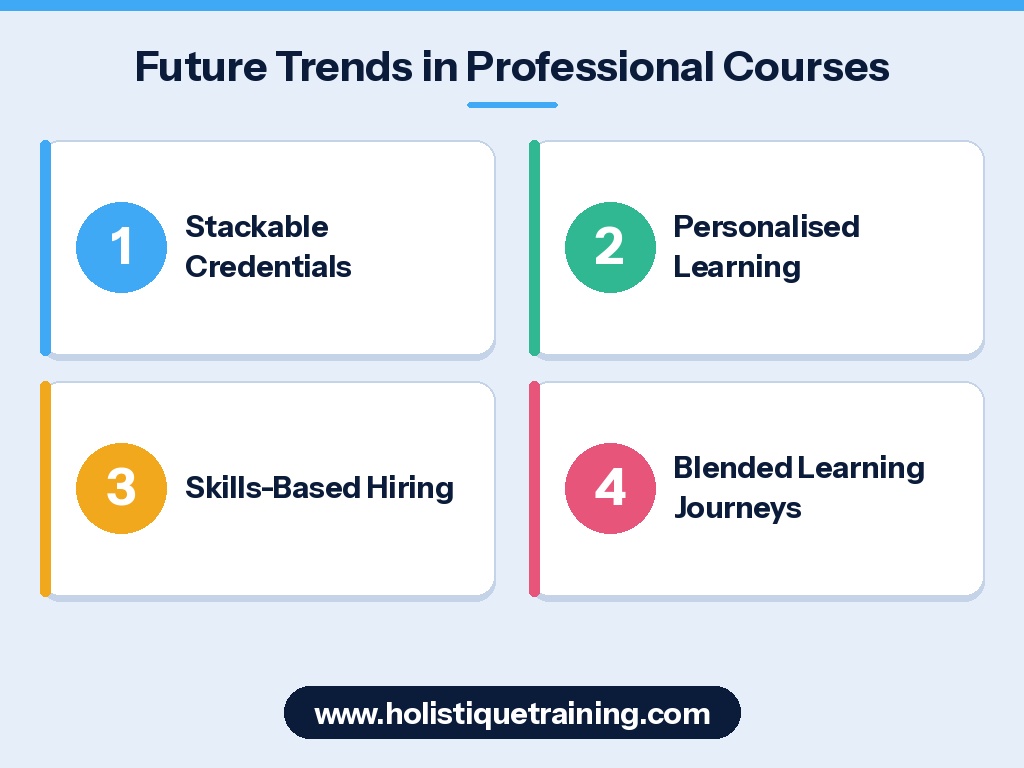
- 12- Future Trends in Professional Courses
- Stackable Credentials
- Personalised Learning
- Skills-Based Hiring
- Blended Learning Journeys
- 13- Conclusion
Introduction
Choosing which courses to take has never been harder, nor more important. Technology is rewriting job descriptions faster than qualifications can be updated, employers are hiring for demonstrable capability rather than job titles alone, and professionals at every level are expected to keep learning while still delivering results. For managers and team leaders, the pressure comes from two directions at once: they must keep their own skills current and guide their teams through constant change.
Choosing well matters because time and budget are limited. A course that builds a genuinely useful capability can open doors to promotion, wider responsibility and new sectors, while a poorly matched one consumes weeks of effort and leaves little to show for it. The best courses for the future share a few traits: they teach skills that remain valuable as tools change, they allow learners to apply what they study at work, and they come from providers that employers recognise.
In this article, we will discuss why skills matter for career growth, how to choose a course, the skill categories most likely to shape careers, and the best course options in artificial intelligence and data, leadership, communication, critical thinking and project delivery. We will also compare learning formats, show how to build a personal learning plan, explain how managers can support their teams, and look at the trends that will shape professional learning in the years ahead.
1- Why Skills Matter More Than Ever for Career Growth
The Shrinking Shelf Life of Skills
Skills no longer last a whole career. Tools, platforms and working methods change within a few years, which means knowledge gained at university or in an early job can become outdated surprisingly quickly. Professionals who treat learning as an occasional event risk falling behind colleagues who build it into their routine. Courses offer a structured way to refresh knowledge, close gaps and gain evidence of new capability that can be shared with employers.
From Job Titles to Capabilities
Employers are paying more attention to what people can do than to where they have worked. Promotion decisions, project assignments and hiring shortlists increasingly rest on demonstrated skills, which makes recognised courses and certificates useful signals. For a manager seeking a broader remit, a well-chosen qualification shows initiative and gives senior leaders confidence that extra responsibility will be handled well.
The Cost of Standing Still
Standing still has a price. Professionals whose skills fall behind often find that interesting projects go to colleagues with newer expertise, that their influence in meetings declines, and that moving to another employer becomes harder. The cost rarely arrives suddenly; it builds quietly over several years. Regular, modest investment in learning is therefore a form of career insurance, protecting earning power and options while the working environment evolves around you.
Why This Matters for Managers and Team Leaders
Managers carry a double responsibility. They need up-to-date skills to perform well, and they set the learning culture for everyone they lead. A team leader who visibly studies, applies new methods and shares what works encourages colleagues to do the same, which strengthens the capability of the whole team.
2- How to Choose the Best Courses for the Future
With thousands of options available, a clear set of criteria saves time and money. The following four checks help managers and team leaders separate valuable programmes from attractive but shallow ones.
1- Relevance to your goals:
Begin with the role you want in two to three years and work backwards. Identify the skills that role demands, compare them with your current strengths, and prioritise courses that close the biggest gaps rather than those that simply sound impressive.
2- Provider credibility:
Look for universities, professional bodies and established platforms. Accreditation or endorsement from organisations such as the Chartered Management Institute or the Project Management Institute signals that content has been reviewed against recognised standards.
3- Practical application:
The strongest courses include projects, case studies or assessments that mirror real work. If you finish with a portfolio piece, a plan or a tested method, you can show impact rather than simply attendance.
4- Flexibility and cost:
Consider the time commitment, delivery format and total cost, including any exam fees. Self-paced online options suit busy schedules, while cohort-based programmes offer discussion and networking. Applying these checks before enrolling prevents the common mistake of collecting certificates that never change daily performance.
It also helps to watch for warning signs. Be cautious of courses that promise dramatic career change in a few days, that hide their syllabus, or that offer no way to check what the certificate represents. Reading recent learner reviews, checking whether instructors have real professional experience and confirming that assessments test applied skills will usually reveal whether a programme is worth the investment.
3- The Skill Categories That Will Shape Careers
Although every sector has its own requirements, several skill categories appear repeatedly in research and in job advertisements. Grouping courses by category makes planning simpler, because a balanced portfolio usually combines technical, human and organisational skills. The table below summarises the main categories and the kinds of provider that offer strong courses in each.
Skill Category | Why It Matters | Example Providers |
|---|---|---|
AI and data literacy | Helps managers use tools wisely and interpret evidence | Coursera, edX, Microsoft Learn |
Leadership and management | Builds team performance and promotion readiness | CMI, ILM, Harvard Business School Online |
Communication and negotiation | Improves influence, feedback and conflict handling | University of Michigan on Coursera, Crucial Learning |
Critical thinking and adaptability | Supports sound decisions under uncertainty | LinkedIn Learning, FutureLearn, OpenLearn |
Project and change management | Delivers results across teams and deadlines | PMI, PeopleCert, Prosci |
Balance is the key idea. Technical skills such as data analysis can become dated as software evolves, while human skills such as negotiation and coaching keep their value across tools and industries. Managers who combine both are better able to translate technology into team results, which is why the best learning plans rarely focus on only one row of the table.
A sensible approach is to choose one technical course and one human skills course each year, rather than concentrating on a single area.
4- Best Courses in Artificial Intelligence and Data Literacy
Artificial intelligence is now part of everyday management, from drafting reports to analysing performance data. The goal for most managers is not to become engineers but to understand what the tools can and cannot do, spot errors and make responsible decisions. According to PwC’s 2026 Global AI Jobs Barometer, the average wage premium for workers with AI skills has risen to 62 per cent, and jobs requiring specific AI skills are growing almost eight times faster than the total jobs market. These figures show why AI literacy has moved from optional to essential.
Understanding AI helps managers in three practical ways. It improves judgement about which tasks are suited to automation, it makes conversations with technical specialists more productive, and it strengthens oversight of accuracy, privacy and fairness. Managers who grasp these basics can encourage responsible experimentation in their teams instead of either ignoring new tools or adopting them without proper checks.
Several well-regarded options suit non-specialists and can be completed alongside a full-time role.
1- AI for Everyone:
Offered by DeepLearning.AI on Coursera, this short course explains what AI can and cannot do in plain language, making it a sound starting point for managers who need to discuss AI projects with confidence.
2- Elements of AI:
Created by the University of Helsinki, this free online course covers core concepts and the wider implications of AI for society without requiring any programming skills.
3- Microsoft Learn AI fundamentals:
Microsoft Learn provides free learning paths that introduce machine learning, language services and responsible AI, and they prepare learners for entry-level certification.
4- Google Data Analytics Professional Certificate:
Hosted on Coursera, this programme teaches spreadsheets, SQL and data visualisation through practical projects, helping managers read dashboards critically and ask sharper questions of their analysts.
Whichever course you choose, apply it quickly by using an AI tool on a real task, such as summarising a report, and then checking the result carefully.

The rise of artificial intelligence is reshaping how we think, learn, and solve problems. In today’s fast-changing world, learning is no longer a linear process—it’s a dynamic interaction between human insight and machine intelligence. This course introduces the concept of hybrid intelligence and empowers participants to
5- Best Courses in Leadership and Management
Many managers are promoted for technical excellence and then expected to lead without formal preparation. Courses in leadership and management fill that gap by teaching coaching, delegation, motivation and strategic thinking. The need is growing as AI changes how managers work. According to the Chartered Management Institute’s report Artificial Intelligence; Real Leadership, over 80 per cent of managers agree that their own performance and their team’s would improve with a better understanding of how to manage AI. The same research found that 70 per cent of managers seek advice from generative AI rather than going to their own managers. These findings suggest that leadership courses should now cover both people skills and AI-aware decision-making.
Good leadership courses usually cover four areas: setting direction and priorities, coaching and developing people, making decisions with imperfect information, and leading change. They also encourage reflection on personal style, because the habits that made someone an excellent individual contributor, such as doing everything personally, can limit the performance of a team. Choose programmes that ask you to apply each idea to your own team during the course.
Strong options for managers and team leaders include the following.
1- CMI management and leadership qualifications:
The Chartered Management Institute offers qualifications at several levels, from first-line management to senior leadership, and they are widely recognised by UK employers.
2- ILM leadership programmes:
The Institute of Leadership and Management awards qualifications through approved centres, with a strong emphasis on applying learning in the workplace.
3- Leadership Principles from Harvard Business School Online:
This short, case-based programme helps participants examine their own leadership style and apply practical frameworks to real decisions.
4- Strategic Leadership and Management specialisation:
Offered by the University of Illinois on Coursera, this multi-course specialisation covers strategy, innovation and people management, and it can be completed alongside demanding work.
Whichever route you take, look for programmes that include feedback from tutors or peers, because leadership improves fastest when it is observed and discussed.

Strong management is always required within any business, regardless of industry or influence. A successful business cannot be achieved without skilled supervisors who manage their teams and promote productivity. Supervisors provide an important link between those developing strategies and those
6- Best Courses in Communication and Emotional Intelligence
Communication is consistently named among the most valuable workplace skills, because every management task, from giving feedback to negotiating deadlines, depends on it. Emotional intelligence, meaning the ability to recognise and manage emotions in yourself and others, strengthens that foundation. Courses in this category work best when they include practice, since conversation skills improve through rehearsal rather than reading alone.
1- Crucial Conversations:
Offered by Crucial Learning, this widely used programme teaches techniques for discussing high-stakes topics calmly and productively.
2- Successful Negotiation: Essential Strategies and Skills:
This University of Michigan course on Coursera explores preparation, bargaining and agreement through practical scenarios.
3- LinkedIn Learning communication pathways:
Short video courses on giving feedback, running meetings and building emotional intelligence suit managers who prefer to learn in small steps.
Written communication deserves attention as well. Clear emails, concise reports and well-structured proposals save time for everyone and reduce misunderstandings, particularly in teams that work across locations. Short writing courses or business communication workshops can lift the quality of everyday messages noticeably, and they pair well with the conversation-focused programmes described above.
Pair any course with a real conversation you have been postponing, and use the framework within a week of learning it.

This comprehensive course focuses on developing advanced business communication skills crucial for organisational success. Participants will learn practical tools and techniques to enhance their communication effectiveness, from verbal and nonverbal cues to written and digital communication. The course emphasises understanding various communication styles, improving presentation skills, and
7- Critical Thinking, Problem-Solving and Adaptability
As AI takes on routine tasks, human judgement becomes more valuable. Managers are the people who decide whether an output is trustworthy, whether a plan is sound and whether a risk is acceptable. According to Coursera’s Global Skills Report 2026, enrolments in critical thinking rose by 107 per cent year over year, and learners are developing human skills to safeguard the quality of AI-supported work. The same report found that micro-credential enrolments grew by 33 per cent and AI micro-credential enrolments by 122 per cent, which shows that learners are choosing structured pathways that make new skills visible.
Courses that build these abilities include the following.
1- Learning How to Learn:
Created by Barbara Oakley and Terrence Sejnowski and offered on Coursera, it teaches memory techniques and study habits that help busy professionals absorb new material efficiently.
2- Critical thinking and decision-making courses:
The Open University’s OpenLearn, FutureLearn and edX all run short courses on reasoning, evidence and bias, which help managers question assumptions before they act.
3- Design thinking and problem-solving:
Practical introductions offered by universities on edX and Coursera teach structured methods for framing problems and testing solutions quickly.
Adaptability can be strengthened as well. Courses that expose you to unfamiliar tools, sectors or methods train the habit of learning quickly, which is increasingly valuable when roles change shape. Managers can model this by trying a new approach on a small project, reviewing the result honestly with their team, and sharing the lessons, so that experimentation becomes normal rather than risky.
8- Project, Change and Digital Skills
Managers deliver results through projects, and projects increasingly involve change. Courses in this area give structure to planning, risk, stakeholder management and adoption. They also offer recognised credentials that travel between employers and countries.
1- Project Management Professional (PMP):
Awarded by the Project Management Institute, the PMP is a globally recognised certification covering predictive, agile and hybrid approaches.
2- PRINCE2:
Administered by PeopleCert, PRINCE2 is a structured method widely used in public and private sector projects across the UK and Europe.
3- Agile and Scrum certifications:
Providers such as Scrum.org and Scrum Alliance offer courses suited to teams that work in short cycles with frequent feedback.
4- Prosci change management:
Prosci’s certification focuses on the people side of change, helping managers prepare teams for new systems and processes.
When choosing between these options, consider where your organisation and sector are heading. A manager in a construction or public sector setting may gain most from PRINCE2 or the PMP, while a team leader in a software or digital environment may find agile and Scrum training more directly useful. Change management training suits anyone leading transformation, regardless of sector.
9- Comparing Learning Formats
Content matters, but format often determines whether a course is finished. The table below compares the main routes available to busy professionals.
Format | Typical Duration | Best For | Main Limitation |
|---|---|---|---|
Short online course | Hours to weeks | Quick skill refresh | Limited depth |
Professional certificate | Weeks to months | Career-relevant credentials | Needs steady commitment |
University programme | Months to years | Deep knowledge and recognised awards | Higher cost and time |
Professional body qualification | Months | Sector recognition | Fixed assessment rules |
Classroom or live workshop | Days | Discussion and practice | Travel and scheduling |
Many professionals combine formats, for example a short online course to test interest, followed by a certificate or qualification once the topic proves useful.
Time is the hidden cost in every format. Before committing, estimate the weekly hours required, check your calendar for the busiest months at work, and choose a start date that gives you a realistic chance of finishing. A shorter course completed on time delivers more value than an ambitious programme abandoned halfway through.
10- Building a Personal Learning Plan
Courses deliver the most value when they sit inside a plan. A personal learning plan sets out goals, chosen courses, deadlines and the way progress will be measured, turning scattered interest into steady development. Start by reviewing your current role and identifying the skills you will need next. Then select a small number of courses, schedule protected study time and agree learning goals with your own manager. Reviewing the plan every quarter keeps it realistic as priorities change.
The roadmap below shows how a manager might spread learning across a year without overloading the calendar.
Quarter | Focus | Example Activity | Evidence of Progress |
|---|---|---|---|
Quarter 1 | AI and data literacy | Complete an introductory AI course | AI tool used on a live task |
Quarter 2 | Communication | Take a negotiation or conversations course | Better feedback meetings |
Quarter 3 | Leadership | Begin a management qualification | Delegation plan for the team |
Quarter 4 | Project or change | Study for a recognised certification | Small project delivered |
Progress should be measured by changes in work, not by certificates alone. After each course, note one new practice you introduced, one result you observed and one question that remains. Sharing these notes in a one-to-one meeting with your manager keeps learning visible and helps justify further support. If a course delivers little practical benefit, treat that as useful information and adjust the plan rather than persisting out of habit.
11- How Managers Can Support Team Learning
Leaders multiply their impact when they help others learn. Regular development conversations, protected study time and recognition for completed courses show that learning is valued. Managers can also encourage peer teaching, where a colleague who finishes a course shares the key lessons in a short session. This spreads knowledge cheaply and reinforces retention for the presenter. Linking each course to a work challenge keeps learning relevant and makes its benefits visible to senior stakeholders.
Support should be fair as well as generous. Offering similar access to every team member, including part-time and remote colleagues, builds trust and widens the pool of future leaders.
Finally, managers should look at their own development honestly. Asking team members for feedback, noticing where decisions slow down, and identifying the skills that would make the team more effective all help to decide which course to take next. Leading by example remains the most persuasive form of encouragement.
12- Future Trends in Professional Courses
Stackable Credentials
Short credentials that combine into larger qualifications will keep growing, allowing professionals to build recognised expertise in stages and update it as needs change.
Personalised Learning
AI-driven platforms already recommend modules based on role and performance, and this personalisation will become more precise as learning data improves.
Skills-Based Hiring
More employers will assess candidates on demonstrated skills, which raises the value of practical, project-based courses over those that rely on attendance alone.
Blended Learning Journeys
Learners will increasingly mix self-paced online study, live workshops and on-the-job practice in a single journey. This blended approach combines flexibility with real interaction, and it suits managers who need both knowledge and the chance to test it with colleagues.
13- Conclusion
The best courses for the future are not defined by a single subject or provider. They are the ones that close a real skills gap, teach capabilities that last, and let learners apply new knowledge at work almost immediately. For managers and team leaders, that usually means a balanced mix of AI and data literacy, leadership and management, communication, critical thinking, and project or change delivery.
Success depends on planning. Choosing courses against clear criteria, comparing formats honestly, and placing each course within a personal learning plan turns scattered study into visible career growth. Managers who also support their teams’ learning build stronger, more adaptable organisations. Those who start now, with one carefully chosen course and a firm date to apply it, will be best placed to benefit as skills continue to change.
For readers ready to act, a simple first step is to list the three skills that would most improve your performance over the next year, then match each one to a course from the categories above. Booking the first course, telling your manager about it and deciding how you will apply the learning in practice makes follow-through far more likely than good intentions alone.