

- Table of Contents
- Introduction
- 1- What Is Cross-Functional Flow Management?
- 2- Why Cross-Functional Career Paths Are Rising
- 3- Core Competencies for Cross-Functional Flow Managers
- 4- The Cross-Functional Career Ladder: From Analyst to Executive
- 5- Cross-Functional vs Traditional Career Paths
- 6- A Global View of Salary Benchmarks
- 7- The Role of HR and L&D in Shaping These Career Pathways
- 8- Internal Mobility as a Growth Engine
- 9- Key Challenges HR Professionals Face
- 10- How Organisations Build Cross-Functional Career Frameworks
- 11- Cross-Functional Flow Management Across Industries
- 12- AI and the Evolution of Cross-Functional Careers
- 13- Succession Planning and the Cross-Functional Leader Pipeline
- Conclusion
Introduction
Modern organisations are structured around departments, but they operate through flows. Strategy becomes results only when work, information, and decisions move efficiently across marketing, operations, finance, HR, supply chain, and technology without unnecessary friction or delay. This interconnected reality has produced an increasingly prominent category of professional: the cross-functional flow manager. These are practitioners who do not merely belong to one function but navigate and optimise the pathways that connect them all.
For HR and learning and development professionals, this shift carries significant implications. Building career pipelines for these roles requires rethinking traditional progression models, developing new competency frameworks, and creating internal mobility programmes that encourage professionals to move laterally as well as vertically. It also requires understanding why cross-functional experience has become one of the most commercially valuable assets a professional can hold in today's talent market.
Cross-functional flow management draws from multiple disciplines including process improvement, project management, organisational behaviour, operations, and strategic HR. It is practised across every major sector, from technology companies managing product development cycles to humanitarian organisations coordinating multi-stakeholder response operations. The career paths that lead into and through this field are varied, and the seniority levels it spans range from analyst to enterprise-level executive.
In this article, we examine what cross-functional flow management is, why these careers are rising, the core competencies involved, how career ladders are structured, global salary benchmarks, the role of HR and L&D in shaping these pathways, internal mobility strategies, the challenges organisations face, how to build career frameworks, industry applications, the influence of AI, succession planning considerations, and how professionals can build their own cross-functional career strategy.
1- What Is Cross-Functional Flow Management?
Cross-functional flow management refers to the systematic coordination of workflows, resources, decisions, and communications across two or more organisational functions. Unlike traditional management, which focuses on a single department or vertical, cross-functional flow management is concerned with the entire value chain that connects different teams. A professional in this role might oversee the process by which a product idea passes from research and development through manufacturing, quality assurance, marketing, and distribution, identifying delays and resolving interdependencies at each transition point.
The term draws on concepts from lean management, systems thinking, and process optimisation. Value stream mapping is a lean tool used to visualise and improve the end-to-end flow of work across functions. Operational excellence frameworks incorporate similar principles to align cross-functional activity with organisational strategy. In practice, cross-functional flow management involves both analytical work, such as mapping processes and measuring throughput, and interpersonal work, including influencing stakeholders who do not report to you and negotiating priorities across competing departmental agendas.
For HR professionals, the significance of this discipline lies in its career architecture. Unlike roles that develop within a single specialism, cross-functional careers are built through breadth. The professionals who eventually lead at enterprise level in these areas are those who have accumulated meaningful experience across multiple functions, developed a portfolio of transferable skills, and demonstrated the capacity to think systemically about organisational performance rather than optimising for a single vertical.
2- Why Cross-Functional Career Paths Are Rising
Several converging forces have accelerated the demand for professionals with cross-functional competencies. The first is organisational complexity. As companies globalise, adopt matrix structures, and integrate digital tools across every function, the interdependencies between departments multiply. A decision made in procurement now affects timelines in product development, which in turn affects marketing campaigns and customer experience. Managing these interdependencies effectively requires people who understand multiple functions, not just one.
The second driver is the pace of change. Markets shift quickly, and organisations that respond effectively tend to do so by mobilising cross-functional teams rapidly rather than waiting for siloed functions to align sequentially. Agile methodologies, originally developed in software, have migrated into product development, HR, and even finance precisely because they enable cross-functional collaboration at speed. Leaders who have experienced this mode of working in practice are disproportionately valuable.
The third and perhaps most significant driver is the skills gap. According to a McKinsey Global Survey, 87% of executives said they were either already experiencing skill gaps in the workforce or expected to encounter them within a few years. Much of that gap is not in technical knowledge but in the integrative capabilities that come from working across domains. Professionals who can connect technical understanding with business strategy, or translate operational constraints into commercial language, are in genuinely short supply in virtually every global market.
The combined effect of these three forces is that cross-functional capability is shifting from a desirable differentiator to a baseline expectation for mid-level and senior professionals in many organisations. HR and L&D teams that recognise this shift early are in a position to build talent pipelines that deliver a genuine competitive advantage.
3- Core Competencies for Cross-Functional Flow Managers
The competency profile for cross-functional flow managers is distinctive. It combines technical process skills with a set of deeply interpersonal and strategic capabilities that are not easily taught in a single course or role. HR professionals designing development frameworks for these roles need to understand this full spectrum and build learning pathways that address it systematically over time rather than in a single training intervention.
At the foundational level, professionals need a working knowledge of how different business functions operate and how they depend on one another. This includes understanding financial reporting, supply chain constraints, technology integration, workforce planning, and customer experience metrics. At the intermediate level, the emphasis shifts to process tools, stakeholder management, and systems thinking. At the senior level, strategic integration, change leadership, and enterprise-wide communication become the defining competencies that separate effective from exceptional cross-functional leaders. The table below summarises the key competencies by career level.
Career Level | Technical Competencies | Interpersonal & Strategic Competencies |
Entry Level (0–3 years) | Process mapping, data analysis, basic project coordination, reporting | Active listening, cross-team communication, feedback reception, task ownership |
Mid-Level (3–7 years) | Lean/Six Sigma tools, KPI design, workflow optimisation, dependency tracking | Stakeholder influence, conflict resolution, change facilitation, matrix navigation |
Senior Level (7–12 years) | Value stream management, systems integration, enterprise process modelling | Strategic alignment, executive communication, organisational design, sponsorship |
Executive Level (12+ years) | Enterprise-wide flow architecture, transformation governance | Board-level communication, culture shaping, multi-function P&L oversight |
4- The Cross-Functional Career Ladder: From Analyst to Executive
Career progression in cross-functional flow management does not follow a single straight line. Unlike functional careers where seniority is defined by depth in one specialism, cross-functional paths are shaped by the breadth and combination of experiences accumulated across roles. There are, however, recognisable stages through which most practitioners pass, and understanding these stages is essential for HR professionals designing succession pipelines and talent development programmes.
The entry stage typically involves a role within a single function, such as an analyst in operations, a coordinator in supply chain, or an associate in project management. What distinguishes early cross-functional development is involvement in collaborative projects that cut across departments. Stretch assignments, job rotations, and participation in cross-functional improvement initiatives all contribute to building the foundational breadth that later career stages require. Without these early lateral exposures, professionals tend to develop deep functional roots but limited integrative capability.
The mid-level stage involves active management of cross-functional projects or processes. Titles at this stage include process manager, operations business partner, project lead, or cross-functional programme coordinator. These professionals are responsible for delivering outcomes that require sustained coordination across departments. They spend a significant portion of their time managing competing priorities, aligning stakeholders, and resolving workflow bottlenecks that emerge at departmental boundaries.
The senior and executive stages involve strategic ownership of enterprise-wide processes. Chief Operating Officers, VP of Operations, Head of Transformation, or Chief of Staff roles often incorporate significant cross-functional flow management responsibilities. These leaders do not manage individual processes directly but design the systems within which processes run and create the cultural conditions that enable cross-functional collaboration to thrive at scale across the organisation.
5- Cross-Functional vs Traditional Career Paths
The distinction between cross-functional and traditional career paths is not simply about movement across departments. It reflects a fundamentally different philosophy of professional development, a different relationship with authority and expertise, and a different set of rewards and risks for the professional who chooses it. Understanding this distinction helps HR and L&D professionals communicate the value proposition of cross-functional career development clearly, both to senior leadership and to the employees themselves.
Traditional career paths reward depth. The accountant who becomes head of accounting, the engineer who rises to chief engineer, or the marketing specialist who becomes marketing director — each has built authority through deep mastery within one domain. Their career logic is vertical: each step up the ladder requires greater expertise in the same discipline. Promotion is largely predictable and tied to measurable performance within the function.
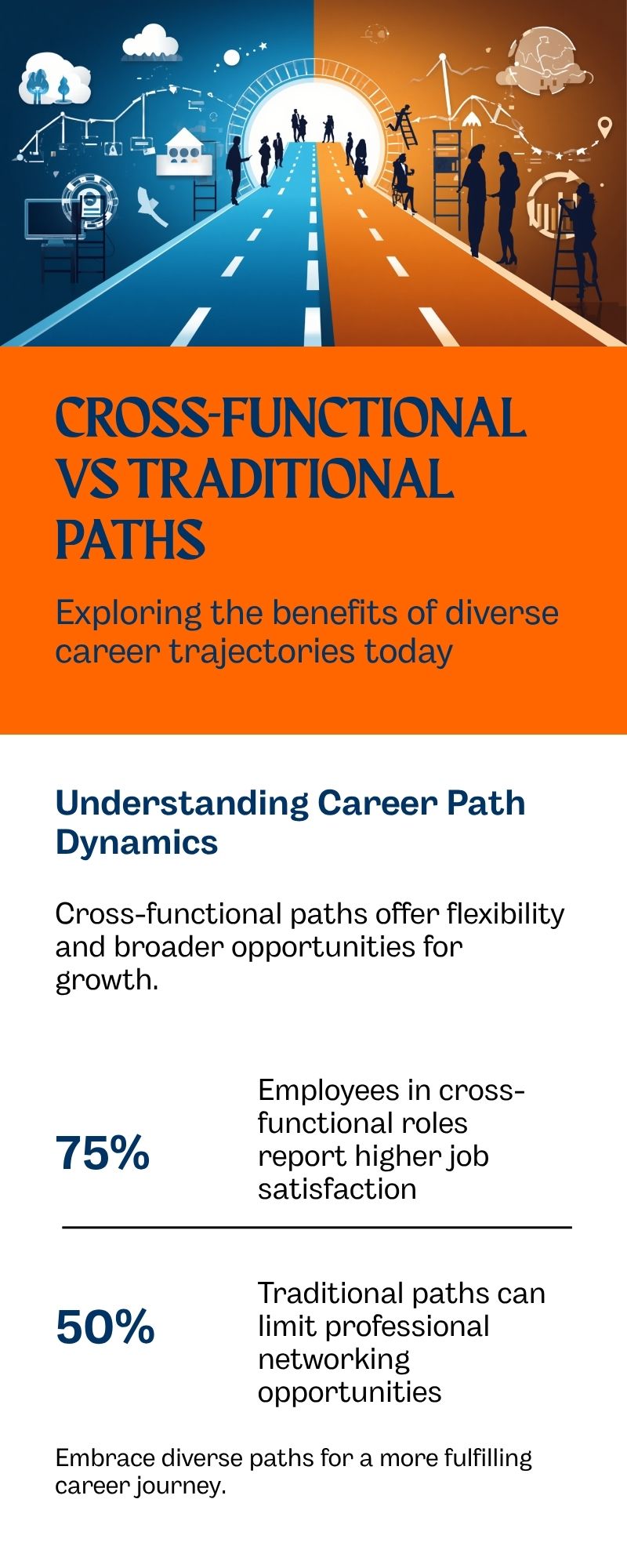
Cross-functional career paths reward breadth and integration. Advancement depends not on being the most technically expert person in the room but on being the most capable at connecting the knowledge in the room. This requires a different kind of professional confidence, one that is comfortable with partial expertise across multiple areas and skilled at knowing when and how to engage others with deeper specialism. The table and infographic below illustrate the core structural differences between these two career models.
Dimension | Traditional Career Path | Cross-Functional Career Path |
Progression Direction | Primarily vertical within one function | Lateral and vertical across multiple functions |
Core Value Proposition | Deep functional expertise and mastery | Broad integrative capability and systems thinking |
Promotion Criteria | Technical mastery and years of service | Demonstrated cross-domain impact and influence |
Development Activities | Specialist training, mentoring within function | Job rotations, stretch projects, multi-function exposure |
Leadership Scope | Single-department positional authority | Enterprise-wide influence without direct authority |
Career Risk Profile | Vulnerability to specialism obsolescence | Resilience through adaptability and breadth |
Typical Senior Roles | Director or VP of function | COO, Chief of Staff, Head of Transformation |
6- A Global View of Salary Benchmarks
Salary data for cross-functional flow management roles varies significantly by geography, sector, and seniority. Professionals in this field are not always categorised under a single job title, which makes benchmarking challenging. Titles such as Operations Manager, Process Improvement Manager, Transformation Lead, and Chief of Staff all incorporate cross-functional flow responsibilities but are compensated differently depending on industry and organisational context.
In general terms, cross-functional professionals command a salary premium over purely functional peers at the same seniority level, particularly in mid-to-senior roles. This premium reflects the scarcity of professionals who have both functional knowledge and the interpersonal capability to work effectively across departments. In high-growth sectors such as technology, healthcare, and professional services, this premium is especially pronounced. The table below provides indicative global salary ranges by seniority level, drawing on aggregated compensation data from major consultancy and HR survey sources.
Seniority Level | Indicative Global Range (USD) | Common Titles |
Entry Level | $40,000 – $65,000 | Process Analyst, Operations Coordinator, Project Associate |
Mid-Level | $65,000 – $100,000 | Process Manager, Operations Business Partner, Programme Manager |
Senior Level | $100,000 – $160,000 | Head of Operations, Senior Transformation Manager, Director of Process Excellence |
Executive Level | $160,000 – $300,000+ | Chief Operating Officer, VP of Operations, Chief of Staff, Head of Enterprise Transformation |
These figures reflect broad global medians and should be treated as directional benchmarks rather than definitive market rates. HR professionals undertaking compensation reviews should triangulate against region-specific salary surveys from sources such as Mercer, Korn Ferry, and the Global Compensation Institute, adjusting for cost of labour in relevant markets and sector-specific premium or discount factors.
7- The Role of HR and L&D in Shaping These Career Pathways
HR and learning and development professionals are the primary architects of cross-functional career pathways within organisations. Without deliberate design, cross-functional development happens informally, unevenly, and disproportionately among those with the social capital or managerial support to pursue it. Formalising it requires structural interventions at multiple levels, from how roles are designed and advertised internally to how performance is assessed and how succession pools are built and reviewed.
The first critical intervention is competency framework design. Most organisations maintain functional competency frameworks that describe the skills required to progress within a single function. Introducing a cross-functional layer to these frameworks — one that describes how professionals are expected to develop integrative and enterprise-wide capabilities over time — sends a clear signal that lateral experience is valued and tracked. It also provides the foundation for meaningful development conversations between managers and employees who might otherwise default to purely vertical career planning.
The second is job architecture. Cross-functional flow management roles often fall into the gaps between existing job families, making them difficult to classify, compensate, and develop people toward. HR leaders who work proactively with their total rewards and talent management colleagues to create dedicated job families for these roles send an important structural message: these careers are real, they are valued, and the organisation has a deliberate plan for developing professionals who pursue them. Understanding the structural dynamics and leadership requirements of cross-functional teams is foundational for anyone designing these pathways.

This course explores the strategic integration of human resources within organisational frameworks to enhance business performance. It is designed to equip HR professionals with the skills to align HR strategies with corporate goals, ensuring a sustainable competitive advantage.
8- Internal Mobility as a Growth Engine
Internal mobility is one of the most powerful and underutilised levers available to HR professionals seeking to build cross-functional talent pipelines. When organisations actively support the movement of employees across functions and departments, they produce professionals with broader contextual knowledge, stronger professional networks, and greater resilience in the face of change. These are precisely the characteristics that cross-functional flow management careers demand.
However, most organisations still struggle to operationalise internal mobility at scale. According to the LinkedIn Workplace Learning Report 2024, only 1 in 5 employees report having confidence in their ability to make an internal move within their organisation. The same report notes that companies with strong learning cultures experience significantly higher retention rates and healthier management pipelines, yet many organisations remain at the starting line when it comes to building the cultural conditions and structural mechanisms that make genuine internal mobility work.
For HR leaders, the practical barriers to internal mobility are well known: managers who resist releasing their best people, compensation structures that discourage lateral moves, and job-posting processes that systematically favour external candidates over internal ones. Addressing these barriers requires both policy changes and a cultural shift in how career development is framed. When cross-functional experience is positioned as a pathway to senior leadership rather than a detour from it, both employees and their managers become significantly more likely to engage with internal mobility constructively.
Structured job rotation programmes are a particularly effective tool for building cross-functional capability through internal mobility. When designed deliberately, with clear learning objectives, defined duration, and thoughtful reintegration plans, rotations give employees the kind of multi-function exposure that forms the bedrock of a genuinely cross-functional career. Organisations with mature job rotation programmes consistently produce a broader and deeper pipeline of enterprise-ready leaders.
9- Key Challenges HR Professionals Face
Despite the growing organisational demand for cross-functional talent, HR professionals encounter consistent challenges when trying to build, develop, and retain these professionals. Understanding these challenges is a prerequisite for addressing them effectively through programme design and policy change.
One of the most persistent challenges is measurement. Cross-functional contributions are harder to quantify than functional ones. A supply chain manager who improves warehouse throughput has a clear and measurable impact. A cross-functional process manager who improves the handoff between procurement and product development may deliver equally significant value, but it is less visible and less directly attributable to individual performance. Performance management systems that rely on functional metrics systematically undervalue cross-functional work, which in turn discourages professionals from pursuing it and managers from championing it.
A second challenge is career clarity. Many professionals are willing to develop cross-functionally but are uncertain about where that development leads. Without visible examples of senior leaders who have followed cross-functional paths, and without explicit career maps showing the connection between early lateral moves and later executive roles, employees are understandably cautious about stepping outside their primary function. HR professionals who invest in making these pathways visible and who actively sponsor cross-functional career role models make lateral development feel both safer and more strategically sound.
A third challenge is the learning design gap. Most corporate learning and development programmes are still organised around functional curricula. Building credible cross-functional learning pathways requires L&D teams to design content and experiences that intentionally span departmental boundaries, which demands new partnerships with business leaders across functions and a willingness to challenge the prevailing logic of single-domain expertise as the primary path to senior leadership.

The role of an HR Business Partner (HRBP) is central to modern organisations, where human capital is recognised as a key driver of success. As organisations grow and face increasingly complex challenges, the HRBP bridges the gap between human resources and business units, ensuring that
10- How Organisations Build Cross-Functional Career Frameworks
Building an effective cross-functional career framework requires a deliberate and structured approach that goes beyond simply declaring an intention to support lateral moves. Organisations that do this well typically begin by mapping the flows of work that matter most to their strategic goals, then identifying the roles and capabilities required to manage those flows effectively. This backwards design approach ensures that cross-functional career pathways are anchored in real organisational need rather than abstract developmental ideals.
The next step is to make the framework visible. This means publishing role progression maps that show how cross-functional careers develop over time, how they connect to traditional functional ladders, and what the leadership endpoints look like. Visibility is critical because it makes the career proposition legible to both employees and managers, reducing the uncertainty that often prevents lateral moves from being seriously considered in annual review or succession conversations.
Organisations also need to invest in the social infrastructure that makes cross-functional development possible. Cross-functional mentoring circles, internal communities of practice, and senior leader sponsorship programmes all contribute to building the relationships and informal networks that cross-functional professionals depend on. Because these professionals typically lack the tight-knit community of peers that functional specialists enjoy within a single department, intentional network-building support is especially valuable in the early and mid-career stages.
Finally, recognition systems need to be calibrated to reward cross-functional contributions. Whether through dedicated awards, promotion criteria that explicitly value breadth of experience, or performance review frameworks that capture multi-function impact, organisations that send consistent and visible signals about what they value will attract and retain the professionals who are best positioned to deliver it.
11- Cross-Functional Flow Management Across Industries
While cross-functional flow management is relevant across all sectors, its specific character and the career paths it generates vary considerably by industry. In manufacturing and logistics, cross-functional roles tend to centre on supply chain integration, lean process management, and the coordination of procurement, production, and distribution. Career paths in this sector often begin with operational analyst roles before progressing into process improvement leadership, plant management, or supply chain strategy.
In technology and product companies, cross-functional flow management manifests most clearly in product operations, programme management, and platform roles. Professionals in these environments learn to coordinate between engineering, design, commercial, and customer success teams, developing a deep understanding of how product decisions ripple through to revenue, support costs, and user satisfaction. Career paths here frequently lead to Chief of Staff, VP of Product Operations, or Chief Operating Officer roles, especially in organisations that have scaled quickly.
In humanitarian and non-governmental organisations, cross-functional flow management often takes the form of programme coordination, emergency response management, and multi-stakeholder partnerships. These environments are particularly demanding because decisions must be made quickly with incomplete information, and because the organisations involved often span multiple countries, funding structures, and operational contexts. Professionals who develop cross-functional capabilities in this sector frequently move into senior coordination, strategy, or executive leadership roles within the broader development and emergency response field.
In professional services and consulting, cross-functional experience is effectively the product being delivered. Consultants who understand how change in one function affects others are more effective advisers, and career development in this context naturally involves exposure to multiple client industries and functional domains, building a broad portfolio of applied cross-functional knowledge that is commercially valued and professionally transferable.
12- AI and the Evolution of Cross-Functional Careers
Artificial intelligence is reshaping the nature of work across every function, and its implications for cross-functional career development are significant. On one hand, AI is automating many of the routine analytical tasks that have historically been the entry point for cross-functional learning, including data collation, process monitoring, scheduling, and basic reporting. On the other, it is creating new demands for professionals who can work across the boundary between AI systems and human decision-making, ensuring that automated processes are correctly calibrated, appropriately supervised, and integrated into broader organisational workflows.
According to the World Economic Forum's Future of Jobs Report 2025, 39% of existing role skills will be transformed or become outdated between 2025 and 2030, and 170 million new roles are projected to be created globally in the same period. Many of the most significant new roles will be inherently cross-functional, involving the intersection of AI capability with strategic, operational, and human domains. The professionals best positioned to fill these roles will be those who have developed both functional depth and cross-domain fluency, enabling them to act as informed bridges between the technical and organisational dimensions of transformation.
For HR and L&D teams, this means that cross-functional career development is not simply a strategy for building versatile professionals. It is a structural response to the AI transition, equipping the workforce with precisely the kind of integrative, adaptive capability that automated systems cannot replicate. Professionals who learn to work effectively at the intersections of functions — between data and strategy, between process and people, between technology and organisational culture — will define the next generation of enterprise leadership.

This advanced training course provides a comprehensive framework for achieving and sustaining operational excellence within organisations. Participants will explore strategies to optimise processes, enhance performance, and build a culture of continuous improvement. By blending theory with real-world applications, the course equips leaders and managers with the tools to
13- Succession Planning and the Cross-Functional Leader Pipeline
Succession planning for senior leadership positions is one of the areas most directly affected by the growing importance of cross-functional career development. Research consistently shows that leaders who have held roles across multiple functions are better equipped to manage enterprise-wide complexity, communicate across disciplinary boundaries, and drive transformation initiatives that require sustained collaboration across departments. Yet many succession planning processes still favour candidates who have risen through a single, high-visibility functional track.
Reforming succession planning to better reflect the value of cross-functional experience requires changes at multiple levels. Talent review processes need to include explicit assessment of cross-functional exposure, not just functional performance metrics. High-potential programmes need to build in structured rotation opportunities and project leadership responsibilities across departments. And the criteria used to evaluate readiness for senior roles need to reward breadth of understanding alongside depth of expertise, signalling to the organisation that enterprise-ready leadership is the goal.
HR professionals who champion cross-functional career paths within their organisations' succession frameworks play a genuinely strategic role in shaping the kind of leadership culture the organisation will have five to ten years from now. An organisation that systematically develops leaders with cross-functional experience will be better placed to navigate complexity, adapt to change, and build the trust-based internal networks that high-performance organisations depend on. Positioning cross-functional development as a succession planning imperative, rather than a peripheral development activity, is one of the highest-impact contributions HR professionals can make to long-term organisational health and strategic resilience.
Conclusion
Cross-functional flow management career paths represent one of the most important and undertheorised areas of talent development in contemporary organisations. As the boundary between functions becomes increasingly porous, as AI transforms the nature of functional work, and as organisations seek leaders who can operate across the full breadth of enterprise complexity, the professionals who have developed genuine cross-functional capability will be disproportionately valuable in every sector and geography.
For HR and L&D professionals, this creates both a responsibility and an opportunity. The responsibility is to build the frameworks, programmes, and cultural conditions that make cross-functional career development accessible to a wider range of professionals, not just those who happen to find informal opportunities through personal networks or managerial sponsorship. The opportunity is to position HR itself as a strategic driver of organisational capability, designing talent systems that deliver real and measurable competitive advantage.
Cross-functional careers are not linear, and they are not without risk. They require a tolerance for ambiguity, a willingness to learn continuously in unfamiliar contexts, and the interpersonal confidence to lead without positional authority. But for the organisations and professionals who commit to them, the returns are significant: broader perspective, stronger networks, deeper organisational understanding, and the kind of adaptive leadership that modern business cannot afford to develop too late.