

- Table of Contents
- Introduction
- 1- What Does a Design Engineer Do?
- 2- Design Engineer vs Related Roles
- 3- How Much Do Design Engineers Earn?
- 4- Core Technical Skills Employers Look For
- 5- Essential Soft Skills for Design Engineers
- 6- Career Path and Progression
- 7- Educational Pathways and Qualifications
- 8- Industries That Hire Design Engineers
- 9- The Impact of AI and Automation on Design Engineering
- 10- Certifications and Continuous Professional Development
- 11- Building a Portfolio and Gaining Practical Experience
- 12- How to Get Hired as a Design Engineer
- 13- Common Career Challenges and How to Overcome Them
- 14- Specialisations Within Design Engineering
- 15- The Future Outlook for Design Engineers
- 16- Conclusion
Introduction
Design engineering sits at the point where an idea becomes something that can actually be built, tested, and manufactured. Every product on a shop shelf, every piece of machinery on a factory floor, and every structural component in a building has passed through the hands of a design engineer at some stage. It is a discipline that blends technical rigour with creative problem-solving, and it remains one of the most consistently in-demand engineering career paths across manufacturing, automotive, aerospace, construction, and consumer technology.
Yet for anyone considering this career, or looking to move further within it, the picture can feel fragmented. Job titles vary between employers, salary expectations differ enormously by industry and region, and the skills that mattered a decade ago are no longer sufficient on their own. Computer-aided design remains central to the role, but employers increasingly expect design engineers to combine that technical foundation with simulation literacy, an understanding of artificial intelligence tools, and the communication skills needed to work across departments.
This article sets out what a design engineer actually does, how the role differs from adjacent titles such as mechanical engineer or CAD technician, what design engineers can expect to earn globally, the technical and soft skills that employers prioritise, the typical career path from junior designer to principal engineer, the qualifications and certifications that support progression, and the practical steps involved in getting hired. It also looks at how automation and artificial intelligence are reshaping the profession, and what the future is likely to hold for those building a career in design engineering.
1- What Does a Design Engineer Do?
A design engineer is responsible for translating a concept, requirement, or problem into a design that can be manufactured, built, or produced at scale. This involves creating detailed technical drawings and three-dimensional models, selecting appropriate materials, running calculations to confirm that a design will perform safely under expected loads or conditions, and refining that design through multiple rounds of testing and revision. The role sits at the intersection of creativity and constraint: a design must work, but it must also be manufacturable, cost-effective, safe, and often aesthetically considered.
In practice, design engineers spend much of their time working within computer-aided design and computer-aided engineering software, but the job extends well beyond modelling. They liaise with manufacturing teams to confirm that a design can actually be produced with available tooling and materials, work with quality assurance colleagues to define acceptable tolerances, and collaborate with product managers or clients to ensure the final design meets functional and commercial requirements. Depending on the sector, a design engineer might focus on mechanical components, electrical systems, structural elements, or consumer products, but the underlying process of concept, calculation, modelling, testing, and refinement remains broadly consistent.
2- Design Engineer vs Related Roles
The term design engineer is often used loosely, and it overlaps with several adjacent job titles. Understanding the distinctions helps clarify both what a specific job advertisement is really asking for and where a design engineering career can lead. A mechanical engineer typically has a broader remit covering systems, thermodynamics, and mechanics beyond pure design work. A CAD technician or drafter usually focuses on producing detailed drawings from an engineer's specifications rather than making the underlying design decisions. A product designer places more emphasis on user experience and market fit, while a manufacturing engineer concentrates on optimising the production process for a design that already exists.
Career Stage | Typical Experience | Core Responsibilities | Typical Titles |
|---|---|---|---|
Entry-level | 0 to 2 years | Drafting, basic modelling, supporting senior engineers | Junior Design Engineer, CAD Designer |
Mid-level | 3 to 6 years | Independent design projects, prototyping, and testing | Design Engineer |
Senior | 7 to 12 years | Leading design work, technical sign-off, mentoring junior staff | Senior Design Engineer, Lead Design Engineer |
Principal / Management | 12+ years | Strategic design direction, cross-department leadership | Principal Engineer, Engineering Manager, Chief Engineer |
None of these roles is strictly superior to another; they simply require different balances of technical depth, production knowledge, and creative input. Many professionals move fluidly between them over the course of a career, particularly as they gain ex perience across the full product development lifecycle.
3- How Much Do Design Engineers Earn?
Design engineer salaries vary considerably depending on region, industry, seniority, and specialisation, but the profession consistently sits above the median wage for all occupations in most major economies. In the United States, design engineers are frequently benchmarked against the broader mechanical engineering discipline, given the significant overlap in required skills and qualifications.
According to the U.S. Bureau of Labor Statistics, the median annual wage for mechanical engineers, a closely related discipline, was $102,320 in May 2024, with the lowest-paid tenth of the profession earning under $68,740 and the highest-paid tenth earning more than $161,240. Employment in the field is projected to grow 9 percent between 2024 and 2034, considerably faster than the average for all occupations, with roughly 18,100 openings expected each year over the decade.
In Europe, design engineer salaries typically range from the equivalent of £30,000 to £45,000 at entry level, rising to £55,000 to £75,000 for experienced and senior professionals, with specialists in aerospace, automotive, and semiconductor design often commanding a premium. In Asia-Pacific markets, particularly Singapore, Japan, and Australia, design engineers in advanced manufacturing and electronics sectors also see strong compensation growth as regional production capacity expands. Across all regions, professionals who combine CAD proficiency with simulation, programming, or systems integration skills tend to command noticeably higher salaries than those with modelling skills alone.
4- Core Technical Skills Employers Look For
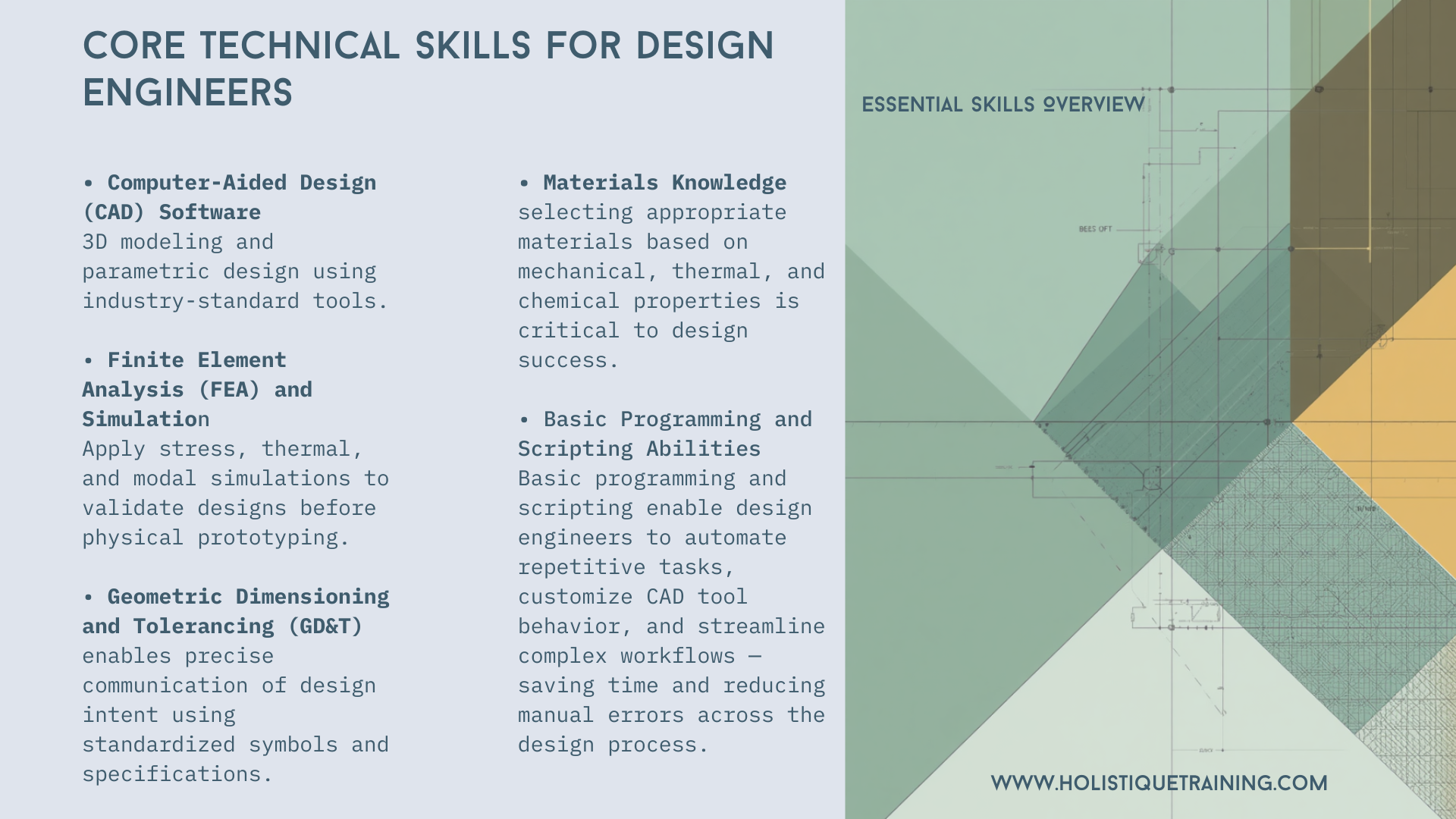
Technical competency remains the foundation of any design engineering career, and employers consistently prioritise a small cluster of core skills when reviewing candidates. Proficiency in computer-aided design software such as SolidWorks, AutoCAD, Fusion 360, or Creo is close to a baseline requirement across most industries, but employers increasingly expect design engineers to go further than basic modelling.
Finite element analysis and simulation skills allow engineers to test how a design will behave under real-world stresses before a physical prototype is built, reducing both cost and development time. Familiarity with geometric dimensioning and tolerancing ensures that designs can be manufactured consistently and inspected accurately. Materials knowledge, an understanding of manufacturing processes such as injection moulding, machining, or additive manufacturing, and basic programming or scripting ability for automating repetitive design tasks are all increasingly listed as preferred or required skills in job postings, particularly for mid-level and senior positions.
5- Essential Soft Skills for Design Engineers
Technical skill alone rarely defines a successful design engineering career. Because the role sits at the centre of a wider product development process, design engineers need to communicate clearly with colleagues who may not share their technical background, including sales teams, clients, and senior management. The ability to explain why a design decision was made, and what trade-offs it involves, is often what separates a competent designer from one who is trusted with greater responsibility.
Problem-solving under constraint is another defining soft skill. Design engineers rarely work with unlimited time, budget, or material options, and the best professionals in the field are those who can find workable, elegant solutions within tight boundaries. Attention to detail is essential given the safety and cost implications of design errors, while adaptability has become increasingly important as tools, standards, and manufacturing techniques continue to evolve at pace.
6- Career Path and Progression
A design engineering career typically follows a fairly predictable structure, even though the pace of progression varies by industry and individual performance. Most professionals begin in a junior or graduate design role, supporting senior engineers with modelling, drafting, and basic calculations while building familiarity with company standards and processes. With experience, they move into independent design work, taking ownership of components or subsystems and working directly with manufacturing and quality teams.
Global demand for design engineers has remained resilient even as some adjacent drafting-only roles have flattened. According to Randstad's career guidance for the profession, demand for design engineers was projected to grow by 6 percent between 2020 and 2030, a pace that reflects continued investment in new product development across consumer goods, industrial equipment, and infrastructure.
Career Stage | Typical Experience | Core Responsibilities | Typical Titles |
|---|---|---|---|
Entry-level | 0 to 2 years | Drafting, basic modelling, supporting senior engineers | Junior Design Engineer, CAD Designer |
Mid-level | 3 to 6 years | Independent design projects, prototyping, and testing | Design Engineer |
Senior | 7 to 12 years | Leading design work, technical sign-off, mentoring junior staff | Senior Design Engineer, Lead Design Engineer |
Principal / Management | 12+ years | Strategic design direction, cross-department leadership | Principal Engineer, Engineering Manager, Chief Engineer |
Beyond this vertical path, many design engineers choose to specialise, moving into simulation-focused roles, systems engineering, project management, or consultancy. Others move laterally into manufacturing engineering or quality engineering, drawing on their design background to improve how products are produced once they leave the drawing board.
7- Educational Pathways and Qualifications
Most design engineering roles require a bachelor's degree in mechanical, electrical, manufacturing, or product design engineering, typically taking three to four years to complete. Coursework generally covers mathematics, mechanics, materials science, thermodynamics, and increasingly, digital design tools and simulation software as standard components of the curriculum rather than optional extras.
A degree, however, is rarely sufficient on its own. Internships, co-operative placements, and practical project work during study are widely regarded by employers as strong indicators of a candidate's readiness for the workplace, since they demonstrate an ability to apply theoretical knowledge to real design problems. In some countries and sectors, particularly structural and civil-adjacent design work, professional engineering licensure or chartered status adds further credibility and, in some cases, is a legal requirement to sign off on certain categories of design.
8- Industries That Hire Design Engineers
Design engineers are employed across a strikingly wide range of industries, which is part of what makes the career path attractive to newcomers. Automotive and aerospace manufacturers hire large numbers of design engineers to develop everything from structural components to interior systems, often requiring familiarity with strict regulatory and safety standards. Consumer electronics and medical device companies place a premium on design engineers who can balance compact, manufacturable designs with rigorous reliability requirements.
Industrial equipment and machinery manufacturers rely heavily on design engineers to develop and refine the systems used in factories, warehouses, and processing plants, while construction and infrastructure firms employ design engineers focused on structural components, building systems, and civil works. Increasingly, renewable energy companies are also significant employers, as the design of wind turbine components, solar mounting systems, and battery enclosures draws directly on core design engineering skills.
9- The Impact of AI and Automation on Design Engineering
Artificial intelligence and automation are changing the day-to-day reality of design engineering rather than eliminating the profession outright. Generative design tools can now explore thousands of design variations based on constraints such as weight, strength, and cost, presenting engineers with options that would take far longer to generate manually. Routine drafting and checklist-level quality checks are increasingly automated, shifting the emphasis of the human role towards judgement, interpretation, and accountability for the final design.
This shift is reflected in wider labour market data. According to the World Economic Forum's Future of Jobs Report 2025, artificial intelligence, big data, and technological literacy rank among the fastest-growing skills employers expect to need over the next five years, with growing roles such as drafters and engineering technicians increasingly required to combine traditional manual and technical proficiency with stronger digital literacy.
For design engineers, the practical implication is that pure modelling skills are becoming a smaller part of the value they add. Professionals who combine CAD proficiency with simulation, basic programming, and an understanding of how AI-assisted tools fit into the design process are positioning themselves for the roles that are growing fastest, rather than the narrower drafting-focused work that is under the most pressure from automation.
10- Certifications and Continuous Professional Development
Formal certifications can meaningfully strengthen a design engineer's employability, particularly in competitive markets or when transitioning between industries. Software-specific certifications in tools such as SolidWorks, AutoCAD, or Revit demonstrate a verified level of proficiency that goes beyond a line on a CV, while broader qualifications in areas such as geographic information systems integration, structural analysis, or project management add depth to a design engineer's professional profile.
Continuous professional development matters just as much as initial qualifications, given how quickly design tools, materials, and manufacturing methods evolve. Building a structured personal learning path, rather than acquiring skills reactively, tends to produce more consistent long-term career progression.

This advanced course provides an in-depth exploration of integrating AutoCAD and GIS to enhance spatial data management and analysis. Designed for professionals seeking to bridge the gap between CAD and GIS technologies, this course offers hands-on experience and practical skills in leveraging AutoCAD for GIS support. Participants

Learn how to create an effective career development plan—assess skills, set goals, seek mentorship, and build a clear path for continuous growth.
11- Building a Portfolio and Gaining Practical Experience
Because design engineering is fundamentally a practical discipline, employers place significant weight on tangible evidence of a candidate's ability to design, refine, and deliver working solutions. A well-organised portfolio showcasing personal or academic design projects, ideally including the reasoning behind key decisions and not just finished renders, can be as persuasive as formal work experience for early-career candidates.
Practical experience can be gained through internships, university design competitions, open-source hardware projects, or volunteering technical skills to community and non-profit initiatives that need product or equipment design support. Each of these routes provides an opportunity to demonstrate the full design process, from problem definition through to a tested, functioning outcome, which is precisely what hiring managers want to see beyond a transcript of grades.
12- How to Get Hired as a Design Engineer
Getting hired as a design engineer typically involves several distinct stages, and candidates who prepare for each one separately tend to perform noticeably better than those who rely on a single generic CV and cover letter. The first stage is tailoring application materials to the specific tools, industries, and design challenges mentioned in a job posting, rather than submitting a generic engineering CV to every vacancy.
The rise of skills-based hiring has also changed what employers look for during the interview process itself. Many now ask candidates to complete a practical design exercise or talk through a past project in detail, testing not just technical knowledge but the reasoning process behind design decisions. Building broader career readiness, including communication, adaptability, and structured self-assessment of strengths and gaps, has become as relevant to landing a design engineering role as technical CAD ability alone.
Networking within professional engineering bodies, attending industry trade shows, and seeking informational interviews with practising design engineers can also surface opportunities that never appear on public job boards, particularly at small and mid-sized manufacturing firms where hiring is often done through referral rather than formal recruitment campaigns.

The 21st century demands more than just subject knowledge — learners need a set of future skills to thrive in an ever-changing, technology-driven, and interconnected world. These skills — often called “soft” or “essential” — include creativity, critical thinking, digital literacy, collaboration, and resilience.This course equips
13- Common Career Challenges and How to Overcome Them
Design engineering careers are not without friction points. Early-career professionals often struggle with the gap between academic design theory and the practical, cost-constrained reality of commercial product development, where the elegant solution taught in a classroom is rarely the one that survives contact with a manufacturing budget. Building relationships with manufacturing and quality colleagues early in a career helps close this gap far faster than working in isolation.
Mid-career professionals sometimes face a plateau once they have mastered the core technical demands of the role, and moving further often requires a deliberate choice between deepening technical specialisation or shifting towards people and project leadership. For those considering a shift into design engineering from an adjacent field, such as manufacturing, drafting, or a different branch of engineering entirely, understanding whether that shift represents a full career change or a more incremental pivot can clarify how much retraining is genuinely required.
14- Specialisations Within Design Engineering
As design engineers gain experience, many choose to specialise in a particular technical domain or industry, which typically brings both deeper expertise and stronger earning potential. The right specialisation depends heavily on personal interest, regional industry strength, and long-term career goals, but certain patterns recur across the profession.
Specialisation | Typical Industry | Key Focus |
|---|---|---|
Mechanical Design Engineering | Manufacturing, automotive, industrial equipment | Mechanisms, materials, and structural integrity |
Electrical / Electronics Design Engineering | Electronics, consumer technology, telecommunications | Circuit design, PCB layout, and power systems |
Structural Design Engineering | Construction and infrastructure | Load analysis and structural safety |
Product Design Engineering | Consumer goods and medical devices | User-centred, functional product design |
Automotive / Aerospace Design Engineering | Automotive and aerospace manufacturing | High-performance, safety-critical systems |
Specialisation is rarely a permanent commitment. It is common for design engineers to move between two or three related specialisations over the course of a career, particularly when transitioning between industries that share overlapping technical requirements, such as moving from automotive to aerospace design work.
15- The Future Outlook for Design Engineers
The long-term outlook for design engineering remains positive, driven by sustained demand for new product development, the ongoing energy transition, and the continued growth of advanced manufacturing across both established and emerging economies. Rather than displacing the profession, artificial intelligence and generative design tools appear to be redistributing where value is created within it, rewarding engineers who can direct and interpret these tools rather than compete with them on raw modelling speed.
Professionals who invest early in adaptive, technology-aware skill sets, alongside the fundamentals of sound engineering judgement, are best placed to benefit from this shift. Building comfort with AI-assisted design workflows now is likely to prove far more valuable over a career than resisting them.

The rise of artificial intelligence is reshaping how we think, learn, and solve problems. In today’s fast-changing world, learning is no longer a linear process—it’s a dynamic interaction between human insight and machine intelligence. This course introduces the concept of hybrid intelligence and empowers participants to
16- Conclusion
Design engineering remains one of the more resilient and rewarding paths within the broader engineering profession, offering strong global demand, competitive salaries, and genuine variety across industries ranging from automotive and aerospace to renewable energy and consumer products. Success in the field depends on a combination that has remained fairly constant even as the specific tools have changed: solid technical grounding in CAD and simulation, the communication skills needed to work across departments, and a willingness to keep learning as design technology continues to evolve.
For those entering the profession or looking to progress within it, the clearest path forward is to build practical, demonstrable experience alongside formal qualifications, pursue certifications that reflect genuine market demand, and stay deliberately engaged with how artificial intelligence and automation are reshaping the day-to-day work of design. Those who do so will find that design engineering continues to offer one of the more stable and well-compensated routes into a lasting technical career.