

- Table of Contents
- Introduction
- 1- What Is a High-Performance Culture?
- High Standards With High Support
- Results and the Way You Reach Them
- Common Misunderstandings
- 2- Why a High-Performance Culture Matters
- The Engagement Problem
- The Payoff for Getting It Right
- Retention and Customer Experience
- 3- High-Performance Culture vs Average Culture
- 4- The Building Blocks of a High-Performance Culture
- 5- The Role of Leaders and Managers
- Culture Starts at the Top
- Managers Make It Real Every Day
- Looking After Wellbeing
- 6- Hiring and Developing the Right People
- Hire for Attitude and Skill
- Onboarding and Growth
- Build Diverse and Inclusive Teams
- 7- Performance Management and Feedback
- Make Feedback Normal
- Set Goals People Can Own
- Deal With Underperformance Early
- 8- Recognition and Rewards
- 9- Continuous Improvement and Learning
- Make Learning Part of the Work
- Treat Experiments as Progress
- Share Knowledge Across Teams
- 10- Common Mistakes That Derail a High-Performance Culture
- 11- How to Measure a High-Performance Culture
- 12- A Practical Roadmap to Get Started
- Adapting to Hybrid and Remote Work
- Conclusion
Introduction
Almost every leader says they want a high-performance culture. Very few can explain what it actually looks like on a Tuesday afternoon, when deadlines are tight, a client is unhappy and half the team is feeling stretched. That gap between the slogan and the daily reality is exactly why so many culture initiatives fade after a few months. Posters go up, values get printed on mugs, and nothing much changes in the way people work together.
The good news is that a high-performance culture is not a mystery, and it is not reserved for tech giants or elite sports teams. It is simply an environment where people know what great work looks like, feel trusted to deliver it, get honest feedback along the way and see their effort recognised. Done well, it lifts results, keeps talented people in the building and makes work far more enjoyable. Done badly, it turns into a pressure cooker that burns people out.
In this article, we will discuss what a high-performance culture is, why it matters for business results, how it differs from an average culture, the building blocks that hold it together, the role of leaders, hiring and development, feedback, recognition, continuous improvement, the mistakes that derail it, how to measure it, and a practical roadmap for getting started.
1- What Is a High-Performance Culture?
A high-performance culture is a way of working in which clear goals, high standards, mutual trust and continuous learning combine to produce consistently strong results. The word culture matters here. It means the behaviours that are rewarded, tolerated and ignored every day, not just the values written on a website. If you want to know what your culture really is, watch what happens when someone misses a deadline or brings bad news to a meeting.
High Standards With High Support
The part people often miss is that standards are only half the story. High-performing teams pair demanding expectations with genuine support, such as coaching, resources and room to make honest mistakes. Take away the support and you get fear. Take away the standards and you get a pleasant but average workplace. The magic sits where both are strong at the same time.
Results and the Way You Reach Them
A strong culture cares about outcomes, but it also cares about how those outcomes are achieved. A salesperson who hits every target by cutting corners or steamrolling colleagues is not a high performer in this sense. High-performance cultures define success by both results and behaviours, which protects trust and keeps everyone pulling in the same direction over the long term.
Common Misunderstandings
It helps to clear up a few myths. A high-performance culture is not about working longer hours, hiring only superstars or chasing targets at any cost. It is also not a one-size-fits-all model that can be copied from another company. Every organisation has its own people, customers and pressures, so the culture has to be shaped around them. What stays constant is the focus on clarity, trust, honest feedback and growth.
2- Why a High-Performance Culture Matters
Culture sounds soft, but its effects show up in hard numbers: productivity, retention, quality, customer loyalty and profit. When people understand their goals and care about their team, they spend less energy on workarounds, office politics and second-guessing, and more on doing good work. They also stay longer, which saves money on recruitment and protects the knowledge that walks out of the door every time someone leaves.
The Engagement Problem
According to Gallup’s State of the Global Workplace 2026 report, only 20 percent of employees worldwide were engaged at work in 2025, the lowest level since 2020. Gallup estimates that this low engagement cost the world economy around 10 trillion US dollars in lost productivity. In other words, most workers are turning up without being fully switched on, and that is a huge amount of untapped potential sitting inside organisations of every size.
The Payoff for Getting It Right
The upside is just as striking. A study by Gallup, based on a meta-analysis of 183,806 business units, found that teams in the top quartile for engagement achieved 23 percent higher profit than those in the bottom quartile. The researchers linked this to lower absenteeism and turnover, fewer safety incidents and defects, and higher customer loyalty and productivity. A strong culture is therefore not a luxury for good times. It is a practical way to protect the bottom line.
Retention and Customer Experience
The benefits spill over into the customer experience too. Engaged, well-supported employees tend to be more attentive, more creative and more willing to go the extra mile when something goes wrong. Customers feel that difference, even if they can’t name its cause. At the same time, strong cultures become magnets for talent, which makes hiring easier and stops the best people drifting towards competitors.
3- High-Performance Culture vs Average Culture
The easiest way to understand a high-performance culture is to compare it with the average workplace most of us have experienced at some point. The differences are rarely about talent or budget. They are about everyday habits, as the table below shows.
Dimension | Average Culture | High-Performance Culture |
Goals | Vague or constantly changing | Clear, shared and visible |
Accountability | Blame when things go wrong | Ownership and learning |
Feedback | Annual and often awkward | Regular, honest and two-way |
Mistakes | Hidden or punished | Discussed and learned from |
Recognition | Occasional and generic | Frequent and specific |
Leadership | Directing and controlling | Coaching and enabling |
Change | Resisted | Treated as normal |
Notice that none of these differences require a big budget. They depend on consistent behaviour from leaders and managers, repeated until it becomes the normal way of doing things.
4- The Building Blocks of a High-Performance Culture
Every high-performance culture is made from a handful of ingredients. You don’t need all of them perfect on day one, but you do need to be working on each of them if the culture is going to last.
1- Clear Purpose and Direction:
People perform better when they understand why their work matters and how it connects to the bigger picture. Leaders should be able to explain the organisation’s goals in a couple of sentences, and every team member should be able to say how their role contributes. When direction is fuzzy, effort scatters in all directions.
2- Accountability Without Blame:
Ownership means people take responsibility for their results and for putting things right when they go wrong. The difference lies in the response. Instead of asking who is at fault, high-performing teams ask what happened, what can be learned and what will change next time. That keeps accountability high and fear low.
3- Psychological Safety:
Team members need to feel safe to ask questions, admit errors and challenge ideas, including their manager’s. Without that safety, problems stay hidden until they become expensive. With it, small issues are raised early and solved quickly, which is exactly what you want in a busy operation.
4- Autonomy and Trust:
Talented people do their best work when they have a real say over how they reach their goals. Micromanagement signals distrust and drains motivation. Giving people clear outcomes and the freedom to choose their route builds confidence, creativity and a stronger sense of ownership.
5- Continuous Learning:
Markets, tools and customer expectations keep changing, so yesterday’s skills won’t carry a team forever. High-performance cultures treat learning as part of the job, with time for training, coaching and sharing lessons across the team, rather than something that only happens when the budget allows.
6- Strong Teamwork:
High-performing teams share information freely, help each other through busy periods and celebrate wins together. They also know how to disagree productively. Respectful debate improves decisions, while silent resentment slowly poisons them. Building this takes shared goals, clear roles and leaders who encourage collaboration instead of rewarding lone heroes.
5- The Role of Leaders and Managers
Culture Starts at the Top
Employees watch leaders far more closely than they read values statements. If senior leaders talk about openness but punish bad news, people learn very quickly what is really expected. If leaders arrive prepared, keep their promises, admit their own mistakes and hold themselves to the same standards as everyone else, the culture follows. Behaviour at the top sets the ceiling for behaviour everywhere else.

Explore organisational culture—values, norms, and leadership—and learn how aligning culture with goals drives engagement, innovation, and performance.
Managers Make It Real Every Day
Senior leaders set the tone, but line managers deliver the culture. They are the ones holding one-to-ones, giving feedback, assigning work and deciding how a team member’s mistake is handled. This is why investing in management skills pays off so heavily. A brilliant strategy will not survive a layer of managers who don’t know how to coach, communicate and motivate. Strong managers turn good intentions into daily habits.
Looking After Wellbeing
High performance is a marathon, not a sprint. Leaders who protect their own energy, take proper breaks and encourage others to do the same show that sustainable effort is valued. Managers should also watch for signs of stress, such as withdrawal, irritability or a drop in quality, and start supportive conversations early. A team that feels cared for is far more likely to keep delivering over the long term.
6- Hiring and Developing the Right People
Hire for Attitude and Skill
Skills can be taught, but curiosity, resilience and a willingness to collaborate are much harder to build from scratch. High-performance cultures look for people who share the team’s standards, then check that they have, or can quickly gain, the technical ability. Structured interviews, realistic work samples and honest conversations about expectations help avoid mismatches that cost everyone later.
Onboarding and Growth
The first ninety days shape how people see an organisation for years. A clear onboarding plan, a friendly buddy and some early wins help new starters understand what good looks like. After that, regular development conversations, stretch assignments and visible career paths show people that their growth matters. Employees who can see a future with you are far more likely to give their best and stay.

The "Human Resources Lifecycle Training: Mastering the Employee Journey" course provides a comprehensive understanding of the HR lifecycle and its critical role in shaping organisational success. Covering every stage of the employee experience—from recruitment to offboarding—this training equips HR professionals with the knowledge and tools
Build Diverse and Inclusive Teams
Teams made up of people with different backgrounds, experiences and ways of thinking tend to challenge assumptions and spot risks that a uniform group might miss. Inclusion is what makes that diversity useful. When everyone’s voice is heard and fair opportunities are open to all, you get better ideas and a stronger sense of belonging, both of which feed performance.
7- Performance Management and Feedback
Make Feedback Normal
In many workplaces, feedback arrives once a year in a stressful appraisal, by which point it is too late to act on. In a high-performance culture, feedback is frequent, specific and two-way. A short weekly check-in, a quick comment after a presentation or a conversation about what went well and what could be better turns feedback into a habit rather than an event. It also helps when managers ask for feedback on their own performance, because it shows everyone that honesty is safe.
Set Goals People Can Own
Goals work best when people understand them, believe they are fair and have helped shape them. Clear objectives with measurable outcomes, reviewed regularly, keep everyone focused on what matters most. Avoid overloading people with dozens of priorities. When everything is a priority, nothing is, and performance suffers quietly.
Deal With Underperformance Early
Every team has moments when someone struggles. Ignoring the problem is unfair to the individual and to colleagues who end up picking up the slack. A supportive conversation, a clear explanation of the gap and an agreed plan with a realistic timeline usually works. Often the cause is unclear expectations, a skills gap or a personal difficulty rather than a lack of effort. If improvement still doesn’t come, acting fairly and decisively shows the rest of the team that standards genuinely matter.
8- Recognition and Rewards
Recognition is the fuel that keeps high effort going. People want to know that their work is noticed and valued, and they want to hear it from someone whose opinion matters to them. The most effective recognition is timely, specific and sincere. Thanking someone for handling a difficult client call calmly, and explaining why it mattered, will mean far more than a generic well done in a group email.
Recognition also doesn’t have to cost much. The table below shows a few common types and when each one works best.
Type | Example | Works Best When |
Verbal praise | A personal thank-you after a tough project | Effort should be acknowledged straight away |
Public recognition | A shout-out in a team meeting | A win can inspire others |
Development opportunity | Leading a new project or course | You want to reward and grow talent |
Financial reward | A bonus or pay rise | Results are clearly measurable |
Time and flexibility | An extra day off after a big deadline | The team has worked intensely |
Financial rewards matter, but they work best as one part of a wider mix. Fairness is crucial. If people feel rewards go to favourites rather than results, trust collapses. Clear criteria, applied consistently, keep recognition credible and motivating.

Having a great benefits and rewards system is the key to attracting quality candidates to a job role. The right employee will usually want to work with the company and participate in benefits schemes and may be more motivated by the company has extras than
Non-financial recognition deserves just as much attention. Autonomy, interesting work, visible progress and a sense of belonging often motivate people more than an occasional bonus. Ask your team what they value most. You may be surprised by how simple and affordable the answers turn out to be.
9- Continuous Improvement and Learning
Make Learning Part of the Work
High-performing teams never assume they have arrived. They run short reviews after projects, ask what could have been done better and share lessons with the wider organisation. Small, regular improvements add up to a big competitive edge over time, and they keep people curious and engaged. Learning works best when it sits inside the daily workflow instead of being squeezed in after hours.
Treat Experiments as Progress
Innovation needs room to fail safely. If every misstep is punished, people will stick to what they already know. Encourage small experiments, agree in advance how you will judge them and celebrate the lessons even when the result is disappointing. That tells people smart risk-taking is welcome.

This advanced training course provides a comprehensive framework for achieving and sustaining operational excellence within organisations. Participants will explore strategies to optimise processes, enhance performance, and build a culture of continuous improvement. By blending theory with real-world applications, the course equips leaders and managers with the tools to
Share Knowledge Across Teams
Good ideas shouldn’t stay trapped in one department. Short internal presentations, shared documents and cross-team projects help lessons travel quickly. When people see their ideas adopted elsewhere, it boosts pride and encourages more contributions. It also reduces duplicated effort, which frees up time for more valuable work.
10- Common Mistakes That Derail a High-Performance Culture
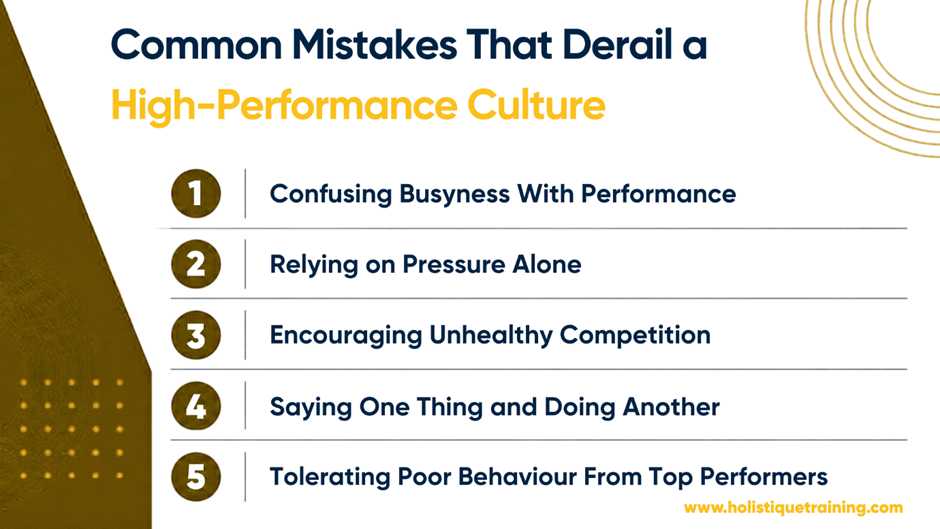
Plenty of well-meaning organisations try to build a high-performance culture and end up with something quite different. These are the mistakes that appear most often.
1- Confusing Busyness With Performance:
Long hours and full diaries look impressive, but they are not the same as results. A culture that rewards visible effort over real outcomes encourages people to look busy rather than be effective.
2- Relying on Pressure Alone:
Constant urgency may produce short bursts of output, but it also produces exhaustion, errors and resignations. Sustainable performance needs realistic workloads, time to recover and managers who notice the early signs of burnout.
3- Encouraging Unhealthy Competition:
Friendly rivalry can be motivating, but league tables that pit colleagues against each other discourage sharing and teamwork. Reward collective success as well as individual contribution.
4- Saying One Thing and Doing Another:
If the company celebrates work-life balance while sending emails at midnight, employees will believe the actions. Inconsistency between words and behaviour is the quickest way to destroy credibility.
5- Tolerating Poor Behaviour From Top Performers:
Excusing a high earner who bullies colleagues sends a message that results matter more than values. The rest of the team will notice, and your best people may be the first to leave.
11- How to Measure a High-Performance Culture
You can’t improve what you don’t measure, and culture is no exception. The trick is to track a mix of results and people indicators so that you see both what is being achieved and how it feels to achieve it. Looking at them together helps you spot problems early, such as strong sales figures sitting alongside rising turnover.
Measure | What It Tells You | How Often |
Engagement score | How committed and motivated people feel | Quarterly |
Staff turnover and absence | Whether people want to stay and feel well | Monthly |
Goal achievement rate | Whether priorities are being delivered | Quarterly |
Customer satisfaction | Whether the culture reaches the customer | Monthly |
Feedback and recognition frequency | Whether everyday habits are in place | Quarterly |
McKinsey’s research on organisational health shows how closely culture and results are linked. According to McKinsey, the top quartile of companies on its Organizational Health Index delivers roughly three times the returns to shareholders of those in the bottom quartile. The firm also found that companies working on their health saw tangible performance gains in as little as six to twelve months. Treat culture data the way you treat financial data, by reviewing it regularly and acting on what you find.
Alongside the numbers, make time to listen. Short pulse surveys, open team discussions and exit interviews give you the stories behind the statistics. Share what you learn with employees and explain what you plan to do about it. People are far more willing to give honest input when they can see that it leads to action rather than disappearing into a spreadsheet.
12- A Practical Roadmap to Get Started
You don’t need a huge programme to begin. This simple sequence works for organisations of almost any size.
1- Define What High Performance Means Here:
Agree on a short list of behaviours and results that matter most in your organisation, written in plain language that everyone can understand and repeat.
2- Start With Leaders and Managers:
Give them the skills and the expectation to model the behaviours, coach their teams and hold honest conversations, because the team will copy what they see.
3- Fix the Basics of Feedback and Goals:
Introduce regular check-ins and clear objectives so people always know where they stand and what good looks like.
4- Build Recognition and Learning Into the Routine:
Make thanks, development and reflection part of the weekly rhythm rather than occasional events.
5- Measure, Review and Adjust:
Check your indicators every quarter, listen to your people and refine your approach. Culture is never finished.
Adapting to Hybrid and Remote Work
Whether your team sits in one office or across several time zones, the roadmap stays the same, but the habits need adjusting. Remote and hybrid teams benefit from written goals, predictable check-ins, clear communication norms and deliberate moments of connection. Trust matters even more when you can’t see people at their desks, so judge work by outcomes rather than hours online.

The rise of artificial intelligence is reshaping how we think, learn, and solve problems. In today’s fast-changing world, learning is no longer a linear process—it’s a dynamic interaction between human insight and machine intelligence. This course introduces the concept of hybrid intelligence and empowers participants to
Conclusion
A high-performance culture isn’t built with a slogan or a one-off workshop. It is built through thousands of small, consistent moments: a clear goal, an honest conversation, a thank-you that lands, a mistake treated as a lesson. When these moments add up, people feel trusted and challenged at the same time, and that combination is what produces strong, lasting results.
If you take only one idea away, let it be this: start with your managers. They shape how goals are set, how feedback feels and how people are treated on difficult days. Support them with training, time and clear expectations, and the rest of the culture gradually follows. Neglect them, and even the best-designed programme will struggle to survive contact with the real world.
The path is practical. Get clear on what high performance means, equip your managers, make feedback and recognition routine, keep learning, and measure progress honestly. Avoid the traps of pressure, inconsistency and unhealthy competition. Start small, stay consistent and give it time. The organisations that do will find that culture becomes their most reliable advantage.