


- Table of Contents
- Introduction
- 1- What Is Operations as a Career Field?
- 2- The Salary Spectrum: Entry-Level to Executive
- 3- Regional Salary Benchmarks
- 4- Sector Differences in Operations Pay
- 5- Fixed vs Variable Pay: How Operations Compensation Is Structured
- 6- How Experience and Seniority Drive Earnings
- 7- Education, Certifications, and Their Pay Impact
- 8- The Role of Industry Volatility
- 9- Gender and the Operations Pay Gap
- 10- The Future of Operations Salaries
- 11- How to Negotiate a Higher Operations Salary
- 12- Comparing Operations Salaries Globally
- Conclusion
Introduction
Operations is one of the most expansive career fields in the modern economy. It spans industries, geographies, and organisational sizes, encompassing roles as varied as logistics coordinators, supply chain directors, process improvement managers, and chief operating officers. Despite this breadth, the question of what operations professionals actually earn is rarely answered with precision. Salary data is fragmented across sectors and regions, job titles are inconsistently applied, and the structure of compensation itself — blending fixed salaries with bonuses, profit-sharing, and long-term incentive plans — makes straightforward comparisons difficult.
Understanding operations salaries matters for multiple reasons. For individuals entering or advancing in the field, it informs career decisions, salary negotiations, and professional development investments. For organisations, it shapes recruitment strategy, retention planning, and compensation benchmarking. For human resources and people operations professionals, it provides the empirical foundation for designing competitive reward frameworks. This article examines what operations professionals earn at different levels and in different contexts, how compensation structures are built, and what factors most reliably drive earnings upward.
1- What Is Operations as a Career Field?
Operations as a professional discipline sits at the intersection of strategy, process, and people. At its most fundamental level, operations encompasses the management of the activities and resources that an organisation uses to deliver its products or services. This includes supply chain management, procurement, logistics, facilities, quality assurance, production planning, business process improvement, and administrative coordination. In practice, operations roles exist in every sector and at every level of an organisation, from the coordinator managing daily workflow in a warehouse to the chief operating officer overseeing an entire corporate function.
The breadth of the field means that the term 'operations professional' covers a remarkably diverse population. In manufacturing, it implies oversight of production lines and quality systems. In healthcare, it relates to managing clinical processes, resource scheduling, and compliance. In financial services, operations teams handle transaction processing, risk controls, and regulatory reporting. This diversity is one of the reasons why salary comparisons across operations roles require careful contextualisation. A title such as Operations Manager can carry very different responsibilities and compensation depending on the industry, company size, and geographic market in which it exists.
2- The Salary Spectrum: Entry-Level to Executive
Operations salaries follow a progression that broadly mirrors the growth in responsibility, complexity, and accountability that comes with seniority. Entry-level roles such as operations coordinators, logistics assistants, and process analysts typically earn between USD 30,000 and USD 55,000 annually, depending on location and sector. These roles provide the operational foundation from which most careers in the field are built.
Mid-career professionals holding titles such as Operations Manager or Supply Chain Manager occupy the most densely populated part of the salary distribution. According to the United States Bureau of Labour Statistics , the median annual wage for general and operations managers was USD 102,950 in 2024, with the top ten per cent of earners reaching USD 239,200 or above. Senior managers and directors typically command packages in the range of USD 95,000 to USD 190,000, with significant variation by industry. At the executive level, vice presidents of operations and chief operating officers can earn anywhere from USD 180,000 to well over USD 350,000, particularly in large multinational companies where variable pay — including bonuses, equity, and long-term incentive plans — constitutes a substantial share of total compensation.
3- Regional Salary Benchmarks
Geography is among the most powerful determinants of operations pay. Compensation benchmarks vary enormously across countries and even between cities within the same country, reflecting differences in cost of living, labour market conditions, industry concentration, and regulatory environments.
In North America, the United States consistently offers the highest absolute compensation for operations roles. Operations managers in major metropolitan areas such as New York, San Francisco, and Chicago command significantly higher salaries than the national median, often twenty to thirty per cent above average. Canada offers broadly comparable frameworks, though typically at a lower absolute level. In the United Kingdom, operations managers typically earn between GBP 35,000 and GBP 75,000 annually, with senior and director-level roles reaching GBP 90,000 to GBP 130,000 in larger organisations. Western Europe generally follows a similar trajectory, with Germany, Switzerland, and the Netherlands sitting at the upper range of European compensation.
In the Middle East, particularly across the Gulf Cooperation Council countries, operations roles attract significant compensation that is further enhanced by tax-free income structures and comprehensive benefits packages including housing and transport allowances. In Asia-Pacific, Singapore and Australia offer the most competitive packages in the region, while markets such as India and Southeast Asia provide more modest base salaries alongside rapid career progression opportunities and growing demand for operations talent.
Region | Entry-Level (USD) | Mid-Level (USD) | Senior / Director (USD) |
|---|---|---|---|
North America | 30,000 – 55,000 | 65,000 – 130,000 | 130,000 – 239,000+ |
United Kingdom | 38,000 – 60,000 | 60,000 – 95,000 | 95,000 – 155,000 |
Western Europe | 35,000 – 58,000 | 58,000 – 100,000 | 100,000 – 160,000 |
Middle East (GCC) | 35,000 – 60,000 | 65,000 – 110,000 | 110,000 – 200,000+ |
Asia-Pacific | 20,000 – 45,000 | 45,000 – 90,000 | 80,000 – 150,000 |
Latin America | 15,000 – 30,000 | 30,000 – 65,000 | 60,000 – 110,000 |
4- Sector Differences in Operations Pay
The industry in which an operations professional works is one of the strongest predictors of total compensation. Sectors characterised by high capital intensity, significant regulatory complexity, or fast-moving market dynamics tend to pay more for operations talent because the cost of poor operational performance is especially high.
Technology companies rank among the highest-paying employers of operations professionals globally, with operations managers at major technology firms often earning base salaries that sit twenty-five to forty per cent above the national median, supplemented by equity compensation that can substantially increase total earnings. Financial services and pharmaceuticals also sit at the top of the operations pay scale, driven by compliance requirements and the material financial consequences of operational errors. Energy and oil and gas have historically offered premium operations packages, particularly for roles involving complex logistics, safety management, and regulatory oversight. By contrast, retail, hospitality, and non-profit organisations typically offer lower base salaries, though they may compensate through non-financial benefits, flexibility, and mission-driven working environments.
Sector | Relative Pay Level | Primary Salary Drivers |
|---|---|---|
Technology | High | Equity, rapid growth, talent competition |
Financial Services | High | Compliance complexity, transaction volumes |
Pharmaceuticals | High | Regulatory requirements, supply chain precision |
Energy / Oil and Gas | High | Operational risk, remote locations, safety |
Manufacturing | Mid to High | Scale, lean expertise, process complexity |
Healthcare | Mid | Clinical coordination, patient safety standards |
Logistics and Transport | Mid | Volume operations, time-sensitivity |
Retail and Hospitality | Lower | Thin margins, high turnover, service focus |
5- Fixed vs Variable Pay: How Operations Compensation Is Structured
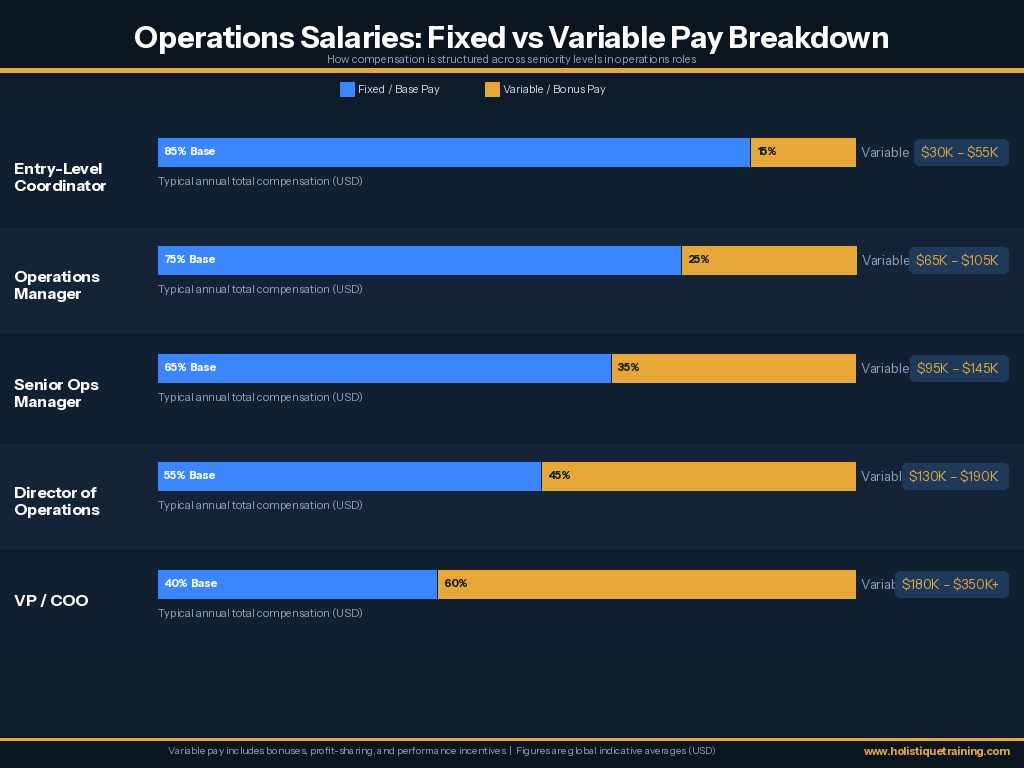
A critical aspect of understanding operations salaries is grasping not just the headline figure but how that figure is constructed. Most operations roles combine a fixed base salary with one or more forms of variable pay, and the balance between these two components shifts meaningfully as seniority increases.
At entry level, compensation is predominantly fixed. An operations coordinator receiving a package of USD 45,000 is likely receiving the vast majority of that as guaranteed base pay, with perhaps a modest performance-related bonus of ten to fifteen per cent in well-structured organisations. As professionals progress to operations manager level, a variable component of twenty to thirty per cent begins to appear more consistently, tied to individual KPIs, team performance metrics, or broader organisational results. At director and vice president level, the variable portion can represent forty-five per cent or more of total target compensation, often structured as an annual short-term incentive plan with additional long-term components such as equity awards or deferred bonuses. At the COO level in larger organisations, the variable share may exceed the base salary itself, with total packages structured to align executive behaviour closely with shareholder and organisational outcomes. The infographic below illustrates how this fixed-to-variable ratio shifts across seniority levels in a typical operations career ladder.

Having a great benefits and rewards system is the key to attracting quality candidates to a job role. The right employee will usually want to work with the company and participate in benefits schemes and may be more motivated by the company has extras than
6- How Experience and Seniority Drive Earnings
Experience is one of the most reliable drivers of salary growth in operations, though the relationship is not purely linear. In the early years of a career, each additional year of experience typically produces meaningful salary increases as professionals develop foundational competencies and demonstrate their capacity to manage increasing complexity. This growth tends to accelerate around the five-to-seven-year mark, when many professionals transition from operational execution roles to management positions that carry explicit accountability for team performance, process outcomes, and budget.
Beyond ten years, salary growth increasingly depends less on tenure and more on demonstrated strategic impact, leadership breadth, and the ability to manage cross-functional or cross-regional responsibilities. Professionals who develop expertise in high-demand specialisations — such as digital operations transformation, supply chain resilience, or data-driven process improvement — often experience steeper salary trajectories than generalists, particularly as organisations seek to modernise their operational capabilities in response to technological change.
7- Education, Certifications, and Their Pay Impact
Formal education provides a baseline credential that many operations employers use in initial screening, but it is rarely the primary driver of long-term earnings in the field. A bachelor's degree in business administration, supply chain management, engineering, or a related discipline is the most common educational background for operations professionals and typically satisfies the minimum threshold for managerial roles. A master's degree — particularly an MBA or a specialised master's in operations management — can accelerate entry into senior roles and may command a salary premium of fifteen to twenty-five per cent at the point of hire in some markets.
Professional certifications often deliver a more direct and measurable return on investment for mid-career operations professionals. Qualifications such as APICS CSCP, APICS CPIM, CIPS, PMP, and Lean Six Sigma Black Belt are widely recognised across sectors and geographies and are consistently associated with higher compensation. According to a salary survey conducted by ASCM , APICS-certified professionals earn up to twenty-five per cent more than their non-certified counterparts, representing a compelling financial case for certification investment. In the context of operations roles specifically, certifications signal not only knowledge but also a commitment to professional development that many employers actively reward.

This advanced training course provides a comprehensive framework for achieving and sustaining operational excellence within organisations. Participants will explore strategies to optimise processes, enhance performance, and build a culture of continuous improvement. By blending theory with real-world applications, the course equips leaders and managers with the tools to
8- The Role of Industry Volatility
Operations professionals working in volatile or high-growth industries often experience more variable but potentially higher total earnings than those in stable, mature sectors. In high-growth technology and e-commerce organisations, operations teams are frequently expected to scale rapidly, and compensation reflects the premium placed on adaptability, speed, and the ability to build processes from scratch rather than optimise established ones. In cyclical industries such as energy, mining, and construction, operations compensation can fluctuate significantly with commodity cycles and project pipelines, creating periods of elevated pay alongside periods of contraction.
Industry volatility also influences the structure of compensation packages. In sectors where long-term financial performance is difficult to predict, employers tend to weight variable pay more heavily as a mechanism for managing fixed labour costs while retaining the ability to reward high performance when conditions allow. This places an additional premium on understanding one's own industry cycle when evaluating a compensation offer or considering a sector move.
9- Gender and the Operations Pay Gap
Like most management disciplines, operations exhibits a persistent gender pay gap that varies by region, level, and sector. Research by McKinsey and Company found that women in managerial roles earn approximately twenty-seven per cent less than men on average by their tenth year of career progression, with differing career trajectories and time out of the workforce identified as the two principal explanatory factors. In operations specifically, the gap tends to be most pronounced at the senior management and director level, where women remain underrepresented in many industries.
The mechanisms behind the gap are multiple. Women in operations are less likely to be in the highest-paying subsectors such as energy and heavy manufacturing, face greater career interruption effects, and in some markets encounter structural barriers to promotion into roles with the highest variable pay components. Organisations seeking to address this disparity are increasingly investing in structured pay equity reviews, transparent salary banding, and targeted sponsorship of women into senior operations leadership roles. These measures do not resolve the gap overnight, but they represent meaningful progress towards more equitable compensation structures.
10- The Future of Operations Salaries
The outlook for operations salaries is shaped by two competing forces. On the demand side, the increasing strategic importance of operations functions — driven by supply chain disruption, digital transformation, and the growing complexity of global business — is creating sustained upward pressure on compensation for skilled professionals. According to the World Economic Forum's Future of Jobs Report 2025 , General and Operations Managers are among the job categories driving the most net job growth globally through 2030, with resource management and operations listed among the most prominent skills differentiating growing from declining roles worldwide.
On the supply side, automation and artificial intelligence are reshaping operational roles, eliminating routine transactional work while simultaneously creating demand for professionals capable of designing, overseeing, and optimising AI-augmented processes. This bifurcation is likely to widen the pay gap between operations professionals with strong digital and analytical competencies and those whose skills remain primarily manual or process-oriented. Professionals who invest in developing data literacy, AI tool proficiency, and systems-level thinking are well positioned to benefit from this transition.

The Chief Operating Officer (COO) is the architect of organisational execution — translating strategy into results through efficient operations, effective processes, and engaged teams. As the second-in-command in many organisations, the COO ensures that day-to-day activities align seamlessly with long-term goals.This course equips current and aspiring
11- How to Negotiate a Higher Operations Salary
Salary negotiation is a skill that many operations professionals underutilise. Research consistently shows that professionals who negotiate at the point of offer typically achieve meaningfully higher starting salaries, and those gains compound over time through future percentage-based increases. In operations roles, effective negotiation begins with rigorous market research: understanding what comparable roles pay in the same sector, geography, and organisational size is the single most important foundation for a credible negotiation.
Beyond market data, operations professionals can strengthen their negotiating position by quantifying the value of their contributions. Unlike roles where output is difficult to measure, operations often produces clear, trackable outcomes: cost reductions achieved, process cycle times improved, inventory levels optimised, or compliance incidents avoided. Translating these achievements into financial terms gives a negotiator concrete evidence of return on investment that is difficult for employers to discount. Timing also matters: negotiations conducted at the point of a new offer, following a significant achievement, or at a planned review cycle tend to produce better outcomes than those initiated at arbitrary points in the calendar.
12- Comparing Operations Salaries Globally
When comparing operations salaries across countries, purchasing power parity and total compensation structure are as important as nominal figures. A salary of USD 80,000 in the United States, GBP 60,000 in the United Kingdom, and AED 250,000 in the UAE may appear very different in absolute terms but represent broadly comparable purchasing power once local costs, tax regimes, and benefits structures are factored in. This is particularly relevant for operations professionals considering international assignments or relocations, for whom a higher nominal salary may not always translate into a better standard of living.
Total compensation packages in the Middle East frequently include housing and transport allowances, school fee support, annual flights home, and end-of-service gratuities that can substantially increase the real value of a package beyond the base salary. In Scandinavia and Western Europe, comprehensive social benefits, generous pension contributions, and statutory leave entitlements add significant value that does not appear in headline salary figures. In the United States, employer-provided health insurance, 401(k) matching, and equity awards are critical components of total rewards that vary widely across employers and sectors. Understanding these components holistically is essential for making meaningful cross-border salary comparisons.
Country | Tax on Salary | Key Benefits Culture | Purchasing Power Note |
|---|---|---|---|
United States | Federal and state income tax | Private healthcare, equity awards | High; tax burden reduces take-home |
United Kingdom | Income tax and National Insurance | NHS, auto-enrolment pension | High; NI significantly reduces net pay |
Germany | Progressive income tax | Social insurance, generous leave | High; strong social safety net |
UAE | Tax-free income | Housing, flights, end-of-service gratuity | Very high for expatriates |
Singapore | Low progressive tax | CPF pension, private health options | High; strong currency |
India | Progressive income tax | Provident fund, variable health cover | Moderate; fast-growing market |
Conclusion
Operations salaries are shaped by a complex interplay of seniority, geography, sector, compensation structure, and individual capability. Entry-level roles provide a solid financial foundation, mid-career management positions offer competitive packages aligned with measurable outcomes, and senior and executive roles can yield total compensation that reflects the significant organisational value these professionals generate. Understanding this landscape in full — including not just base salary but the variable components, benefits, and structural factors that determine total rewards — is essential for any professional seeking to make informed decisions about their career in operations.
The field's long-term trajectory is positive. Demand for operations talent is rising, skill requirements are evolving, and the growing strategic importance of operational excellence is being reflected in improved compensation at every level. Professionals who invest in relevant certifications, develop digital and analytical competencies, and position themselves in high-demand sectors and geographies are well placed to earn at the upper end of the distributions described in this article. For those already in the field, understanding the mechanics of compensation negotiation and the factors that drive premium pay remains one of the most practical and high-return investments a professional can make.