
- Table of Contents
- Introduction
- 1. What Is Virtual Reality Health and Safety Training?
- Virtual, Augmented and Mixed Reality Compared
- The Components of a Typical VR Safety Programme
- 2. Why Organisations Are Turning to VR for Safety Training
- The Persistent Burden of Workplace Injury
- The Limits of Traditional Training
- Cost, Disruption and Access
- 3. How VR Training Differs from Traditional Methods
- 4. The Core Benefits of VR Safety Training
- Safe Rehearsal of Dangerous Situations
- Stronger Engagement and Memory
- Consistency Across Sites and Shifts
- 5. Applications Across Industries
- 6. Which Hazards Suit VR Training Best?
- 7. What the Evidence Says
- 8. Limitations and Risks
- Confidence Without Competence
- Cybersickness and Physical Comfort
- Cost and Content Quality
- Access and Inclusion
- 9. Designing an Effective VR Safety Programme
- Start With Real Risk
- Match Scenarios to Real Procedures
- Blend Immersion With Instructor-Led Debriefing
- 10. A Practical Roadmap for Implementation
- 11. Measuring Effectiveness
- 12. Legal, Compliance and Ethical Considerations
- 13. The Future of VR Health and Safety Training
- Adaptive and AI-Driven Scenarios
- Conclusion
Introduction
Workplace safety training has always faced the same uncomfortable problem: the situations that matter most are the ones that cannot be rehearsed safely. A worker cannot practise escaping a burning building by lighting one, and a new apprentice cannot learn to isolate live electrical equipment by working on the real thing. For decades, organisations have relied on classroom lectures, slide decks, videos and occasional drills to bridge that gap, accepting that what employees learn in a training room rarely matches what they must do under pressure.
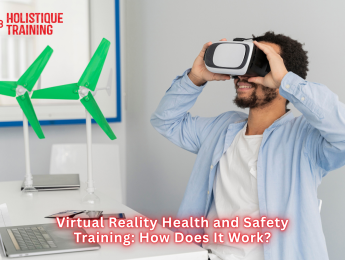
Virtual reality offers a different approach. By placing employees inside a realistic, interactive simulation of their workplace, virtual reality health and safety training allows people to experience hazards, make mistakes and practise emergency responses without any real-world consequence. What was once an expensive novelty confined to aerospace and defence is now available on affordable standalone headsets, and a growing body of research is testing how well it works in practice.
At the same time, virtual reality raises serious questions. Does immersive practice genuinely change behaviour on site, or does it simply make training more enjoyable? How should it sit alongside instructor-led teaching, and what will it really cost? In this article, we will discuss what virtual reality health and safety training is, why organisations are adopting it, how it differs from traditional methods, its benefits, its applications across industries, the hazards it suits best, the evidence behind it, its limitations, how to design and implement a programme, how to measure results, the legal considerations, and where the technology is heading.
1. What Is Virtual Reality Health and Safety Training?
Virtual reality health and safety training uses a head-mounted display, hand controllers and simulation software to place a learner inside a computer-generated environment that reproduces a workplace, a piece of equipment or a hazardous event. The learner can look around, move, handle virtual objects and respond to unfolding situations, while the system records what they do. Unlike a video, which is watched passively, a simulation requires decisions, and unlike a classroom discussion, it allows those decisions to have visible consequences.
Virtual, Augmented and Mixed Reality Compared
The term is often used loosely, so it helps to be precise. Virtual reality fully replaces the learner’s view of the real world with a digital one. Augmented reality overlays digital information, such as step-by-step instructions, onto the real environment through a phone, tablet or glasses. Mixed reality goes further by anchoring digital objects to the physical space so that the two interact. Each has a role in safety training, although fully immersive virtual reality is the form most commonly used for rehearsing dangerous procedures, because nothing in the real environment can be harmed.
The Components of a Typical VR Safety Programme
A working programme usually combines several elements, each of which affects the quality of the final experience.
1- Headset and controllers:
Standalone headsets that need no separate computer have made deployment far simpler, allowing a trainer to carry several units to a site, depot or classroom. Controllers let learners grip tools, press switches and operate virtual equipment, which is what turns observation into practice.
2- Simulation content:
Scenarios are built to match real procedures, equipment and site layouts. Content may be bought from a supplier library, adapted from an existing module or commissioned to reproduce a specific facility, and its realism largely determines how well the training transfers to the job.
3- Feedback and scoring:
The system can tell a learner immediately when they have skipped a step, missed a hazard or reacted too slowly, replacing delayed feedback with correction at the moment of error.
4- Facilitator controls:
Trainers can watch what the learner sees, change conditions such as weather or equipment faults, and pause to ask questions, which keeps the human instructor at the centre of the experience.
5- Data and reporting:
Completion records, error counts and response times can feed into a learning management system, giving safety managers evidence that training has taken place and what it revealed.
2. Why Organisations Are Turning to VR for Safety Training
The Persistent Burden of Workplace Injury
Despite decades of progress, serious workplace harm has not disappeared. According to the Health and Safety Executive’s 2026 statistics, 126 workers were killed in work-related incidents in Great Britain in 2025/26, and falls from height were the most common cause, accounting for 31 of those deaths. The figures show a long-term improvement and place Britain among the safest countries in which to work, yet they also show that a small number of familiar accident types continue to cause the greatest loss of life. Falls from height, in particular, are difficult to demonstrate convincingly in a classroom and dangerous to rehearse on site.
The Limits of Traditional Training
Conventional safety training tends to rely on presentations, written procedures and short videos. These methods are efficient at delivering information, but information is not the same as competence. Learners may pass a test on Monday and still hesitate or improvise on Friday, particularly when the real situation looks nothing like the slide. This gap between knowing and doing is often called the transfer problem, and it is one of the central reasons organisations are experimenting with immersive alternatives. Training that cannot be felt as relevant is quickly forgotten, whereas training that lets people experience the consequences of a decision is more likely to stay with them.
Cost, Disruption and Access
Practical safety training is also expensive in less obvious ways. Taking a team away from live operations, hiring specialist facilities, consuming materials and arranging cover for absent colleagues can cost more than the course itself. Virtual reality reduces many of these burdens because a scenario can be repeated indefinitely, at any time, with no consumables and no exposure to risk.
3. How VR Training Differs from Traditional Methods
Virtual reality changes not only the delivery medium but the whole logic of how safety competence is built. Traditional training explains what should happen and then tests whether the learner can recall it. Virtual reality puts the learner in the situation and observes what they actually do. The comparison below sets out the main differences.
Dimension | Virtual Reality Training | Traditional Training |
Learning style | Active, hands-on and experiential | Mostly passive, lecture or video based |
Risk exposure | None, errors carry no real consequence | Low in classrooms, higher in live drills |
Scenario variety | Wide, including rare and extreme events | Limited by cost, space and safety |
Repeatability | Immediate and unlimited | Restricted by scheduling and resources |
Feedback | Instant and automated | Delayed and dependent on the trainer |
Data capture | Detailed performance and response data | Attendance records and test scores |
Initial investment | Higher, for hardware and content | Lower |
Ongoing cost per learner | Falls as usage grows | Rises with every session delivered |
Instructor role | Facilitator and debriefer | Presenter and assessor |
The table shows that neither approach is simply better. The strongest programmes use each for what it does best.
4. The Core Benefits of VR Safety Training
Safe Rehearsal of Dangerous Situations
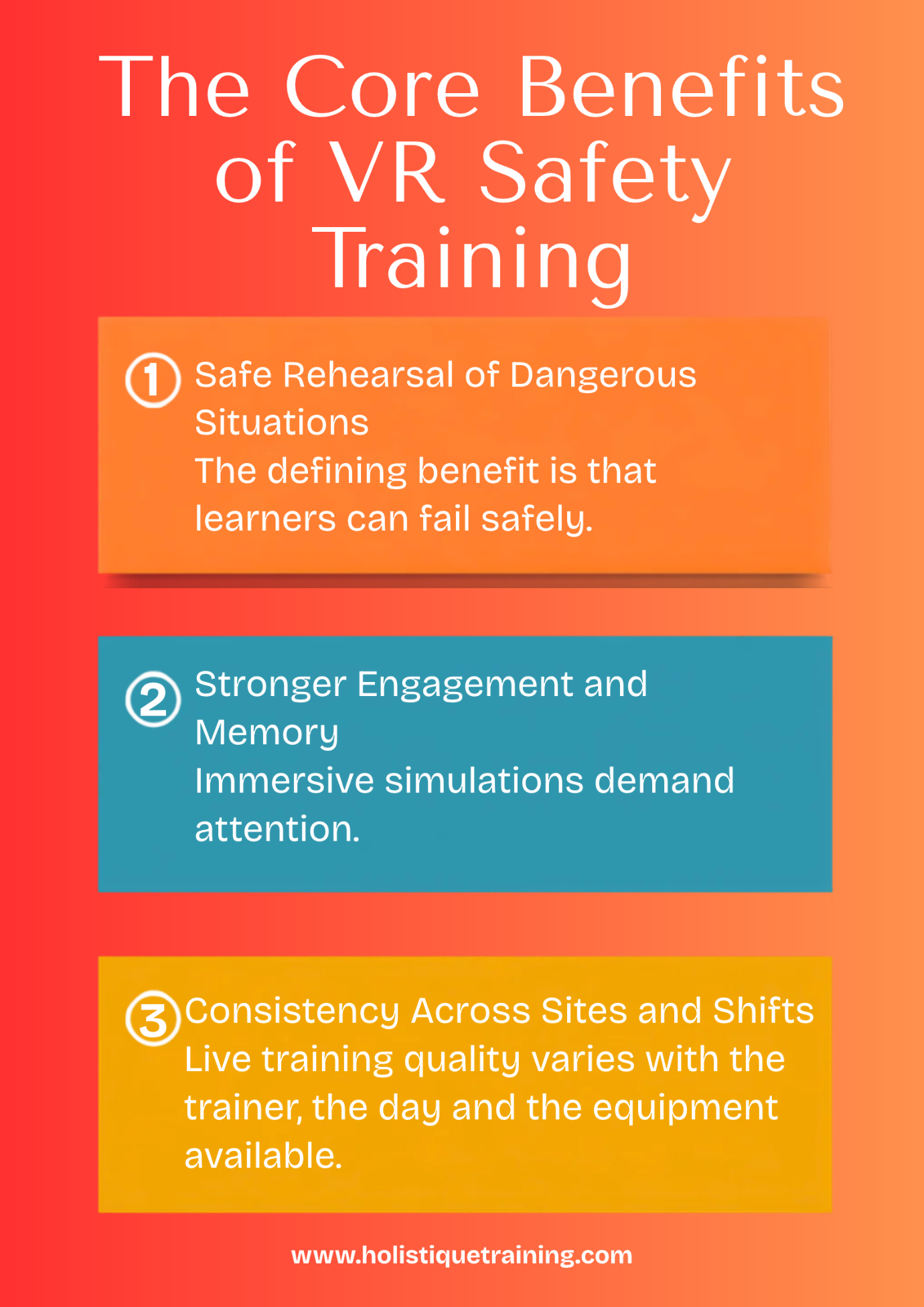
The defining benefit is that learners can fail safely. A trainee who opens a virtual electrical panel in the wrong sequence experiences the consequence, understands why the sequence matters and tries again, all without injury or damage.
Stronger Engagement and Memory
Immersive simulations demand attention. It is difficult to check a phone while standing on a virtual scaffold, and the sense of presence tends to make experiences feel memorable. Because learners physically act out responses rather than reading about them, the knowledge is anchored in movement and spatial memory, which can make it easier to recall under stress.
Consistency Across Sites and Shifts
Live training quality varies with the trainer, the day and the equipment available. A simulation delivers the same scenario in the same way to every learner, whether they work in a head office, a remote depot or an overseas site. For multi-site organisations, that consistency makes it easier to demonstrate that every employee has received the same standard of instruction.
5. Applications Across Industries
Virtual reality safety training is not confined to a single sector. It is most useful wherever hazards are severe, expensive to reproduce or impractical to demonstrate, and the following examples show how different industries are applying it.
1- Construction:
Learners can practise working at height, inspecting scaffolding, recognising unprotected edges and responding to falling objects. Hazard-spotting exercises place deliberate risks around a virtual site, such as unguarded openings or poorly stacked materials, and ask the learner to find them before work begins.
2- Manufacturing:
Simulations can cover machine guarding, lock-out and tag-out procedures, safe use of forklift trucks and manual handling. Workers can rehearse isolating a machine before maintenance without halting a real production line.
3- Energy and utilities:
High-voltage environments, battery storage systems and substations are costly and dangerous to use for training. Virtual replicas allow technicians to practise isolation and shutdown sequences repeatedly before they approach live equipment.
4- Oil, gas and chemicals:
Process plants involve gas leaks, fires and permit-to-work systems that cannot be staged realistically. Simulations let teams rehearse emergency shutdowns, evacuation and communication under simulated stress.
5- Healthcare:
Staff can practise infection control, patient handling, evacuation of wards and responses to violent or aggressive behaviour, with scenarios that adapt to the choices they make.
6- Transport and logistics:
Drivers, rail workers and warehouse operatives can rehearse working near moving vehicles, reversing, loading and trackside safety, including adverse weather and poor visibility.
7- Emergency preparedness:
Fire marshals and office staff can experience smoke-filled corridors, blocked exits and alarm failures, learning evacuation routes and assembly points in a way a scheduled drill rarely achieves.
Across all of these sectors, the common thread is hazard recognition. Many incidents occur not because workers lack knowledge of a rule but because they fail to notice the danger in front of them. Simulations that train people to scan an environment, spot what is wrong and act on it can build that habit more directly than written guidance.

The International General Certificate in Occupational Health and Safety is part of the 2019 syllabus for workplace health and safety regulations. Achieving this certification sets you apart in your career and demonstrates your commitment to a safe and compliant working environment.
6. Which Hazards Suit VR Training Best?
Not every safety topic benefits equally from immersion. Virtual reality tends to work best where spatial awareness, sequence and decision-making under pressure matter most, and less well where physical sensation or human nuance is central. The table below offers a practical guide.
Hazard or Scenario | Suitability for VR | Reason |
Working at height | Very high | Spatial awareness and fear responses can be rehearsed with no fall risk |
Fire evacuation | Very high | Smoke, noise and blocked exits can be simulated safely |
Electrical isolation | High | Lethal energy sources can be practised without exposure |
Confined space entry | High | Restricted layouts and rescue steps can be repeated |
Site hazard spotting | High | Hidden risks can be placed in realistic environments |
Manual handling | Moderate | Posture can be coached, but physical strain is not reproduced |
First aid and CPR | Moderate | Decision-making transfers well, but hands-on technique needs a manikin |
Safety leadership conversations | Moderate | Dialogue can be simulated, but nuance still needs human coaching |
This pattern suggests a sensible rule of thumb. Where the main risk is a decision made too late or a step done in the wrong order, virtual reality is a strong candidate. Where the skill depends on touch, force or the subtleties of human conversation, it is better treated as a supplement to practical or instructor-led learning.
7. What the Evidence Says
The research base is growing quickly, and the picture is broadly encouraging but not uniform. Reviews of virtual reality in construction and industrial settings generally report positive effects on engagement, hazard perception and self-confidence, although results differ depending on what is measured and how the training is designed. A recurring theme is that the technology alone does not guarantee better outcomes; the way a simulation is structured and facilitated matters at least as much as the headset.
A 2026 field study published in the journal Multimodal Technologies and Interaction offers a useful example. According to researchers at the University of Applied Sciences and Arts Northwestern Switzerland working with Swiss Federal Railways, 127 participants on a real track safety course were assigned to one of six training formats. Around 95 per cent of participants in the immersive single-player and instructor-led classroom formats achieved the full score on a safety-critical exam item, compared with 56.5 per cent in the standard course. The researchers noted that allocation was not random and the groups differed in age, so the findings show an association rather than proof of cause.
8. Limitations and Risks
Confidence Without Competence
Engaging training can make people feel more prepared than they actually are. A 2026 randomised experiment by researchers at Pennsylvania State University, published in the Journal of Information Technology in Construction, compared immersive virtual reality with video instruction for a safety-critical battery storage shutdown procedure. According to the study of 60 engineering students, virtual reality produced spatial understanding scores 27 per cent higher and procedural comprehension scores 28 per cent higher, and participants completed productive tasks about 45 per cent faster. However, the authors also found that neither method adequately explained the safety reasoning behind the procedure, and some virtual reality participants rated their abilities above their measured performance.
The message for safety professionals is clear. Immersive practice builds the “how” of a task effectively, but the “why” still needs explicit teaching, and confidence should always be checked against objective assessment.
Cybersickness and Physical Comfort
Some users experience nausea, dizziness, eye strain or disorientation in virtual environments, particularly during long sessions or when movement in the simulation does not match the body’s sense of motion. Sessions should be kept short, movement options should include comfortable alternatives such as teleporting, and learners must be free to stop at any time without penalty.
Cost and Content Quality
Hardware is only part of the investment. Bespoke simulations can be expensive to build and maintain, and off-the-shelf content may not reflect an organisation’s specific equipment, procedures or site layout. Poorly designed scenarios can teach incorrect habits or overload learners with unnecessary complexity.
Access and Inclusion
Not every employee can use a headset comfortably. People with certain visual, balance or mobility conditions, or those who are prone to motion sickness, may need alternative formats such as desktop versions of the same scenario. Reasonable adjustments should be planned from the start so that no one is excluded from essential safety training.
9. Designing an Effective VR Safety Programme
Start With Real Risk
The most common mistake is to begin with the technology and look for a use for it. A better starting point is the organisation’s own risk assessments, incident records and near-miss reports. These show which hazards cause the greatest harm, which tasks are hardest to train and where existing methods are failing. Virtual reality should be directed at those gaps first.
Match Scenarios to Real Procedures
A simulation is only as useful as its fidelity to the job. Scenarios should reflect current written procedures, real equipment and the conditions workers actually face, including time pressure, noise and imperfect information. This depends on clear, well-written procedures in the first place, since a simulation built on vague or outdated instructions will teach vague or outdated behaviour.

Regardless of the type of organisation or industry, health and safety must always be a priority. Maintaining health and safety is crucial to the welfare of all working within an organisation. It encompasses identifying risks, implementing preventative measures, and producing health and safety procedures when
Blend Immersion With Instructor-Led Debriefing
The learning often happens after the headset comes off. A short debrief in which the trainer reviews what the learner did, explains why each step matters and discusses what could have gone wrong turns an experience into understanding.
10. A Practical Roadmap for Implementation
Organisations that adopt virtual reality successfully tend to proceed in stages rather than attempting a full roll-out at once. The following sequence reflects common good practice.
1- Define the problem:
Identify two or three priority risks where current training is weak, using incident data, audits and feedback from supervisors and workers.
2- Set measurable objectives:
Decide in advance what success looks like, such as fewer specific errors during assessment, improved hazard detection or reduced time away from operations.
3- Select content and hardware:
Compare suppliers on realism, validation, accessibility options, update arrangements and support, and check that the content aligns with your own procedures.
4- Run a controlled pilot:
Test with a small, mixed group, gather feedback on comfort and usability, and compare results with a group trained conventionally where possible.
5- Train the trainers:
Facilitators need confidence with the equipment and skill in debriefing, since their role shifts from presenter to guide.
6- Integrate and scale:
Link the system to existing records, schedule sessions around operations and expand gradually to additional sites and topics.
7- Review and refresh:
Revisit content whenever procedures, equipment or regulations change, and use performance data to decide where further training is needed.
Throughout, virtual reality should be treated as one component of a wider health and safety management system, not a standalone fix. Leadership commitment, clear responsibilities, competent supervision and a culture in which people feel able to report concerns determine whether any training investment translates into safer behaviour on site.
Health and safety within your organisation aren’t just requirements; they provide beneficial training, processes, and procedures to help your business progress. They also help you remain within legislative guidelines to manage risks and profile disasters, guaranteeing the continuation of your business.
11. Measuring Effectiveness
A training programme that cannot show its impact is difficult to justify. A useful way to structure evaluation is to look at four levels, moving from how learners felt to what changed for the organisation.
Level | What It Measures | Example Indicators |
Reaction | How learners experienced the training | Comfort ratings, perceived relevance, willingness to repeat |
Learning | What learners understood and could do | Assessment scores, critical errors, hazards identified |
Behaviour | What changed on the job | Observed practice, audit findings, near-miss reporting |
Results | What changed for the organisation | Incident rates, lost time, insurance and compliance outcomes |
Many studies concentrate on the first two levels because they are easiest to measure immediately after a session. The most valuable evidence, however, comes from behaviour and results, which require follow-up weeks or months later. Organisations should therefore plan delayed assessments and link training records to workplace observations.
12. Legal, Compliance and Ethical Considerations
In Great Britain, employers have a general duty under the Health and Safety at Work etc. Act 1974 to provide the information, instruction, training and supervision necessary to ensure employees’ health and safety. The Management of Health and Safety at Work Regulations 1999 add requirements to assess risks and ensure workers are competent for their tasks. Virtual reality can help meet these duties, but it does not replace them, and an employer remains responsible for ensuring that training is suitable, effective and properly recorded.
Some roles also require recognised qualifications or supervised practical assessment, and a simulation cannot stand in for these. Where accredited certification is needed, virtual reality is best used to prepare learners and supplement formal courses. Employees should also be told how their data will be used and offered alternatives where participation is difficult.
13. The Future of VR Health and Safety Training
Adaptive and AI-Driven Scenarios
Artificial intelligence is beginning to allow simulations that respond to a learner’s behaviour, increasing difficulty when someone is performing well and offering additional guidance when they struggle. This could make practice more personal and help to identify gaps in understanding earlier.
Conclusion
Virtual reality health and safety training addresses a genuine and long-standing weakness in workplace learning: the difficulty of rehearsing dangerous situations without exposing anyone to danger. Its strengths lie in safe repetition, strong engagement, consistent delivery and rich performance data, and early field evidence suggests it can improve results on safety-critical tasks. Its sectors of greatest value are those where hazards are severe, costly to reproduce or impossible to stage.
Yet virtual reality is not a complete solution. It builds practical skill more reliably than deeper understanding, can inflate confidence, requires careful attention to comfort, access and data, and cannot replace the legal duties, qualifications and supervision that underpin safe workplaces. The most realistic path is a blended approach in which immersive practice is combined with clear procedures, skilled facilitation, objective assessment and a strong safety culture. Organisations that adopt it in that spirit are likely to find that virtual reality strengthens, rather than replaces, the foundations of good safety management.