
- Table of Contents
- Introduction
- 1- Understanding the Resilience Crisis in Today's Workforce
- The Scale of the Problem
- What Is Driving the Decline
- 2- What Resilience Actually Means in a Workplace Context
- Beyond Bouncing Back
- The Four Pillars of Workforce Resilience
- 3- The Business Case for Resilience Training
- Engagement, Retention, and Productivity
- Resilience as a Competitive Differentiator
- 4- Resilience Training Approaches: A Comparison
- 5- Designing Effective Resilience Training Programmes
- Starting With a Genuine Needs Assessment
- Embedding Resilience in Learning Culture Rather Than One-Off Events
- The Role of Psychological Safety
- 6- Individual Versus Organisational Resilience: Understanding the Distinction
- 7- The Leader's Role in Building Resilient Teams
- Resilient Leadership as a Prerequisite
- Communication During Uncertainty
- 8- Measuring and Sustaining Workforce Resilience
- From Training to Transformation: Measuring What Matters
- Sustaining Resilience Through Continuous Learning
- Reactive Versus Proactive Approaches to Workforce Resilience
- Conclusion
Introduction
Uncertainty has always been a feature of professional life. But the particular texture of uncertainty in the 2020s — chronic rather than episodic, systemic rather than localised, affecting entire industries and workforces simultaneously — has pushed the limits of how organisations and their people cope. The traditional assumption that resilience is a personal trait, something employees either have or don't, is giving way to a more sophisticated understanding: that resilience is an organisational capability that must be deliberately built, resourced, and maintained.
For business leaders, HR professionals, and L&D practitioners, this shift carries both urgency and opportunity. Urgency, because the data on workforce stress and burnout is alarming and its commercial consequences are real. Opportunity, because organisations that invest seriously in resilience training are building a genuine competitive advantage — the capacity to navigate disruption, retain talent, and sustain performance through conditions that will defeat less prepared competitors. This article explores what workforce resilience means in practice, why it has become a strategic imperative, and what it takes to build it in teams operating under sustained pressure.
1- Understanding the Resilience Crisis in Today's Workforce
The Scale of the Problem
The numbers are stark. According to a Modern Health study published by Forbes in 2025, 66% of workers globally report experiencing symptoms of burnout — a figure that represents not a temporary spike but a sustained trend that has been building for several years. The same research reveals that the Society for Human Resource Management found 34% of workers have accepted lower-paying jobs to protect their mental health, whilst 22% have quit without another role secured — a dramatic signal of how far workplace stress has eroded employees' basic relationship with their employers.
These are not merely human costs. They are commercial ones. High absenteeism, elevated turnover, declining engagement, and reduced innovation capacity all carry measurable financial consequences. The question for organisations is no longer whether to invest in workforce resilience, but how to do so in ways that produce durable rather than superficial results.
What Is Driving the Decline
Several converging forces are behind the current resilience deficit. Rapid technological change — particularly the acceleration of artificial intelligence — is creating widespread anxiety about job security and role relevance. Economic volatility has made long-term planning feel futile for both organisations and individuals. Hybrid and remote working arrangements, whilst offering genuine benefits, have blurred the boundaries between professional and personal life in ways that make psychological recovery from work harder to achieve. And the relentless pace of information — the expectation that employees will be continuously available and continuously informed — generates a chronic low-level stress that accumulates over time into something far more serious.
2- What Resilience Actually Means in a Workplace Context
Beyond Bouncing Back
The popular metaphor for resilience — "bouncing back" from adversity — is helpful but incomplete. It implies a return to a prior state, as if the goal of resilience training were simply to restore the status quo after a disruption. In practice, the most resilient individuals and organisations do not merely return to where they were. They adapt, integrate what they have learned, and emerge with enhanced capacity to handle future challenges. This distinction matters enormously for how resilience training is designed and delivered.
Resilience in a workplace context operates at two levels that must be addressed in tandem. At the individual level, it involves the psychological skills to manage stress, regulate emotions, reframe setbacks constructively, and maintain clarity of purpose under pressure. At the organisational level, it involves the structures, leadership behaviours, cultures, and processes that create the conditions in which individual resilience can develop and be sustained over time. Training programmes that focus exclusively on the individual without addressing the organisational context will consistently underdeliver.
The Four Pillars of Workforce Resilience
Practitioners in organisational psychology have identified four interconnected dimensions of workplace resilience that effective training must address. Emotional resilience concerns the capacity to manage difficult feelings — anxiety, frustration, grief, anger — without those feelings derailing performance or wellbeing. Mental resilience involves cognitive flexibility: the ability to reframe challenges, problem-solve under pressure, and avoid the cognitive rigidity that makes adaptation impossible. Social resilience is the capacity of a group to maintain cohesion, trust, and collaborative effectiveness under stress. And physical resilience — often underemphasised — refers to the bodily foundations of mental performance: sleep, nutrition, movement, and the physical rhythms that underpin cognitive function and emotional regulation.

Build workplace resilience with strategies for communication, growth mindset, and adaptability. Strengthen individuals and organisations alike.
3- The Business Case for Resilience Training
Engagement, Retention, and Productivity
The business case for investing in resilience and learning is compelling and well-evidenced. According to the Gallup State of the Global Workplace 2024 report , only 23% of employees globally are engaged at work, whilst 41% report experiencing significant stress on a daily basis. These figures represent an enormous reservoir of untapped human potential — and a significant drag on organisational performance. The same Gallup analysis makes clear that poor management practices and inadequate support for work-life balance are primary drivers of both disengagement and stress, which points directly to where organisational investment needs to be directed.
The connection between training investment and retention is equally well-established. Research shows that employees who feel their employer is genuinely investing in their future skills are twice as likely to indicate they do not intend to leave. For organisations spending significant sums on recruitment and onboarding, the arithmetic of resilience investment is straightforward: the cost of training is almost always lower than the cost of replacement.

Many forward-thinking business owners realise that simply giving orders isn't the most effective way to get work done. Research shows that employees are more motivated and productive when they are free to make their own choices and follow paths they enjoy.
Resilience as a Competitive Differentiator
Beyond individual metrics of retention and engagement, resilience-trained organisations tend to demonstrate qualitatively different responses to disruption. Rather than fragmenting under pressure, losing institutional knowledge, and contracting into risk-averse inertia, resilient organisations maintain the capacity to innovate, adapt, and move forward — even in conditions that paralyse their less-prepared competitors. This adaptive capacity is increasingly recognised as a source of durable competitive advantage that conventional financial metrics fail to capture.
4- Resilience Training Approaches: A Comparison
The landscape of resilience training is broad, and not every approach suits every organisation or context. The following comparison outlines the key differences between the main modalities that organisations are currently deploying.
Training Approach | Primary Focus | Best For | Delivery Method | Timeframe |
Psychological Flexibility (ACT) | Emotional regulation and values alignment | Individuals under chronic stress | Workshop or group session | Short-term intensive |
Cognitive Restructuring | Reframing negative thought patterns | Teams facing frequent setbacks | Blended online and in-person | Ongoing, embedded in culture |
Mindfulness-Based Training | Attention, stress regulation | High-pressure roles and managers | App-based or facilitated sessions | Daily practice, 8–12 weeks |
Leadership Resilience Programmes | Leading with empathy under pressure | Senior managers and team leads | Executive coaching and seminars | Medium-term structured journey |
Peer Support and Social Resilience | Collective coping and team cohesion | Entire organisations and departments | Peer networks and group activities | Continuous and cultural |
5- Designing Effective Resilience Training Programmes
Starting With a Genuine Needs Assessment
The single most common mistake organisations make when designing resilience training is beginning with the solution rather than the problem. Off-the-shelf resilience programmes, applied uniformly without regard for the specific stressors, cultures, and dynamics of the organisation in question, consistently underdeliver. Effective resilience training begins with a rigorous assessment of where the resilience deficits actually lie — through employee surveys, manager interviews, focus groups, absenteeism data, and engagement metrics — and designs interventions that address those specific gaps.
This assessment phase also serves an important secondary function: it signals to employees that the organisation takes their experience seriously. When people feel genuinely heard in the process of designing support programmes, their engagement with those programmes is substantially higher. Conversely, when resilience training is perceived as a box-ticking exercise imposed from above, it tends to generate cynicism rather than change.
Embedding Resilience in Learning Culture Rather Than One-Off Events
Research on the effectiveness of resilience training consistently distinguishes between one-off interventions and sustained learning cultures. A study published in the Journal of Contextual Behavioral Science by Archer et al. in 2024 found that organisation-wide training in psychological flexibility — the capacity to remain open and purposeful in the face of difficult thoughts and feelings — produced significant reductions in exhaustion and improvements in personal accomplishment when applied at scale rather than to high-risk individuals alone. This finding has significant implications for how organisations allocate their L&D budgets: the greatest returns come not from premium interventions for a few but from scalable programmes embedded in the everyday experience of the many.
Practically, this means weaving resilience content into existing management development frameworks, team meetings, onboarding processes, and performance conversations — rather than reserving it for a standalone annual workshop. It means training line managers to recognise and respond to stress signals in their teams. And it means creating organisational norms — around recovery time, psychological safety, and the acceptability of discussing difficulty — that make resilience a cultural reality rather than a training room aspiration.

This training course provides a practical roadmap for designing and implementing effective wellness programs in the workplace. With rising levels of stress, burnout, and chronic health conditions among employees, organizations need structured wellness strategies to support their teams’ physical and mental health.In this course, participants will
The Role of Psychological Safety
No resilience training programme can achieve its potential in an organisation where employees do not feel psychologically safe. Psychological safety — the shared belief that speaking up, admitting mistakes, asking questions, and raising concerns will not be punished — is the single most important contextual variable in determining whether resilience training translates into behaviour change. Without it, even the most technically excellent training content fails to transfer to the workplace, because people lack the conditions in which adaptive behaviour can be safely practised and reinforced.
6- Individual Versus Organisational Resilience: Understanding the Distinction
Effective resilience strategy requires attention to both the individual and the system in which that individual operates. The following comparison clarifies the key differences between these two levels and why both must be addressed.
Dimension | Individual Resilience | Organisational Resilience |
Definition | Capacity to recover from personal adversity and maintain performance | Collective ability to absorb disruption and adapt systems while continuing to operate |
Primary driver | Psychological skills, mindset, and self-awareness | Leadership, culture, structures, and processes |
Training focus | Emotional regulation, cognitive reframing, stress management | Change management, psychological safety, leadership development |
Measurement | Wellbeing scores, absenteeism, engagement surveys | Turnover rates, productivity metrics, crisis response times |
Risk if neglected | Burnout, disengagement, poor performance | High attrition, innovation failure, reputational and operational collapse |
7- The Leader's Role in Building Resilient Teams
Resilient Leadership as a Prerequisite
The evidence on leadership and resilience is unambiguous: the behaviour of direct managers is the most proximate determinant of team resilience. Employees who feel supported, trusted, and fairly treated by their managers are substantially more resilient than those who do not — regardless of their individual psychological predispositions. This means that any serious investment in workforce resilience must include investment in leadership development as a non-negotiable component.
Resilient leadership is not about projecting invulnerability or demanding that teams endure hardship without complaint. It is about modelling adaptive behaviour: acknowledging difficulty honestly, communicating with transparency rather than false reassurance, making decisions under uncertainty without paralysis, and actively creating the conditions in which team members can develop their own resilience. Leaders who do this consistently — who are visibly practising what they advocate — generate a multiplier effect on team resilience that no training programme alone can replicate.
Communication During Uncertainty
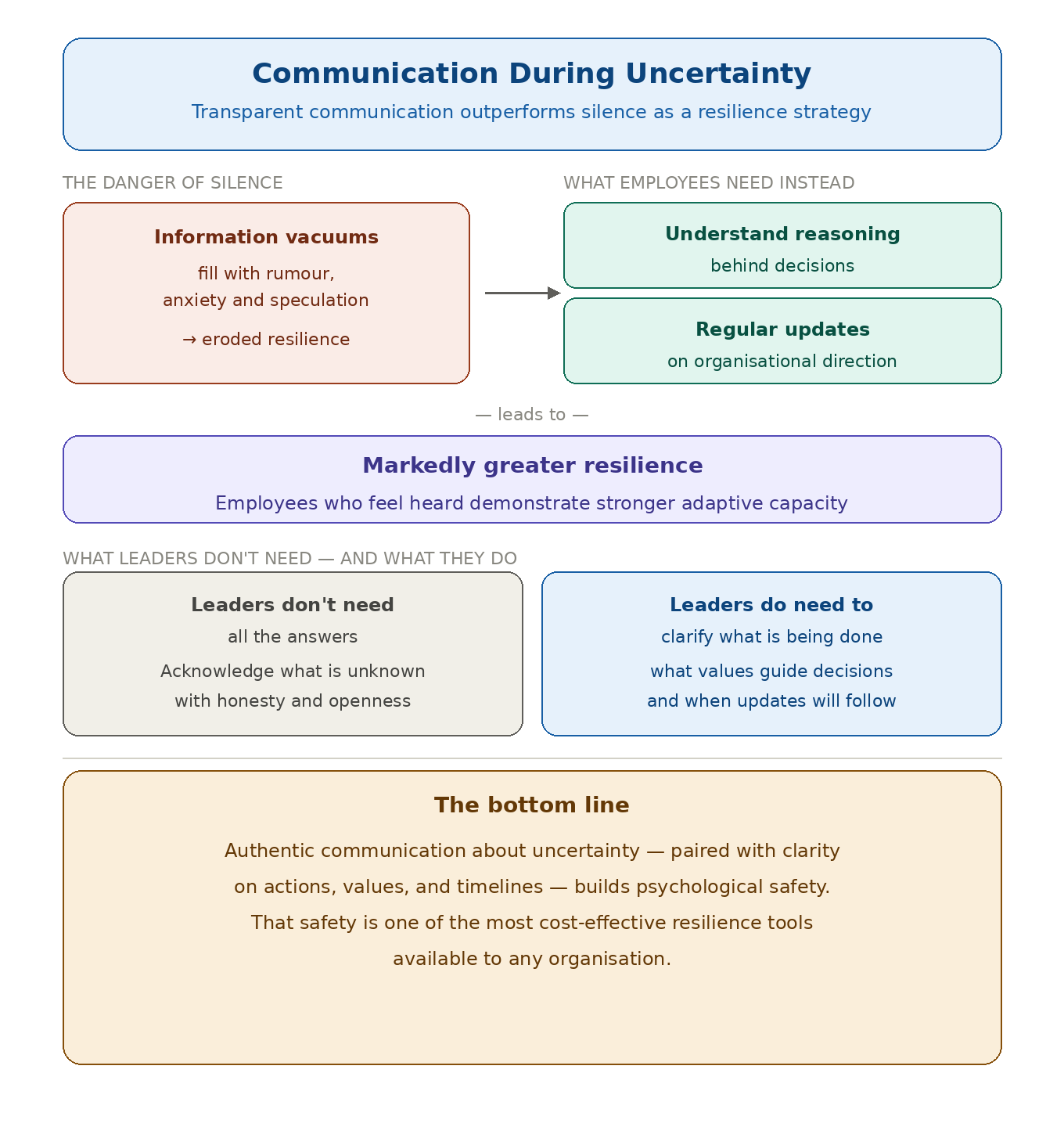
One of the most damaging things leaders can do during uncertain periods is go silent — allowing information vacuums to fill with rumour, anxiety, and speculation. Transparent communication, even when the message is difficult or the answers are incomplete, consistently outperforms silence as a resilience-building strategy. Employees who understand the reasoning behind decisions, who receive regular updates about organisational direction, and who feel that their concerns are heard and taken seriously, demonstrate markedly greater resilience than those left to interpret events without guidance.
This does not require leaders to have all the answers. In fact, the willingness to communicate authentically about what is unknown — combined with clarity about what is being done, what values are guiding decisions, and when updates will be provided — is itself a powerful signal of trustworthy leadership. The psychological safety that flows from this kind of communication is one of the most powerful and cost-effective resilience interventions available to any organisation.
8- Measuring and Sustaining Workforce Resilience
From Training to Transformation: Measuring What Matters
According to the World Economic Forum's Future of Jobs Report 2025 , resilience and flexibility now rank as the second most important core skill for the global workforce — behind only analytical thinking.This framing — resilience as a core workforce skill rather than a wellness add-on — has important implications for how organisations measure its development. Skills-based measurement frameworks track observable behavioural change over time: how quickly teams recover from setbacks, how effectively individuals regulate stress responses, how readily managers create conditions of psychological safety. These behavioural indicators are more meaningful than attendance records and self-reported satisfaction scores, and they align resilience investment with broader workforce capability strategy.
Organisations that treat resilience measurement rigorously — using validated psychological assessments, longitudinal data, and both quantitative and qualitative methods — are better positioned to demonstrate ROI to boards and leadership teams, and to refine their programmes based on evidence rather than instinct. The investment required to build robust measurement frameworks is typically modest relative to the insight it generates.
Sustaining Resilience Through Continuous Learning
The most resilient organisations are, without exception, learning organisations. They have built into their operating rhythms the habits of reflection, adaptation, and deliberate skill development that allow them to grow through disruption rather than merely survive it. Sustaining workforce resilience over time requires the same commitment to continuous learning that drives competitive advantage in other domains: regular reviews of what is working and what is not, iterative refinement of training programmes, and a leadership culture that models curiosity, openness to feedback, and the willingness to change course when evidence warrants it.
Reactive Versus Proactive Approaches to Workforce Resilience
Organisations typically fall into one of two broad orientations in how they approach workforce resilience. Understanding the difference is essential for leaders seeking to move from crisis management to capability building.
Characteristic | Reactive Approach | Proactive Approach |
Timing | Responds after crisis or breakdown occurs | Builds capacity before disruption arrives |
Focus | Damage control and short-term recovery | Long-term resilience infrastructure and culture |
Training investment | One-off interventions triggered by events | Continuous, embedded learning and development programmes |
Leadership role | Crisis manager responding to visible problems | Culture architect embedding resilience in daily practice |
Outcome | Temporary stabilisation; underlying vulnerabilities remain | Adaptive capacity that compounds over time |
Cost profile | High per-incident cost; unpredictable | Predictable investment with measurable long-term ROI |
Conclusion
Workforce resilience is no longer a nice-to-have feature of enlightened employment practice. It is a strategic asset — one that determines whether organisations can maintain performance, retain talent, and sustain innovation through the conditions of uncertainty that now define the contemporary business environment. The research is clear that resilience can be built, that the returns on investment are real and measurable, and that the organisations choosing not to invest are accepting a competitive disadvantage that will compound over time.
Building genuine resilience requires more than a wellness workshop or an annual mental health awareness day. It demands a sustained, systemic commitment: to training programmes designed around actual needs, to leadership development that puts manager behaviour at the centre, to learning cultures that make adaptation an everyday habit rather than a crisis response, and to measurement frameworks that hold organisations accountable for real behavioural change. The teams that thrive in uncertain times are not the ones that are shielded from difficulty — they are the ones that have been genuinely prepared to meet it.