
- Table of Contents
- Introduction
- 1- What Is an Occupational Safety and Health Training Course?
- Who Delivers These Courses
- What They Typically Cover
- Why the Distinction Between Safety and Health Matters
- 2- Why Occupational Safety and Health Training Matters
- The Global Scale of Work-Related Harm
- The Business Case for Investment
- Legal and Reputational Protection
- 3- How to Identify the Best Occupational Safety and Health Training Course
- 1- Accreditation and recognition:
- 2- Relevance to the learner’s role:
- 3- Quality and experience of trainers:
- 4- Practical application:
- 5- Assessment rigour:
- 6- Currency of content:
- 4- Main Types of Occupational Safety and Health Training Courses
- Awareness and Induction Courses
- Foundation Certificates
- Management and Leadership Programmes
- Specialist and Professional Qualifications
- 5- Leading Accredited Qualifications and Standards
- NEBOSH Qualifications
- IOSH Courses
- OSHA Outreach Training
- ISO 45001 Training
- How to Verify Accreditation
- 6- Best Occupational Safety and Health Course by Role and Industry
- HR and L&D Professionals
- Line Managers and Supervisors
- Safety Officers and Practitioners
- Frontline Employees
- High-Risk Industries
- 7- Choosing the Right Delivery Format
- Classroom Delivery
- Online and Self-Paced Learning
- Blended Learning
- Immersive and Simulation-Based Learning
- 8- The Role of HR and L&D in Selecting and Embedding Training
- Building a Training Needs Analysis
- Choosing and Managing Providers
- Managing Budget Realities
- Embedding Learning After the Course
- 9- Measuring Effectiveness and Return on Investment
- 1- Learner reaction:
- 2- Assessment results:
- 3- Behaviour change:
- 4- Safety outcomes:
- 5- Cost and value:
- 10- Common Mistakes When Choosing a Course
- 1- Choosing on price alone:
- 2- Confusing attendance with competence:
- 3- Ignoring sector-specific hazards:
- 4- Training once and never refreshing:
- 5- Excluding managers:
- 11- Future Trends in Occupational Safety and Health Training
- Artificial Intelligence and Personalised Learning
- Immersive Technology
- Wellbeing and Psychosocial Risk
- Conclusion
Introduction
Choosing an occupational safety and health training course is one of the most consequential decisions an HR or learning and development team can make. A well-chosen programme protects people, satisfies regulators, and gives managers the confidence to spot hazards before they cause harm. A poorly chosen one consumes budget, produces certificates that nobody values, and leaves real risks untouched. The market is crowded, with accredited qualifications, short awareness sessions, online modules, and immersive technology-led programmes all competing for attention.
This article helps HR and L&D professionals identify the best occupational safety and health training course for their organisation. It explains what these courses are, why they matter, how to judge quality, and which types and qualifications suit which roles. It also compares delivery formats, explores the role of HR in embedding learning, shows how to measure results, highlights common selection mistakes, and looks at where occupational safety and health education is heading.
1- What Is an Occupational Safety and Health Training Course?
An occupational safety and health training course is a structured learning programme that teaches people how to identify workplace hazards, assess and control risks, comply with legal duties, and promote healthy working practices. Occupational safety focuses on preventing accidents and injuries, while occupational health focuses on protecting long-term wellbeing, including exposure to hazardous substances, noise, ergonomic strain, and psychological pressure. The best courses cover both dimensions rather than treating them as separate subjects.
Who Delivers These Courses
Courses are offered by awarding bodies, professional institutions, universities, private training providers, and in-house academies. Some lead to recognised qualifications, while others provide attendance certificates that demonstrate awareness rather than competence. Understanding this distinction is the first step towards choosing well, because the two outcomes carry very different weight with regulators, insurers, and employers.
What They Typically Cover
Core content usually includes legal frameworks, risk assessment, accident investigation, fire safety, manual handling, hazardous substances, safe systems of work, emergency planning, and the principles of a safety management system. Advanced programmes add auditing, behavioural safety, and the leadership of safety culture.
Why the Distinction Between Safety and Health Matters
Many organisations still buy training that addresses only visible, accident-related risks. Yet long-term exposures, fatigue, stress, and poor work design often do more cumulative damage than a single incident. When comparing courses, HR teams should therefore check that the syllabus addresses occupational health and wellbeing alongside traditional safety topics such as machinery, falls, and fire.
2- Why Occupational Safety and Health Training Matters
Training sits at the centre of every credible safety strategy because policies and equipment only work when people understand and apply them. It converts written procedures into daily habits, gives managers the vocabulary to challenge unsafe behaviour, and shows employees that the organisation takes their wellbeing seriously. It also reduces avoidable costs such as absence, compensation claims, enforcement action, and lost productivity.
The Global Scale of Work-Related Harm
The problem is not confined to visible accidents. According to the International Labour Organization, more than 840,000 people die each year from health conditions linked to psychosocial risks such as long working hours, job insecurity, and workplace harassment, as set out in its 2026 World Day for Safety and Health at Work report. This shows that modern occupational safety and health training must extend beyond physical hazards to cover mental health and the design of work itself.
The Business Case for Investment
Beyond compliance, safety training supports operational resilience. Teams that understand hazards are more likely to report near misses, stop unsafe work, and cooperate during investigations, which lets organisations fix weaknesses before they escalate. Training also supports recruitment and retention, because candidates increasingly judge employers by the visible care they take of their people. For HR leaders, the business case rests on prevention: every incident avoided protects an individual, preserves productivity, and safeguards reputation.
Legal and Reputational Protection
Most jurisdictions require employers to provide information, instruction, and training so that workers can do their jobs safely. Recorded, relevant training is therefore both a legal safeguard and evidence of due diligence. According to the Health and Safety Executive, 126 workers were killed in work-related incidents in Great Britain in 2025/26, and falls from height were the leading cause with 31 deaths. Even in one of the safest working environments in the world, familiar hazards continue to cause fatal harm, which is why regular refreshers on core hazard awareness remain essential.
3- How to Identify the Best Occupational Safety and Health Training Course
No single course is best for every organisation. The best course is the one that fits the learner’s role, the organisation’s risk profile, and the standard of competence required. HR and L&D professionals can judge quality consistently by applying the following six criteria.
1- Accreditation and recognition:
Courses awarded by respected bodies carry weight with regulators, insurers, and employers. Check whether the qualification is independently accredited and whether it is recognised in every country where your people work.
2- Relevance to the learner’s role:
A frontline operative, a line manager, and a safety officer need different depth. The best course maps directly to the tasks the learner performs and the decisions they are expected to make.
3- Quality and experience of trainers:
Instructors with genuine field experience bring case studies, practical judgement, and credibility that slides cannot replace. Ask providers about trainer qualifications and industry background.
4- Practical application:
Look for risk assessment exercises, workplace inspections, simulations, and case studies. Courses that rely solely on lectures rarely change behaviour back at work.
5- Assessment rigour:
Meaningful assessment, whether an examination, a project, or a practical demonstration, proves competence rather than attendance and gives HR defensible evidence.
6- Currency of content:
Legislation, standards, and technology move quickly. Content should reflect current regulations and emerging risks such as psychosocial hazards and new work technologies.
Scoring each shortlisted provider against these criteria produces a transparent, defensible decision that can be explained to budget holders and auditors alike.
It is also worth requesting sample materials, speaking to previous clients, and attending a trial session where possible. These steps reveal whether the course is genuinely interactive and whether the provider can adapt examples to your sector. A provider that is unwilling to discuss learning outcomes in detail is rarely the best partner for a long-term safety programme.
4- Main Types of Occupational Safety and Health Training Courses
Occupational safety and health courses fall into four broad levels, and the best choice depends on where the learner sits in the organisation and how much responsibility for safety they carry.
Awareness and Induction Courses
These short programmes, lasting from a few hours to a day, give all employees a baseline understanding of hazards, reporting routes, and emergency procedures. They are essential for new starters but are not enough for anyone who supervises others.
Foundation Certificates
Multi-day certificate programmes suit supervisors, team leaders, and HR professionals who need a working knowledge of risk assessment, legal duties, fire safety, and workplace inspection. For organisations that want a broad foundation delivered in a structured format, a certificate-level course is usually the best starting point.

The International General Certificate in Occupational Health and Safety is part of the 2019 syllabus for workplace health and safety regulations. Achieving this certification sets you apart in your career and demonstrates your commitment to a safe and compliant working environment.
Management and Leadership Programmes
Managers who are accountable for safety performance need more than technical knowledge. They need to understand management systems, legislation, hazard control, and how to lead a positive safety culture. Programmes at this level focus on decision-making, accountability, and continual improvement.
Health and safety within your organisation aren’t just requirements; they provide beneficial training, processes, and procedures to help your business progress. They also help you remain within legislative guidelines to manage risks and profile disasters, guaranteeing the continuation of your business.
Specialist and Professional Qualifications
Diploma-level qualifications and specialist programmes prepare safety practitioners for advanced risk assessment, auditing, investigation, and sector-specific hazards. They suit those building a career in safety rather than managing it alongside other duties.
Course Level | Typical Learner | Typical Duration | Main Outcome |
|---|---|---|---|
Awareness and induction | All employees | Hours to one day | Baseline hazard awareness |
Foundation certificate | Supervisors, team leaders, HR | Several days to two weeks | Working knowledge of risk and legal duties |
Management programme | Managers and department heads | Several days | Ability to lead safety performance |
Professional qualification | Safety practitioners | Months of study | Advanced technical competence |
Most organisations need a combination of these levels rather than a single course. A sensible model gives every employee an awareness course, every supervisor a foundation certificate, senior managers a leadership programme, and safety practitioners a professional qualification. Mapping the levels to job families in this way prevents both under-training, which creates risk, and over-training, which wastes budget.
5- Leading Accredited Qualifications and Standards
Several internationally recognised qualifications and standards dominate the market, and familiarity with them helps HR teams compare providers fairly. Each has a different origin, audience, and purpose.
NEBOSH Qualifications
The National Examination Board in Occupational Safety and Health, based in the United Kingdom, offers general certificates and diplomas that are widely used as benchmark qualifications for supervisors, managers, and aspiring practitioners. Their international reach makes them useful for organisations with staff in several countries.
IOSH Courses
The Institution of Occupational Safety and Health offers short, accessible courses such as Managing Safely, designed for line managers, and Working Safely, designed for general employees. They are popular because they are practical, brief, and easy to schedule around operations.
OSHA Outreach Training
In the United States, the Occupational Safety and Health Administration’s Outreach Training Program offers 10-hour and 30-hour courses. The shorter course is aimed at entry-level workers, while the longer one is aimed at supervisors with safety responsibilities, and both focus on recognising and preventing common hazards.

Occupational health and safety standards are used internationally by organisations to ensure the safety and care of employees. It’s essential that all companies understand how to accurately carry out risk assessments, employ individuals who are sufficiently trained in first aid, and have strict policies and
ISO 45001 Training
ISO 45001 is the international standard for occupational health and safety management systems. Training ranges from awareness sessions to implementation and lead auditor courses, and it suits organisations that want to build a systematic approach to safety or pursue formal certification.
Explore Health & Safety Management—its importance and 10 guiding principles to protect well-being, ensure compliance, and drive safer workplaces.
Qualification | Origin | Best Suited To | Main Focus |
|---|---|---|---|
NEBOSH general certificate | United Kingdom, international reach | Supervisors, managers, aspiring practitioners | Broad risk management foundation |
IOSH Managing Safely | United Kingdom, international reach | Line managers | Practical safety responsibilities |
OSHA 10-hour and 30-hour | United States | Workers and supervisors | Regulatory hazard recognition |
ISO 45001 training | International standard | Managers, auditors, system owners | Management system implementation |
These options are not mutually exclusive. A multinational employer might use an international certificate for its safety managers, regional regulatory courses for site supervisors, and ISO 45001 training for the team that maintains the management system. The deciding factor is always the fit between the qualification and the legal and operational context in which the learner works.
How to Verify Accreditation
Before committing funds, confirm that the awarding body lists the provider as approved, check that the qualification title on the certificate matches what was advertised, and ask how results are verified. Reputable providers share this information openly, and doing so protects the organisation from paying for credentials that regulators or clients may not accept.
6- Best Occupational Safety and Health Course by Role and Industry
Matching the course to the role is where HR and L&D teams add the most value. The best course for one group can be a poor investment for another.
HR and L&D Professionals
HR professionals need to understand legal duties, absence and wellbeing management, and training governance. A foundation certificate or a managerial course gives enough knowledge to commission, evaluate, and support safety training without becoming a technical specialist.
Line Managers and Supervisors
Supervisors translate policy into daily practice. They benefit most from programmes that build practical skills in risk assessment, incident reporting, and the behavioural conversations needed to correct unsafe acts.
Safety Officers and Practitioners
Safety officers need diploma-level depth covering auditing, investigation, and management systems. Their training should be accredited and regularly refreshed so that their advice remains credible.
Frontline Employees
Frontline workers need clear, practical, and repeatable training that links directly to their tasks. Short, well-designed courses supported by on-the-job demonstrations are usually more effective than long theoretical programmes, and they should be delivered in languages that every worker understands.
High-Risk Industries
Construction, manufacturing, oil and gas, healthcare, and agriculture require sector-specific content such as working at height, confined spaces, machinery guarding, and infection control. In these environments, structured hazard identification techniques should be part of the curriculum.
Healthcare settings add further needs, including infection control, manual handling of patients, and protection from violence. Construction and engineering teams need strong coverage of permits to work, energy isolation, and job safety analysis. Selecting a course that mirrors these realities makes classroom learning far easier to transfer to the job.
7- Choosing the Right Delivery Format
Delivery format influences cost, convenience, and learning outcomes, so it deserves as much attention as content. Four formats are common.
Classroom Delivery
Face-to-face courses encourage discussion, peer learning, and practical exercises. They are strongest for hands-on skills and team cohesion, but they demand time away from work and travel costs.
Online and Self-Paced Learning
Online modules are flexible and scalable, which makes them ideal for awareness training and refreshers. Their weakness is limited practical application, and completion rates need active monitoring.
Blended Learning
Blended programmes combine online theory with practical workshops. For many organisations this offers the best balance of flexibility, cost, and skill development.
Immersive and Simulation-Based Learning
Virtual reality and simulations allow learners to rehearse dangerous scenarios without exposure to real harm. They require higher investment but are valuable for high-risk tasks.
Format | Main Strength | Main Limitation | Best For |
|---|---|---|---|
Classroom | Practical exercises and discussion | Time away from work | Certificates and management courses |
Online | Flexibility and scale | Limited hands-on practice | Awareness and refreshers |
Blended | Balanced cost and depth | Needs careful coordination | Supervisors and mixed teams |
Immersive | Safe rehearsal of high-risk tasks | Higher set-up cost | High-hazard operations |
The strongest programmes rarely depend on one format alone. A typical blended pathway might begin with an online module covering legal basics, continue with a classroom workshop on risk assessment, and close with a workplace project assessed by a manager. This sequence respects the time of busy employees while ensuring that theory is tested in real conditions before a certificate is awarded.
8- The Role of HR and L&D in Selecting and Embedding Training
HR and L&D teams do more than purchase courses; they shape whether learning is applied. The process should begin with a training needs analysis that links job roles to risk assessments and incident data. Safety officers and line managers should help shortlist providers, because they understand the practical hazards that the course must address.
Building a Training Needs Analysis
An effective analysis reviews incident and near-miss records, risk assessments, audit findings, and legal requirements for each role. It then identifies gaps between the competence people need and the competence they currently have. The result is a prioritised plan that directs money towards the roles where poor knowledge would create the greatest harm, rather than spreading budget evenly across every department.
Choosing and Managing Providers
Once needs are clear, HR should issue a simple specification covering learning outcomes, accreditation, trainer experience, assessment, and reporting. Comparing proposals against the same specification keeps decisions objective. After the contract begins, regular review meetings and learner feedback help ensure that quality remains high and that the provider adapts to changing risks.
Managing Budget Realities
Budget is a constant constraint. According to the Astutis Voice of Our Learners Report 2026, around one in three health and safety professionals say their current training budget is insufficient, and nearly 40 per cent of employees say they lack the skills to use AI tools effectively. These findings show why investment must be targeted, with accredited qualifications reserved for high-risk and high-responsibility roles and lower-cost refreshers used elsewhere.
Embedding Learning After the Course
A course only changes outcomes when learning is reinforced. Short toolbox talks, on-the-job coaching, manager follow-up, and scheduled refreshers keep knowledge fresh and show employees that safety is a continuing priority rather than a one-off event.
9- Measuring Effectiveness and Return on Investment
Without measurement, it is impossible to know whether a course is genuinely the best one for your organisation. A balanced approach looks at several layers of evidence.
1- Learner reaction:
Short surveys capture whether participants found the content relevant and the delivery engaging, which is an early indicator of future take-up.
2- Assessment results:
Pass rates and knowledge checks show whether learners understood the material, and they highlight topics that need reinforcement.
3- Behaviour change:
Workplace inspections, observations, and near-miss reporting rates show whether people apply what they learned. A rise in near-miss reporting after training is often a positive sign of greater awareness.
4- Safety outcomes:
Incident frequency, lost-time injuries, and absence trends reveal whether training is contributing to safer operations over time.
5- Cost and value:
Comparing training costs with avoided incidents, reduced absence, and lower insurance exposure supports future budget requests.
Results should be reviewed at fixed intervals, such as six and twelve months after the course, so that short-term enthusiasm is not mistaken for lasting change. If indicators do not improve, HR should examine whether the problem lies in the course content, the delivery, or the workplace conditions that prevent people from applying what they learned.
10- Common Mistakes When Choosing a Course
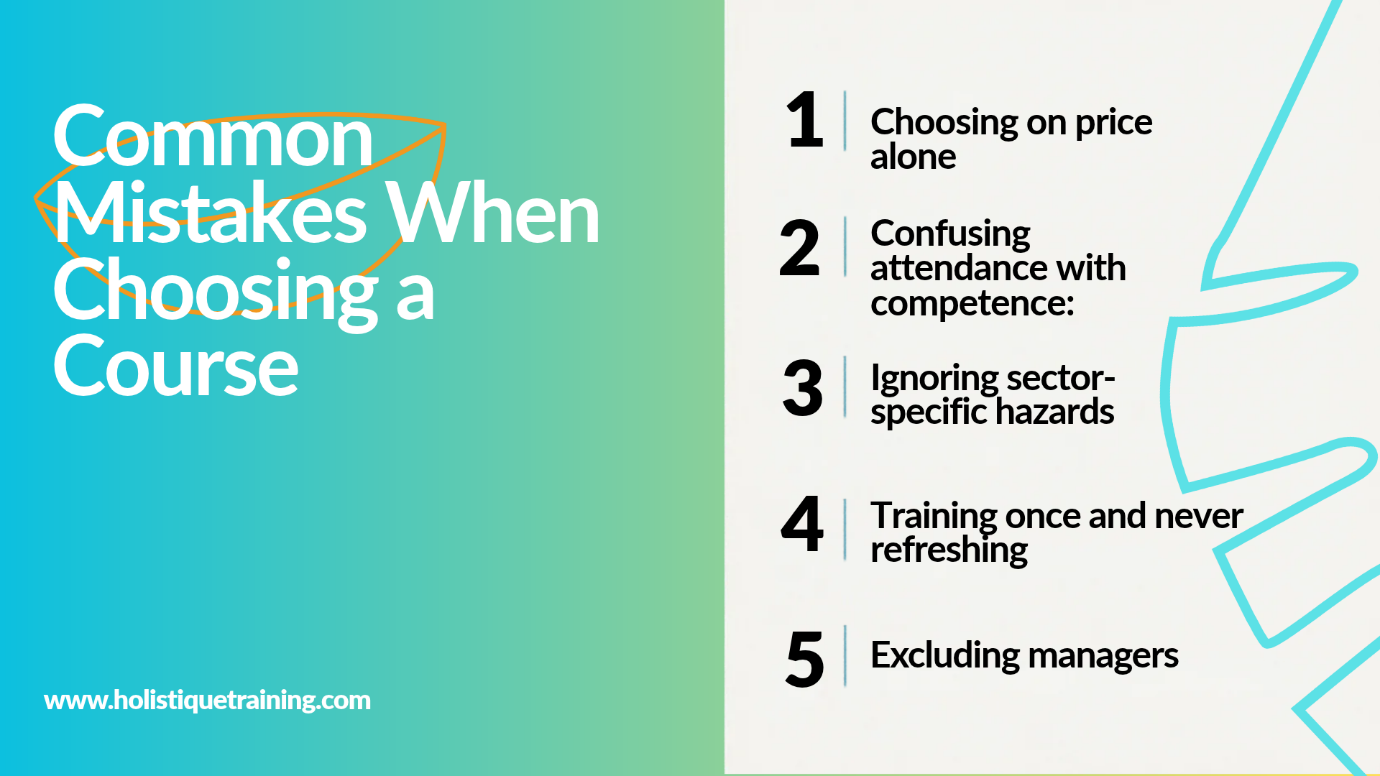
Even experienced HR teams can make avoidable errors when selecting safety training. The five most common mistakes are listed below.
1- Choosing on price alone:
The cheapest course may lack accreditation, practical content, or credible trainers, which makes it poor value in the long run.
2- Confusing attendance with competence:
A certificate of attendance does not prove that a learner can assess risk or lead a safe team.
3- Ignoring sector-specific hazards:
Generic content cannot prepare people for the particular risks of construction, healthcare, or manufacturing.
4- Training once and never refreshing:
Knowledge fades and regulations change, so refreshers must be planned from the outset.
5- Excluding managers:
If leaders are not trained, frontline learning is quickly undermined by inconsistent expectations.
Avoiding these pitfalls does not require a large budget. It requires clear objectives, honest evaluation, and a willingness to treat safety training as a continuing process rather than a single annual event.
11- Future Trends in Occupational Safety and Health Training
Occupational safety and health education is evolving quickly, and HR teams that follow these developments will be better placed to future-proof their training portfolios.
Artificial Intelligence and Personalised Learning
Artificial intelligence is enabling personalised learning paths and smarter recommendations based on role, location, and risk profile. Adaptive systems can identify weak areas and adjust the pace of content, which makes shorter courses more effective.
Immersive Technology
Virtual and augmented reality are making realistic hazard simulations more accessible and more affordable, particularly for high-risk tasks that are difficult to rehearse safely in real life.
Wellbeing and Psychosocial Risk
Mental health, harassment, workload, and job design are moving from the margins to the core of the curriculum. Sustainability and data analysis skills are also becoming part of the modern safety professional’s toolkit.
Conclusion
The best occupational safety and health training course is not a single named product but the one that matches the learner’s role, the organisation’s risks, and the level of competence required. Accreditation, relevant content, experienced trainers, practical application, and rigorous assessment are the qualities that separate valuable programmes from box-ticking exercises.
For HR and L&D professionals, the most effective approach is to map roles to appropriate course levels, choose delivery formats that suit the work, embed learning through follow-up, and measure results honestly. When training is treated as a continuing strategic investment rather than a compliance task, it protects people, strengthens culture, and supports organisational performance. Organisations that begin with a clear needs analysis, apply consistent selection criteria, and review results regularly will find that the best occupational safety and health training course is the one that keeps their people safe, informed, and confident every working day.