

- Table of Contents
- Introduction
- 1. Understanding the Two Roles
- 2. Key Responsibilities Side-by-Side
- 3. Core Skill Sets and Qualifications
- 4. Global Salary Overview: Demand Planning Roles
- 5. Global Salary Overview: Inventory Management Roles
- 6. Pay Comparison at a Glance
- 7. Factors That Drive Pay Differences
- 8. Career Progression and Earning Potential
- 9. Industry Sector and Its Effect on Compensation
- 10. The Skills Premium: What Commands Higher Pay
- 11. How HR and Compensation Managers Should Approach Pay Benchmarking
- 12. The Talent Shortage and Its Impact on Compensation Decisions
- Conclusion
Introduction
Compensation decisions within supply chain functions are among the more complex HR challenges in modern organisations. Unlike roles with a single, clearly bounded set of tasks, supply chain professionals often operate across overlapping domains, making it difficult for HR and compensation managers to draw clean distinctions when setting pay ranges. This challenge is especially pronounced when evaluating demand planning and inventory management roles, two functions that sit side by side in the supply chain structure, share some technical ground, yet diverge considerably in their strategic weight, analytical demands, and contribution to organisational performance.
The question of how to benchmark and structure compensation for these roles has grown more pressing as supply chains have become increasingly complex and data-driven. Disruptions in global logistics, the accelerated adoption of AI-enabled forecasting tools, and the growing importance of working capital management have all elevated the profile of both demand planning and inventory management. At the same time, the talent market for skilled supply chain professionals has tightened considerably, placing additional pressure on organisations to ensure their pay structures are competitive and appropriately differentiated.
This article is designed to assist HR professionals and compensation managers in understanding how these two roles differ in scope and seniority, how pay compares across global markets, what factors drive compensation premiums in each function, and how to build a fair and competitive pay framework that reflects the true strategic value of each role.
1. Understanding the Two Roles
Before any compensation comparison can be meaningful, it is essential to understand what each role actually involves. Demand planning and inventory management are often grouped under the same supply chain umbrella, and in smaller organisations the functions may even be carried out by the same person. In larger, more complex operations, however, they represent distinct disciplines with different skill profiles, different reporting lines, and different levels of business influence.
A demand planner is primarily concerned with the future. Their core function is to forecast how much of a product or service will be required by customers over a given planning horizon, typically ranging from a few weeks to twelve months or more. This forecast is not simply an extrapolation of past sales; it requires the planner to synthesise market intelligence, promotional activity, macroeconomic signals, and statistical modelling to produce a demand plan that other functions, including procurement, production, and logistics, can rely on to make their own decisions.
An inventory manager, by contrast, is primarily concerned with the present and the near term. Their role is to ensure that the right stock is in the right place at the right time, in the right quantity. Where the demand planner works with data to anticipate the future, the inventory manager works with physical and system-based controls to manage current reality. They are responsible for stock accuracy, replenishment timing, carrying costs, and the elimination of waste through obsolescence or shrinkage.

Explore demand chain management—its components, challenges, and strategies. Learn how data-driven approaches boost efficiency and customer value.
2. Key Responsibilities Side-by-Side
The following infographic summarises the core responsibilities of each role, highlighting where they diverge and where they converge. HR and compensation managers will find this a useful reference when reviewing job descriptions, grading roles, or benchmarking pay against market data.
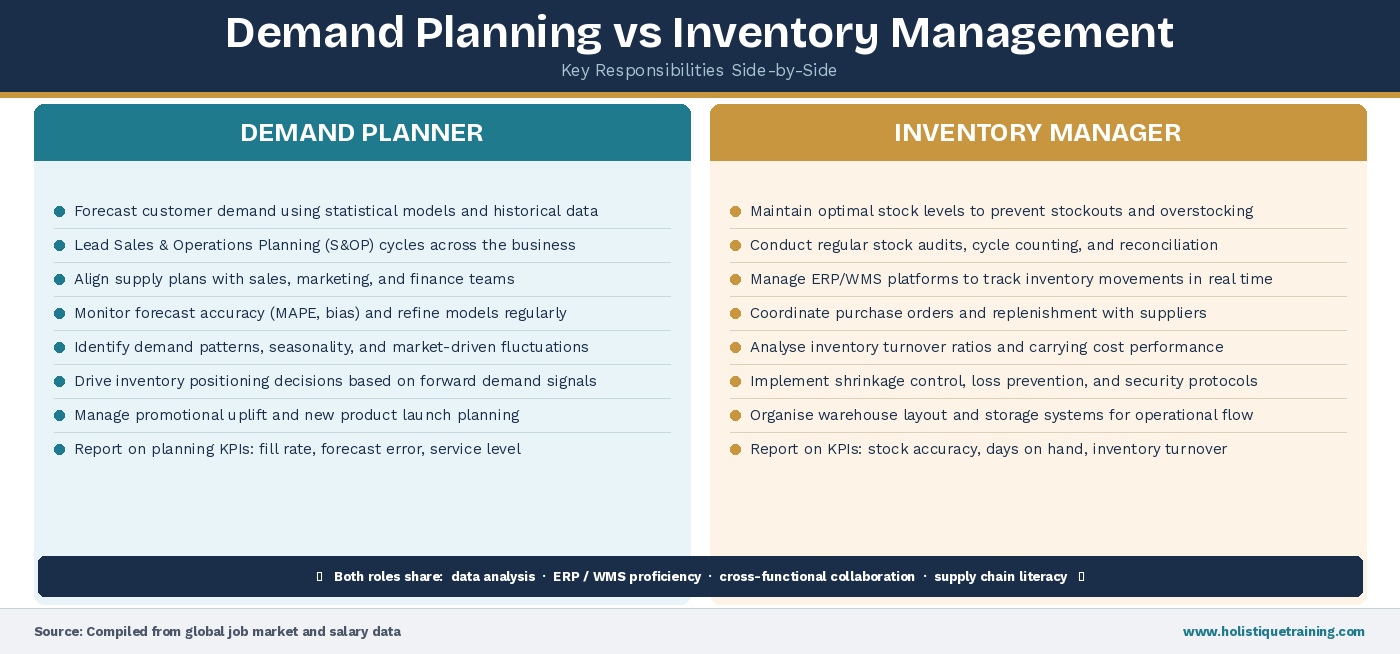
As the infographic illustrates, the two roles share a common foundation in data literacy, ERP proficiency, and supply chain awareness, but their day-to-day deliverables and strategic interactions differ substantially. Demand planners operate on a forward-looking, cross-functional basis, whilst inventory managers are more focused on operational accuracy and physical stock control. The table below provides a further structured comparison of how the roles differ across several professional dimensions.
Aspect | Demand Planner | Inventory Manager |
Primary focus | Forward-looking demand forecasting | Real-time stock control |
Core output | Demand plan / forecast | Inventory accuracy report |
Planning horizon | Weeks to 12+ months ahead | Daily to short-term |
Key stakeholders | Sales, finance, marketing | Procurement, warehouse, ops |
Decision type | Strategic and analytical | Operational and tactical |
Data used | Historical sales, market signals | Stock counts, PO data, WMS |
Primary tool | Forecasting software, ERP | WMS, ERP, inventory systems |
Risk managed | Excess inventory / stockout via poor forecast | Shrinkage, obsolescence, overstock |

Demand planning is the cross-functional process of meeting customer demand while managing inventory levels and avoiding supply chain disruptions. It is essential to ensure high customer satisfaction levels, reduce operating costs, and free up working capital. This course provides you
3. Core Skill Sets and Qualifications
The skills required by demand planners and inventory managers overlap in several areas but diverge in ways that are directly relevant to compensation benchmarking. For HR professionals, understanding these skill differences is essential when evaluating whether two roles should sit at the same pay grade or whether one commands a consistent premium.
Demand planners are typically expected to bring strong quantitative and analytical capabilities. Proficiency in statistical forecasting methodologies, including time series analysis, regression modelling, and demand sensing techniques, is increasingly a baseline expectation rather than a differentiating factor. Beyond the technical, demand planners must be skilled communicators and influencers, capable of facilitating Sales and Operations Planning (S&OP) processes that involve senior stakeholders across multiple departments. The ability to manage ambiguity, build consensus, and translate complex data into actionable business recommendations is a valued and compensated skill.
Inventory managers, on the other hand, are expected to bring operational precision and systems mastery. Deep familiarity with warehouse management systems, ERP inventory modules, and cycle counting methodologies is standard. Their value lies in their ability to maintain stock accuracy under real-world conditions, manage supplier relationships, and drive continuous improvement in fulfilment processes. In organisations with complex multi-site or multi-channel inventory, the role can carry substantial strategic weight and commensurate compensation.

Inventory management tracks inventory from its point of manufacture through intermediary facilities such as warehouses to its point of sale. Strategic inventory management can improve profitability, reduce waste, and enhance customer satisfaction. This course provides the basics of managing inventory, controlling
4. Global Salary Overview: Demand Planning Roles
Salary benchmarking for demand planners varies significantly by geography, industry sector, and the complexity of the supply chain environment in which the professional operates. In the United States, the most widely cited market for supply chain compensation data, demand planners at the mid-career level typically earn between $78,000 and $126,000 per year, based on data compiled by PayScale and Glassdoor for 2025 and 2026.
According to PayScale , the average salary for a Demand Planner in the United States stands at approximately $78,289 in 2026, whilst senior and global demand planning roles frequently exceed $110,000 per year. In the United Kingdom, mid-level demand planners typically earn between £36,000 and £46,000 annually, reflecting both the lower general salary floor in the UK market and the concentration of demand planning roles in consumer goods, food and beverage, and retail sectors.
Across other major markets, demand planning salaries reflect both the local cost of living and the relative scarcity of qualified professionals. In Australia, mid-level demand planners typically earn between AU$80,000 and AU$110,000, while in Germany salaries generally range from €45,000 to €70,000. In the UAE and broader Middle East region, where multinational supply chain hubs have grown considerably, demand planners can command between AED 120,000 and AED 200,000 annually, particularly within FMCG, pharmaceuticals, and oil and gas companies. In rapidly growing markets such as India, salary ranges are lower in absolute terms but growing, with mid-level demand planners typically earning between ₹6,00,000 and ₹15,00,000 per year depending on organisation size and sector.
5. Global Salary Overview: Inventory Management Roles
Inventory management roles show a broader salary range than demand planning positions at the entry and mid levels, largely because the role exists across a much wider spectrum of organisations and operational contexts. A small retail business and a global pharmaceutical distributor may both employ inventory managers, but the complexity, accountability, and compensation attached to those roles differ enormously.
In the United States, PayScale reports an average annual salary of $65,353 for inventory managers in 2026, with inventory control managers averaging $72,450. Glassdoor data for the same period places the average US inventory manager salary at $85,530, reflecting the higher reporting of senior-level roles in that dataset. These figures illustrate the wide dispersion in inventory management pay, which is strongly influenced by industry sector, scope of responsibility, and the extent to which the role involves strategic stock policy rather than purely operational execution.
In the United Kingdom, inventory managers typically earn between £28,000 and £40,000 per year at the mid-level, though senior roles in complex supply chain environments can push considerably beyond this range. In Australia, the equivalent range is approximately AU$65,000 to AU$90,000. German inventory management professionals typically earn between €38,000 and €58,000, and in the Middle East, inventory managers generally earn slightly less than demand planners, with mid-level salaries ranging from AED 90,000 to AED 160,000 depending on the sector and organisation.
6. Pay Comparison at a Glance
The table below summarises median salary ranges for demand planning and inventory management roles across seven major global markets. These figures are intended as directional benchmarks for HR and compensation managers and should be supplemented with sector-specific and company-size-adjusted data when making individual pay decisions.
Region / Market | Demand Planner (Annual) | Inventory Manager (Annual) |
United States | ~$78,000 – $126,000 | ~$65,000 – $86,000 |
United Kingdom | ~£36,000 – £46,000 | ~£28,000 – £40,000 |
Canada | ~CA$60,000 – CA$90,000 | ~CA$50,000 – CA$75,000 |
Australia | ~AU$80,000 – AU$110,000 | ~AU$65,000 – AU$90,000 |
UAE / Middle East | ~AED 120,000 – 200,000 | ~AED 90,000 – 160,000 |
India | ~₹6,00,000 – ₹15,00,000 | ~₹4,50,000 – ₹10,00,000 |
Germany | ~€45,000 – €70,000 | ~€38,000 – €58,000 |
Several clear patterns emerge from this comparison. In most markets, demand planners earn between 10% and 25% more than inventory managers at equivalent career levels. This premium reflects the greater analytical complexity of the demand planning function, its cross-functional seniority, and the strategic consequences of poor demand forecasting, which can ripple through the entire supply chain. However, the gap narrows considerably at the senior and director levels, particularly in organisations where inventory optimisation is a critical lever for working capital performance.
7. Factors That Drive Pay Differences
Pay differences between demand planners and inventory managers are not simply a function of job title. Several structural and market factors influence where each role sits on the compensation spectrum, and HR professionals should be aware of these when designing or reviewing pay frameworks.
The first and most significant factor is analytical complexity. Demand planning requires the integration of multiple data streams, the application of statistical methodologies, and the management of uncertainty across a long planning horizon. Roles that demand this level of analytical sophistication command a consistent market premium. Inventory management, whilst data-intensive, tends to involve shorter decision cycles and more transactional data analysis.
The second factor is organisational influence. Demand planners typically sit in the middle of cross-functional processes, facilitating alignment between commercial and operational functions. This exposure to senior leadership and the direct financial impact of demand plan accuracy on revenue and margin tends to elevate their compensation positioning. Inventory managers, particularly at the mid-level, often have a narrower internal stakeholder footprint.
The third factor is tool and technology expectations. As organisations invest in advanced planning platforms, AI-enabled forecasting tools, and integrated supply chain software, the demand for professionals who can use these systems effectively increases. Demand planners who combine domain expertise with digital fluency attract measurable pay premiums. Inventory managers working with sophisticated WMS and ERP systems similarly benefit from a technology skills premium, though this is typically lower in absolute terms.

Explore Supply Chain Management—from standards to sustainability and responsible practices—shaping the future of global supply chains.
8. Career Progression and Earning Potential
Both demand planning and inventory management offer structured career progression pathways, though they converge at senior leadership levels into supply chain director and VP roles that encompass both functions. Understanding career trajectory is important for compensation managers when designing pay bands that reflect both current contribution and future potential.
Career Level | Demand Planning Role | Inventory Role | Approx. US Salary Range |
Entry-level | Demand Planner Analyst | Inventory Coordinator | $45,000 – $60,000 |
Mid-level | Demand Planner | Inventory Manager | $65,000 – $90,000 |
Senior | Senior Demand Planner | Senior Inventory Manager | $90,000 – $115,000 |
Manager / Lead | Demand Planning Manager | Inventory Control Manager | $100,000 – $130,000 |
Director / Head | Director of Demand Planning | Head of Inventory & Fulfilment | $130,000 – $180,000+ |
At the entry and mid levels, the demand planning pathway tends to generate higher absolute salaries. However, inventory professionals who progress to head of inventory or supply chain director roles in large, complex organisations can achieve comparable or superior compensation, particularly when their remit includes working capital accountability and multi-site distribution network management. For organisations building long-term supply chain capability, investment in both pathways through structured pay progression is important for retention.
9. Industry Sector and Its Effect on Compensation
Industry context is one of the most powerful determinants of supply chain compensation, often overriding geography as the primary differentiator. In sectors where supply chain accuracy is a direct driver of profitability and customer satisfaction, both demand planners and inventory managers tend to earn above average salaries.
The pharmaceutical sector consistently pays among the highest supply chain salaries globally, reflecting strict regulatory requirements, complex cold chain management, and the direct human consequences of supply failure. Technology and electronics companies are another high-paying sector for demand planners in particular, given the short product life cycles, highly volatile demand patterns, and the financial impact of either excess component inventory or stock shortages. Consumer goods and retail, whilst high volume for supply chain hiring, tend to offer more moderate salaries, though premium brands and global retailers with complex international supply chains pay considerably more than domestic equivalents.
For inventory managers, the highest compensation is typically found in healthcare, aerospace and defence, and large e-commerce operations, where inventory accuracy, compliance, and fulfilment speed carry significant financial and operational consequences. Manufacturing and industrial sectors sit in the mid-range, whilst distribution and third-party logistics providers tend to pay towards the lower end of the spectrum for standard inventory roles.

This course stresses the importance and effect of operational delivery on the overall success of transport and logistics-focused companies. It helps enhance all procurement and inventory procedures to improve business performance and look to the future. It concentrates on the effective management processes and procedures
10. The Skills Premium: What Commands Higher Pay
Within both demand planning and inventory management, there are specific skills and credentials that attract consistent pay premiums above the market average. Identifying these for the purposes of compensation benchmarking allows HR managers to design more precise pay structures that reward high-value capabilities rather than simply tenure or job title.
For demand planners, the strongest pay premiums are associated with proficiency in AI-driven forecasting platforms such as Blue Yonder, o9 Solutions, and Kinaxis; experience leading integrated S&OP processes at a senior level; and the ability to manage demand planning in highly volatile or global supply chain environments. Professional certifications, particularly the APICS CPIM (Certified in Planning and Inventory Management) and the IBF Certified Professional Forecaster designation, also correlate with higher salaries in most markets.
For inventory managers, skills that attract above-market pay include deep ERP systems expertise (particularly SAP MM and Oracle), experience managing multi-site or international inventory networks, proficiency in demand-driven replenishment methodologies, and a demonstrable record of reducing inventory holding costs whilst maintaining or improving service levels. Lean and Six Sigma certifications, which are commonly held by senior inventory professionals, also contribute to a modest pay premium.
11. How HR and Compensation Managers Should Approach Pay Benchmarking
For HR and compensation managers, establishing fair and competitive pay structures for supply chain roles requires more than a standard salary survey comparison. The overlapping nature of demand planning and inventory management, combined with the wide variation in role complexity across different organisations, means that a nuanced approach is necessary.
The first step is to invest in accurate, detailed job documentation. Generic job descriptions for supply chain roles often fail to capture the true scope of analytical responsibility, stakeholder influence, and systems expertise involved. Before any market comparison is undertaken, it is essential to review and update job descriptions so that the role being benchmarked accurately reflects what the incumbent or the future hire will actually be doing.
The second step is to use sector-specific benchmarking data wherever possible. Cross-industry salary surveys can obscure the large variances that exist between sectors. A demand planner in a large pharmaceutical business operates in a materially different environment from a demand planner in a domestic food manufacturer, even if their core methodology is similar. Targeted benchmarking against competitors within the same sector provides far more actionable data.
The third step is to account for internal equity as well as external competitiveness. Supply chain teams often include demand planners and inventory managers who collaborate closely on a daily basis. If the pay gap between the two functions is perceived as unfair, it can create resentment and undermine collaboration. Building a transparent pay framework that clearly explains why demand planning roles carry a higher market premium, whilst also recognising the strategic value of senior inventory capability, supports both retention and team cohesion.
12. The Talent Shortage and Its Impact on Compensation Decisions
Supply chain talent has been in short supply for several years, and the situation is not improving quickly. According to the U.S. Bureau of Labor Statistics , the employment of logisticians is projected to grow by 18% between 2022 and 2032, with nearly 22,000 job openings expected each year across the decade. This structural imbalance between demand for qualified supply chain professionals and the available talent pool has a direct and measurable impact on compensation.
The pressure is compounded by technological change. A survey of 509 supply chain leaders globally conducted by Gartner between July and October 2025 found that advancements from AI and agentic AI are expected to be the most impactful drivers of future supply chain performance over the next three years. As AI tools are integrated into both demand forecasting and inventory optimisation, the skills required to manage these systems effectively are evolving rapidly, creating further shortages of professionals who combine domain knowledge with digital capability.
For HR and compensation managers, the practical consequence of this talent shortage is that both demand planning and inventory management roles are subject to competitive upward pressure on salaries, particularly at the mid-senior level. Organisations that do not keep pace with market movements risk losing experienced professionals to competitors willing to offer premium packages. Regular benchmarking cycles, ideally conducted annually, are essential for maintaining competitive positioning in this environment.
Conclusion
Demand planning and inventory management are two of the most critical functions within any supply chain organisation, yet they are frequently misunderstood and inadequately differentiated from a compensation perspective. This article has shown that whilst the two roles share a common professional foundation in data management and supply chain awareness, they diverge substantially in their strategic orientation, analytical demands, and market compensation positioning.
In most global markets, demand planners command a salary premium over inventory managers at equivalent career levels, typically in the range of 10% to 25%. This premium reflects the cross-functional complexity of the demand planning role, its direct influence on organisational revenue and cost performance, and the growing expectation of advanced analytical and digital skills. However, senior inventory management professionals, particularly those with responsibility for large, complex networks and working capital accountability, can command comparable or superior compensation in the right organisational context.
For HR and compensation managers, the key takeaway is that both roles deserve careful, sector-specific benchmarking rather than generic salary comparisons. As supply chain talent remains scarce and the skills required continue to evolve with technology, organisations that invest in competitive, transparent, and fairly structured pay frameworks for these two functions will be better positioned to attract, develop, and retain the professionals who keep their supply chains performing.