


- Table of Contents
- Introduction
- 1. Defining Fixed Compensation and Performance Incentives
- 2. Theoretical Foundations: Motivation and Pay
- 3. Fixed Compensation: Advantages in Operational Contexts
- 4. Fixed Compensation: Limitations
- 5. Performance Incentives: Advantages in Operations
- 6. Performance Incentives: Limitations and Risks
- 7. The Role of Operational Context in Compensation Design
- 8. Equity, Fairness, and Employee Trust
- 9. Metrics, Measurement, and the Challenge of KPI Design
- 10. Hybrid Compensation Models in Operations
- 11. Sector-Specific Considerations
- 12. Legal, Compliance, and Global Considerations
- 13. Implementation Principles for Compensation Design
- Conclusion
Introduction
Compensation is one of the most consequential decisions an organisation makes. It shapes behaviour, defines expectations, and communicates what the organisation values in its people. In operational environments — where the coordination of tasks, processes, and people determines whether outputs meet standards and timelines — the question of how employees are paid has direct implications for performance, retention, and organisational culture. The debate between fixed compensation and performance-based incentive pay is therefore not merely a payroll matter; it is a strategic question that intersects organisational design, behavioural economics, and labour relations.
Fixed compensation refers to a predetermined salary or wage that remains constant regardless of individual or organisational output. Performance incentives, by contrast, tie a portion of an employee's total compensation to measurable outcomes, whether individual, team-based, or organisational. Both models have long histories and well-documented applications across sectors ranging from manufacturing and logistics to professional services and the public sector. Neither can be declared universally superior; each carries distinct implications that must be assessed against the specific operational context in which it is applied.
This article examines the defining characteristics of each compensation model, explores the theoretical and empirical evidence underpinning both approaches, and analyses their respective strengths, limitations, and contextual fit. It also addresses how operations managers and HR professionals might approach the design of hybrid compensation structures that balance the stability of fixed pay with the motivational potential of performance incentives. Topics covered include the definitions and types of each model, their relationship to employee motivation and engagement, the impact of operational role type, equity and fairness considerations, metrics and measurement challenges, the role of trust, sector-specific applications, legal and compliance considerations, and implementation principles for hybrid models.
1. Defining Fixed Compensation and Performance Incentives
Fixed compensation, sometimes called base pay or guaranteed pay, is a regular payment made to an employee in exchange for performing a defined role. It does not fluctuate with short-term performance variations and is typically agreed upon at the point of employment through a contract. Fixed pay can take the form of an annual salary, a weekly wage, or an hourly rate, and it provides both the employer and the employee with predictability. For organisations, it represents a fixed labour cost that must be met irrespective of revenue performance. For employees, it represents income security.
Performance incentives, by contrast, are variable pay elements whose value depends on the achievement of predefined outcomes. These may include annual bonuses linked to individual KPIs, team-based productivity bonuses, profit-sharing arrangements, commission structures, or gain-sharing plans. According to the WorldatWork Total Rewards Model, variable pay occupies a distinct pillar within the total rewards framework, operating separately from base salary, benefits, and non-monetary recognition. Short-term incentive plans typically align with a fiscal year or shorter performance window, while long-term incentive plans operate over multi-year cycles, often three to five years.
The structural difference between the two models is not only financial but psychological. Fixed pay signals that the organisation values the role itself and the competencies required to perform it. Variable pay signals that the organisation values outcomes and the contribution of the individual or team to measurable results. Both signals have implications for who the organisation attracts, how employees behave, and what kind of culture develops.
Feature | Fixed Compensation | Performance Incentives |
|---|---|---|
Pay predictability | High — fixed each period | Low — varies with results |
Employer cost certainty | High — budgetable in advance | Variable — rises with performance |
Motivational mechanism | Role-value and security | Output-linked reward |
Administrative complexity | Low | High — requires KPI design |
Attraction of talent | Security-oriented candidates | Results-driven candidates |
Risk distribution | Borne by employer | Shared with employee |
2. Theoretical Foundations: Motivation and Pay
The debate between fixed and variable compensation is grounded in longstanding theories of human motivation. Frederick Winslow Taylor's scientific management framework, one of the earliest systematic approaches to workplace performance, assumed that financial incentives were the primary driver of worker output. Piece-rate pay — a direct form of performance incentive — was central to Taylor's model, as it linked each unit of production to a unit of financial reward, creating a direct, legible connection between effort and earnings.
Subsequent research challenged this view. Frederick Herzberg's two-factor theory distinguished between hygiene factors, which include pay, job security, and working conditions, and motivators, which include recognition, responsibility, and achievement. Herzberg argued that adequate compensation prevents dissatisfaction but does not by itself produce motivation. This finding has important implications: fixed pay, provided it meets basic needs and market expectations, may be sufficient to prevent disengagement, even if it does not actively drive performance. Variable pay, by contrast, may function as a motivator only when employees believe they have genuine control over the outcomes being measured.
Expectancy theory, developed by Victor Vroom, adds further nuance. For an incentive to influence behaviour, the employee must believe that increased effort will lead to measurable performance improvement, that improved performance will lead to a reward, and that the reward is personally valued. When any of these links is weak — because outputs are difficult to measure, rewards are perceived as inequitable, or performance is heavily influenced by factors outside the employee's control — the motivational impact of variable pay is substantially diminished. This is a critical consideration in many operational contexts, where outcomes are often shaped by systems, supply chains, and macroeconomic conditions rather than individual effort alone.
3. Fixed Compensation: Advantages in Operational Contexts
Fixed compensation offers several advantages that are particularly relevant in operational environments. The first is financial security for employees. Operational roles frequently include frontline and process-dependent work in which income predictability is closely linked to personal financial planning, household stability, and mental wellbeing. Where employees cannot confidently predict their monthly take-home pay, research consistently links financial stress to reduced cognitive performance, absenteeism, and health deterioration. A guaranteed base salary removes this source of uncertainty.
The second advantage is its facilitation of team-based working. Operations often depend on coordinated effort across functions, shifts, and teams. Performance incentive structures that reward individual output can inadvertently undermine cooperation by creating competition within teams or discouraging knowledge sharing. Fixed pay, by removing the direct financial incentive to out-perform colleagues, tends to reinforce a culture of collective responsibility and mutual support, which is often essential in logistics, healthcare operations, and manufacturing environments.
The third advantage is administrative simplicity. Designing, communicating, and auditing performance-based pay systems requires significant organisational investment. Measurement systems must be accurate, transparent, and resistant to gaming. When these conditions are not met, the system can generate mistrust and perceptions of unfairness that are more damaging to engagement than the absence of incentives. Fixed compensation avoids this complexity entirely, allowing management attention to be directed towards operational improvement rather than incentive design.
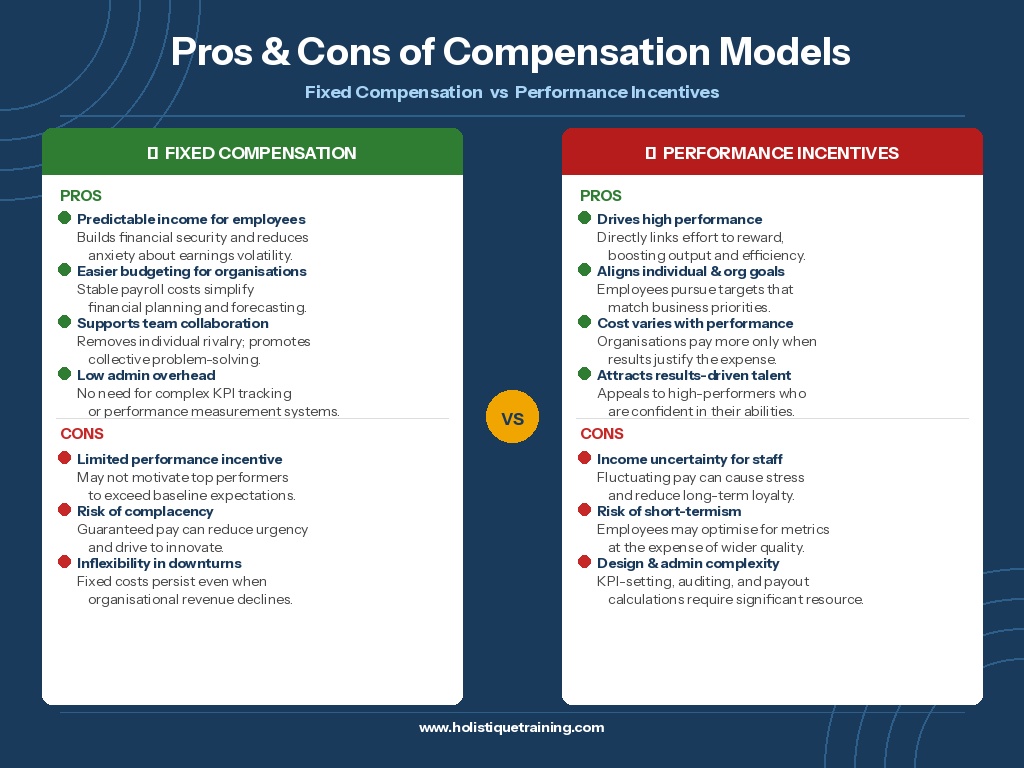
The infographic below summarises the core pros and cons of each compensation model, providing a visual reference for the comparison explored throughout this article.
4. Fixed Compensation: Limitations
The principal limitation of fixed compensation is its limited capacity to differentiate between high and low performers. When all employees in a role receive the same or similar pay regardless of their contribution, high performers may feel undervalued and become susceptible to recruitment by competitors offering performance-linked rewards. This is particularly relevant in knowledge-intensive or technical operational roles where individual expertise and problem-solving capability make a material difference to outcomes.
A second limitation is the risk of complacency. Guaranteed pay removes the direct financial downside of underperformance, which may, over time, reduce the urgency employees feel to address inefficiencies, meet targets, or pursue continuous improvement. This is not an inevitable outcome; organisational culture, leadership, and non-financial forms of recognition can counteract complacency effectively. However, in organisations that rely primarily on compensation as a management tool, fixed pay alone may be insufficient to sustain high levels of discretionary effort.
A third limitation is its inflexibility during periods of organisational financial stress. In downturns, organisations with high fixed payroll commitments face structural rigidity. Variable pay structures, by contrast, provide a natural cost-adjustment mechanism: when performance falls, so does the variable component of the wage bill. For organisations operating in volatile or cyclical industries, this flexibility can be strategically significant.
5. Performance Incentives: Advantages in Operations
Performance incentive structures carry significant motivational potential when implemented under the right conditions. Their core advantage is the direct alignment between individual or team effort and financial reward, which, when the link is credible and transparent, can drive measurable improvements in output, quality, and efficiency. Research consistently shows that well-designed incentive systems can raise performance in roles where output is clearly attributable to individual effort and where measurement is reliable.
According to McKinsey's Next-Generation Operational Excellence Survey , conducted between December 2023 and January 2024 across 1,000 employees representing hundreds of organisations globally, aligning incentives, rewards, and recognition with management behaviours is identified as one of the most important steps organisations can take to revive productivity growth, second only to articulating organisational purpose. The same research found that only one-fifth of respondents said their organisations systematically recognised employees for individual or team achievements, suggesting a significant untapped opportunity in many operational environments.
A second advantage is the capacity of incentive structures to attract and retain performance-oriented talent. Professionals who are highly confident in their own capabilities and who are motivated by measurable achievement tend to self-select into organisations and roles where their effort is rewarded proportionately. This can create a virtuous cycle in which incentive structures attract high performers, whose output validates the model, which in turn reinforces the organisation's ability to sustain competitive compensation.

Having a great benefits and rewards system is the key to attracting quality candidates to a job role. The right employee will usually want to work with the company and participate in benefits schemes and may be more motivated by the company has extras than
6. Performance Incentives: Limitations and Risks
Despite their motivational potential, performance incentive structures carry substantial risks that are particularly pronounced in complex operational environments. The most widely documented is the problem of metric distortion, sometimes called gaming. When employees are financially rewarded for achieving specific measurable targets, rational actors will optimise their behaviour to maximise performance on those metrics, even when doing so undermines broader organisational goals. A logistics team incentivised purely on throughput may sacrifice accuracy or safety. A customer service team incentivised on call resolution speed may provide inadequate support.
A second risk is the potential for incentive structures to generate feelings of unfairness, particularly when performance is partly determined by factors outside the employee's control. Employees who miss incentive thresholds due to supply chain disruptions, seasonal demand patterns, or organisational failures may feel penalised for circumstances beyond their influence. This perception of inequity, documented extensively in the organisational justice literature, is a significant driver of disengagement and voluntary turnover.
A third risk concerns the narrowing effect of extrinsic reward on intrinsic motivation. Edward Deci and Richard Ryan's Self-Determination Theory predicts that introducing external rewards for activities that employees already find intrinsically meaningful can, under certain conditions, erode their internal motivation. This phenomenon, known as the crowding-out effect, is most likely to occur when incentives are perceived as controlling rather than informational. In practice, this means that performance pay structures should be designed to support autonomy and competence, not merely to create financial pressure.
According to Gallup's State of the Global Workplace 2024 report , only 21 percent of employees globally reported feeling engaged at work, down from 23 percent the year before. Disengagement carries a substantial cost: Gallup estimates that declining engagement cost the global economy approximately 438 billion US dollars in lost productivity in 2024 alone. These figures underscore the importance of compensation design that sustains motivation rather than eroding it over time.
7. The Role of Operational Context in Compensation Design
The appropriateness of fixed versus variable compensation is not universal; it depends significantly on the nature of the operational role, the measurability of output, the degree of interdependence between tasks, and the volatility of the operating environment. A useful framework for analysing this is the distinction between roles with high individual controllability — where the employee's actions directly and predictably determine outputs — and roles with low individual controllability, where systemic, collaborative, or environmental factors significantly shape results.
Roles with high individual controllability, such as sales, piece-rate production, or client-facing consultancy, are generally more amenable to performance incentive structures because the causal link between effort and outcome is relatively clear. Roles with low individual controllability, such as process management, maintenance, quality assurance, or regulatory compliance, are typically better served by fixed compensation, since the employee's primary contribution is consistent, careful execution of defined protocols rather than the generation of variable output.
The degree of task interdependence also matters considerably. In operational settings where outputs depend on coordinated team performance — assembly lines, logistics networks, healthcare wards, or disaster response operations — individual incentive structures can undermine the cooperative behaviour on which outcomes depend. Team-based or organisational-level incentives may be more appropriate in these contexts, though they introduce their own challenges around free-riding and attribution.
Operational Context | Recommended Primary Model | Rationale |
|---|---|---|
Sales and commission roles | Performance incentives | Direct, attributable individual output |
Manufacturing (piece-rate) | Performance incentives | Measurable, controllable unit output |
Process and quality management | Fixed compensation | Low individual controllability of outcomes |
Healthcare operations | Fixed (with team bonuses) | Team interdependence; patient safety primacy |
Logistics and supply chain | Hybrid model | Mix of individual and systemic factors |
Project management | Fixed with milestone incentives | Outcome clarity with completion risk |
Customer service operations | Fixed (with satisfaction bonuses) | Quality outcomes not fully measurable by volume |
8. Equity, Fairness, and Employee Trust
The perceived fairness of a compensation system is at least as important as its structural design. Organisational justice research distinguishes between distributive justice, which concerns whether outcomes are allocated fairly relative to contribution, procedural justice, which concerns whether the processes by which decisions are made are fair and transparent, and interactional justice, which concerns the quality of communication and respect in the application of those processes. Compensation systems that are perceived as inequitable on any of these dimensions generate disengagement, reduced effort, and elevated turnover, regardless of whether they are fixed or variable in structure.
Fixed compensation carries lower procedural complexity and therefore tends to generate fewer perceived fairness concerns in day-to-day administration, provided that the underlying pay structures are themselves equitable. Gender pay gaps, unexplained salary differentials between comparable roles, or opacity in pay-setting processes can generate serious fairness grievances even within a fixed pay environment.
Performance incentive systems are particularly susceptible to perceived unfairness because they require ongoing measurement, assessment, and allocation decisions that are subject to managerial discretion. The transparency of KPI-setting processes, the consistency of measurement, and the clarity of communication about how rewards are calculated are therefore not merely administrative concerns; they are fundamental determinants of whether the incentive system achieves its motivational purpose or generates resentment.

One of the current buzzwords in business is HR Transformation, but if you do not understand the concept, it is hard to deliver this within your organisation. The idea is to ensure that you are driving business and getting results while improving the
9. Metrics, Measurement, and the Challenge of KPI Design
The quality of a performance incentive system depends almost entirely on the quality of its measurement infrastructure. Key performance indicators must be specific, measurable, attributable to the employee or team being rewarded, and aligned with broader organisational goals. The failure to meet any of these criteria introduces distortions that can undermine both the incentive's motivational effect and its credibility with employees.
One of the most persistent challenges in operational KPI design is the tension between what is easy to measure and what is strategically important. Volume metrics — units produced, calls handled, orders processed — are straightforward to quantify but may not capture the quality, sustainability, or systemic contribution of the work. Quality metrics — error rates, customer satisfaction scores, safety records — are strategically important but more complex to attribute, more susceptible to external influence, and more difficult to define in ways that are perceived as fair.
A further challenge is the temporal alignment between incentive periods and operational cycles. Short-term incentive plans aligned with quarterly targets may encourage behaviours that optimise for the reporting period at the expense of longer-term asset management, team development, or process improvement. Operations managers should carefully consider whether the incentive horizon matches the operational rhythm of the work being performed.
10. Hybrid Compensation Models in Operations
In practice, most organisations that operate in complex environments do not choose between pure fixed or pure variable pay but design hybrid structures that combine a guaranteed base with a variable component. The proportion of fixed to variable pay varies widely by industry, seniority, and role type. At senior leadership levels, variable pay may constitute a substantial share of total compensation, reflecting the degree to which organisational outcomes are attributable to strategic decisions. At frontline operational levels, a high base with a modest team-based bonus is more common, reflecting the collaborative and process-dependent nature of the work.
Effective hybrid models share several design characteristics. First, the fixed component must be sufficient to provide genuine financial security; a base salary so low that employees are financially dependent on hitting incentive targets creates the same anxieties as pure variable pay and undermines the security benefits of the fixed component. Second, the variable component must be credibly linked to outcomes that employees can influence; targets that are perceived as unachievable or arbitrary generate cynicism rather than motivation. Third, the measurement and communication of performance outcomes must be transparent and timely; delays in reporting or opacity in calculation methods erode trust in the system.
According to WorldatWork's 2024 report on bonus programmes and practices, variable pay offers a flexible lever that organisations use to attract and retain workers while managing fixed costs. The report also notes that companies may concentrate bonuses among fewer employees to control overall compensation costs, particularly in uncertain economic conditions — a dynamic that operations managers should monitor carefully to avoid the erosion of team-wide motivation.

This course explores the strategic integration of human resources within organisational frameworks to enhance business performance. It is designed to equip HR professionals with the skills to align HR strategies with corporate goals, ensuring a sustainable competitive advantage.
11. Sector-Specific Considerations
The optimal balance between fixed and variable compensation differs significantly across sectors. In manufacturing, the long tradition of piece-rate pay reflects the measurability and individual controllability of production output. However, as modern manufacturing has shifted towards team-based assembly, lean systems, and quality-first cultures, many organisations have moved towards hybrid structures that retain a team bonus component while maintaining a secure base salary to support workforce stability.
In healthcare operations, the primacy of patient safety and the interdependence of clinical and non-clinical roles create strong arguments against performance incentive structures tied to individual output metrics. The risk of metric distortion is particularly acute: an incentive system tied to patient throughput may create pressures that compromise the quality of care. Fixed compensation with team-based or organisational-level quality bonuses tends to be more appropriate, ensuring that staff are rewarded for collective adherence to standards rather than for individual productivity.
In logistics and supply chain management, the interaction between individual effort and systemic factors is complex. A warehouse operative's picking accuracy and speed are individually attributable, making piece-rate or efficiency bonuses reasonable. A supply chain analyst's contribution to demand forecasting or supplier risk management, by contrast, is harder to disentangle from team effort and organisational capability. Hybrid structures that reward individual operational metrics while also acknowledging broader team and organisational performance are typically most effective in these environments.
12. Legal, Compliance, and Global Considerations
Compensation design must operate within a complex legal framework that varies significantly across jurisdictions. In many countries, performance-based pay structures intersect with minimum wage legislation, employment contract law, and equal pay regulations in ways that require careful legal review. In the United Kingdom, for example, the National Minimum Wage applies to all workers regardless of whether they are paid on a fixed or variable basis, meaning that piece-rate and commission structures must be constructed to ensure that workers never fall below the statutory minimum in any pay reference period.
Equal pay obligations create further constraints on incentive design. Where performance incentive programmes systematically reward groups of employees differently along demographic lines — whether through structural features such as the concentration of incentive-eligible roles in male-dominated functions or through managerial discretion in award decisions — they may generate legal exposure under equal pay and anti-discrimination legislation. Organisations operating across multiple jurisdictions must also navigate significantly different legal requirements around bonus disclosure, collective bargaining obligations, and social security implications of variable pay.
Internationally, attitudes towards performance pay vary culturally as well as legally. Research in cross-cultural management has documented substantial differences in the extent to which employees in different national contexts find individual performance incentives motivating or fair. In cultures characterised by high collectivism, individual incentive structures may generate discomfort or be perceived as undermining group cohesion, suggesting that globally operating organisations should adapt their compensation models to local cultural norms rather than imposing a universal structure.
13. Implementation Principles for Compensation Design
Whether an organisation is introducing a new incentive structure, revising an existing one, or reviewing the adequacy of its fixed pay framework, several implementation principles apply across contexts. The first is alignment: the compensation model must be demonstrably connected to the organisation's strategic objectives, ensuring that what is rewarded is what the organisation genuinely needs to achieve. Misalignment between compensation design and strategic priority is one of the most common sources of long-term incentive failure.
The second principle is transparency. Employees must understand how their compensation is determined, how targets are set, how performance is measured, and how rewards are calculated. Opacity in any of these dimensions generates suspicion and reduces the motivational effect of the structure. Clear, accessible communication about compensation — including the publication of pay ranges, incentive formulae, and performance criteria — is a prerequisite for employee trust.
The third principle is regular review. Compensation structures that were well designed at inception may become misaligned over time as roles evolve, organisational priorities shift, or market rates change. Regular benchmarking against market data, periodic review of KPI relevance, and systematic collection of employee feedback on the perceived fairness of the compensation system are essential maintenance activities for any organisation that regards compensation as a strategic tool rather than a fixed administrative function.
Conclusion
The choice between fixed compensation and performance incentives in operations is not a binary decision but a design challenge that requires careful analysis of role characteristics, organisational culture, measurement capability, legal context, and strategic objectives. Fixed compensation offers financial security, administrative simplicity, and support for collaborative team cultures, making it well suited to roles characterised by high task interdependence, low individual controllability of outcomes, or significant patient and public safety responsibilities. Performance incentives offer direct motivational alignment, cost flexibility, and the capacity to attract and retain results-driven talent, making them well suited to roles where output is clearly attributable, measurement is reliable, and individual effort makes a demonstrable difference to outcomes.
For most organisations operating in complex environments, the most effective approach is a well-designed hybrid model that provides a secure and competitive base while deploying targeted variable pay components where the conditions for effective incentive design can be met. The success of such models depends less on the proportion of pay that is variable than on the quality of the measurement infrastructure, the transparency of the communication framework, and the perceived fairness of the process by which rewards are determined and distributed. Organisations that invest seriously in these foundations will find that compensation becomes a genuine instrument of operational performance rather than merely a cost to be managed.