

- Table of Contents
- Introduction
- What Is Microlearning?
- Why Is Microlearning Important?
- Supports Better Knowledge Retention
- Improves Learner Engagement
- Allows Flexible, On-Demand Access
- Responds to Shifting Workforce and Academic Expectations
- Cost-Effective and Scalable
- Encourages Self-Directed Learning
- Supports Immediate Application of Knowledge
- How Is Microlearning Changing Academic Growth and Corporate Training?
- Changing Academic Growth
- Changing Corporate Training
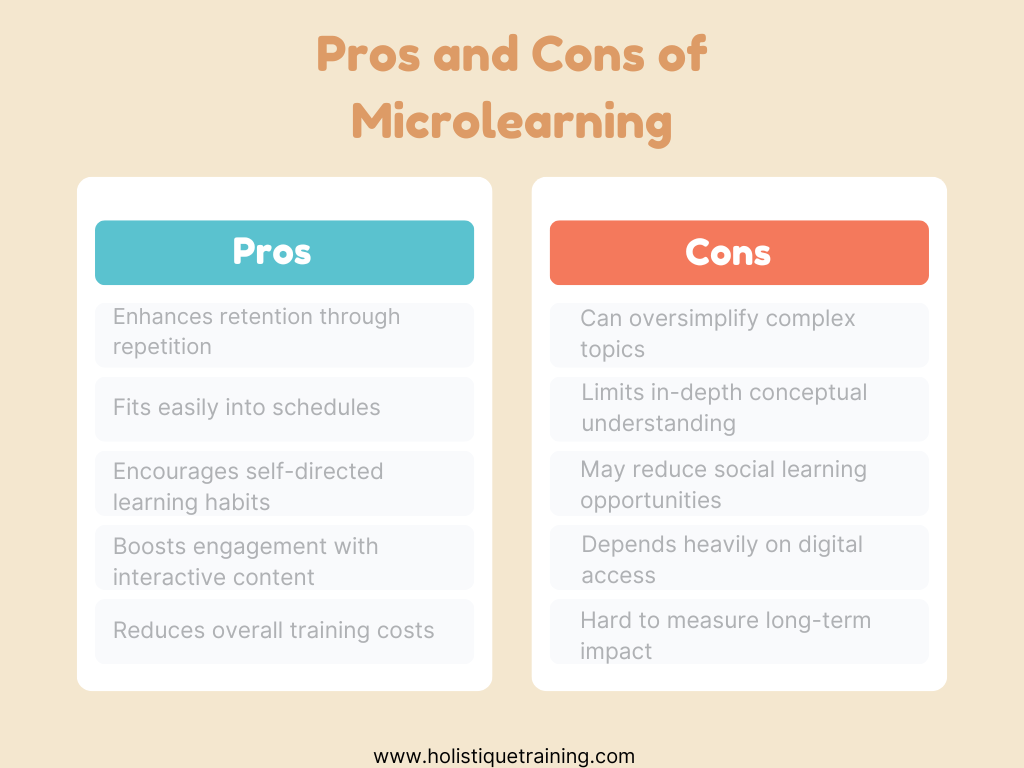
- Drawbacks of Microlearning
- 1. Risk of Oversimplification
- 2. Fragmentation of Learning Experience
- 3. Limited Social Interaction
- 4. Dependence on Digital Tools
- 5. Measurement and Evaluation Challenges
- How to Implement Microlearning in Your Corporate Training Strategy
- 1. Identify Skill Gaps and Training Objectives
- 2. Break Down Content into Targeted Learning Objectives
- 3. Choose Appropriate Content Formats
- 4. Integrate Microlearning into Daily Workflow
- 5. Utilize Learning Management Systems (LMS)
- 6. Apply Spaced Repetition and Reinforcement
- 7. Blend with Other Learning Methods
- 8. Measure Outcomes and Adjust Strategy
- Conclusion
Introduction
Curiosity drives learning, yet attention is a fragile resource. People absorb information best when presented with knowledge that feels approachable, timely, and relevant to their personal goals or job responsibilities. Modern learners, whether students balancing coursework and part-time jobs or employees juggling meetings, deadlines, and family obligations, increasingly seek learning experiences that fit into small windows of time. The digital age has fueled this need for flexibility, inviting a shift from traditional, lengthy lessons toward shorter, more targeted formats of training. That shift has introduced a powerful concept that is rapidly transforming knowledge delivery: microlearning.
This blog post offers a comprehensive exploration of microlearning as a concept and as a strategy for boosting academic and workplace development. It explains the meaning of microlearning, why it has gained significant importance, how it is reshaping both personal educational growth and corporate learning initiatives, the drawbacks organizations should be aware of, and finally, practical guidance for implementing microlearning successfully in a corporate environment. Through a detailed and analytical lens, this discussion aims to give educators, corporate trainers, and decision-makers a clear understanding of how microlearning can optimize learning outcomes while addressing limitations that accompany it.
What Is Microlearning?
Microlearning refers to a learning approach centered on delivering information in small, digestible segments that focus on a single topic, skill, or learning objective. Instead of hour-long lectures or extensive modules, learners engage with brief content experiences that typically range from a few seconds to ten minutes. These content pieces may include videos, infographics, mini-quizzes, flashcards, short readings, or interactive scenarios. Regardless of the format, the defining characteristic of microlearning is its targeted and tightly scoped instructional design.
The concept is rooted in cognitive science, especially in research related to attention span, memory retention, and spaced repetition. When information is broken down into manageable units, learners are less likely to feel overwhelmed and are more equipped to process and store knowledge effectively. Microlearning aligns with the brain’s natural ability to acquire information through repetition and reinforcement over time rather than through long and intensive sessions that risk cognitive overload.
Digital technology has accelerated the adoption of microlearning, making it accessible anytime and anywhere. Phones, tablets, and laptops allow learners to access content on demand, transforming downtime — such as commuting, waiting between meetings, or short breaks — into valuable learning opportunities. As a result, microlearning is now commonly used across academic institutions, professional training programs, and self-development contexts.
It also promotes agency, empowering learners to take ownership of their growth. Because microlearning modules are typically self-paced and easily navigated, individuals can choose what and when to learn based on their needs or interests. The flexibility and personalization embedded in this approach help maintain motivation and engagement, which are critical factors influencing long-term learning success.
Why Is Microlearning Important?
The importance of microlearning stems from its ability to meet the evolving needs and behaviors of modern learners. Several key factors contribute to its rise:
Supports Better Knowledge Retention
Research in educational psychology consistently highlights that information is better retained when it is presented in short, repeated intervals rather than long, continuous sessions. Microlearning’s concise modules allow learners to focus on one concept at a time, reducing cognitive overload. For instance, medical students can benefit from short, repeated microlearning modules that reinforce anatomy or pharmacology concepts, improving recall during exams or practical applications. By spacing learning and reinforcing it gradually, microlearning strengthens long-term memory retention, which is critical for both academic success and workplace performance.
Improves Learner Engagement
Engagement is a key factor in the effectiveness of any learning experience. Long lectures or extensive e-learning modules can overwhelm learners, causing attention to wane and motivation to drop. Microlearning combats this by providing content that is manageable, targeted, and immediately actionable. Learners experience quick wins, completing short lessons or mini-quizzes that offer a sense of accomplishment. In corporate environments, this could translate to higher engagement rates in compliance or skills training programs. Incorporating elements like interactive quizzes, gamification, or scenario-based exercises further enhances motivation, making learning enjoyable rather than obligatory.
Allows Flexible, On-Demand Access
One of microlearning’s most significant advantages is its adaptability to learners’ schedules and environments. Traditional classroom or workshop-based approaches often require learners to dedicate large blocks of uninterrupted time, which may not be feasible in busy academic or professional settings. Microlearning content, delivered via mobile devices or online platforms, enables learners to access lessons whenever and wherever convenient. Whether during a commute, lunch break, or brief window between meetings, individuals can engage in meaningful learning without disrupting their routine. This flexibility supports continuous development and allows learning to become a natural, integrated part of daily life.
Responds to Shifting Workforce and Academic Expectations
The modern world demands rapid adaptation. Academic curricula are continually evolving to reflect new discoveries and methodologies, while workplaces face ever-changing technologies, regulations, and skill requirements. Microlearning offers a scalable solution to keep pace with these shifts. For students, it allows supplemental learning that reinforces classroom instruction and provides immediate clarification of challenging concepts. For employees, microlearning enables organizations to update training materials quickly, deliver timely interventions, and address skill gaps as they emerge, fostering agility and readiness in both educational and professional contexts.
Cost-Effective and Scalable
From a practical standpoint, microlearning is both cost-efficient and scalable. Developing concise modules typically requires fewer resources than creating full-length training courses or extensive classroom programs. Once created, modules can be reused, updated, or repurposed with minimal additional cost. Organizations and educational institutions can deploy microlearning across large teams or student populations without incurring significant logistical challenges. Additionally, the modular nature of microlearning allows easy customization, ensuring that content remains relevant and aligned with specific learning objectives or organizational goals.
Encourages Self-Directed Learning
Microlearning empowers individuals to take ownership of their education and development. Learners can select topics that match their immediate needs or interests, control the pace at which they progress, and revisit content as necessary. This self-directed approach fosters critical thinking, self-motivation, and a proactive mindset — skills that are increasingly valued in academic, professional, and personal contexts. By allowing learners to steer their learning journey, microlearning helps cultivate lifelong learning habits that extend far beyond a single course or training program.
Supports Immediate Application of Knowledge
Because microlearning is often task-focused, it bridges the gap between learning and practical application. Learners can immediately apply the knowledge gained to real-world scenarios, whether solving a problem in the workplace or tackling an academic exercise. This immediate reinforcement strengthens retention and demonstrates the value of the learning experience, encouraging continued engagement and further exploration of related topics.
Through these benefits, microlearning has established itself as an essential methodology for modern education and corporate training. Its strategic use enhances retention, engagement, and efficiency, aligning learning experiences with the demands of contemporary life and the expectations of digital learners. When applied thoughtfully, microlearning becomes more than a convenient format — it is a driver of meaningful growth and sustained knowledge acquisition.
How Is Microlearning Changing Academic Growth and Corporate Training?
Microlearning’s impact spans personal learning journeys and organizational development strategies. Its adaptability makes it suitable for various learning environments, but the effects differ slightly between academia and the workplace. What connects both settings, however, is microlearning’s ability to offer learning that is agile, relevant, and tailored to individual needs.
Changing Academic Growth
Students experience countless distractions—technology, time pressure, mental overload—and microlearning offers an approach that aligns with their learning behaviors. Its accessible format complements formal education rather than replacing it, making learning feel less burdensome and more integrated into everyday life. The following shifts are increasingly visible across educational contexts:
1. Enhanced Supplemental Learning
Microlearning provides additional support outside the classroom. Students can reinforce difficult concepts through bite-sized content such as short explainer videos or mini practice exercises. This scaffolding contributes to deeper understanding over time. It allows learners to revisit content repeatedly at their own pace, which strengthens confidence, particularly in subjects that require cumulative skills like mathematics or science.
2. Improved Accessibility
Microlearning tools often account for diverse learning needs, providing audio, visual, and interactive elements. Students with disabilities or specific learning challenges benefit from manageable content sizes and multimodal formats. Many platforms now include language support, captioning, and adjustable reading speeds, ensuring that learning does not rely on a single traditional teaching method. This inclusivity plays a major role in reducing learning disparities.
3. Increased Autonomy
The self-directed format encourages students to take initiative. Microlearning platforms allow them to track progress, choose what to review, and engage at their own pace, helping develop personal responsibility and self-management. As learners build habits around short bursts of studying, they gradually strengthen time-management skills that are essential for academic success beyond the classroom.
4. Growth in Digital and Self-Learning Skills
Students gain experience using digital tools and managing their learning independently, preparing them for lifelong self-development and future careers where continuous learning is expected. The familiarity with educational technology also equips them with digital literacy skills that universities and modern workplaces now view as fundamental qualifications. Microlearning thus contributes to stronger academic confidence and a growth mindset.
Through these advantages, microlearning supports academic resilience, allowing students to learn without the overwhelming pressure of large assignments or long lectures.
Aspect | Academic Growth | Corporate Training |
Purpose | Reinforces classroom learning, supports self-study | Enhances skills, addresses performance gaps, ensures compliance |
Content Focus | Concept understanding, exam prep, supplemental knowledge | Role-specific skills, practical tasks, real-world scenarios |
Engagement Methods | Interactive exercises, quizzes, short videos | Gamified modules, scenario-based simulations, mobile learning |
Flexibility | Learners choose pace and revisit concepts as needed | Training available on-demand to fit workflow and schedules |
Outcome Management | Grades, retention, comprehension, self-assessment | Performance metrics, application of skills, productivity improvement |

Artificial Intelligence is reshaping the future of education by enabling highly personalized, responsive, and scalable learning experiences. AI-powered learning systems analyze learner behavior, adapt to individual needs, and deliver customized content that evolves in real time. This course explores how educators, instructional designers, and EdTech innovators can harness
Changing Corporate Training
Organizations operate in environments requiring constant adaptation due to digital transformation, new market demands, and rapidly shifting job responsibilities. Microlearning directly supports these realities and has introduced a more flexible and performance-oriented model of corporate learning.
1. Continuous Skill Development
Companies no longer rely solely on periodic workshops. Microlearning allows employees to learn new technologies, policies, or compliance requirements on an ongoing basis without halting productivity. Employees can immediately apply what they learn, making training actionable and closely tied to practical outcomes. This continuous approach helps organizations react quickly to industry changes.

Many forward-thinking business owners realise that simply giving orders isn't the most effective way to get work done. Research shows that employees are more motivated and productive when they are free to make their own choices and follow paths they enjoy.
2. Stronger Performance Alignment
Microlearning modules can be tailored to specific roles and individual performance gaps, ensuring relevance and efficiency. For instance, a customer service representative can instantly access a quick refresher before handling a complex case. This ability to receive the right content at the right moment helps shorten learning curves and improves overall workplace performance.
3. Better Knowledge Transfer
Short, scenario-based modules often mirror real workplace challenges, increasing the likelihood of applying knowledge immediately on the job. Because learning experiences are brief and focused, employees retain essential information longer and feel more prepared to handle emerging tasks. Microlearning reinforces desired behaviors, making training more impactful than one-time sessions.
4. Higher Engagement and Retention
Organizations frequently encounter disengagement during long training sessions. Microlearning addresses this by providing quick wins and motivating employees through measurable progress — such as badges, achievement levels, or skill milestones. In fact, companies that implemented microlearning reported a130% increase in employee engagement and productivity compared to those that did not. This format sparks curiosity and reduces the resistance that employees may feel toward mandatory training initiatives.
5. Scalability Across Teams and Locations
Remote and hybrid work environments rely heavily on digital learning systems. Microlearning delivers standardized content across global offices while enabling personalization based on local regulations or cultural differences. This adaptability allows organizations to scale training without significantly increasing costs, ensuring inclusivity across regions and time zones.
These contributions demonstrate that microlearning is not simply a trend — it is becoming a foundational practice for developing talent and ensuring organizational competitiveness.
Drawbacks of Microlearning
Although microlearning offers immense value, it is not without challenges. Recognizing limitations is essential to building successful strategies that avoid misuse. When implemented without thoughtful planning, microlearning can lose effectiveness and create learning gaps instead of bridging them.
1. Risk of Oversimplification
Reducing content size can unintentionally remove the depth needed for comprehensive understanding. Some topics — such as complex problem-solving, theoretical frameworks, or strategic decision-making — require more time and detailed explanation. When learning is overly condensed, individuals might remember facts yet fail to grasp the reasoning behind them. This can lead to misconceptions or insufficient preparedness for more advanced tasks. To prevent this, microlearning must be used as a supplement to — not a replacement for — deep learning experiences.
2. Fragmentation of Learning Experience
If modules are not strategically sequenced and interconnected, learners may struggle to see the bigger picture. Fragmentation can limit conceptual understanding and reduce the integration of knowledge across topics. This challenge often appears in environments where microlearning modules are taken “as needed” rather than through a structured pathway. Without clear progression, learners may complete tasks but fail to build cumulative skills over time. Effective instructional design remains crucial to ensure continuity and flow.
3. Limited Social Interaction
Traditional learning environments support collaboration, group discussions, and peer-to-peer support. Because microlearning is typically self-paced and individual, it may weaken communication and teamwork development if used in isolation. Human interaction reinforces learning by allowing individuals to debate, challenge ideas, and learn from practical experiences shared by others. To balance this limitation, organizations often introduce blended learning options that incorporate microlearning alongside instructor-led sessions or collaborative group activities.

Collaboration is a cornerstone of 21st-century education — helping learners develop teamwork, communication, and problem-solving skills while fostering deeper engagement and understanding. However, creating and sustaining a truly collaborative learning environment requires intentional design, facilitation, and reflection.This course provides educators and trainers with practical strategies to
4. Dependence on Digital Tools
Technology accessibility varies across regions, age groups, and job environments. Microlearning is primarily delivered digitally, meaning those without reliable access to devices or internet connectivity may face disadvantages. Additionally, employees or students with low digital literacy may feel intimidated by platforms and apps, detracting from learning motivation. Technical issues — such as software bugs or compatibility concerns — can also disrupt the learning process. Consistent user support and platform reliability are essential to overcome this barrier.
5. Measurement and Evaluation Challenges
Short modules can make it difficult to assess deeper learning outcomes. Completion rates and quick quizzes often provide surface-level metrics that do not fully capture skill application in real situations. Organizations may mistakenly assume that successful module completion equals improved performance, overlooking behavioral changes and long-term retention. To counter this, organizations need to pair microlearning analytics with workplace observations, performance data, and ongoing reinforcement strategies.
These drawbacks emphasize that microlearning should not stand alone as the sole educational strategy. It must be thoughtfully integrated into broader learning plans that include assessment, collaboration, and opportunities for deeper understanding. When balanced correctly, microlearning becomes a powerful tool — but only as one part of a comprehensive learning ecosystem.
How to Implement Microlearning in Your Corporate Training Strategy
To maximize success, microlearning should not be introduced as isolated content but as part of a comprehensive learning ecosystem. When implemented strategically, it enhances knowledge retention, encourages continuous development, and ensures alignment with organizational goals. Below is a structured approach to effectively implementing microlearning in corporate training:
1. Identify Skill Gaps and Training Objectives
The first step in designing a microlearning strategy is to thoroughly analyze the skills employees currently have versus the skills required for optimal performance. This involves gathering data from performance evaluations, manager observations, and employee feedback. By defining clear goals for each microlearning module, organizations can ensure that content addresses specific needs rather than offering generic training. Well-defined objectives also provide measurable outcomes that help assess the effectiveness of the training.
Goal management is the process of setting, aligning, tracking, and achieving objectives within an organisation or for personal development. This Goal Management Training Course is designed to provide participants with the skills and tools necessary to set realistic, measurable, and achievable goals that contribute to
2. Break Down Content into Targeted Learning Objectives
Broad training topics must be deconstructed into smaller, actionable concepts that can be absorbed quickly. For example, instead of teaching “Effective Sales Techniques” in a single, hour-long session, it can be broken down into modules like “Building Rapport in the First 2 Minutes,” “Handling Objections Efficiently,” and “Closing Techniques for Different Client Profiles.” Each module should have a clear purpose and measurable outcome to reinforce learning, making knowledge easier to retain and apply immediately.
3. Choose Appropriate Content Formats
Different topics and learning objectives benefit from specific formats. Microlearning can include:
- Short instructional videos (2–5 minutes) for complex topics
- Interactive quizzes to test understanding and reinforce memory
- Infographics summarizing key points visually for fast comprehension
- Flashcards for vocabulary, definitions, or procedure steps
- Simulations or scenario-based exercises that replicate real work challenges
- Text-based tips, checklists, or step-by-step guides delivered via mobile apps
- Gamified challenges, including points or badges, to motivate engagement
Selecting the appropriate format ensures that content is engaging, practical, and accessible to employees with different learning preferences.
4. Integrate Microlearning into Daily Workflow
Microlearning is most effective when it aligns with employees’ natural work routines. Organizations should identify opportunities to embed learning moments into daily activities. For example, an employee could complete a two-minute module during a coffee break or review a checklist before client meetings. In fact, research shows83% of employees complete a 10-minute microlearning module, compared to just 20–30% for traditional courses. By integrating learning seamlessly into workflow, microlearning becomes less of a “task” and more of a natural part of professional development. This approach reduces disruption, increases engagement, and encourages frequent learning reinforcement.
5. Utilize Learning Management Systems (LMS)
A robust LMS is essential to manage, deliver, and track microlearning content efficiently. Modern platforms allow employees to access modules on-demand, track progress, and receive recommendations for next steps. LMSs also enable administrators to update content quickly, customize learning paths for individual roles, and gather analytics on completion rates, engagement, and assessment results. By centralizing training management, companies can scale microlearning while maintaining quality and consistency across teams.
Table: Metrics to measure the effectiveness of microlearning
Metric | Description |
Completion Rate | Percentage of learners who finish a microlearning module or course. |
Knowledge Retention | Ability of learners to recall and apply information over time. |
Engagement Level | Measures learner interaction, such as quiz participation, video views, or module clicks. |
Performance Improvement | Assessment of how learning impacts job performance or academic outcomes. |
Learner Satisfaction | Feedback from learners regarding content relevance, usability, and overall experience. |
6. Apply Spaced Repetition and Reinforcement
Microlearning modules are most effective when learners revisit key information at intervals, reinforcing memory retention over time. Spaced repetition can involve sending follow-up quizzes, reminders, or refresher modules days or weeks after initial training. For example, an employee completing a module on cybersecurity best practices may receive short quizzes after one week and one month to reinforce retention. This approach strengthens long-term recall and encourages practical application of newly acquired skills.
7. Blend with Other Learning Methods
While microlearning is effective for quick knowledge acquisition, it should not completely replace other methods of instruction. Combining microlearning with traditional workshops, mentoring, coaching sessions, or collaborative group exercises provides a more holistic approach. For example, a sales team might complete microlearning modules on negotiation techniques, followed by a live role-playing session with a manager to practice real-world application. This blended learning approach mitigates the risks of oversimplification and fragmentation while promoting deeper comprehension.
8. Measure Outcomes and Adjust Strategy
Successful microlearning initiatives rely on robust evaluation. Metrics such as completion rates, quiz scores, and user engagement provide insight into immediate performance. However, measuring long-term impact requires tracking how learning translates into workplace behavior, productivity improvements, and goal achievement. Collecting qualitative feedback from employees, managers, and trainers further informs adjustments to content, format, or delivery timing. Continuous evaluation ensures the microlearning strategy evolves alongside organizational needs, technology, and employee expectations.
By following these principles, companies can implement microlearning in a structured, strategic, and impactful manner. When executed thoughtfully, microlearning becomes more than a series of short lessons — it transforms corporate training into a dynamic, learner-centered system that drives continuous growth and measurable performance improvement.
Conclusion
Learning continues to change as technology, society, and workplaces evolve. Microlearning has emerged as a powerful response to these changes, promoting flexibility, engagement, and better retention of information. It empowers students to supplement their education with digestible modules that enhance comprehension and autonomy. Simultaneously, it transforms corporate learning by enabling continuous skill development, supporting performance outcomes, and accommodating the realities of busy work environments.
However, microlearning is not a one-size-fits-all solution. When used without intention, it may oversimplify complex topics, isolate learning experiences, or rely too heavily on technology. The most successful approaches use microlearning as part of a broader training ecosystem—one that blends short-form modules with collaborative, practical, and in-depth learning opportunities.
Ultimately, microlearning represents more than shorter lessons; it signifies a learner-centered transformation. Individuals thrive when knowledge feels accessible, relevant, and immediately applicable. Organizations and educational institutions that understand this shift — and adapt thoughtfully — will be better equipped to unlock continuous growth, encourage lifelong learning, and navigate the ever-changing demands of modern life.