
- Table of Contents
- Introduction
- 1- What Are International ETFs?
- Global, International and Single-Country Funds
- How They Differ from Mutual Funds and Direct Holdings
- Index Providers and Benchmarks
- 2- Why the Global ETF Market Has Expanded
- 3- Main Types of International ETFs
- 1- Developed market ETFs.
- 2- Emerging market ETFs.
- 3- Global all-world ETFs.
- 4- Single-country and regional ETFs.
- 5- International fixed income and thematic ETFs.
- 4- How International ETFs Are Structured and Replicated
- Replication Methods
- Securities Lending and Collateral
- Trading Across Time Zones
- 5- Domicile, Regulation and Tax
- Withholding Tax and Reporting Rules
- 6- Diversification Benefits of International ETFs
- Home Bias and Sector Exposure
- 7- Building Portfolios with International ETFs
- Core-Satellite Approaches
- Currency Decisions
- Rebalancing and Monitoring
- 8- Costs, Liquidity and Tracking
- Premiums, Discounts and Execution
- 9- Active and Smart Beta International ETFs
- 10- Key Risks of International ETFs
- 1- Currency risk.
- 2- Political and regulatory risk.
- 3- Liquidity and pricing risk.
- 4- Counterparty and structural risk.
- 5- Concentration and tracking risk.
- 11- How to Select an International ETF
- 1- Index and methodology.
- 2- Domicile and tax treatment.
- 3- Total cost.
- 4- Size and liquidity.
- 5- Replication and lending policy.
- 6- Provider and governance.
- 12- Future Trends in International ETFs
- 1- Wider active and semi-transparent structures.
- 2- Access to private and long-term assets.
- 3- Technology-driven efficiency.
- 4- Sustainability integration.
- 13- Conclusion
Introduction
International exchange traded funds have moved from a niche allocation tool to a central building block of global portfolios. An exchange traded fund, or ETF, is a pooled investment vehicle that holds a basket of securities and trades on a stock exchange throughout the day. When that basket is drawn from outside an investor’s home market, or spans many countries at once, the fund is described as an international ETF. For finance and investment professionals, these products now sit at the intersection of asset allocation, cost control, liquidity management and regulatory design.
The appeal is easy to understand. A single trade can deliver exposure to dozens of countries, thousands of securities and several currencies, with transparent holdings and fees that are usually lower than those of comparable active funds. At the same time, international ETFs introduce complications that domestic products do not, including currency risk, withholding taxes, time-zone mismatches and differing regulatory regimes. Getting these details right is what separates a well-built global allocation from an expensive or unintended one.
In this article, we will discuss what international ETFs are, why the global market has expanded, the main fund types, how they are structured and replicated, the role of domicile and tax, diversification benefits, portfolio construction, costs, active strategies, key risks, selection criteria, future trends, and common professional questions.
1- What Are International ETFs?
International ETFs are exchange traded funds whose holdings sit outside the investor’s home market, or are spread across several markets. They usually track an index compiled by a provider such as MSCI, FTSE Russell, S&P Dow Jones Indices or STOXX, and they hold the constituents directly or gain exposure through derivatives. Fund shares are bought and sold on an exchange at a market price, while the fund itself is valued daily by reference to its net asset value.
Global, International and Single-Country Funds
Terminology varies between providers, so precision matters. A global ETF usually includes domestic and foreign holdings, whereas an international ETF excludes the investor’s home market. Regional funds focus on areas such as Europe or Asia, and single-country funds concentrate on one economy. Reading the index methodology and factsheet, rather than relying on the fund name, is the only reliable way to confirm what is actually owned.
How They Differ from Mutual Funds and Direct Holdings
Index Providers and Benchmarks
The benchmark is the foundation of every index-tracking international ETF, and small methodological differences can produce large differences in outcome. Providers disagree on how to classify certain markets as developed or emerging, how to treat foreign ownership limits, and whether to include smaller companies. Two funds that both describe themselves as emerging market ETFs may therefore hold different countries, different weights and different risks, which is why benchmark due diligence should always precede product comparison.
Compared with traditional mutual funds, ETFs offer intraday trading, generally lower ongoing charges and daily holdings disclosure. Compared with buying foreign shares directly, they remove the need for multiple brokerage accounts, local custody and market-by-market settlement. They also make partial or tactical exposure far simpler, which is why many asset allocators now treat them as the default implementation tool.
2- Why the Global ETF Market Has Expanded
Three forces explain the growth. First, investors have moved towards lower-cost, transparent products as fee pressure has intensified across asset management. Second, regulation and market infrastructure have matured, allowing ETFs to be listed, traded and distributed across borders. Third, the case for geographic diversification has strengthened as regional leadership has rotated and valuation gaps have widened.
The scale of that growth is now striking. According to ETFGI, global ETF assets reached a record 24.03 trillion US dollars at the end of August 2026, up 21.3 per cent since the end of 2025, spread across 17,713 funds from 1,044 providers listed on 86 exchanges in 66 countries. The same data shows that the three largest providers, iShares, Vanguard and State Street SPDR, managed 58.7 per cent of industry assets, which illustrates how concentrated the market remains despite the number of issuers.
Institutional adoption has reinforced this trend. Pension funds, insurers and wealth managers now use international ETFs for transition management, cash equitisation, tactical tilts and the implementation of model portfolios, because the wrapper allows rapid and cost-efficient changes to regional exposure. Advisers also benefit from simpler reporting, as a single line item can represent hundreds of foreign holdings that would otherwise demand separate custody and monitoring.
3- Main Types of International ETFs
International ETFs can be grouped by geography, asset class and investment objective. The most common categories in institutional and advisory portfolios are set out below.
1- Developed market ETFs.
These track indices such as MSCI EAFE, covering Europe, Japan, Australasia and other developed economies outside North America. They are often the core international allocation because of their liquidity, depth and mature governance standards, and they typically offer the lowest costs and tightest spreads among international categories.
2- Emerging market ETFs.
These provide exposure to economies such as China, India, Taiwan and Brazil. Higher growth potential comes with greater volatility, currency swings and governance risk, and index treatment of markets such as South Korea differs between providers, so benchmark choice can materially change outcomes. Many professionals therefore size these allocations carefully within a satellite budget.
3- Global all-world ETFs.
A single fund covering developed and emerging markets, including the domestic market, in market-capitalisation weights. These suit investors seeking one core holding with minimal maintenance.
4- Single-country and regional ETFs.
These allow targeted views on, for example, Japan, India or Europe, and are widely used for tactical positioning. Concentration makes them more sensitive to local political and economic events, so they are better suited to defined holding periods and clear risk limits than to permanent core exposure.
5- International fixed income and thematic ETFs.
These cover sovereign, corporate and emerging market debt, often with hedged share classes, as well as themes such as infrastructure or clean energy. Thematic funds frequently carry higher concentration and turnover.
Fund Type | Typical Use | Main Advantage | Key Consideration |
|---|---|---|---|
Developed market | Core international allocation | Liquidity and market depth | Currency exposure |
Emerging market | Growth allocation | Higher growth potential | Volatility and governance |
Global all-world | One-fund core holding | Broad diversification | Includes home market |
Single-country or regional | Tactical views | Targeted exposure | Concentration risk |
International bond or thematic | Income or specific themes | Defined objective | Hedging cost and concentration |
Choosing between these categories is ultimately a question of what role each holding plays in the wider allocation, which is why an understanding of equity market structure and valuation remains as important as product knowledge.

Stocks and equity markets play an important role in the wider market-based economy. They allow companies to invest in and develop their financial standing, research other company metrics to change their operations, and investigate and recover from financial downturns. While stocks
4- How International ETFs Are Structured and Replicated
Most ETFs rely on a creation and redemption mechanism operated by authorised participants, typically large banks and market makers. When demand for a fund rises, an authorised participant delivers the underlying securities, or cash, to the manager in exchange for new ETF shares, and the process reverses when investors sell. This arbitrage keeps the market price close to net asset value and allows liquidity to extend beyond what is visible on the order book.
Replication Methods
International funds also differ in how they replicate their index. Full physical replication holds every constituent, optimised sampling holds a representative subset, and synthetic replication uses derivatives, usually total return swaps, to deliver index returns. Sampling and synthetic approaches are often chosen where markets are costly, restricted or hard to access directly.
Method | How It Works | Strength | Limitation |
|---|---|---|---|
Full physical | Holds all index constituents | Simple and transparent | Costly in illiquid markets |
Optimised sampling | Holds a representative subset | Lower trading costs | Possible tracking difference |
Synthetic | Swap delivers the index return | Access to restricted markets | Counterparty risk |
Securities Lending and Collateral
Many physically replicated funds lend a portion of their holdings to generate additional revenue, which can partly offset costs and narrow tracking difference. Lending introduces borrower and collateral risk, so the quality of collateral, the share of revenue returned to the fund and the maximum lending limits should all be disclosed and reviewed. In international funds, the collateral may itself be denominated in different currencies or drawn from different markets, which adds another layer of analysis for risk teams.
Trading Across Time Zones
A feature specific to international funds is the time-zone gap. A European-listed ETF holding Japanese shares may trade while the underlying market is closed, so its price relies on estimates of fair value, often published as an indicative net asset value. Spreads can therefore widen when underlying markets are shut, and many professionals trade when both the ETF and its holdings are open.
5- Domicile, Regulation and Tax
Domicile determines the regulatory framework, the investor protections and often the tax outcome. The two dominant frameworks are the United States regime under the Investment Company Act of 1940 and the European UCITS directive, with Ireland and Luxembourg the leading UCITS domiciles. UCITS rules impose diversification limits, cap counterparty exposure on synthetic funds at 10 per cent and offer a passport for cross-border distribution, which is why many non-US professionals prefer them. Investors should also confirm that a fund is eligible for sale to their client type, since marketing and distribution rules differ by jurisdiction.
Feature | US-Domiciled ETFs | UCITS ETFs |
|---|---|---|
Regulatory framework | Investment Company Act of 1940 | UCITS directive and national regulators |
Main investor base | US investors | Cross-border investors in Europe and beyond |
Income treatment | Typically pays out income | Accumulating or distributing classes |
Tax point for non-US investors | Possible US estate tax exposure | Treaty benefits, such as 15 per cent on US dividends via Ireland |
Withholding Tax and Reporting Rules
Tax drag is one of the most important and least visible drivers of net returns. Foreign dividends are often subject to withholding tax, and the effective rate depends on the fund’s domicile and the relevant double taxation treaty. Local rules on share classes and fund reporting status, such as those applying in the United Kingdom, also shape the final outcome, so professionals should confirm treatment with a qualified tax adviser.
Disclosure and oversight also differ across markets. Regulators generally require prospectuses, key investor documents and regular reporting, but the format, frequency and depth of information vary. Professionals should read the prospectus for details on permitted derivatives, borrowing limits and the process for suspending dealing in stressed conditions, as these provisions govern how the fund behaves when markets are disorderly.
6- Diversification Benefits of International ETFs
International ETFs offer a straightforward route to geographic diversification. Domestic markets are concentrated in a few sectors and companies, and they can lag for long periods, so adding foreign equities and bonds spreads exposure across economic cycles, interest rate regimes and currencies. A portfolio limited to one market also risks home bias, which is the tendency to hold far more domestic assets than a global market-capitalisation weighting would suggest.

Learn why diversifying your investment portfolio is crucial for financial resilience and growth. Explore different types of diversity and discover the eight significant benefits it brings, from risk reduction and improved potential returns to protection against inflation and flexibility in changing market conditions.
Recent flows show investors acting on this logic. According to State Street Investment Management data reported by InvestmentNews in March 2026, US-listed ETFs attracted 173 billion US dollars in February 2026, and international equity ETFs accounted for 51 per cent of all equity ETF inflows that month, even though non-US equity ETFs represent roughly 21 per cent of equity ETF assets. Developed markets outside the United States drew 24 billion dollars, emerging market funds took in 11 billion and single-country funds collected 9 billion.
Home Bias and Sector Exposure
International exposure also changes sector composition. Some markets are heavily weighted towards financials, energy or industrials, while others are dominated by technology or consumer companies. Adding foreign funds can therefore reduce reliance on a handful of sectors and introduce earnings drivers that are less correlated with the domestic economy, provided that the investor understands the sector tilts embedded in each index.
Diversification is not a guarantee. In global sell-offs, correlations between regions tend to rise, which limits short-term protection, so the benefit is most reliable over longer horizons.
7- Building Portfolios with International ETFs
Portfolio construction begins with the investment policy statement, which defines objectives, constraints and risk tolerance. Within it, the strategic allocation to international assets is usually anchored to market-capitalisation weights, then adjusted for home bias, liabilities, currency exposure and valuation views. Modern portfolio theory remains the framework most practitioners use to assess how added international exposure shifts the risk and return profile.

Delve into the world of Modern Portfolio Theory (MPT) and its impact on investment portfolios. Learn how MPT balances risk and return, explores the concept of the efficient frontier, and overcomes challenges for optimal portfolio construction.
Core-Satellite Approaches
Many professionals adopt a core-satellite structure. A low-cost global or developed market ETF forms the core, providing broad market exposure at minimal expense, while satellites such as emerging market, small-cap, factor or single-country funds express specific views. This keeps costs low, makes risk budgets easier to monitor and allows rebalancing through a few liquid trades.
Currency Decisions
Currency is the most distinctive decision. Unhedged exposure adds a second source of return and risk, while hedged share classes remove much of it at a cost linked to interest rate differentials. A common approach is to hedge bonds more fully than equities, since currency volatility can overwhelm the modest return of fixed income.
Rebalancing and Monitoring
Rebalancing disciplines are particularly important because regional performance can diverge sharply. Calendar-based reviews, tolerance bands around target weights, or a combination of both help keep risk aligned with the policy statement. Because ETFs trade intraday and settle quickly, rebalancing can usually be implemented cheaply, although large orders in less liquid funds should be worked carefully to limit market impact.

In today's corporate landscape, sound financial decision-making is paramount to business success and sustainability. This course equips executives with essential tools to navigate complex financial scenarios, mitigating risks and maximising returns. Participants will delve into the language of finance and accounting, gaining insights into financial markets, investment
8- Costs, Liquidity and Tracking
The headline total expense ratio is only one component of cost. Total cost of ownership also includes bid-offer spreads, brokerage and platform charges, foreign exchange costs, withholding tax leakage and tracking difference, which is the gap between fund and index returns over time. For international funds, tax leakage and spreads often outweigh the difference in expense ratios between competing products.
Liquidity deserves equal attention. An ETF’s tradability depends not only on its own volume but on the liquidity of its underlying securities, so a thinly traded emerging market fund can be cheap to hold yet expensive to trade in size. Professionals should review average spreads, assets under management and the depth of market makers, and understand that securities lending can offset costs while introducing collateral and counterparty considerations.
Premiums, Discounts and Execution
Execution quality can influence returns as much as the choice of fund. Market prices can deviate from net asset value, particularly around market opens, closes and periods of stress. Using limit orders, avoiding trading during the first and last minutes of a session, and consulting market makers for larger blocks are standard practices that help investors transact close to fair value.
9- Active and Smart Beta International ETFs
Beyond plain market-capitalisation tracking, international ETFs now cover factor, dividend, quality, equal-weight and actively managed strategies. These can address concerns such as the concentration of large index constituents, or give managers flexibility where security selection may add value, as in emerging economies. Active ETFs combine daily transparency with a manager’s discretion, though investors should check fees, turnover and consistency of strategy. In the international context, active management can also address structural quirks such as index rules that exclude frontier markets or underweight smaller companies. Fee transparency matters here, because the premium charged for active management must be justified by durable, repeatable value.
Flows suggest the line between active and passive is narrowing. According to S&P Global Market Intelligence’s Global ETF Industry Review for the first quarter of 2026, global ETFs attracted 358.1 billion US dollars, with active funds taking in 179.3 billion against 178.7 billion for passive funds. The same report found sharp regional divergence, with Americas-listed funds gathering 421.9 billion and European-listed funds 111.3 billion, while Asia-Pacific-listed funds recorded net outflows of 196.5 billion as investors reduced exposure to North Asian equities.

In an increasingly complex financial landscape, investment firms and hedge funds must blend high performance with constant innovation to maintain competitive advantage. This course delivers a comprehensive framework for enhancing fund performance through innovative investment strategies, advanced analytics, and adaptive management techniques.Participants will explore how cutting-edge
10- Key Risks of International ETFs
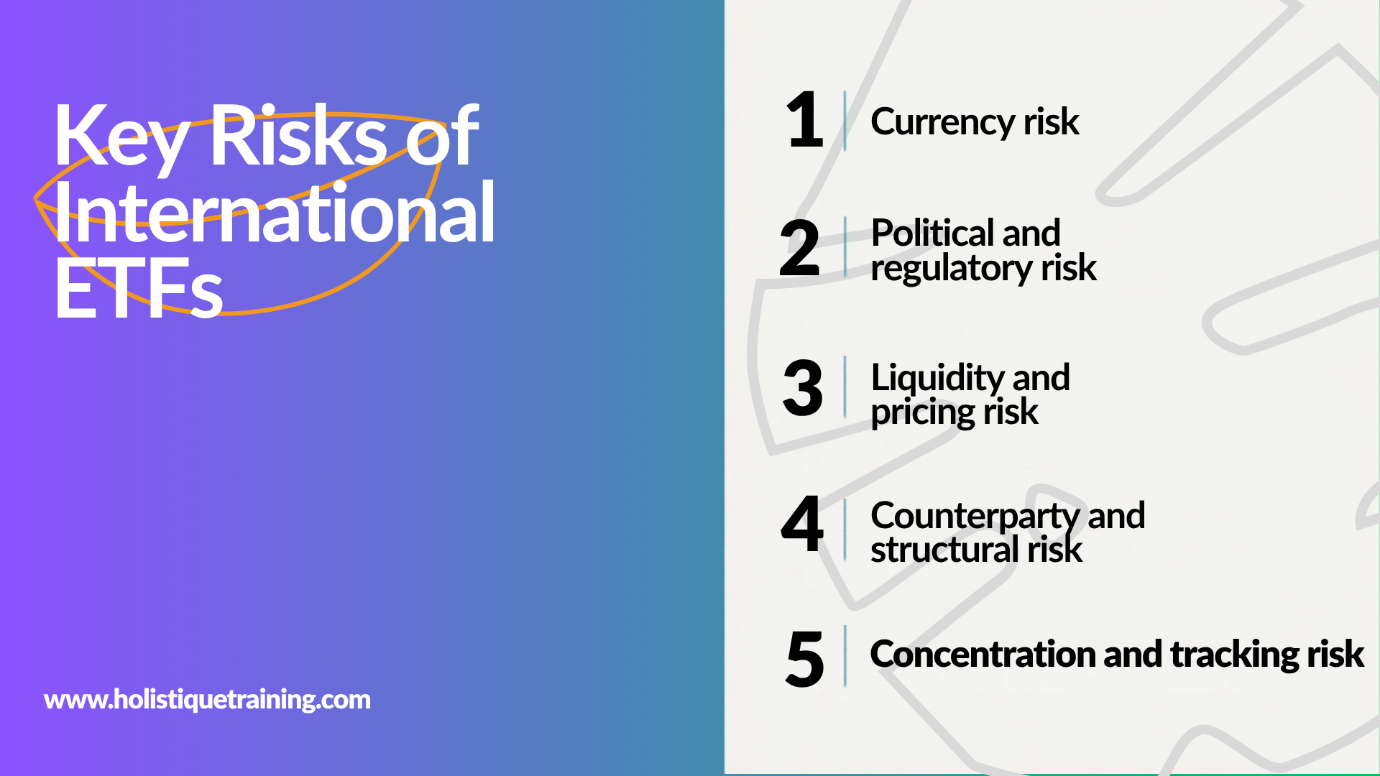
Professionals should weigh the following risks, each of which can affect results independently of market direction.
1- Currency risk.
Exchange rate movements can add to or erase local market returns. Hedged share classes reduce this exposure but do not eliminate it, and the hedging cost varies with interest rate differentials.
2- Political and regulatory risk.
Capital controls, sanctions or index reclassifications can quickly change a fund’s holdings and liquidity, and episodes of heavy regional outflows show how fast sentiment can shift.
3- Liquidity and pricing risk.
Time-zone gaps and thin underlying markets can push ETF prices away from net asset value, especially in stressed conditions when spreads widen.
4- Counterparty and structural risk.
Synthetic funds depend on swap counterparties and securities lending depends on borrowers, so collateral quality and counterparty diversification should be reviewed.
5- Concentration and tracking risk.
Capitalisation-weighted indices can be dominated by a few companies or a single country, while sampling can produce tracking difference against the benchmark.
Risk management does not mean avoiding international ETFs. It means sizing positions sensibly, diversifying across regions and fund structures, and reviewing exposures regularly against policy limits. Stress testing allocations against currency shocks and regional drawdowns gives a clearer picture of potential outcomes than historical averages alone.
11- How to Select an International ETF
A disciplined selection process reduces the risk of unintended exposures. The following criteria form a practical checklist.
1- Index and methodology.
Confirm country coverage, weighting rules and treatment of China, Korea and other contested classifications, and check whether the index excludes smaller companies.
2- Domicile and tax treatment.
Match the fund’s domicile to the investor’s residence and expected withholding tax outcomes.
3- Total cost.
Compare expense ratio, spreads, tracking difference and any hedging charges together, since a low headline fee can mask higher indirect costs.
4- Size and liquidity.
Review assets under management, average volume and market maker coverage.
5- Replication and lending policy.
Understand whether the fund is physical or synthetic and how lending revenue is shared.
6- Provider and governance.
Assess the issuer’s track record, operational resilience, transparency and history of closing or merging funds.
Documenting this process in a repeatable template also helps compliance teams evidence suitability, a growing expectation under conduct regulations in many jurisdictions.
12- Future Trends in International ETFs
Several developments are likely to shape the next phase of the market.
1- Wider active and semi-transparent structures.
Regulators in several Asia-Pacific markets are gradually allowing more flexibility, which should broaden the active international universe.
2- Access to private and long-term assets.
European frameworks such as ELTIF 2.0 are expected to support broader use of ETF-style wrappers in less liquid strategies.
3- Technology-driven efficiency.
Tokenisation and AI-assisted analytics may improve portfolio analysis, pricing and settlement, although adoption will depend on regulation.
4- Sustainability integration.
Climate and governance data are increasingly embedded in index design, giving international investors more tailored options.
None of these trends removes the need for judgement. As product choice expands, the ability to read documentation, interpret index rules and judge total cost will remain a key professional differentiator.
13- Conclusion
International exchange traded funds give investors efficient, transparent and flexible access to markets worldwide. Their strengths are clear: diversification, low costs, daily liquidity and simple implementation. Their complexities are equally clear, including currency exposure, tax leakage, time-zone effects and structural differences between domiciles and replication methods.
The most effective users treat them as precision tools rather than generic products. They define the role of each holding, check index methodology, compare total cost rather than headline fees, and monitor risks continuously. With record assets, growing active options and expanding regulation, international ETFs will remain central to global portfolio construction for years to come. For investment professionals, the practical priority is clear: build a repeatable due diligence framework so that every international ETF added to a portfolio has a defined purpose, an understood cost and a known set of risks.