

- Table of Contents
- Introduction
- What is Quiet Hiring?
- Reasons Behind Quiet Hiring
- 1. Economic Considerations
- 2. Talent Shortages
- 3. Workforce Agility
- 4. Employee Engagement and Retention
- 5. Future-Focused Skills Development
- 6. Efficiency in Knowledge Retention
- 7. Competitive Advantage
- 8. Promotes a Learning Culture
- Quiet Hiring vs. Quiet Quitting: Key Differences
- Benefits of Quiet Hiring for Employees and Employers
- Benefits for Employees
- Benefits for Employers
- 1. Project-Based Assignments
- 2. Internal Mobility and Role Expansion
- 3. Upskilling and Reskilling Programs
- 4. Cross-Functional Role Rotation
- 5. Temporary or Contingent Assignments
- 6. Shadowing and Mentorship Opportunities
- 7. Special Assignments for Skill Gaps
- 8. Recognition of Informal Contributions
- Quiet Hiring Pitfalls to Avoid
- 1. Increased Workload Without Recognition
- 2. Role Ambiguity and Confusion
- 3. Perceived Favoritism or Inequity
- 4. Skill Gaps in Original Roles
- 5. Insufficient Training or Support
- 6. Risk of Burnout
- 7. Misalignment with Career Goals
- 8. Overreliance on Internal Talent
- The Role of HR: How Can They Make Quiet Hiring Effective?
- 1. Strategic Workforce Planning
- 2. Transparent Communication
- 3. Compensation, Recognition, and Career Pathing
- 4. Structured Learning and Development Programs
- 5. Monitoring Workload and Well-Being
- 6. Performance Metrics and Continuous Feedback
- 7. Promoting a Culture of Growth and Learning
- 8. Balancing Internal Development with External Recruitment
- Conclusion
Introduction
Organizations are constantly adapting to evolving business needs, shifting market conditions, and emerging skill demands. Traditional hiring methods, while effective in some contexts, are often costly, time-consuming, and competitive, particularly when seeking specialized expertise. Quiet hiring has emerged as a strategic approach that allows companies to strengthen their workforce by optimizing internal talent rather than solely relying on external recruitment.
This blog post examines the concept of quiet hiring in depth. It defines the approach, explores the reasons behind its rising popularity, differentiates it from quiet quitting, outlines the benefits for both employees and employers, provides examples of how it looks in practice, identifies common pitfalls, and highlights the role HR plays in making quiet hiring effective. By the end of this article, you will have a comprehensive understanding of how quiet hiring can support organizational growth while enhancing employee development.
What is Quiet Hiring?
Quiet hiring refers to the process of addressing organizational talent needs without engaging in traditional external recruitment. Instead, companies rely on their existing employees or temporary resources to fill skill gaps, meet business priorities, and develop internal capabilities. It is “quiet” not because it is secretive, but because the changes are often subtle and not publicly advertised.
Quiet hiring can include:
- Reassigning responsibilities: Employees may be asked to take on new tasks or projects that fall outside their original job descriptions.
- Internal promotions or role expansions: Talented employees are given opportunities to step into higher-level responsibilities before a formal external search is conducted.
- Skill development and upskilling: Training programs equip employees with capabilities needed for emerging business needs.
- Project-based assignments: Employees temporarily join high-priority initiatives in cross-functional capacities.
Unlike traditional hiring, quiet hiring focuses on leveraging existing resources to meet immediate and strategic needs. This approach emphasizes agility, efficiency, and skill-based workforce planning rather than simply expanding headcount.

Human Resources plays a key role in all aspects of an organisation, from hiring new employees to paying wages to supporting individuals with workplace issues and managing performance. It is also an HR professional’s job to display and communicate all workplace values and
Reasons Behind Quiet Hiring
Organizations adopt quiet hiring for several strategic reasons. Understanding these drivers helps explain why the approach is becoming increasingly popular across industries.
1. Economic Considerations
Hiring externally is often expensive. Recruiting costs include job advertising, agency fees, onboarding, and the time required to train new employees. During periods of economic uncertainty or budget constraints, organizations may freeze hiring or limit headcount growth. Quiet hiring provides a cost-effective alternative by maximizing the potential of current employees, allowing businesses to maintain productivity and meet organizational goals without additional payroll expenses.
2. Talent Shortages
Many industries face acute skill shortages, particularly in areas like technology, healthcare, and finance. Competition for specialized talent can be intense, with high salaries and benefits used as leverage to attract candidates. By focusing on quiet hiring, organizations can cultivate internal talent for high-demand roles. Employees already familiar with company systems and culture can be trained or upskilled faster than external hires, reducing reliance on a competitive labor market.
3. Workforce Agility
Business priorities often shift rapidly due to market changes, technological innovations, or evolving customer demands. Quiet hiring allows companies to reassign employees, deploy them to critical projects, or expand their responsibilities to fill gaps. This agility helps organizations respond quickly without waiting for lengthy external recruitment processes, ensuring continuity in operations and the ability to adapt to unforeseen challenges.
4. Employee Engagement and Retention
Providing employees with opportunities to grow their skills and assume new responsibilities increases engagement and loyalty. When employees see that their organization trusts them with higher-level tasks or challenging projects, they feel valued and motivated to contribute more meaningfully. Quiet hiring reinforces a sense of purpose and investment in employees’ career paths, reducing turnover and creating a culture of growth.
5. Future-Focused Skills Development
As industries evolve, certain skills become increasingly critical. Quiet hiring enables organizations to focus onskills-based workforce planning, rather than strictly adhering to rigid job titles. By providing employees with opportunities to learn new competencies, such as digital tools, leadership abilities, or cross-functional expertise, organizations ensure that their workforce is prepared for future demands. Employees, in turn, gain a competitive edge in their careers.
6. Efficiency in Knowledge Retention
Employees already possess institutional knowledge about processes, systems, and organizational culture. By leveraging this knowledge through quiet hiring, organizations can address skill gaps quickly while maintaining continuity. Unlike new hires, existing employees can ramp up rapidly in new responsibilities, reducing downtime and preserving critical expertise.
7. Competitive Advantage
In fast-moving industries, companies that can deploy talent internally to respond to opportunities or challenges gain a strategic edge. Quiet hiring fosters a workforce that is adaptable, multi-skilled, and prepared to take on new challenges, giving organizations a clear advantage over competitors relying solely on traditional recruitment strategies.
8. Promotes a Learning Culture
Quiet hiring encourages continuous learning and cross-functional collaboration. Employees are incentivized to acquire new skills and stretch beyond their current roles. This culture of ongoing development benefits both the individual and the organization, creating a resilient workforce that can navigate changing business landscapes.
By understanding these reasons, it becomes clear that quiet hiring is not just a short-term solution to staffing challenges—it is a long-term strategy that supports employee growth, organizational flexibility, and overall business sustainability.

A job interview is a chance to find the best candidate for your role. You can discuss their relevant experience and gauge their personal attributes to decide if they will be a good fit for your team. But it’s not as simple as asking questions
Quiet Hiring vs. Quiet Quitting: Key Differences
Though the terms share the word “quiet,” they represent opposite workplace phenomena.
Aspect | Quiet Hiring | Quiet Quitting |
Definition | Strategic reassignment or development of internal talent to meet business needs | Employee disengagement, performing only minimum required tasks |
Employee Mindset | Motivated, growth-oriented, willing to take on new challenges | Disengaged, limiting effort, emotionally detached |
Impact on Productivity | Increases productivity and skills development | Reduces productivity and collaboration |
Organizational Role | Employer-driven, proactive strategy | Often employee-driven, reactive response to dissatisfaction |
Cultural Effect | Reinforces trust, opportunity, and engagement | Signals disengagement and potential morale issues |
Understanding the distinction is critical. Quiet hiring enhances workforce capability, whereas quiet quitting reflects disengagement that organizations must address.
Benefits of Quiet Hiring for Employees and Employers
Quiet hiring creates a win-win scenario by delivering tangible advantages to both employees and the organization. Understanding these benefits helps explain why this approach has gained traction across industries and why it is increasingly seen as a strategic priority.
Benefits for Employees
Career Growth Opportunities
Quiet hiring provides employees with exposure to projects and responsibilities beyond their current roles. For example, an analyst might take on project management tasks or contribute to strategic planning, positioning themselves for internal promotion. This proactive development can accelerate career progression without the need to switch employers.
Skill Development and Upskilling
Employees gain opportunities to learn new skills that are critical for current and future business needs. Statistics show that a whopping 82% of employees believe training in the workplace is the most effective way to learn. Also, a poll conducted by Monster revealed that 63% of workers viewed quiet hiring as an opportunity to learn new skills. Participation in cross-functional projects or temporary role expansions allows employees to acquire competencies such as leadership, data analytics, or digital literacy, enhancing their long-term employability and versatility.
Increased Visibility Across the Organization
Working on high-impact initiatives or collaborating with multiple departments increases employees’ exposure to leadership and decision-makers. This visibility can result in recognition, mentorship opportunities, and sponsorship for future roles, which might not be accessible in a purely siloed position.
Enhanced Job Satisfaction and Engagement
Employees feel valued when their organization invests in their development. Quiet hiring signals trust and confidence in employees’ abilities, which fosters motivation, loyalty, and overall engagement. Taking on meaningful responsibilities also makes work more fulfilling and aligns tasks with personal strengths and career aspirations.
Adaptability and Resilience
By engaging in diverse roles or projects, employees become more adaptable and better equipped to handle change. This experience builds resilience, problem-solving capabilities, and confidence in managing new challenges, all of which are highly valued in dynamic work environments.

Change management protocols within an HR department are crucial for ensuring smooth transitions during organisational changes. These protocols establish systematic approaches to anticipate, plan, and implement changes effectively, minimising disruptions and maximising employee engagement and productivity. By implementing change management
Benefits for Employers
Cost Efficiency and Resource Optimization
Quiet hiring reduces the need for expensive external recruitment, including job postings, agency fees, relocation costs, and onboarding. By leveraging existing employees, organizations optimize internal talent, achieving strategic objectives without significant additional financial investment.
Faster Talent Deployment
Employees already familiar with company processes, culture, and systems can be deployed quickly to fill critical skill gaps. This rapid response enhances organizational agility, ensuring projects and initiatives continue smoothly without waiting for external hires to ramp up.
Retention of Institutional Knowledge
Internal employees carry vital institutional knowledge, from workflow processes to client relationships. By redeploying or upskilling them through quiet hiring, organizations retain expertise that might otherwise be lost if they relied solely on new hires unfamiliar with company operations.
Enhanced Workforce Agility and Flexibility
Cross-trained employees can move between teams, fill skill gaps, and support strategic priorities efficiently. This flexibility allows organizations to respond to market changes, seasonal demands, or unexpected challenges without disrupting operations.
Improved Employee Engagement and Morale
When employees see opportunities for growth and feel trusted to handle meaningful responsibilities, morale improves. A workforce that is engaged and motivated is more productive, collaborative, and less likely to leave, creating a positive feedback loop that benefits both employees and the organization.
Talent Pipeline Development
Quiet hiring acts as a proactive approach to succession planning. Organizations can identify high-potential employees, provide them with developmental assignments, and groom them for future leadership roles, creating a strong internal talent pipeline.
Culture of Learning and Innovation
By encouraging employees to stretch beyond their existing roles, quiet hiring fosters a culture of curiosity, continuous learning, and experimentation. Employees become more likely to propose innovative solutions and contribute ideas that drive business growth and competitive advantage.
What Does Quiet Hiring Look Like in Action?
Quiet hiring is most effective when organizations take deliberate steps to align employee skills with evolving business needs. While it may appear subtle externally, internally it can take many forms that demonstrate flexibility, growth, and strategic deployment of talent. Below are some common real-world manifestations:
1. Project-Based Assignments
Employees are often temporarily reassigned to high-priority projects outside their standard roles. For example, a marketing coordinator might assist the product development team by conducting customer research or competitive analysis. This provides employees with cross-functional exposure while helping the company meet critical objectives. Project-based assignments allow employees to gain new skills and experience without formal promotions, creating an opportunity for development while meeting organizational needs efficiently.
2. Internal Mobility and Role Expansion
Quiet hiring frequently involves identifying high-potential employees and entrusting them with expanded responsibilities within their current department or in a new functional area. For instance, a financial analyst could take on budget planning for a newly launched product line or support strategic forecasting for other departments. This internal mobility helps organizations fill critical gaps quickly while giving employees meaningful opportunities to grow and demonstrate leadership potential.
3. Upskilling and Reskilling Programs
Companies may offer formal or informal learning initiatives to prepare employees for emerging business needs. For example, IT staff might receive advanced cybersecurity training to handle evolving threats, while customer service employees could be trained in data analytics to support decision-making. Upskilling initiatives not only strengthen organizational capability but also increase employees’ confidence and career readiness.

Many forward-thinking business owners realise that simply giving orders isn't the most effective way to get work done. Research shows that employees are more motivated and productive when they are free to make their own choices and follow paths they enjoy.
4. Cross-Functional Role Rotation
Rotating employees across departments or teams is a practical way to leverage existing talent and foster versatility. For example, during peak sales periods, operations staff might assist the sales team with client support, or HR professionals might join a project to enhance employee engagement initiatives. Role rotation encourages collaboration, broadens skill sets, and exposes employees to different perspectives, ultimately making the workforce more agile.
5. Temporary or Contingent Assignments
In some cases, organizations use temporary or project-based assignments as a bridge while employees are trained for longer-term roles. For instance, a company may assign a business analyst to work with the IT team on a digital transformation initiative. While this may be temporary, it allows employees to gain relevant skills and the organization to meet immediate business demands. Over time, these experiences can translate into permanent role expansion or promotions.
6. Shadowing and Mentorship Opportunities
Quiet hiring can also involve creating mentorship or shadowing programs. Employees learn from senior colleagues, observing how they manage projects, interact with stakeholders, and make strategic decisions. This experiential learning equips employees with the knowledge and confidence to handle similar responsibilities, accelerating their development without formal hiring processes.
7. Special Assignments for Skill Gaps
Organizations sometimes identify specific skill gaps that are critical for short- or long-term success. Quiet hiring addresses these by temporarily reassigning employees or creating small cross-functional teams. For example, a digital marketing team may temporarily include a data analyst to optimize campaign performance while the analyst gains exposure to marketing strategies. This approach ensures the company meets its objectives while employees develop complementary skills.
8. Recognition of Informal Contributions
Quiet hiring is not limited to formal projects. Recognizing and leveraging informal contributions is another way it manifests in action. For example, employees who volunteer to lead internal process improvements, propose innovative solutions, or mentor peers can be gradually entrusted with more formal responsibilities aligned with their demonstrated abilities.
By implementing these strategies, organizations ensure that quiet hiring is not simply a cost-saving measure—it becomes a structured approach to talent development, workforce flexibility, and strategic growth. Employees experience meaningful opportunities, while organizations benefit from rapid deployment of talent, increased engagement, and enhanced organizational capability.
Quiet Hiring Pitfalls to Avoid
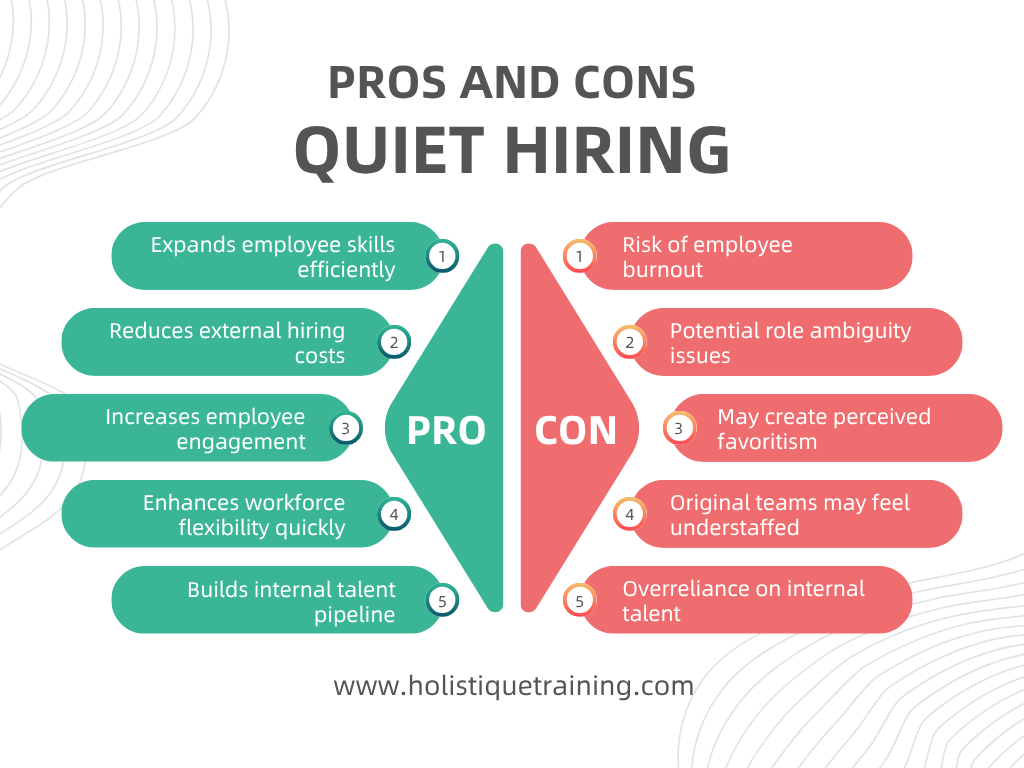
While quiet hiring offers numerous advantages for both employees and organizations, it is not without risks. Mismanagement or lack of planning can lead to unintended consequences, undermining employee morale, productivity, and engagement. Understanding these pitfalls is critical for ensuring quiet hiring remains an effective strategy rather than a source of frustration.
1. Increased Workload Without Recognition
One of the most common pitfalls is adding new responsibilities without adequate acknowledgment, compensation, or support. Employees may feel overburdened or exploited if they are asked to take on additional work without visibility into career advancement or financial reward. Over time, this can erode motivation and lead to disengagement, effectively negating the benefits of quiet hiring. Organizations should ensure that new assignments are paired with recognition, either through promotions, bonuses, or formal acknowledgment of contributions.
2. Role Ambiguity and Confusion
Quiet hiring often involves assigning employees tasks beyond their original job descriptions. If expectations are not clearly defined, employees may struggle to prioritize responsibilities, resulting in duplicated effort or missed deadlines. Ambiguity can also cause friction between teams if accountability and authority are unclear. In fact, 41% of employees believe that being quietly hired would make their company appear disorganized and lacking a clear vision. Clear communication, well-documented responsibilities, and alignment with managers are essential to prevent confusion and maintain operational efficiency.
3. Perceived Favoritism or Inequity
When only certain employees are selected for growth opportunities, others may perceive favoritism, leading to dissatisfaction and disengagement. This is particularly critical in organizations that do not maintain transparent criteria for assignments or role expansions. Ensuring fairness, rotating opportunities where possible, and communicating selection rationale help prevent negative perceptions and maintain organizational trust.
4. Skill Gaps in Original Roles
Reassigning employees to fill gaps elsewhere may leave their original teams understaffed or less effective. For example, if a key operations team member is moved to a cross-functional project, their absence can slow workflow or overburden remaining colleagues. Organizations must balance reassignment with coverage planning to ensure continuity and avoid creating bottlenecks.
5. Insufficient Training or Support
Employees may struggle to succeed in expanded or cross-functional roles if adequate training, resources, and mentorship are not provided. Without support, they risk underperformance, frustration, or diminished confidence. Structured learning programs, clear guidance from supervisors, and access to tools and resources are crucial for successful quiet hiring implementation.
6. Risk of Burnout
Employees participating in quiet hiring may be handling additional responsibilities on top of their standard workload. Without careful monitoring, this can lead to stress, fatigue, and burnout. Burnout not only impacts productivity but can also increase turnover. Employers should track workload distribution, set realistic expectations, and encourage employees to maintain work-life balance while taking on new challenges.
7. Misalignment with Career Goals
Not all employees may be interested in expanded responsibilities or cross-functional assignments. Assigning roles without understanding employees’ career aspirations can lead to frustration or disengagement. Organizations should engage in open dialogue, assess interest and motivation, and align opportunities with both organizational needs and individual goals.
8. Overreliance on Internal Talent
While leveraging existing employees is efficient, exclusive reliance on internal talent can limit fresh perspectives and innovation. Organizations should strike a balance between quiet hiring and strategic external recruitment to ensure diversity of thought, skills, and experience in the workforce.
By proactively addressing these pitfalls, organizations can implement quiet hiring in a way that maximizes benefits while minimizing risks. Careful planning, transparent communication, employee support, and ongoing monitoring ensure that quiet hiring strengthens both employee engagement and organizational performance.
The Role of HR: How Can They Make Quiet Hiring Effective?
Human Resources plays a pivotal role in ensuring that quiet hiring initiatives deliver value for both the organization and its employees. Without thoughtful planning and oversight, quiet hiring can lead to confusion, burnout, or disengagement. HR serves as the bridge between organizational needs and employee development, creating frameworks that align responsibilities, growth opportunities, and company goals.
1. Strategic Workforce Planning
HR must anticipate current and future skill gaps to deploy talent effectively. This involves conducting a thorough skills inventory, mapping employees’ competencies, and understanding which roles are critical for organizational success. By aligning internal talent with business priorities, HR ensures that quiet hiring is both targeted and purposeful. This planning helps prevent overloading employees or creating unbalanced teams while identifying opportunities for career development.
2. Transparent Communication
Clear and consistent communication is essential for employee engagement in quiet hiring. Employees should understand why they are being assigned additional responsibilities, how these tasks contribute to organizational goals, and how their performance will be evaluated. Transparency builds trust, reduces uncertainty, and fosters buy-in from employees, ensuring they perceive quiet hiring as an opportunity rather than an imposition.
3. Compensation, Recognition, and Career Pathing
HR should ensure that expanded responsibilities are paired with appropriate recognition, whether through promotions, bonuses, or formal acknowledgment. Even if immediate financial rewards are not feasible, clear communication about career advancement opportunities reinforces motivation. Career pathing shows employees how new skills and responsibilities can translate into future roles, encouraging engagement and long-term retention.
4. Structured Learning and Development Programs
Employees taking on new roles or responsibilities require the necessary tools, resources, and training to succeed. HR should facilitate access to formal learning initiatives, mentorship programs, and coaching opportunities. For instance, employees assigned to cross-functional projects may benefit from leadership workshops, technical certifications, or hands-on guidance from experienced colleagues. Structured development programs reduce the risk of underperformance and help employees thrive in expanded roles.
5. Monitoring Workload and Well-Being
HR must track employee workloads to prevent burnout. This includes regular check-ins with managers, feedback surveys, and monitoring project timelines. Workload balancing and flexible arrangements can help employees manage new responsibilities while maintaining overall productivity. Providing access to wellness programs, counseling, or stress-management resources further supports employee well-being during periods of role expansion.
6. Performance Metrics and Continuous Feedback
HR should establish clear metrics to evaluate the effectiveness of quiet hiring. These may include productivity, engagement scores, internal mobility rates, skill acquisition, and retention. Continuous feedback loops allow HR to make adjustments quickly, ensuring that employees are supported, teams remain effective, and organizational objectives are met. Regular assessment also helps identify high-potential talent for future leadership roles.
Table: Metrics to measure the effectiveness of quiet hiring
Metric | Purpose/What It Measures |
Employee Engagement Score | Tracks whether employees feel motivated and valued after taking on expanded responsibilities. |
Internal Mobility Rate | Measures how often employees move into new roles or take on additional responsibilities, indicating skill growth and career progression. |
Skill Acquisition / Training Completion | Assesses how effectively employees are developing new skills relevant to organizational needs. |
Retention Rate of High-Potential Employees | Monitors whether top talent stays within the company after quiet hiring initiatives. |
Project / Performance Outcomes | Evaluates the impact of quiet hiring on team productivity, project success, and overall business performance. |
7. Promoting a Culture of Growth and Learning
Beyond operational management, HR plays a strategic role in embedding quiet hiring into organizational culture. By encouraging cross-functional collaboration, recognizing employee contributions, and valuing skill development, HR fosters an environment where employees are motivated to take on new challenges. A strong culture of learning ensures that quiet hiring is sustainable and aligns with long-term workforce planning.
8. Balancing Internal Development with External Recruitment
While quiet hiring leverages existing talent, HR must ensure that the organization does not become overly insular. Strategic external hiring remains important for bringing fresh perspectives, specialized skills, and diversity of thought. HR’s role is to balance quiet hiring with selective external recruitment, maintaining organizational innovation while optimizing internal talent.
By executing these strategies, HR ensures that quiet hiring is not merely a short-term fix but a comprehensive, sustainable workforce strategy. Effective HR involvement transforms quiet hiring into a tool that develops talent, strengthens engagement, and drives organizational performance, benefiting both employees and the business as a whole.
Conclusion
Quiet hiring is reshaping workforce strategies by emphasizing the optimization of internal talent, skill development, and cross-functional collaboration. Unlike traditional recruitment, it leverages existing employees to fill capability gaps, meet evolving business priorities, and strengthen organizational resilience.
Employees gain exposure to new responsibilities, skill development, and career advancement, while employers benefit from cost efficiency, agility, and retention of institutional knowledge. Successful implementation requires thoughtful planning, transparent communication, fair recognition, and robust HR support.
When executed strategically, quiet hiring not only addresses immediate business needs but also fosters a culture of growth, adaptability, and engagement. Organizations that embrace this approach position themselves to remain competitive, future-ready, and capable of nurturing talent from within — turning subtle shifts in responsibility into significant opportunities for both employees and the business.