
- Table of Contents
- Introduction
- 1- What Are Trading Technologies?
- Definition and Scope
- Core Components of a Modern Trading Stack
- Why These Systems Matter to Performance
- 2- The Evolution of Electronic Trading
- From Trading Pits to Electronic Screens
- The Race for Speed and Reliability
- Market Growth and Rising Complexity
- The Shift Towards Unified Platforms
- 3- Trading Technologies International: Company Overview
- Origins and Positioning
- Scale and Reach
- Client Base and Ecosystem
- Industry Recognition in 2026
- 4- Core Capabilities of the TT Platform
- Platform Architecture
- 5- Multi-Asset Expansion: From Derivatives to FX and Beyond
- Why Cross-Asset Platforms Matter
- TT FX as a Case Study
- Implications for Trading Desks
- 6- Algorithmic Trading, AI and Data-Driven Execution
- The Normalisation of Algorithmic Trading
- AI Adoption in Securities Markets
- Using Data to Improve Execution
- 7- Risk Management, Margin and Pre-Trade Controls
- Why Risk Controls Belong in the Platform
- Margin and Capital Efficiency
- Resilience and Third-Party Risk
- 8- Trade Surveillance, Compliance and Regulation
- Surveillance as a Regulatory Expectation
- Navigating Regulatory Fragmentation
- 9- Choosing a Trading Technology Provider
- Build, Buy or Hybrid
- Key Evaluation Criteria
- 10- Skills and Training for Trading Technology Professionals
- 11- Future Trends in Trading Technologies
- Challenges to Manage
- 12- Conclusion
Introduction
Trading technologies sit at the centre of modern capital markets. Every order that reaches an exchange passes through layers of software that route, validate, monitor and record it, and the quality of those layers increasingly determines who wins and loses on execution. For finance and trading professionals, understanding this technology is no longer optional. It shapes costs, risk exposure, regulatory standing and the ability to trade across asset classes from a single desk.
Among the vendors that have defined this space, Trading Technologies International, Inc. (TT) stands out. Founded in 1994, the Chicago-based company built its reputation on fast, reliable futures trading and has since grown into a multi-asset platform services provider. This article examines what trading technologies are, how they evolved and how Trading Technologies International illustrates the wider direction of the industry. It also covers algorithmic and AI-driven execution, risk controls, surveillance, vendor selection, professional skills and the trends likely to shape the next few years.
1- What Are Trading Technologies?
Definition and Scope
Trading technologies are the software systems, networks and data services that allow market participants to find prices, send orders, manage positions and settle trades. They span the front office, where traders interact with markets, through to the middle and back office, where risk, compliance and post-trade processes take over. The term covers everything from a basic order entry screen to a global network of co-located servers connected to dozens of exchanges.
Core Components of a Modern Trading Stack
A professional trading environment usually combines several distinct components, each solving a different problem. The most important examples are listed below.
1-Order Management Systems (OMS):record and track orders through their lifecycle, hold position and allocation data, and run compliance checks before orders reach the market. Portfolio managers and operations teams rely on them for a single, auditable view of activity.
2-Execution Management Systems (EMS):give traders the tools to work orders in the market, including smart order routing, depth-of-market views, spreading tools and access to broker algorithms. Speed, clarity and usability matter most here.
3-Market Data and Connectivity:deliver real-time prices and reliable exchange connections. Without low-latency gateways and well-normalised data feeds, even the best front end cannot compete.
4-Algorithmic and Quantitative Tools:automate order slicing, benchmark execution and strategy logic, so that traders can manage more flow with greater consistency.
5-Risk, Surveillance and Analytics:provide pre-trade limits, margin analysis, transaction cost analysis and monitoring for market abuse.
Together, these components form a workflow that runs from idea to execution to post-trade review. The strongest platforms reduce the friction between each stage.
Why These Systems Matter to Performance
Technology choices have a direct effect on trading results. Slow or unreliable connectivity increases slippage, poor integration between systems creates manual work and operational errors, and weak risk controls expose firms to losses and regulatory scrutiny. For institutions competing on thin margins, small gains in execution quality, repeated across thousands of trades, can add up to a meaningful competitive advantage. This is why trading technology is now treated as a strategic investment rather than a back-office cost.
2- The Evolution of Electronic Trading
From Trading Pits to Electronic Screens
Until the 1990s, much of the world's derivatives trading took place in open outcry pits, where brokers shouted and signalled orders. Electronic exchanges changed that model by allowing participants to trade remotely, with transparent prices and lower transaction costs. Software vendors emerged to give traders the screens and connectivity they needed, and early platforms competed on how quickly and reliably they could place an order.
The Race for Speed and Reliability
As electronic markets matured, latency became a competitive variable. Firms invested in co-location, optimised networks and efficient order routing to shave milliseconds from execution. Reliability mattered just as much, because an outage during volatile conditions can be costly. This period established the performance standards that professional derivatives traders still expect from their technology.
Market Growth and Rising Complexity
Market activity has expanded alongside the technology. According to the FIA, worldwide exchange-traded derivatives volume reached 50.48 billion contracts in the first four months of 2026, which was 35.6% higher than the same period of 2025, with equity contracts accounting for most of the increase. Higher volumes, more products and more venues increase the burden on trading infrastructure, which must scale without compromising control.
The Shift Towards Unified Platforms
Rising complexity has pushed the industry away from specialist single-product tools. Traders now expect to manage futures, options, currencies and fixed income through consistent interfaces, while risk and compliance teams demand a shared view of activity. This demand has encouraged vendors to broaden their offerings and to build integrated environments that connect execution, analytics and oversight.
The table below summarises how technology priorities have shifted across each era of market development.
Era | Typical Technology | Main Priority | Key Limitation |
|---|---|---|---|
Open outcry | Pits, floor brokers and telephones | Personal relationships | Limited transparency and scale |
Early electronic | Proprietary exchange screens | Remote market access | Fragmented, single-venue tools |
Low-latency | Co-located servers and direct market access | Speed and reliability | High infrastructure cost |
Multi-asset platform | Unified EMS, OMS and analytics | Workflow consolidation | Integration and data governance |
3- Trading Technologies International: Company Overview
Origins and Positioning
Trading Technologies International was founded in 1994 and became known for low-latency order routing that set the standard for competitive futures trading. The company is a software-as-a-service provider rather than a broker or exchange. It licenses the TT platform to institutions and professional traders, and adds optional modules for algorithmic trading, trade surveillance and transaction cost analysis. This neutrality is part of its appeal, since clients keep their own brokers, exchanges and clearing relationships.
Scale and Reach
TT describes itself as a global capital markets technology platform services provider. In a September 2026 announcement, the company stated that the TT platform handled more than 3 billion derivatives transactions in 2025, and that volumes traded on Asia-Pacific markets through the platform rose by over 16%, outperforming underlying growth on most of those markets. TT also describes the platform as the most widely used globally for futures and options on futures, a claim that reflects its derivatives heritage.
Client Base and Ecosystem
TT serves a wide range of participants, including Tier 1 banks, brokerages, money managers, hedge funds, proprietary traders, commodity trading advisors, commercial hedgers and risk managers. It also works with exchanges, helping them deliver new solutions to their market participants, and with technology companies that distribute complementary offerings to TT clients. This ecosystem approach turns the platform into a hub rather than a closed product, which can reduce the effort needed to add new data sources, analytics or execution venues.
Industry Recognition in 2026
Recognition has followed the platform's expansion. TT was named Multi-Asset Trading System of the Year at the FOW International Awards in February 2026 and again at the FOW Asia Pacific Awards in September. In October it was named World's Best EMS/OMS and World's Best Algo Trading Technology at the Euromoney Markets Awards, taking its tally to 24 awards this year. Awards are no substitute for due diligence, but they show how industry judges view the platform's breadth.
4- Core Capabilities of the TT Platform
Platform Architecture
The TT platform ecosystem supports execution across futures, equities, options, fixed income, foreign exchange and cryptocurrencies, supplemented by tools for data and margin analytics, trade surveillance, clearing and post-trade allocation. Its design aim is to deliver these capabilities in one environment rather than a patchwork of separate systems. The main capabilities are outlined below.
1-Execution and Order Management: a combined EMS and OMS lets desks manage orders from entry to allocation, with spreading tools and depth views suited to derivatives traders.
2-Algorithmic Trading: algo tools allow users to automate execution strategies, and TT's algorithmic offering was recognised at the 2026 Euromoney Markets Awards.
3-Direct Market Access: in February 2026, TT announced that it had become an empanelled vendor of the National Stock Exchange of India and planned to offer direct connectivity from within the exchange's co-location data centre.
4-Trade Surveillance: a June 2026 upgrade added a Market Replay tool and a new case management interface, helping compliance teams and exchanges examine trading behaviour in granular detail.
5-Transaction Cost Analysis and Margin Analytics: post-trade analysis shows what execution really cost, while margin tools help risk managers understand capital requirements.
The following table links each module to its function and its most likely users.
TT Module | Primary Function | Typical User |
|---|---|---|
EMS and OMS | Order entry, routing and allocation | Traders and operations teams |
Algorithmic trading | Automated execution strategies | Execution desks and quants |
TT FX | OTC and listed FX execution | FX and multi-asset traders |
Trade surveillance | Market abuse monitoring and case management | Compliance teams and exchanges |
Margin and data analytics | Capital and exposure insight | Risk managers and clearing teams |
Taken together, these modules show how a modern platform spreads value across the trade lifecycle. Front-office users gain speed and flexibility, risk teams gain visibility, and compliance teams gain evidence. The practical question for any firm is whether those capabilities work together smoothly in daily operations, because integration quality often matters more than any single feature.
5- Multi-Asset Expansion: From Derivatives to FX and Beyond
Why Cross-Asset Platforms Matter
Many firms still trade futures on one system, FX on another and bonds on a third. This fragmentation duplicates cost, complicates risk aggregation and forces traders to switch screens at critical moments. Multi-asset platforms address the problem by presenting different instruments within one workflow, using shared risk limits and consistent reporting.
TT FX as a Case Study
In May 2026, TT expanded TT FX to support FX spot, forwards, non-deliverable forwards and swaps alongside futures and precious metals within the TT EMS. Trades execute across TT's global network of co-located servers, and the enhancement is designed to let institutions consolidate OTC and listed activity in a single environment. TT's chief executive has described a steady transformation from a derivatives-first platform into a multi-asset ecosystem.
Implications for Trading Desks
For trading desks, the lesson is practical. A unified platform can reduce integration work, shorten onboarding for new asset classes and give risk teams a single view of exposure. The trade-off is concentration risk, because heavy reliance on one vendor makes resilience planning and exit strategies more important.
Fixed income and digital assets follow a similar logic. As these markets electronify, professional traders expect the same discipline they associate with listed futures, including transparent pricing, dependable connectivity and strong controls. Platforms that bring these instruments into familiar workflows lower the barrier to entry for experienced derivatives traders exploring new opportunities.
Consolidation also supports better governance. When all instruments pass through the same order flow, a firm can apply one set of limits, one audit trail and one approach to reporting. That consistency simplifies internal audits and makes it easier to demonstrate control to regulators and clients.
6- Algorithmic Trading, AI and Data-Driven Execution
The Normalisation of Algorithmic Trading
Algorithmic trading is now a standard part of professional execution. In February 2026, ESMA issued a supervisory briefing on algorithmic trading under MiFID II, giving national regulators practical tools to supervise firms that rely on automated strategies. The briefing makes clear that firms remain responsible when they use third-party algorithms or outsource algorithmic functions.
AI Adoption in Securities Markets
Artificial intelligence adds another layer. According to ESMA's February 2026 analysis of AI in securities markets, adoption in the EU financial sector remains partial and uneven, with smaller firms lagging behind larger ones, yet 70% of firms expect AI-related investment to increase between 2025 and 2027. Firms named data and model vulnerabilities, cybersecurity and third-party dependencies among their main concerns.
Third-party reliance deserves particular attention. Many firms use algorithms and AI tools supplied by vendors, and they must understand how those tools behave, what data they use and how they are tested. Clear contracts, regular reviews and independent validation help preserve control.
Using Data to Improve Execution
The practical value of AI in trading lies less in replacing traders than in improving decisions at the margin. Examples include selecting execution venues, predicting short-term liquidity, flagging anomalous behaviour and analysing post-trade data to refine strategy. These uses depend on clean, well-governed data, which is why data quality has become as important as model sophistication.

In an increasingly complex financial landscape, investment firms and hedge funds must blend high performance with constant innovation to maintain competitive advantage. This course delivers a comprehensive framework for enhancing fund performance through innovative investment strategies, advanced analytics, and adaptive management techniques.Participants will explore how cutting-edge
Model governance is therefore becoming a core discipline. Firms need to document how models are built and tested, monitor them for drift and define who is accountable when automated decisions go wrong. Explainability matters because supervisors and clients will ask why a system acted as it did, and "the algorithm decided" is not an acceptable answer.
7- Risk Management, Margin and Pre-Trade Controls
Why Risk Controls Belong in the Platform
Speed without control is hazardous. Automated systems can build large positions, or large errors, within seconds, so checks must operate before an order leaves the firm. Embedding controls in the trading platform ensures every order passes the same tests, whoever sends it. Common controls include the following.
1-Pre-Trade Limits: caps on order size, price deviation and position size stop fat-finger errors reaching the exchange.
2-Credit and Margin Checks: verifying that accounts hold sufficient credit or margin before orders are accepted protects brokers and clearing members.
3-Kill Switches: authorised staff can cancel working orders and halt algorithms immediately during abnormal market conditions.
4-Real-Time Exposure Monitoring: aggregating positions across products and venues lets risk managers see exposure as it develops.
Margin and Capital Efficiency
Margin is a daily operational concern for derivatives traders. Sudden changes in volatility can raise requirements quickly, and firms that see their exposure late may be forced to reduce positions at unfavourable prices. Analytics that estimate margin ahead of time allow traders and treasury teams to plan liquidity, size positions sensibly and avoid unpleasant surprises at the end of the day.
Resilience and Third-Party Risk
Operational resilience extends beyond limits. Firms should test failover arrangements, monitor vendor performance and understand how outages are communicated. Where one platform supports many asset classes, resilience planning deserves senior-level attention.
Developing a successful and profitable business requires a wide array of financial understanding to create a cost-effective roadmap for future developments, forecasting, and change. Risk management goes hand in hand with financial planning, as a foolproof framework will allow you to make sound, strategic decisions
8- Trade Surveillance, Compliance and Regulation
Surveillance as a Regulatory Expectation
Regulators expect firms and venues to detect and prevent market abuse, and surveillance has moved from periodic review to continuous monitoring. TT's June 2026 upgrade to its trade surveillance product added a Market Replay tool and a cloud-based case management interface covering equities, futures and options, FX, fixed income and cryptocurrencies. The company says the architecture also lays the foundation for future AI-driven insights.
The direction of travel is clear. Regulators want firms to understand their algorithms, test them regularly and keep records that allow events to be reconstructed. Platforms that combine order data, market data and surveillance tools in one place make that task far more manageable than systems that must be pieced together after an incident.
Navigating Regulatory Fragmentation
Firms trading internationally face different rules across jurisdictions, including MiFID II in Europe, alongside local exchange requirements and reporting obligations. Compliance teams need to understand how platform features map to those obligations, from record-keeping to algorithm testing. Technology can automate evidence collection, but accountability remains with the regulated firm.

An organisation that wishes to conduct international payments or trade, particularly those within the banking and finance industry, must have a strong understanding of international banking laws. These laws help set the standard for international payments and transactions, primarily to ensure protection and security for
9- Choosing a Trading Technology Provider
Build, Buy or Hybrid
Every firm must decide how much trading technology to build itself. The table below compares the three common approaches.
Approach | Advantages | Drawbacks |
|---|---|---|
Build in-house | Full control and bespoke strategy support | High cost, long delivery and talent dependence |
Buy from a vendor | Faster deployment, regular updates and exchange connectivity | Less customisation and vendor dependence |
Hybrid | Vendor platform combined with proprietary algorithms | Integration effort and split accountability |
The right answer depends on scale, expertise and strategy. Smaller firms rarely justify the expense of building execution infrastructure, whereas large proprietary trading groups may keep their most valuable logic in-house while relying on vendors for connectivity and compliance. Many organisations therefore settle on a hybrid model that preserves differentiation without duplicating commodity infrastructure.
Key Evaluation Criteria
A structured selection process should test providers against consistent criteria. The most useful are listed below.
1-Market and Asset Coverage: confirm that the provider connects to every exchange and asset class the firm trades or plans to trade.
2-Latency and Resilience: request evidence of performance, uptime and disaster recovery under stress.
3-Compliance Tools: check for surveillance, audit trails and reporting that match regulatory obligations.
4-Integration and Support: assess APIs, onboarding quality and the responsiveness of support teams.
Beyond the checklist, firms should run proofs of concept with real workflows, speak to existing clients and examine the provider's product roadmap. A vendor that invests consistently in new asset classes, exchange connections and surveillance capability is more likely to remain a strong partner as business needs change.
10- Skills and Training for Trading Technology Professionals
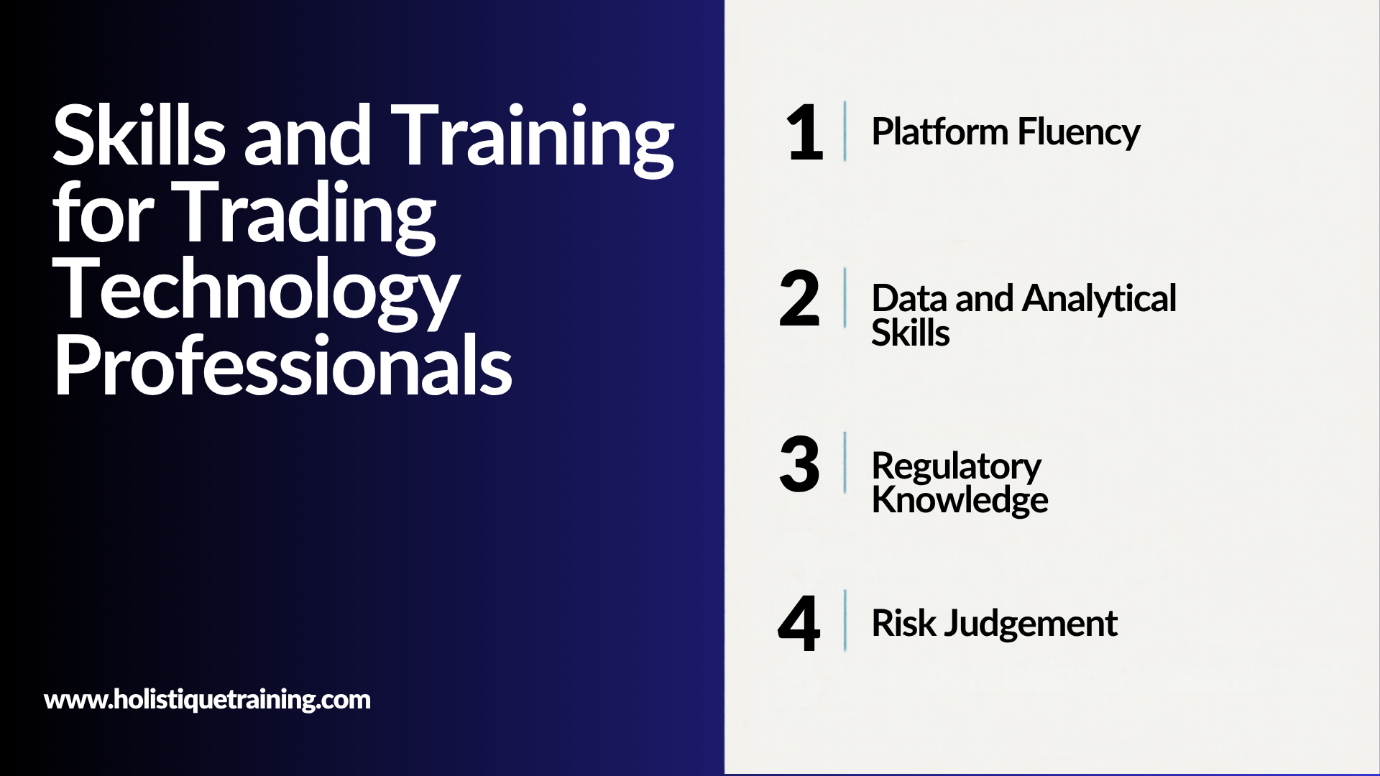
Technology only delivers value when people use it well. Trading, risk and compliance professionals increasingly need a blend of market knowledge and technical fluency. The most valuable capabilities include the following.
1-Platform Fluency: knowing how order routing, algorithms and risk limits behave in practice reduces errors and speeds up decisions.
2-Data and Analytical Skills: interpreting execution analytics and model outputs helps teams challenge results rather than accept them blindly.
3-Regulatory Knowledge: understanding algorithmic trading, market abuse and reporting rules keeps desks inside the lines.
4-Risk Judgement: recognising when automation should be paused is as important as knowing how to start it.
Continuous training closes these gaps as products, venues and rules change.
Employers can support this by combining formal courses with on-the-job practice in simulated environments, where traders can test algorithms and risk settings without financial consequences. Regular refresher sessions are particularly useful after major platform upgrades or regulatory changes.
11- Future Trends in Trading Technologies
Several trends are likely to shape the next phase of development in trading technologies. Professionals should track the following.
1-Supervised AI: software will increasingly act within strict limits while humans retain oversight, reflecting regulators' emphasis on accountability.
2-Cross-Asset Consolidation: firms will keep merging fragmented tools into unified workflows spanning derivatives, FX, fixed income and digital assets.
3-Cloud-Native Delivery: software-as-a-service models should speed up releases, simplify upgrades and widen access to analytics.
4-Broader Global Access: new exchange connections, including India and growing Asia-Pacific activity, will extend the reach of international platforms.
Challenges to Manage
Progress will not be without friction. Cybersecurity threats grow as trading systems become more connected, data quality problems can undermine even sophisticated models, and reliance on a small number of vendors raises concentration concerns. Firms that plan for these risks early, through testing, diversification and clear accountability, will adopt new technology with fewer setbacks.
The common thread is integration. Winning technology will be that which connects markets, data, risk and compliance without adding complexity for the user.
12- Conclusion
Trading technologies now determine how efficiently markets function and how safely firms operate within them. The development of Trading Technologies International, from a futures-focused pioneer to a multi-asset platform provider with FX, surveillance and expanding exchange connectivity, mirrors the wider shift towards unified, data-rich and tightly controlled trading environments.
The evidence from 2026 supports this view. Derivatives volumes are rising sharply, regulators are scrutinising algorithms and AI more closely, and vendors are racing to unify asset classes within a single environment. Trading Technologies International is one of the most visible examples of that convergence, but the lessons apply to any firm choosing, building or managing trading technology.
For finance and trading professionals, the priorities are clear. Choose platforms that scale across asset classes, embed risk and compliance controls at the point of execution, treat AI as a supervised tool rather than an autonomous decision-maker, and invest in the skills that let people get the most from the technology. Firms that do so will be best placed to handle higher volumes, tighter regulation and faster markets.

Explore top risk management courses for 2025—enterprise, project, financial, and operational—to build skills in risk mitigation and resilience.