
- Table of Contents
- Introduction
- 1- What Data-Driven Decision-Making Certifications Actually Cover
- 2- Why Demand for These Programmes Has Grown
- 3- Types of Programmes and Awarding Bodies
- 4- Core Competencies Developed Through DDDM Certification
- 5- How Employers Assess These Credentials
- 6- Choosing the Right Programme for Your Career Stage
- 7- The Organisational Case for Systematic Data Capability
- 8- Sector-Specific Applications of DDDM Certification
- 9- Limitations and Realistic Expectations
- 10- Integrating Certification into a Broader Learning Strategy
- Conclusion
Introduction
Professional environments across every sector are increasingly structured around quantitative evidence. From boardroom strategy to operational day-to-day decisions, the ability to interpret data, evaluate options, and act with analytical rigour has moved from a specialist skill to a widely expected professional competency. For working professionals who need to develop or formalise that competency quickly and credibly, data-driven decision-making certification programmes have become one of the most practical pathways available.
These programmes are not a single category. The term covers a wide range of offerings: short online credentials, university-backed certificates, vendor-specific qualifications from technology companies, and structured professional development courses built around frameworks for evidence-based reasoning. What they share is a focus on teaching professionals how to move from raw data to actionable insight within real organisational contexts. For those who cannot commit to a full postgraduate degree but need to demonstrate serious analytical capability, they occupy a particularly useful middle ground.
This article examines what DDDM certification programmes actually cover, why the demand for them has grown, what distinguishes different tiers and types of qualification, how employers assess them, and how working professionals across different roles and industries can identify the programme most suited to their career objectives. It also discusses the broader organisational case for building data literacy systematically across teams, and the role that certification plays in that effort.
1- What Data-Driven Decision-Making Certifications Actually Cover
The phrase data-driven decision-making is broad by definition, and certification programmes reflect that breadth. The core of most programmes involves some combination of the following: understanding how to frame a business problem as an analytical question, identifying and accessing relevant data sources, applying appropriate analytical techniques, interpreting output accurately, and communicating findings to stakeholders in a way that informs and enables action. The relative weight given to each of these elements varies considerably depending on the programme's level and target audience.
At the foundational end, programmes often focus heavily on data literacy: understanding what different chart types communicate, what statistical measures like averages and variance actually represent, how to identify misleading presentations of data, and how to use common tools such as Microsoft Excel or Google Sheets for basic analysis. These programmes are designed for professionals who work with data regularly but have never had formal training in interpreting it.
More advanced programmes move into structured analytical methods. These typically include descriptive analytics, which summarises historical data; diagnostic analytics, which explains what happened and why; predictive analytics, which uses statistical models to forecast outcomes; and prescriptive analytics, which recommends courses of action based on modelled scenarios. Professionals at this level are expected to work with tools such as SQL, Power BI, Tableau, or Python, and to understand the mechanics behind regression analysis, clustering, or time-series forecasting.
At the highest level, programmes in this space shift towards strategic analytics leadership: how to build a data culture within an organisation, how to govern data responsibly, how to evaluate the outputs of machine learning models without necessarily building them, and how to translate analytical insight into strategic decisions at the executive level. These programmes are typically aimed at senior managers, directors, and executives who need to make sound decisions about data infrastructure, team capability, and organisational investment in analytics.
Certification tier | Typical audience | Technical depth | Key focus | Common tools |
|---|---|---|---|---|
Foundational | All professionals, non-technical staff | Low | Data literacy, KPI interpretation | Excel, basic dashboards |
Analytical practitioner | Analysts, team leads | Moderate | Statistical analysis, data storytelling | SQL, Tableau, Power BI |
Strategic decision scientist | Senior managers, BI leads | High | Predictive modelling, causal reasoning | Python, R, advanced analytics platforms |
Executive / leadership | Directors, C-suite | Conceptual | Data governance, strategy, AI integration | Frameworks, governance tools |
2- Why Demand for These Programmes Has Grown
The growth in DDDM certification demand reflects a structural shift in how organisations operate, not simply a trend. Several converging pressures have made evidence-based decision-making a strategic priority rather than a technical afterthought. Understanding these pressures helps explain why individual professionals and their employers are investing in this type of training at an accelerating rate.
The volume of data that organisations now collect and store has expanded enormously. Digital transactions, customer interactions, operational logs, sensor outputs, and third-party data feeds mean that most organisations have access to far more information than they can process meaningfully. The bottleneck is no longer data availability but human analytical capacity. Professionals who can extract signal from that volume and connect it to decisions have become disproportionately valuable.
According to Hydrogen BI's 2025 report on data-driven decision-making, 81 per cent of organisations now use analytics or AI for key decisions, and companies with strong data cultures make decisions five times faster than their competitors. That competitive acceleration creates pressure on individuals at every level of an organisation to build and demonstrate analytical capability, not just in specialist roles but across functions including marketing, operations, finance, human resources, and strategy.
At the same time, skills-based hiring practices have expanded significantly. Employers across many sectors are placing greater weight on demonstrated competencies and less on formal degree credentials alone when evaluating candidates for analytically demanding roles. Certification programmes respond directly to that shift by offering professionals a structured and assessable way to build and document specific capabilities.
There is also a reskilling dimension that has become more prominent in recent years. Automation and artificial intelligence are reshaping the task composition of many professional roles. Responsibilities that once required manual data processing or basic analysis are increasingly automated, meaning that the human contribution to analytical work is shifting upward towards interpretation, contextualisation, judgement, and communication. Professionals who want to remain competitive need to develop the higher-order analytical capabilities that machines cannot yet replicate, and structured certification programmes offer a practical vehicle for doing so.

This course delves into business analytics, focusing on data-driven decision-making to enhance strategic planning. Participants will learn key analytics techniques, including descriptive, predictive, and prescriptive analytics, to identify and solve business challenges. The curriculum integrates interactive lectures, case studies, and practical exercises to develop skills in data
3- Types of Programmes and Awarding Bodies
The DDDM certification landscape is fragmented but navigable once the main categories are understood. Broadly speaking, programmes fall into four types: university-accredited certificates, vendor or platform credentials, professional body qualifications, and independent online course completions. Each carries different levels of employer recognition, different learning formats, and different prerequisite requirements.
University-accredited certificates are typically the most rigorous and carry the strongest brand recognition. Examples include graduate certificate programmes from institutions such as the University of Washington, Temple University, and Cornell. These are generally credit-bearing, require prior academic achievement, and involve faculty-taught content with structured assessment. They take longer to complete and cost more but provide a credential that transfers across industries and is trusted by hiring committees in a way that platform credentials sometimes are not.
Vendor or platform credentials are issued by technology companies whose tools are directly relevant to the skill being certified. Google's Data Analytics Professional Certificate, Microsoft's Power BI Data Analyst Associate, and IBM's Data Science Professional Certificate are among the most widely recognised in this category. They are practical and tool-specific, often designed to certify proficiency in a particular ecosystem rather than analytical method, and they tend to be highly regarded within sectors where those specific tools are dominant.
Professional body qualifications are less prevalent in data analytics than in fields such as accounting or project management, but they are growing. The International Institute of Business Analysis (IIBA) and the Data Management Association (DAMA) both offer credentials in business analysis and data management respectively that incorporate DDDM principles within broader professional frameworks. These carry particular weight in roles where governance, compliance, and structured methodology matter.
Independent online course completions from platforms such as Coursera, edX, or DataCamp occupy the broadest and most accessible part of the market. Their quality varies significantly, and employer perception of them depends heavily on which institution's content is behind the course and how the credential is represented. Specialisations from reputable universities delivered through these platforms tend to carry more weight than standalone short courses from unaffiliated providers.
4- Core Competencies Developed Through DDDM Certification
Regardless of tier or provider, effective DDDM certification programmes develop a consistent set of core competencies. Understanding what these are helps professionals identify where their existing capability sits, what they need to build, and how different programmes map to those gaps.
The first competency is problem framing: the ability to translate an ambiguous organisational question into a well-defined analytical task. This involves identifying the decision that needs to be made, the variables that are relevant, the data that is available, and the criteria by which options will be evaluated. It is one of the most practically important skills in applied analytics and one that is often underdeveloped in professionals who come to data work from purely technical backgrounds.
The second is statistical literacy: the ability to understand and correctly interpret the outputs of quantitative analysis, including measures of central tendency, distributions, confidence intervals, correlation, and causation. This is not the same as being able to run statistical models, though more advanced programmes build that too. The critical emphasis at this level is on not misinterpreting data, understanding what a result does and does not prove, and communicating uncertainty honestly to decision-makers.
The third competency is tool proficiency. Most programmes teach one or more analytical tools as the primary medium for hands-on learning. These range from Excel for foundational programmes to Tableau and Power BI for visualisation-focused credentials, SQL for database querying, and Python or R for statistical modelling and machine learning. Tool proficiency matters in practice, but effective programmes teach tools in service of analytical thinking rather than as ends in themselves.
The fourth competency is data storytelling and communication. The ability to present analytical findings in a way that is accurate, clear, and actionable for non-technical decision-makers is a distinct skill that receives considerable attention in well-designed programmes. It involves selecting the right visualisation for a given message, structuring a narrative around evidence, anticipating objections, and knowing when a simpler summary serves better than a complex model.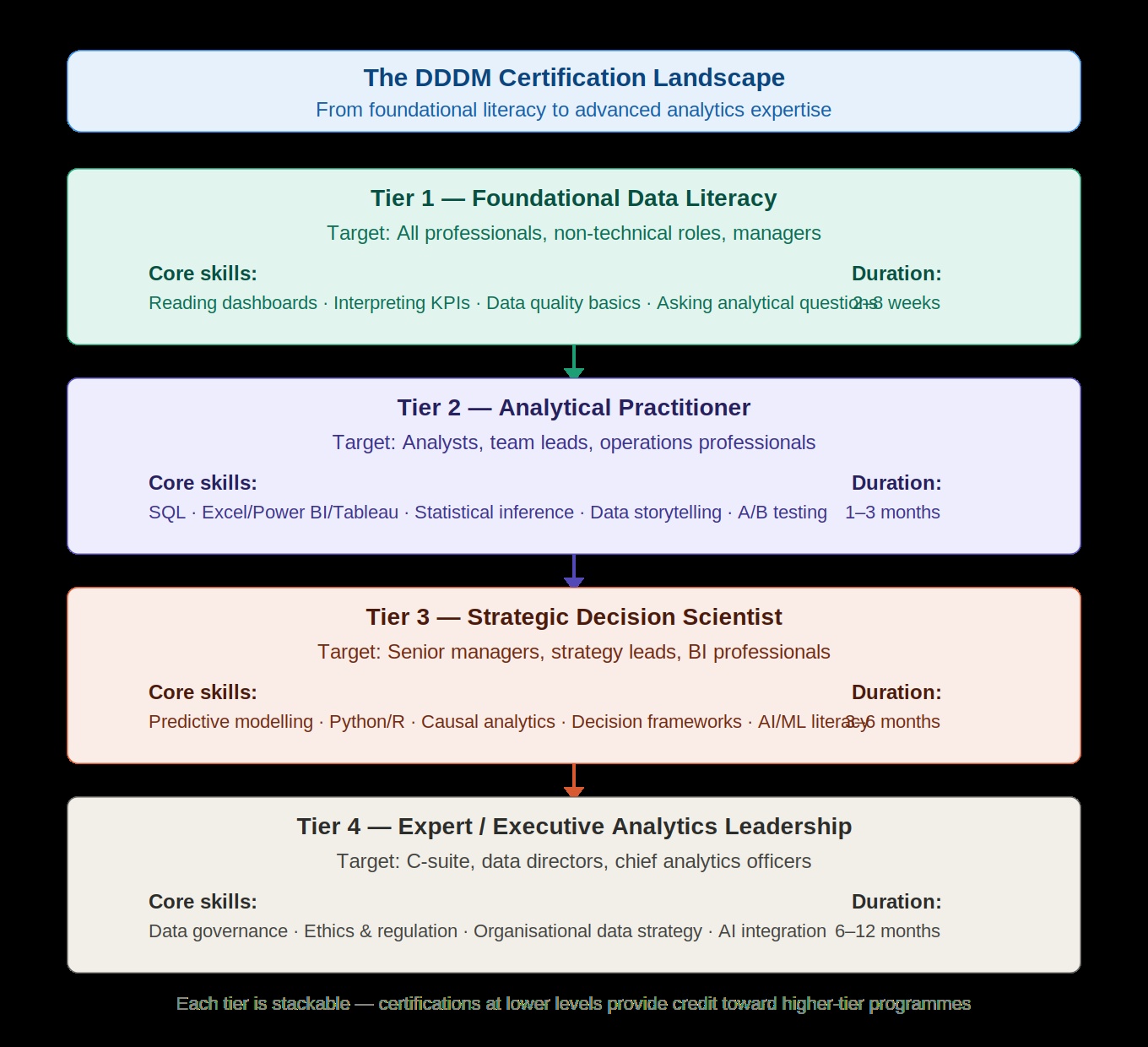

This comprehensive course equips participants with advanced skills in managing, manipulating, and analysing data using Microsoft Excel. Emphasising practical application, the course covers a range of Excel functions, data visualisation techniques, and statistical analysis methods. Participants will learn to leverage Excel’s powerful tools for effective data management
5- How Employers Assess These Credentials
The practical value of a DDDM certification is in large part a function of how employers interpret and weight it in hiring and promotion decisions. That interpretation is not uniform. It varies by sector, by the seniority of the role, by the employer's own data maturity, and by how the credential is contextualised within the broader profile of the candidate.
In technology, financial services, consulting, and healthcare analytics, employer familiarity with the main certification frameworks is relatively high, and credentials from recognised providers are evaluated substantively. Hiring managers in these environments often know what a Google Data Analytics Professional Certificate or an IBM Data Science certificate covers, and they can assess whether it represents genuine competency or merely course completion. In more traditional industries, awareness of certification hierarchies is lower, which means that the burden of explanation and contextualisation falls more on the candidate.
A 2025 report by Coursera found that 96 per cent of employers believe micro-credentials and professional certifications strengthen a candidate's job application, and that 94 per cent of learners who completed such credentials reported faster skill development. This is a meaningful signal of employer receptiveness to credentialled upskilling, even if it does not imply uniform equivalence between certifications and degrees.
For working professionals already employed and seeking internal advancement, the practical impact of a DDDM certification often comes through demonstrated application rather than credential recognition alone. Completing a certification and then visibly applying the skills in a current role — improving a reporting process, contributing to an analytical project, or leading a data review — tends to carry more weight with internal stakeholders than the credential itself. The certification serves as evidence of structured learning and commitment; the application demonstrates that the learning has translated into professional capability.
In roles where analytical responsibility is expanding, such as product management, strategy, people operations, and marketing, DDDM certifications increasingly function as a threshold signal that a candidate has invested deliberately in developing relevant capability. They are rarely the only factor in a hiring or promotion decision, but they reduce ambiguity for employers who cannot easily assess analytical competence from a job title or degree field alone.
6- Choosing the Right Programme for Your Career Stage
One of the most practical decisions facing a professional considering DDDM certification is the question of level and alignment. Choosing a programme that is poorly matched to an individual's existing capability, role requirements, or career trajectory is likely to produce limited value, regardless of the quality of the content. A senior manager who completes a foundational literacy course may find it confirms rather than builds capability. A non-technical professional who enrols in an advanced Python modelling certification without adequate mathematical background is likely to struggle and disengage.
For professionals with no prior analytical training who work in roles involving data interpretation — reporting, project monitoring, financial oversight, or operational management — foundational programmes focused on data literacy, dashboard reading, and KPI analysis offer the most immediate return. These programmes typically require a commitment of a few hours per week over four to eight weeks and can be completed without disrupting day-to-day responsibilities. The skills developed are directly transferable to everyday work tasks from the moment of application.
For professionals with some analytical experience who want to formalise and extend their capabilities — analysts, coordinators, team leads, or specialists who produce or consume data regularly — mid-level programmes in business intelligence, data visualisation, or applied statistical analysis offer the best progression. These programmes require a more substantial time commitment and typically involve hands-on project work assessed against real-world scenarios. The credential earned is more specific and more likely to influence salary and promotion outcomes.
For senior professionals seeking to position themselves for strategic or leadership roles with significant analytical accountability — heads of strategy, chief operating officers, directors of analytics, or chief data officers — executive-level programmes focused on data governance, organisational data strategy, AI literacy, and ethical analytics provide the most relevant development. These programmes are often delivered in cohort formats or blended learning environments and are designed explicitly for professionals who make decisions about data rather than those who perform analysis directly.
Role type | Recommended tier | Primary focus | Expected outcome |
|---|---|---|---|
Non-technical manager | Foundational | Data literacy, KPI reading | Informed decision-making, reduced dependence on analysts |
Business analyst | Analytical practitioner | SQL, visualisation, statistical inference | Independent analysis, credible reporting |
Strategy / BI professional | Strategic decision scientist | Predictive analytics, Python, causal reasoning | Advanced modelling, strategic insight generation |
Director / C-suite executive | Executive / leadership | Data governance, AI strategy, ethics | Organisational capability building, risk-aware investment |
7- The Organisational Case for Systematic Data Capability
The case for DDDM certification is not solely an individual career argument. Organisations that invest in building data literacy systematically across their workforce gain compounding advantages in speed, accuracy, and coordination. When analytical capability is concentrated only in a specialist team, the organisation becomes dependent on that team as a bottleneck. Every decision that requires data interpretation has to pass through a limited group of people, slowing down the organisation's ability to respond to new information.
When data literacy is distributed more broadly — when managers in finance, operations, HR, and marketing can read analytical outputs confidently, frame good questions, and interpret evidence without always requiring specialist mediation — the decision-making process becomes faster and more distributed. The specialist analytics team can focus on higher-order modelling and strategic analysis rather than explaining basic outputs to stakeholders.
Research from McKinsey indicates that data-driven organisations are 23 times more likely to acquire customers, six times more likely to retain them, and 19 times more likely to be profitable compared to their less data-capable competitors. These figures reflect the aggregate impact of systematic data capability on organisational performance, rather than the contribution of any single certification programme. But they do illustrate why executive leadership teams increasingly treat data literacy as a strategic investment rather than a departmental training budget item.
The practical question for organisations is how to build that capability efficiently. Requiring all professionals to complete a single comprehensive programme is usually neither feasible nor necessary. A more targeted approach involves identifying data capability requirements at each level and function, mapping existing gaps, and deploying a tiered certification pathway that builds relevant skills at each level without over-training in areas that are not relevant to a given role. Certification programmes provide the external validation and structured content that internal training often lacks, while remaining sufficiently flexible to be completed part-time alongside normal responsibilities.
8- Sector-Specific Applications of DDDM Certification
The relevance and application of DDDM certification varies meaningfully across sectors. Understanding how these credentials function within specific industry contexts helps professionals evaluate which programmes will most directly strengthen their professional value.
In financial services, data-driven decision-making is already deeply embedded in core functions including credit risk assessment, portfolio management, fraud detection, and regulatory reporting. Professionals in this sector who hold DDDM certifications, particularly those with a quantitative or modelling focus, are well positioned for roles in risk analytics, algorithmic trading, actuarial support, and financial intelligence. The emphasis in this sector tends to fall on statistical rigour, model interpretability, and compliance-aware analytics.
In healthcare and public health, analytical capability has become critical for patient outcome monitoring, resource allocation, epidemiological analysis, and the interpretation of clinical trial data. Professionals working in healthcare management, health policy, or clinical operations who develop DDDM credentials, especially those with exposure to health data governance and privacy frameworks, are increasingly in demand as health systems invest in digital transformation.
In marketing and customer experience, DDDM certifications are particularly relevant for professionals working with customer segmentation, campaign performance analysis, attribution modelling, and customer lifetime value. The shift towards performance-based marketing and the increasing complexity of digital attribution has made basic analytical competence an expectation rather than a differentiator for senior marketing roles. Professionals who can combine strategic instincts with genuine analytical rigour are rare and disproportionately valuable.
In non-governmental organisations and the development sector, data-driven decision-making is increasingly important for programme monitoring, impact evaluation, and resource allocation. NGOs that are accountable to institutional donors and government partners face growing expectations to provide rigorous evidence of their impact and operational efficiency. Professionals in this sector who develop DDDM credentials, particularly in programme evaluation and monitoring frameworks, are better positioned to satisfy those expectations and to design programmes that learn from evidence in real time.

In today's data-driven world, the ability to govern, protect, and ensure compliance with data regulations is critical for any organisation. This comprehensive course is designed to equip professionals with the knowledge and skills required to manage data effectively, ensuring its integrity, security, and compliance with legal standards.
9- Limitations and Realistic Expectations
Certification programmes in data-driven decision-making are valuable but not unlimited in what they can deliver. A clear-eyed understanding of their limitations helps professionals invest in them with appropriate expectations rather than overestimating their transformative power.
The most important limitation is the gap between credentialled knowledge and applied competence. Completing a programme demonstrates that a professional has engaged with a body of knowledge and passed its assessments. It does not by itself mean that the professional can apply that knowledge fluently and independently in a real organisational context. The transfer from structured learning to autonomous practice requires deliberate application, often over a period of months, and is not guaranteed by the credential alone.
A second limitation is the risk of technical over-specification. Some professionals, particularly those attracted to the technical dimensions of data analytics, develop strong skills in tools and methods without developing the contextual judgement and communication skills that make those technical capabilities organisationally useful. A professional who can build a sophisticated predictive model but cannot explain its outputs to a non-technical stakeholder, or cannot connect its implications to an actual business decision, has limited applied value. Effective programmes address this by weighting communication and application alongside technical proficiency.
Programme type | Strength | Limitation | Best suited for |
|---|---|---|---|
University certificate | High credibility, academic rigour | Cost, time commitment | Career pivots, senior roles |
Vendor credential | Tool-specific depth, employer recognition in sector | Platform dependency | Technical roles in tech/finance |
Professional body qualification | Cross-industry framework, governance focus | Narrower analytics scope | Data governance, compliance roles |
Online platform completion | Flexible, affordable, wide topic range | Variable quality, lower signalling power | Foundational upskilling, exploratory learning |
10- Integrating Certification into a Broader Learning Strategy
A single certification is rarely sufficient to constitute a complete professional development strategy in data analytics. For most working professionals, the most effective approach treats certification as one element within a broader and ongoing learning investment that also includes applied project experience, peer learning, professional networking, and exposure to emerging tools and methods.
The certification provides a structured and assessable foundation: a body of organised knowledge, a set of practised techniques, and a credential that signals the investment to external audiences. What the certification cannot provide is the contextual intelligence that comes only from applying analytical skills within specific organisational realities — dealing with messy real-world data, navigating stakeholder dynamics, making decisions under uncertainty, and iterating on models that produce unexpected results. That experience is built through practice, not through assessment.
For professionals building a serious long-term career in analytics or evidence-based management, a sensible strategy might involve a foundational programme to establish literacy, a mid-level certification to build applied skills in a relevant toolset, a portfolio of analytical projects that demonstrate those skills in practice, and a longer-term plan for either a higher-level credential or a more advanced academic qualification as career seniority increases. Continuous engagement with the field through professional communities, industry publications, and structured self-learning keeps skills current between formal certification cycles.
The World Economic Forum's Future of Jobs Report 2025 notes that data and AI literacy are among the fastest-growing skill demands globally, with analytical and critical thinking remaining among the most valued capabilities across sectors through 2030. That trajectory makes continued investment in structured analytical learning not only professionally prudent but increasingly a baseline expectation for professionals operating in complex, information-rich environments.
Organisations have a complementary role to play. Certification is most effective when it is embedded within an organisational culture that values evidence and creates conditions in which certified professionals can apply what they have learned. Investing in certification without investing in the data infrastructure, governance processes, and decision-making culture that allow analytical insights to translate into action produces limited returns. The two dimensions — individual capability and organisational readiness — are mutually reinforcing.
Conclusion
Data-driven decision-making certification programmes have moved from a niche professional development option to a mainstream pathway for working professionals across sectors and seniority levels. Their growth reflects a genuine and lasting shift in how organisations operate: evidence-based decision-making is no longer confined to specialist functions but is expected, in some form, across the whole of a professionally literate workforce. Certification programmes offer a structured, credentialled, and time-efficient way to build and demonstrate the analytical competencies that this shift demands.
For individual professionals, the most important decisions are not whether to invest in this type of training but which programme matches their current capability and intended trajectory, how they will apply and demonstrate what they learn, and how certification fits within a broader and ongoing learning strategy. For organisations, the strategic question is how to deploy structured data capability development in a way that builds genuine literacy across functions rather than concentrating expertise in silos.
The field is evolving rapidly, and the programmes available today will continue to be supplemented by new formats, tools, and frameworks as artificial intelligence reshapes the analytical landscape. Professionals who build strong foundations in data interpretation, evidence-based reasoning, and analytical communication now will be well positioned to adapt as the specific technologies and methods evolve. That adaptability — grounded in genuine analytical literacy rather than narrow tool proficiency — is ultimately what the best DDDM certification programmes are designed to develop.