
- Table of Contents
- Introduction
- Areas Beyond Tech Affected by AI
- 1. Analytics
- 2. Content Creation
- 3. Video Editing
- 4. Human Resources
- 5. Healthcare
- 6. Finance
- 7. Customer Service
- 8. Education
- Importance of Learning AI Skills for Non-Tech Professionals
- 1. Competitive Advantage
- 2. Enhanced Decision-Making
- 3. Adaptability
- 4. Collaboration with Tech Teams
- 5. Innovation
- 6. Improved Efficiency and Productivity
- 7. Future-Proofing Your Career
- 8. Personal Growth and Lifelong Learning
- Top 8 AI Skills for Non-Tech Professionals
- 1. Prompt Engineering
- 2. AI Ethics
- 3. Data Literacy
- 4. Critical Thinking
- 5. Basic Programming Knowledge
- 6. Familiarity with AI Tools
- 7. Project Management Skills
- 8. Continuous Learning Mindset
- Making Learning AI Skills Enjoyable
- 1. Gamification
- 2. Hands-On Projects
- 3. Interactive Learning Platforms
- 4. Collaborative Learning
- 5. Diverse Learning Resources
- 6. Setting Personal Goals
- Steps to Start Learning AI Skills
- 1. Identify Your Goals
- 2. Choose the Right Learning Resources
- 3. Start with the Basics
- 4. Engage in Practical Projects
- 5. Join Online Communities
- 6. Stay Updated with Industry Trends
- 7. Practice Regularly
- Recommended AI Tools to Focus On
- 1. ChatGPT
- 2. Tableau
- 3. Canva
- 4. Hootsuite
- 5. Zapier
- 6. Grammarly
- 7. Google Analytics
- 8. Loom
- Conclusion
Introduction
The rapid advancement of artificial intelligence (AI) has transformed various industries and job roles, making it essential for professionals across all fields to understand and harness the power of these technologies. This blog post delves into the significance of AI skills for non-tech professionals, exploring how AI influences diverse sectors, the importance of acquiring these skills, and practical steps to start learning. We will also highlight the top AI skills necessary for success and recommend tools that can facilitate this learning journey. By the end of this article, you will have a comprehensive understanding of how to navigate the AI landscape, regardless of your technical background.
Areas Beyond Tech Affected by AI
AI is not confined to the realm of technology; its impact stretches across various sectors, reshaping how work is done and enhancing productivity. Here are some key areas where AI is making significant inroads:
1. Analytics
Data-driven decision-making is at the heart of modern business strategy. AI tools can analyze vast datasets quickly, uncovering patterns and insights that would take humans much longer to identify. For instance, predictive analytics powered by AI can forecast market trends, customer behaviors, and operational efficiencies. Non-tech professionals in marketing, finance, and operations can leverage AI analytics to make informed decisions and optimize their strategies, ultimately leading to improved performance and competitive advantage.

For an organisation or business to function successfully, there needs to be a strong focus on analysing and processing data from a variety of sources. As the business, market, and industry develop, an increasing amount of data is generated, which is too vast for an
2. Content Creation
The rise of AI-powered content generation tools has revolutionized how content is created and distributed. From blog posts and social media updates to video scripts and marketing copy, AI can assist in generating high-quality content efficiently. These tools can analyze existing content to determine what resonates with audiences, allowing professionals to tailor their messaging accordingly. Non-tech professionals in marketing, communications, and creative fields can benefit immensely from understanding how to use these tools effectively, enabling them to produce engaging content at scale while freeing up time for more strategic tasks.
3. Video Editing
AI technologies are streamlining video production processes, making it easier for non-tech professionals to create engaging content. Advanced editing software now incorporates AI features that can automatically edit raw footage, suggest cuts, and enhance video quality through stabilization and color correction. Additionally, AI can generate captions and subtitles, making videos more accessible to diverse audiences. This allows professionals in marketing, education, and entertainment to produce high-quality videos without extensive technical knowledge, thus democratizing video creation and expanding their reach.
4. Human Resources
AI is transforming recruitment and employee management. From automating resume screening to using an AI resume builder that helps candidates create optimized, role-specific resumes , AI tools help HR professionals make better hiring decisions and improve employee engagement. For example, AI algorithms can identify the best candidates based on skills and experience, reducing bias and enhancing diversity in hiring. Moreover, AI-driven analytics can provide insights into employee satisfaction and productivity, enabling HR teams to implement targeted interventions. Understanding AI in HR processes can empower non-tech professionals to enhance their workforce management strategies, ultimately leading to a more engaged and productive workforce.
5. Healthcare
In healthcare, AI is being used for diagnostics, patient care optimization, and administrative efficiency. AI algorithms can analyze medical images, predict patient outcomes, and even assist in developing personalized treatment plans based on genetic information. Additionally, AI can streamline administrative tasks such as scheduling and billing, freeing up healthcare professionals to focus more on patient care. Professionals in this sector, including nurses, administrators, and healthcare marketers, can leverage AI to improve patient outcomes and streamline operations, ultimately enhancing the overall healthcare experience.
6. Finance
AI is reshaping the finance industry by enabling better risk assessment, fraud detection, and personalized customer service. Machine learning algorithms can analyze transaction patterns to identify anomalies indicative of fraud, significantly reducing the risk of financial loss. Furthermore, AI-driven chatbots can provide immediate assistance to customers, addressing queries and facilitating transactions seamlessly. Non-tech professionals in finance can harness AI tools to enhance their analytical capabilities and improve client interactions, thereby fostering stronger relationships and driving business growth.
7. Customer Service
AI chatbots and virtual assistants are revolutionizing customer service by providing instant support and resolving queries efficiently. These AI-driven tools can handle a multitude of customer requests simultaneously, ensuring that no query goes unanswered. They can also learn from interactions to improve their responses over time, creating a more personalized customer experience. Professionals in customer-facing roles can benefit from understanding how to implement and manage these AI tools to enhance customer experience, reduce response times, and ultimately drive customer satisfaction and loyalty.
8. Education
AI is personalizing learning experiences and automating administrative tasks in education. Intelligent tutoring systems can adapt to individual student needs, providing tailored resources and feedback that enhance learning outcomes. Additionally, AI can automate grading and administrative processes, allowing educators to focus more on teaching and student engagement. Educators and administrators can utilize AI to create tailored learning paths for students and improve operational efficiencies, making education more effective and accessible for all learners.
By recognizing the profound impact of AI across these sectors, non-tech professionals can better appreciate the importance of acquiring AI skills, positioning themselves to thrive in an increasingly automated and data-driven world.
Importance of Learning AI Skills for Non-Tech Professionals
Acquiring AI skills is no longer a luxury; it has become a necessity for professionals in all fields.The World Economic Forum's 2025 report forecasts a net increase of 2 million jobs between 2025 and 2030, with 170 million new roles created while 92 million are displaced by AI. Here’s why:
1. Competitive Advantage
In an increasingly automated world, having AI skills sets you apart from your peers. As organizations adopt AI technologies to enhance efficiency and innovation, professionals who understand how to leverage these tools will be in high demand. Employers value individuals who can navigate the complexities of AI, as they bring unique perspectives and capabilities that contribute to the organization's growth. By learning AI, you position yourself as a valuable asset, increasing your employability and potential for career advancement.
2. Enhanced Decision-Making
Understanding AI enables better decision-making. AI tools can provide insights derived from data analytics, helping professionals make informed choices that positively impact their teams and organizations. For instance, marketing professionals can use AI-driven analytics to identify customer preferences and tailor campaigns accordingly, while finance professionals can leverage predictive analytics to forecast trends and manage risks effectively. By incorporating AI into your decision-making process, you can enhance the quality of your judgments and drive better outcomes.
3. Adaptability
The workplace is constantly evolving, and AI is at the forefront of this change. By developing AI skills, non-tech professionals can adapt to new technologies and methodologies, ensuring they remain relevant in their fields. This adaptability is crucial in a job market that increasingly values tech-savvy employees. Professionals who embrace AI are better equipped to navigate shifts in their industries, respond to emerging trends, and seize new opportunities as they arise.
4. Collaboration with Tech Teams
As AI becomes integrated into various business functions, non-tech professionals will increasingly collaborate with tech teams. Having a foundational understanding of AI facilitates better communication and collaboration, leading to more successful project outcomes. When non-tech professionals can speak the same language as their technical counterparts, they can contribute valuable insights and ideas that enhance project objectives. This collaboration fosters a culture of innovation, where diverse perspectives come together to solve complex problems.
5. Innovation
AI fosters innovation by providing tools and methodologies that enable creative problem-solving. Non-tech professionals equipped with AI skills can contribute to innovative solutions that drive their organizations forward. For example, in marketing, AI can help identify new market segments or optimize customer engagement strategies. In healthcare, professionals can use AI to develop personalized treatment plans based on patient data. By harnessing AI, non-tech professionals can push the boundaries of traditional practices, leading to groundbreaking advancements in their fields.
6. Improved Efficiency and Productivity
Learning AI skills can streamline workflows and automate repetitive tasks, freeing up time for non-tech professionals to focus on higher-value activities. For instance, AI tools can automate data entry, customer interactions, and report generation, allowing professionals to allocate their time and energy to strategic initiatives that require human creativity and insight. This increased efficiency not only enhances individual productivity but also contributes to overall organizational effectiveness.
7. Future-Proofing Your Career
As AI continues to evolve and permeate various industries, professionals who lack AI skills risk becoming obsolete. A recent survey from the2025 Digital Leadership Report by Nash Squared revealed that the number of organizations facing an AI skills shortage has doubled in the past year, with 51% of technology leaders reporting such a shortage, up from just 28% last year. By proactively learning about AI and its applications, non-tech professionals can future-proof their careers. This foresight ensures that you are prepared for the shifts in job roles and responsibilities that AI will inevitably bring. Embracing AI as a core competency can open up new career paths and opportunities, keeping you at the forefront of your field.
8. Personal Growth and Lifelong Learning
Engaging with AI technologies fosters a mindset of lifelong learning and personal growth. The process of learning about AI encourages curiosity, critical thinking, and adaptability—skills that are valuable in any profession. By challenging yourself to understand and apply AI concepts, you not only enhance your professional capabilities but also cultivate a growth-oriented mindset that can lead to continuous self-improvement.
In summary, the importance of learning AI skills for non-tech professionals cannot be overstated. As AI continues to reshape industries and redefine job roles, embracing these skills will empower you to thrive in an increasingly complex and automated world. By investing in your AI education, you position yourself for success, adaptability, and innovation in your career.

Modern technologies are constantly making vast advancements in all areas, which greatly influences all industries that utilise them. One technology that has made extreme advancements in recent years is artificial intelligence. Artificial intelligence is merging machine systems with data to create a
Top 8 AI Skills for Non-Tech Professionals
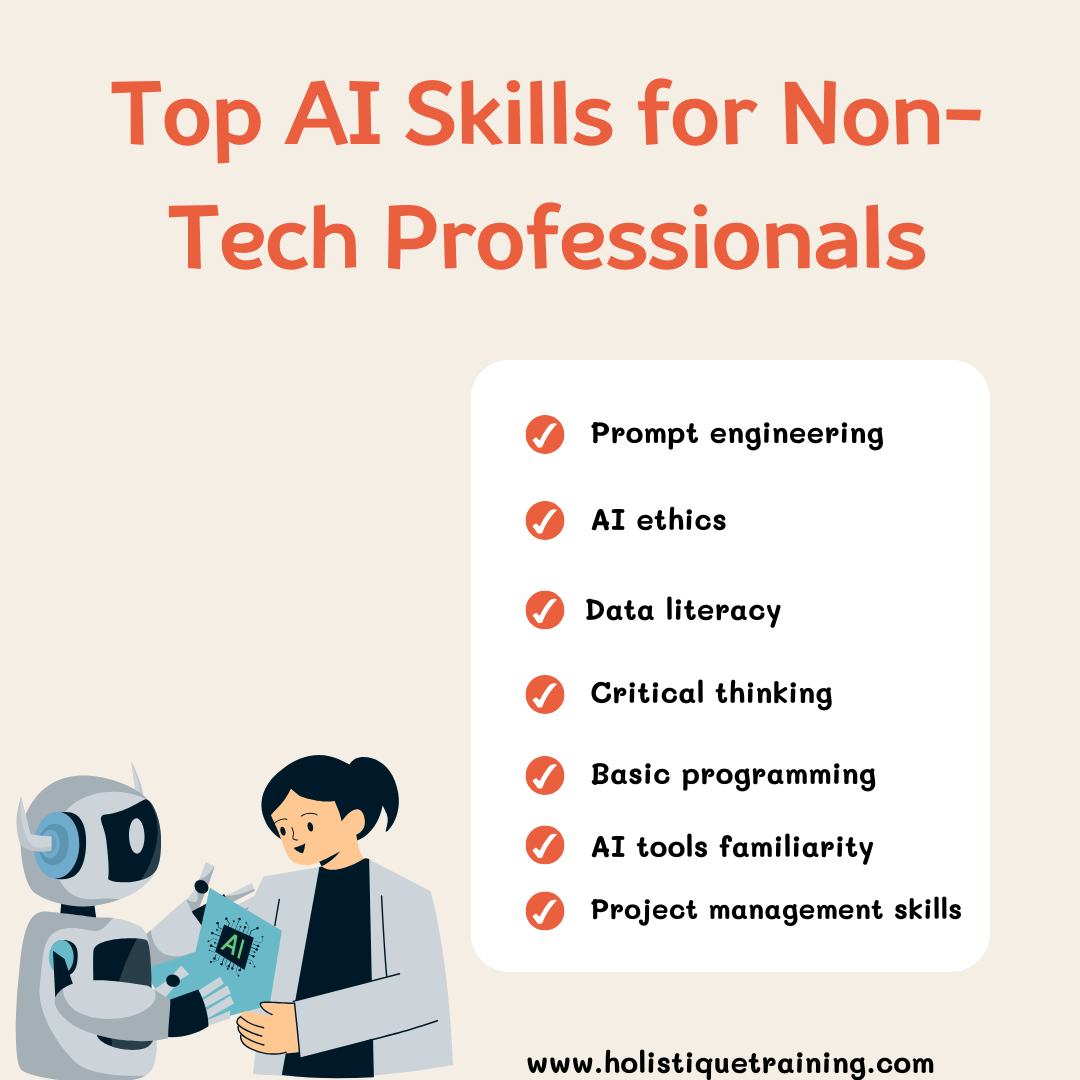
To thrive in an AI-driven world, non-tech professionals should focus on developing the following skills:
1. Prompt Engineering
The ability to craft effective prompts is essential for interacting with AI systems, particularly those based on natural language processing (NLP). Prompt engineering involves formulating questions or commands that elicit the desired responses from AI models. This skill is crucial for content creators, marketers, and analysts who rely on AI tools like ChatGPT for generating ideas, drafting content, or extracting insights. By mastering prompt engineering, non-tech professionals can enhance the quality and relevance of AI-generated outputs, making their interactions with these technologies more productive and impactful.
2. AI Ethics
As AI technologies evolve, so do theethical considerations surrounding their use. Non-tech professionals must understand the ethical implications of AI, including issues related to bias, privacy, and accountability. This knowledge is vital for ensuring that AI applications are implemented responsibly and equitably. For example, marketing professionals must be aware of data privacy regulations when using AI for targeted advertising, while HR professionals should consider the potential biases in AI-driven recruitment tools. By developing a strong foundation in AI ethics, non-tech professionals can advocate for responsible practices within their organizations and contribute to the development of fair and transparent AI systems.
3. Data Literacy
Data literacy is the ability to read, understand, create, and communicate data as information. In an era where data drives decision-making, non-tech professionals should develop skills to interpret data analytics reports, visualize data effectively, and make data-driven decisions. This includes understanding key metrics, recognizing patterns, and drawing actionable insights from data. For instance, marketers can analyze customer behavior data to refine their strategies, while finance professionals can use data literacy to assess financial performance and identify growth opportunities. By enhancing their data literacy, non-tech professionals can improve their overall effectiveness and contribute to a data-informed organizational culture.
4. Critical Thinking
While AI tools can provide insights and recommendations, critical thinking is necessary to evaluate and apply these insights effectively. Non-tech professionals should cultivate the ability to question assumptions, analyze information critically, and synthesize diverse perspectives. This skill is particularly important when interpreting AI-generated data or recommendations, as it enables professionals to assess the validity and relevance of the information presented. For example, a project manager may need to critically evaluate an AI tool's project timeline suggestions, considering team capacity and external factors. By honing critical thinking skills, non-tech professionals can make more informed decisions and navigate complex challenges with greater confidence.
5. Basic Programming Knowledge
While deep programming skills may not be necessary, understanding basic programming concepts can help non-tech professionals better utilize AI tools and communicate effectively with technical teams. Familiarity with programming languages like Python or R can empower professionals to engage in data analysis, automate tasks, or create simple algorithms tailored to their specific needs. This foundational knowledge can bridge the gap between non-tech and tech professionals, fostering collaboration and enabling non-tech professionals to contribute more meaningfully to AI projects. Additionally, basic programming skills can enhance problem-solving abilities and encourage a more analytical approach to work.
6. Familiarity with AI Tools
Getting acquainted withpopular AI tools relevant to your field is crucial. This includes tools for analytics, content generation, and automation, allowing professionals to enhance their productivity and creativity. For instance, marketers should explore AI-driven platforms for social media management, while HR professionals can benefit from AI tools for recruitment and employee engagement. By familiarizing themselves with these tools, non-tech professionals can leverage AI to streamline their workflows, improve efficiency, and produce high-quality outputs. This hands-on experience with AI tools also fosters confidence in using technology to solve everyday challenges.
7. Project Management Skills
AI projects often require collaboration across teams and disciplines. Non-tech professionals should hone their project management skills to effectively coordinate AI initiatives and ensure successful outcomes. This includes understanding project lifecycles, defining objectives, managing resources, and facilitating communication among stakeholders. Effective project management is crucial for navigating the complexities of AI implementation, as it involves aligning technical capabilities with business goals. By developing strong project management skills, non-tech professionals can lead AI initiatives with clarity and purpose, ensuring that projects are executed efficiently and deliver value to the organization.
8. Continuous Learning Mindset
The field of AI is constantly evolving, with new tools, technologies, and best practices emerging regularly. Non-tech professionals should adopt a mindset of continuous learning, staying updated on the latest trends and advancements in AI. This involves actively seeking out educational resources, participating in workshops, and engaging with professional networks. By embracing a culture of lifelong learning, non-tech professionals can remain adaptable and responsive to changes in their industries. This mindset not only enhances individual career prospects but also fosters a culture of innovation within organizations, where employees are encouraged to explore new ideas and approaches.
By focusing on these top AI skills, non-tech professionals can position themselves for success in an increasingly automated and data-driven world. These skills not only enhance individual capabilities but also contribute to organizational growth and innovation, empowering professionals to thrive in their respective fields.
Within the world of business, there is a constant drive to improve the inner functions, processes, and services it provides. Traditionally, this responsibility would solely rely on management and employees and would come with a moderate amount of uncertainty. However, with new technological advancements such
Making Learning AI Skills Enjoyable
Learning AI skills can be an exciting and rewarding journey. Here are some effective strategies to make the process enjoyable:
1. Gamification
Incorporating gamification into the learning process adds an element of fun and competition. By using game-like elements such as points, badges, leaderboards, and challenges, learners can engage more deeply with the material. For example, platforms like Kaggle offer competitions where participants can solve real-world data problems and earn rewards. This competitive aspect not only motivates learners but also fosters a sense of achievement as they progress through various levels of skill mastery. By turning learning into a game, individuals can enjoy the process while gaining valuable experience and knowledge.
2. Hands-On Projects
Engaging in hands-on projects allows learners to apply theoretical concepts in practical scenarios, making the learning experience more tangible and relevant. Working on real-world projects can spark creativity and innovation, as learners see the immediate impact of their efforts. For instance, creating a simple AI chatbot or analyzing a dataset to derive insights can provide a sense of accomplishment and reinforce understanding. By focusing on projects that align with personal interests or professional goals, learners can stay motivated and invested in their education. The satisfaction of seeing a project come to fruition can significantly enhance the enjoyment of the learning process.
3. Interactive Learning Platforms
Utilizing interactive learning platforms can greatly enhance the enjoyment of acquiring AI skills. Many online platforms offer engaging courses that incorporate multimedia elements, quizzes, and interactive coding environments. Websites like Coursera, Udacity, and edX provide courses that combine video lectures with hands-on exercises, allowing learners to practice skills in real-time. This interactive approach caters to different learning styles, making the material more accessible and enjoyable. By breaking down complex topics into manageable, engaging segments, learners can maintain their interest and enthusiasm throughout the learning journey.
4. Collaborative Learning
Learning in groups or communities can make the process more enjoyable and enriching. Collaborating with peers allows individuals to share knowledge, exchange ideas, and provide support to one another. Online forums, study groups, and social media communities focused on AI can facilitate discussions and foster a sense of belonging. Engaging with others who share similar interests can lead to collaborative projects, brainstorming sessions, and even friendly competitions. This social aspect not only enhances motivation but also creates a supportive environment where learners can celebrate each other's successes and learn from challenges together.
5. Diverse Learning Resources
Exploring a variety of learning resources can keep the experience fresh and engaging. Instead of relying solely on textbooks or online courses, learners can incorporate podcasts, videos, webinars, and articles into their study routines. This diversity allows individuals to approach the material from different angles and find what resonates most with them. For example, watching a documentary on AI applications can provide context and inspire learners, while listening to a podcast featuring industry experts can offer valuable insights. By mixing different formats and sources, learners can maintain their interest and excitement about the subject matter.
6. Setting Personal Goals
Establishing personal learning goals can enhance motivation and create a sense of purpose. By setting specific, achievable objectives—such as completing a course, mastering a particular tool, or building a project—learners can track their progress and celebrate milestones along the way. This goal-oriented approach fosters a sense of accomplishment and encourages continuous improvement. Additionally, aligning learning objectives with personal interests or career aspirations can make the process more meaningful and enjoyable. When learners see how their efforts contribute to their personal or professional growth, they are more likely to stay engaged and committed to their learning journey.
In summary, making the learning of AI skills enjoyable involves incorporating gamification, engaging in hands-on projects, utilizing interactive platforms, fostering collaborative learning, exploring diverse resources, and setting personal goals. By adopting these strategies, individuals can transform their educational experience into an exciting and fulfilling journey, paving the way for a successful future in the world of AI.
Steps to Start Learning AI Skills
Embarking on the journey to learn AI skills can seem daunting, but breaking it down into manageable steps can make the process more approachable. Here’s an elaboration on the key steps to get started:
1. Identify Your Goals
Before diving into AI, it's essential to clarify your learning objectives. Ask yourself what you hope to achieve by learning AI skills. Are you looking to enhance your career prospects, transition into a new field, or simply satisfy a personal interest? By identifying specific goals—such as mastering machine learning concepts, understanding data analysis, or applying AI in marketing—you can tailor your learning path to meet your needs. This focus not only helps in selecting relevant resources but also keeps you motivated throughout the learning process. Setting clear, achievable goals allows you to measure your progress and celebrate milestones along the way.
2. Choose the Right Learning Resources
With a plethora of learning resources available, selecting the right ones can significantly impact your learning experience. Consider various formats such as online courses, textbooks, video tutorials, and interactive platforms. Platforms likeHolistique Training offer structured courses with expert instructors, while websites like Khan Academy provide foundational knowledge in mathematics and statistics, which are crucial for AI. Additionally, exploring forums and communities like Stack Overflow or Reddit can provide valuable insights and recommendations from fellow learners. By choosing resources that align with your learning style—whether you prefer visual aids, hands-on practice, or reading—you can create a more engaging and effective study routine.
3. Start with the Basics
Building a strong foundation is crucial for understanding more complex AI concepts. Begin by familiarizing yourself with fundamental topics such as programming (Python is highly recommended for AI), statistics, and data analysis. Online courses that cover these basics can provide a solid starting point. For instance, learning Python not only equips you with a programming language widely used in AI but also helps you understand how to manipulate data and implement algorithms. Additionally, grasping basic statistical concepts will enable you to interpret data and draw meaningful conclusions—skills that are essential for any AI-related work. Taking the time to master these foundational elements will make it easier to tackle advanced topics later on.
4. Engage in Practical Projects
Applying what you learn through practical projects is one of the most effective ways to reinforce your understanding of AI concepts. Start with small projects that align with your interests, such as building a simple chatbot, analyzing a dataset, or creating a recommendation system. These hands-on experiences allow you to experiment with different tools and techniques, deepening your knowledge and boosting your confidence. Additionally, showcasing completed projects in a portfolio can be beneficial for career advancement, demonstrating your practical skills to potential employers. As you progress, you can gradually take on more complex projects, further enhancing your expertise and problem-solving abilities.
5. Join Online Communities
Becoming part of online communities focused on AI can greatly enrich your learning experience. Platforms like GitHub, Kaggle, and LinkedIn groups provide opportunities to connect with like-minded individuals, share knowledge, and collaborate on projects. Engaging in discussions, asking questions, and seeking feedback from others can deepen your understanding and expose you to diverse perspectives. Additionally, participating in challenges or competitions on platforms like Kaggle can help you apply your skills in real-world scenarios, while also offering a sense of camaraderie and motivation. Building a network within these communities can lead to valuable connections and potential career opportunities.
6. Stay Updated with Industry Trends
The field of AI is rapidly evolving, making it crucial to stay informed about the latest trends, technologies, and research developments. Follow reputable blogs, subscribe to newsletters, and listen to podcasts focused on AI to keep your knowledge current. Engaging with thought leaders and industry experts on platforms like Twitter or LinkedIn can provide insights into emerging technologies and best practices. Additionally, attending webinars, conferences, or workshops can offer opportunities to learn from experts and network with professionals in the field. By staying updated, you can adapt your learning journey to align with industry demands, ensuring that your skills remain relevant and valuable.

In today's fast-paced digital era, technological advancements impact every industry. From upgrading Customer Relationship Management (CRM) systems to refining marketing strategies and services on increasingly popular social media platforms, to embracing remote work and integrating artificial intelligence—technology is reshaping the way businesses operate.To be an effective leader in this evolving
7. Practice Regularly
Consistent practice is key to mastering AI skills. Dedicate time each week to work on coding exercises, complete online course assignments, or explore new tools and techniques. Regular practice helps reinforce concepts and builds muscle memory, making it easier to apply your knowledge in real-world situations. Consider setting aside specific time blocks for focused study or project work, and use platforms like LeetCode or HackerRank to tackle coding challenges that enhance your problem-solving abilities. By establishing a routine and making practice a priority, you’ll accelerate your learning and develop a deeper understanding of AI concepts over time.
By following these steps—identifying your goals, choosing the right resources, starting with the basics, engaging in practical projects, joining online communities, staying updated with industry trends, and practicing regularly—you can effectively embark on your journey to learn AI skills. Each step builds upon the previous one, creating a comprehensive and enjoyable learning experience that prepares you for success in the dynamic field of AI.
Table: Metrics used to measure the effectiveness of using AI at work
Metric | Description |
Productivity Increase | Measure the percentage increase in output or efficiency after implementing AI tools |
Cost Savings | Evaluate the reduction in operational costs due to automation and improved processes |
Time Savings | Assess the amount of time saved in completing tasks or projects using AI solutions |
Employee Satisfaction | Survey employee feedback on workload, job satisfaction, and ease of use of AI tools |
Customer Satisfaction | Analyze customer feedback and satisfaction scores before and after AI implementation |
Recommended AI Tools to Focus On
Familiarizing yourself with the right AI tools can significantly enhance your learning experience and productivity. Here are some recommended tools for non-tech professionals:
1. ChatGPT
A powerful language model that can assist with content generation, brainstorming, and answering queries. It's an excellent tool for writers, marketers, and educators.
2. Tableau
A data visualization tool that helps professionals analyze and present data effectively. It’s user-friendly and ideal for those looking to enhance their data literacy.
3. Canva
While primarily a design tool, Canva incorporates AI features that assist in creating visually appealing content quickly. It’s perfect for marketing and social media professionals.
AI Tool | Primary Function | Ideal Users | Key Features |
ChatGPT | Conversational AI | Writers, marketers, customer support | Natural language processing, content generation, Q&A |
Zapier | Automation | Business professionals, marketers | Workflow automation, app integrations, task scheduling |
Tableau | Data Visualization | Data analysts, business intelligence professionals | Interactive dashboards, data blending, real-time analytics |
4. Hootsuite
An AI-driven social media management tool that helps schedule posts, analyze performance, and manage multiple accounts efficiently.
5. Zapier
An automation tool that connects different applications, allowing non-tech professionals to automate repetitive tasks without coding knowledge.
6. Grammarly
An AI-powered writing assistant that helps improve writing quality by providing suggestions on grammar, style, and clarity.
7. Google Analytics
A robust analytics tool that provides insights into website performance and user behavior. Understanding how to use it can enhance your data literacy and decision-making.
8. Loom
A video messaging tool that allows users to create quick video messages for communication and presentations. It’s particularly useful for remote teams.
Conclusion
The integration of AI into various sectors presents a wealth of opportunities for non-tech professionals. By acquiring AI skills, you not only enhance your career prospects but also position yourself to contribute meaningfully to your organization’s success. Embracing the learning journey can be enjoyable and rewarding, especially when you focus on practical applications and leverage the right tools. As you embark on this path, remember that the world of AI is vast and continually evolving, so maintaining a mindset of curiosity and adaptability will serve you well in navigating this exciting landscape.